| Development Boards, Kits, Programmers | 3 | Active | The DS91M047 is a high-speed quad M-LVDS line driver designed for driving clock or data signals to up to four multipoint networks.
M-LVDS (Multipoint LVDS) is a new family of bus interface devices based on LVDS technology specifically designed for multipoint and multidrop cable and backplane applications. It differs from standard LVDS in providing increased drive current to handle double terminations that are required in multi-point applications. Controlled transition times minimize reflections that are common in multipoint configurations due to unterminated stubs.
The DS91M047 accepts LVTTL/LVCMOS input levels and translates them to M-LVDS signal levels with transition times of greater than 1 ns. The device provides the DE andDEinputs that are ANDed together and control the TRI-STATE outputs. The DE andDEinputs are common to all four drivers.
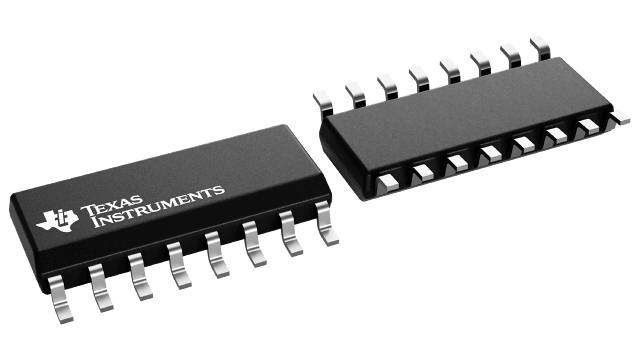
The DS91M047 has a flow-through pinout for easy PCB layout. The DS91M047 provides a new alternative for high speed multipoint interface applications. It is packaged in a space saving SOIC-16 package.
The DS91M047 is a high-speed quad M-LVDS line driver designed for driving clock or data signals to up to four multipoint networks.
M-LVDS (Multipoint LVDS) is a new family of bus interface devices based on LVDS technology specifically designed for multipoint and multidrop cable and backplane applications. It differs from standard LVDS in providing increased drive current to handle double terminations that are required in multi-point applications. Controlled transition times minimize reflections that are common in multipoint configurations due to unterminated stubs.
The DS91M047 accepts LVTTL/LVCMOS input levels and translates them to M-LVDS signal levels with transition times of greater than 1 ns. The device provides the DE andDEinputs that are ANDed together and control the TRI-STATE outputs. The DE andDEinputs are common to all four drivers.
The DS91M047 has a flow-through pinout for easy PCB layout. The DS91M047 provides a new alternative for high speed multipoint interface applications. It is packaged in a space saving SOIC-16 package. |
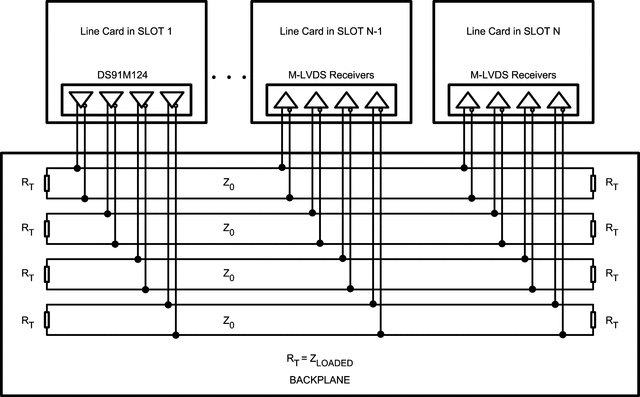
DS91M124125-MHz 1:4 M-LVDS repeater with LVCMOS input | Interface | 2 | Active | The DS91M124 is a 1:4 M-LVDS repeater for driving and distributing clock or data signals to up to four multipoint networks.
M-LVDS (Multipoint LVDS) is a new family of bus interface devices based on LVDS technology specifically designed for multipoint and multidrop cable and backplane applications. It differs from standard LVDS in providing increased drive current to handle double terminations that are required in multi-point applications. Controlled transition times minimize reflections that are common in multipoint configurations due to unterminated stubs.
A single DS91M124 channel is a 1:4 repeater that accepts LVTTL/LVCMOS signals at the driver inputs and converts them to differential M-LVDS signal levels. It features independent driver enable pins for each driver output.
The DS91M124 has a flow-through pinout for easy PCB layout. It provides a new alternative for high speed multipoint interface applications. It is packaged in a space saving SOIC-16 package.
The DS91M124 is a 1:4 M-LVDS repeater for driving and distributing clock or data signals to up to four multipoint networks.
M-LVDS (Multipoint LVDS) is a new family of bus interface devices based on LVDS technology specifically designed for multipoint and multidrop cable and backplane applications. It differs from standard LVDS in providing increased drive current to handle double terminations that are required in multi-point applications. Controlled transition times minimize reflections that are common in multipoint configurations due to unterminated stubs.
A single DS91M124 channel is a 1:4 repeater that accepts LVTTL/LVCMOS signals at the driver inputs and converts them to differential M-LVDS signal levels. It features independent driver enable pins for each driver output.
The DS91M124 has a flow-through pinout for easy PCB layout. It provides a new alternative for high speed multipoint interface applications. It is packaged in a space saving SOIC-16 package. |
| Signal Buffers, Repeaters, Splitters | 5 | Active | |
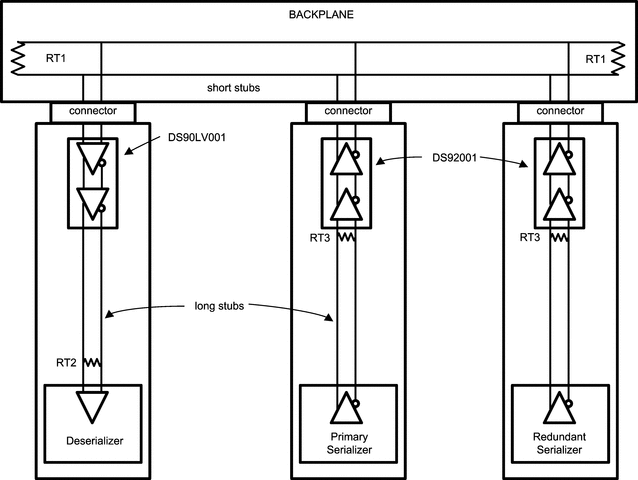
| Interface | 5 | Active | The DS92001 B/LVDS-BLVDS Buffer takes a BLVDS input signal and provides a BLVDS output signal. In many large systems, signals are distributed across backplanes. One of the limiting factors for system speed is the "stub length" or the distance between the transmission line and the unterminated receivers on individual cards. Although it is generally recognized that this distance should be as short as possible to maximize system performance, real-world packaging concerns often make it difficult to make the stubs as short as the designer would like.
The DS92001 has edge transitions optimized for multidrop backplanes where the switching frequency is in the 200 MHz range or less. The output edge rate is critical in some systems where long stubs may be present, and utilizing a slow transition allows for longer stub lengths.
The DS92001, available in the WSON package, will allow the receiver inputs to be placed very close to the main transmission line, thus improving system performance.
A wide input dynamic range allows the DS92001 to receive differential signals from LVPECL, CML as well as LVDS sources. This will allow the device to also fill the role of an LVPECL-BLVDS or CML-BLVDS translator.
The DS92001 B/LVDS-BLVDS Buffer takes a BLVDS input signal and provides a BLVDS output signal. In many large systems, signals are distributed across backplanes. One of the limiting factors for system speed is the "stub length" or the distance between the transmission line and the unterminated receivers on individual cards. Although it is generally recognized that this distance should be as short as possible to maximize system performance, real-world packaging concerns often make it difficult to make the stubs as short as the designer would like.
The DS92001 has edge transitions optimized for multidrop backplanes where the switching frequency is in the 200 MHz range or less. The output edge rate is critical in some systems where long stubs may be present, and utilizing a slow transition allows for longer stub lengths.
The DS92001, available in the WSON package, will allow the receiver inputs to be placed very close to the main transmission line, thus improving system performance.
A wide input dynamic range allows the DS92001 to receive differential signals from LVPECL, CML as well as LVDS sources. This will allow the device to also fill the role of an LVPECL-BLVDS or CML-BLVDS translator. |
DS92CK163-V BLVDS 1 to 6 clock buffer/bus transceiver | Clock Buffers, Drivers | 3 | Active | The DS92CK16 1 to 6 Clock Buffer/Bus Transceiver is a one to six CMOS differential clock distribution device utilizing Bus Low Voltage Differential Signaling (BLVDS) technology. This clock distribution device is designed for applications requiring ultra low power dissipation, low noise, and high data rates. The BLVDS side is a transceiver with a separate channel acting as a return/source clock.
The DS92CK16 accepts LVDS (300 mV typical) differential input levels, and translates them to 3V CMOS output levels. An output enable pinOE, when high, forces all CLKOUTpins high.
The device can be used as a source synchronous driver. The selection of the source driving is controlled by the CrdCLKINandDEpins. This device can be the master clock, driving the inputs of other clock I/O pins in a multipoint environment. Easy master/slave clock selection is achieved along a backplane.
The DS92CK16 1 to 6 Clock Buffer/Bus Transceiver is a one to six CMOS differential clock distribution device utilizing Bus Low Voltage Differential Signaling (BLVDS) technology. This clock distribution device is designed for applications requiring ultra low power dissipation, low noise, and high data rates. The BLVDS side is a transceiver with a separate channel acting as a return/source clock.
The DS92CK16 accepts LVDS (300 mV typical) differential input levels, and translates them to 3V CMOS output levels. An output enable pinOE, when high, forces all CLKOUTpins high.
The device can be used as a source synchronous driver. The selection of the source driving is controlled by the CrdCLKINandDEpins. This device can be the master clock, driving the inputs of other clock I/O pins in a multipoint environment. Easy master/slave clock selection is achieved along a backplane. |
| Integrated Circuits (ICs) | 4 | Active | The DS92LV010A is one in a series of transceivers designed specifically for the high speed, low power proprietary bus backplane interfaces. The device operates from a single 3.3V or 5.0V power supply and includes one differential line driver and one receiver. To minimize bus loading the driver outputs and receiver inputs are internally connected. The logic interface provides maximum flexibility as 4 separate lines are provided (DIN, DE,RE, and ROUT). The device also features flow through which allows easy PCB routing for short stubs between the bus pins and the connector. The driver has 10 mA drive capability, allowing it to drive heavily loaded backplanes, with impedance as low as 27 Ohms.
The driver translates between TTL levels (single-ended) to Low Voltage Differential Signaling levels. This allows for high speed operation, while consuming minimal power with reduced EMI. In addition the differential signaling provides common mode noise rejection of ±1V.
The receiver threshold is ±100mV over a ±1V common mode range and translates the low voltage differential levels to standard (CMOS/TTL) levels.
The DS92LV010A is one in a series of transceivers designed specifically for the high speed, low power proprietary bus backplane interfaces. The device operates from a single 3.3V or 5.0V power supply and includes one differential line driver and one receiver. To minimize bus loading the driver outputs and receiver inputs are internally connected. The logic interface provides maximum flexibility as 4 separate lines are provided (DIN, DE,RE, and ROUT). The device also features flow through which allows easy PCB routing for short stubs between the bus pins and the connector. The driver has 10 mA drive capability, allowing it to drive heavily loaded backplanes, with impedance as low as 27 Ohms.
The driver translates between TTL levels (single-ended) to Low Voltage Differential Signaling levels. This allows for high speed operation, while consuming minimal power with reduced EMI. In addition the differential signaling provides common mode noise rejection of ±1V.
The receiver threshold is ±100mV over a ±1V common mode range and translates the low voltage differential levels to standard (CMOS/TTL) levels. |
| Drivers, Receivers, Transceivers | 4 | Active | The DS92LV040A is one in a series of Bus LVDS transceivers designed specifically for high speed, low power backplane or cable interfaces. The device operates from a single 3.3-V power supply and includes four differential line drivers and four receivers. To minimize bus loading, the driver outputs and receiver inputs are internally connected. The device also features a flow through pin out which allows easy PCB routing for short stubs between its pins and the connector.
The driver translates 3-V LVTTL levels (single-ended) to differential Bus LVDS (BLVDS) output levels. This allows for high speed operation while consuming minimal power and reducing EMI. In addition, the differential signaling provides common mode noise rejection greater than ±1 V.
The receiver threshold is less than +0/−70 mV. The receiver translates the differential Bus LVDS to standard (LVTTL/LVCMOS) levels. (See theApplication InformationSection for more details.)
The DS92LV040A is one in a series of Bus LVDS transceivers designed specifically for high speed, low power backplane or cable interfaces. The device operates from a single 3.3-V power supply and includes four differential line drivers and four receivers. To minimize bus loading, the driver outputs and receiver inputs are internally connected. The device also features a flow through pin out which allows easy PCB routing for short stubs between its pins and the connector.
The driver translates 3-V LVTTL levels (single-ended) to differential Bus LVDS (BLVDS) output levels. This allows for high speed operation while consuming minimal power and reducing EMI. In addition, the differential signaling provides common mode noise rejection greater than ±1 V.
The receiver threshold is less than +0/−70 mV. The receiver translates the differential Bus LVDS to standard (LVTTL/LVCMOS) levels. (See theApplication InformationSection for more details.) |
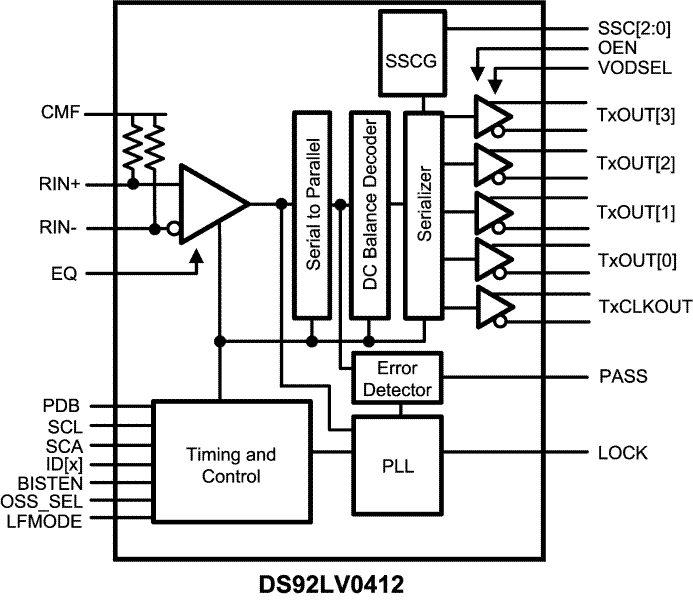
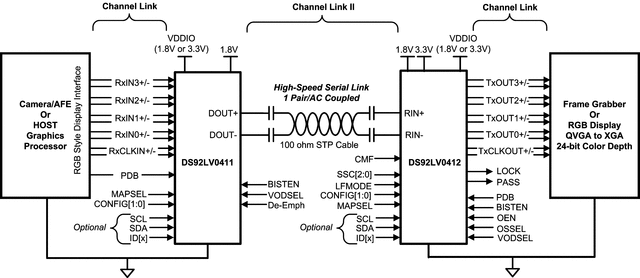
DS92LV04115 - 50 MHz Channel Link II Serializer with LVDS Parallel Interface | Serializers, Deserializers | 2 | Active | The DS92LV0411 (serializer) and DS92LV0412 (deserializer) chipset translates a Channel Link LVDS video interface (4 LVDS Data + LVDS Clock) into a high-speed serialized interface over a single CML pair.
The DS92LV0411/DS92LV0412 enables applications that currently use the popular Channel Link or Channel Link style devices to seamlessly upgrade to an embedded clock interface to reduce interconnect cost or ease design challenges. The parallel LVDS interface also reduces FPGA I/O pins, board trace count and alleviates EMI issues, when compared to traditional single-ended wide bus interfaces.
Programmable transmit de-emphasis, receive equalization, on-chip scrambling and DC balancing enables longer distance transmission over lossy cables and backplanes. The Deserializer automatically locks to incoming data without an external reference clock or special sync patterns, providing easy "plug-and-go" operation.
The DS92LV0411 and DS92LV0412 are programmable though an I2C interface as well as by pins. A built-in AT-SPEED BIST feature validates link integrity and may be used for system diagnostics.
The DS92LV0411 and DS92LV0412 can be used interchangeably with the DS92LV2411 or DS92LV2412. This allows designers the flexibility to connect to the host device and receiving devices with different interface types, LVDS or LVCMOS.
The DS92LV0411 (serializer) and DS92LV0412 (deserializer) chipset translates a Channel Link LVDS video interface (4 LVDS Data + LVDS Clock) into a high-speed serialized interface over a single CML pair.
The DS92LV0411/DS92LV0412 enables applications that currently use the popular Channel Link or Channel Link style devices to seamlessly upgrade to an embedded clock interface to reduce interconnect cost or ease design challenges. The parallel LVDS interface also reduces FPGA I/O pins, board trace count and alleviates EMI issues, when compared to traditional single-ended wide bus interfaces.
Programmable transmit de-emphasis, receive equalization, on-chip scrambling and DC balancing enables longer distance transmission over lossy cables and backplanes. The Deserializer automatically locks to incoming data without an external reference clock or special sync patterns, providing easy "plug-and-go" operation.
The DS92LV0411 and DS92LV0412 are programmable though an I2C interface as well as by pins. A built-in AT-SPEED BIST feature validates link integrity and may be used for system diagnostics.
The DS92LV0411 and DS92LV0412 can be used interchangeably with the DS92LV2411 or DS92LV2412. This allows designers the flexibility to connect to the host device and receiving devices with different interface types, LVDS or LVCMOS. |
DS92LV04125 - 50 MHz Channel Link II Deserializer with LVDS Parallel Interface | Interface | 1 | Active | The DS92LV0411 (serializer) and DS92LV0412 (deserializer) chipset translates a Channel Link LVDS video interface (4 LVDS Data + LVDS Clock) into a high-speed serialized interface over a single CML pair.
The DS92LV0411/DS92LV0412 enables applications that currently use the popular Channel Link or Channel Link style devices to seamlessly upgrade to an embedded clock interface to reduce interconnect cost or ease design challenges. The parallel LVDS interface also reduces FPGA I/O pins, board trace count and alleviates EMI issues, when compared to traditional single-ended wide bus interfaces.
Programmable transmit de-emphasis, receive equalization, on-chip scrambling and DC balancing enables longer distance transmission over lossy cables and backplanes. The Deserializer automatically locks to incoming data without an external reference clock or special sync patterns, providing easy "plug-and-go" operation.
The DS92LV0411 and DS92LV0412 are programmable though an I2C interface as well as by pins. A built-in AT-SPEED BIST feature validates link integrity and may be used for system diagnostics.
The DS92LV0411 and DS92LV0412 can be used interchangeably with the DS92LV2411 or DS92LV2412. This allows designers the flexibility to connect to the host device and receiving devices with different interface types, LVDS or LVCMOS.
The DS92LV0411 (serializer) and DS92LV0412 (deserializer) chipset translates a Channel Link LVDS video interface (4 LVDS Data + LVDS Clock) into a high-speed serialized interface over a single CML pair.
The DS92LV0411/DS92LV0412 enables applications that currently use the popular Channel Link or Channel Link style devices to seamlessly upgrade to an embedded clock interface to reduce interconnect cost or ease design challenges. The parallel LVDS interface also reduces FPGA I/O pins, board trace count and alleviates EMI issues, when compared to traditional single-ended wide bus interfaces.
Programmable transmit de-emphasis, receive equalization, on-chip scrambling and DC balancing enables longer distance transmission over lossy cables and backplanes. The Deserializer automatically locks to incoming data without an external reference clock or special sync patterns, providing easy "plug-and-go" operation.
The DS92LV0411 and DS92LV0412 are programmable though an I2C interface as well as by pins. A built-in AT-SPEED BIST feature validates link integrity and may be used for system diagnostics.
The DS92LV0411 and DS92LV0412 can be used interchangeably with the DS92LV2411 or DS92LV2412. This allows designers the flexibility to connect to the host device and receiving devices with different interface types, LVDS or LVCMOS. |
DS92LV042110- to 75-MHz Channel-Link II serializer with LVDS parallel interface | Integrated Circuits (ICs) | 2 | Active | The DS92LV042x chipset translates a Channel Link LVDS video interface (4 LVDS Data + LVDS Clock) into a high-speed serialized interface over a single CML pair. The DS92LV042x enables applications currently using popular Channel Link or OpenLDI LVDS style devices to upgrade seamlessly to an embedded clock interface. This serial bus scheme reduces interconnect cost and eases design challenges. The parallel OpenLDI LVDS interface also reduces FPGA I/O pins, board trace count, and alleviates EMI issues when compared to traditional single-ended wide bus interfaces.
Programmable transmit de-emphasis, receive equalization, on-chip scrambling, and DC-balancing enables longer distance transmission over lossy cables and backplanes. The DS92LV0422 automatically locks to incoming data without an external reference clock or special sync patterns, providing easy operation.
The DS92LV042x chipset is programmable through an I2C interface as well as through pins. A built-in, at-speed BIST feature validates link integrity and may be used for system diagnostics. The DS92LV0421 and DS92LV0422 can be used interchangeably with the DS92LV2421 or DS92LV2422. This allows designers the flexibility to connect to the host device and receiving devices with different interface types: LVDS or LVCMOS.
The DS92LV042x chipset translates a Channel Link LVDS video interface (4 LVDS Data + LVDS Clock) into a high-speed serialized interface over a single CML pair. The DS92LV042x enables applications currently using popular Channel Link or OpenLDI LVDS style devices to upgrade seamlessly to an embedded clock interface. This serial bus scheme reduces interconnect cost and eases design challenges. The parallel OpenLDI LVDS interface also reduces FPGA I/O pins, board trace count, and alleviates EMI issues when compared to traditional single-ended wide bus interfaces.
Programmable transmit de-emphasis, receive equalization, on-chip scrambling, and DC-balancing enables longer distance transmission over lossy cables and backplanes. The DS92LV0422 automatically locks to incoming data without an external reference clock or special sync patterns, providing easy operation.
The DS92LV042x chipset is programmable through an I2C interface as well as through pins. A built-in, at-speed BIST feature validates link integrity and may be used for system diagnostics. The DS92LV0421 and DS92LV0422 can be used interchangeably with the DS92LV2421 or DS92LV2422. This allows designers the flexibility to connect to the host device and receiving devices with different interface types: LVDS or LVCMOS. |