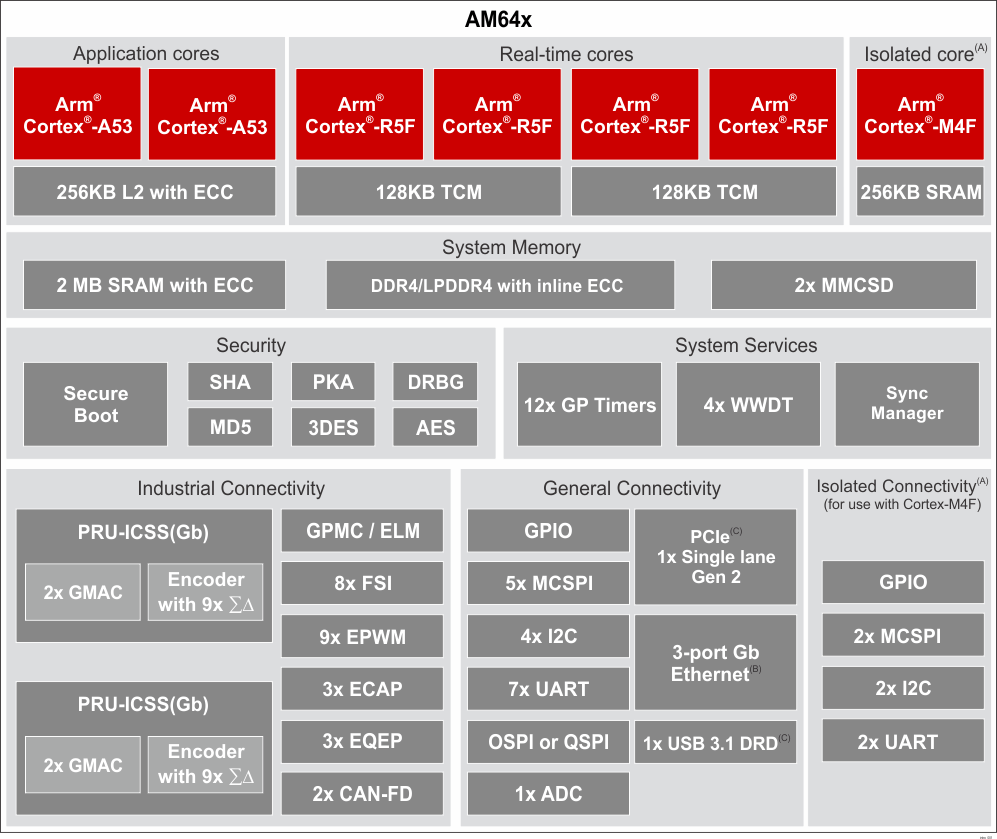
AM6412Dual-core 64-bit Arm® Cortex®-A53, single-core Cortex-R5F, PCIe, USB 3.0 and security | Embedded | 1 | Active | AM64x is an extension of the Sitara™ Industrial-grade family of heterogeneous Arm® processors. AM64x is built for industrial applications, such as motor drives and Programmable Logic Controllers (PLCs), which require a unique combination of real-time processing and communications with applications processing. AM64x combines two instances of the Sitara device’s gigabit TSN-enabled PRU-ICSSG with up to two Arm® Cortex®-A53 cores, up to four Cortex-R5F MCUs, and a Cortex-M4F MCU.
AM64x is architected to provide real-time performance through the high-performance R5Fs, Tightly-Coupled Memory banks, configurable SRAM partitioning, and dedicated low-latency paths to and from peripherals for rapid data movement in and out of the SoC. This deterministic architecture allows for AM64x to handle the tight control loops found in servo drives while the peripherals like FSI, GPMC, PWMs, sigma delta decimation filters, and absolute encoder interfaces help enable a number of different architectures found in these systems.
The Cortex-A53s provide the powerful computing elements necessary for Linux applications. Linux, and Real-time (RT) Linux, is provided through TI’s Processor SDK Linux which stays updated to the latest Long Term Support (LTS) Linux kernel, bootloader and Yocto file system on an annual basis. AM64x helps bridge the Linux world with the real-time world by enabling isolation between Linux applications and real-time streams through configurable memory partitioning. The Cortex-A53s can be assigned to work strictly out of DDR for Linux, and the internal SRAM can be broken up into various sizes for the Cortex-R5Fs to use together or independently.
The AM64x provides flexible industrial communications capability including full protocol stacks for EtherCAT SubDevice, PROFINET device, EtherNet/IP adapter, and IO-Link Master. The PRU-ICSSG further provides capability for gigabit and TSN based protocols. In addition, the PRU-ICSSG also enables additional interfaces in the SoC including sigma delta decimation filters and absolute encoder interfaces.
Functional safety features can be enabled through the integrated Cortex-M4F along with dedicated peripherals which can all be isolated from the rest of the SoC. AM64x also supports secure boot.
AM64x is an extension of the Sitara™ Industrial-grade family of heterogeneous Arm® processors. AM64x is built for industrial applications, such as motor drives and Programmable Logic Controllers (PLCs), which require a unique combination of real-time processing and communications with applications processing. AM64x combines two instances of the Sitara device’s gigabit TSN-enabled PRU-ICSSG with up to two Arm® Cortex®-A53 cores, up to four Cortex-R5F MCUs, and a Cortex-M4F MCU.
AM64x is architected to provide real-time performance through the high-performance R5Fs, Tightly-Coupled Memory banks, configurable SRAM partitioning, and dedicated low-latency paths to and from peripherals for rapid data movement in and out of the SoC. This deterministic architecture allows for AM64x to handle the tight control loops found in servo drives while the peripherals like FSI, GPMC, PWMs, sigma delta decimation filters, and absolute encoder interfaces help enable a number of different architectures found in these systems.
The Cortex-A53s provide the powerful computing elements necessary for Linux applications. Linux, and Real-time (RT) Linux, is provided through TI’s Processor SDK Linux which stays updated to the latest Long Term Support (LTS) Linux kernel, bootloader and Yocto file system on an annual basis. AM64x helps bridge the Linux world with the real-time world by enabling isolation between Linux applications and real-time streams through configurable memory partitioning. The Cortex-A53s can be assigned to work strictly out of DDR for Linux, and the internal SRAM can be broken up into various sizes for the Cortex-R5Fs to use together or independently.
The AM64x provides flexible industrial communications capability including full protocol stacks for EtherCAT SubDevice, PROFINET device, EtherNet/IP adapter, and IO-Link Master. The PRU-ICSSG further provides capability for gigabit and TSN based protocols. In addition, the PRU-ICSSG also enables additional interfaces in the SoC including sigma delta decimation filters and absolute encoder interfaces.
Functional safety features can be enabled through the integrated Cortex-M4F along with dedicated peripherals which can all be isolated from the rest of the SoC. AM64x also supports secure boot. |
AM6421Single-core 64-bit Arm® Cortex®-A53, dual-core Cortex-R5F, PCIe, USB 3.0 and security | Integrated Circuits (ICs) | 3 | Active | AM64x is an extension of the Sitara™ Industrial-grade family of heterogeneous Arm® processors. AM64x is built for industrial applications, such as motor drives and Programmable Logic Controllers (PLCs), which require a unique combination of real-time processing and communications with applications processing. AM64x combines two instances of the Sitara device’s gigabit TSN-enabled PRU-ICSSG with up to two Arm® Cortex®-A53 cores, up to four Cortex-R5F MCUs, and a Cortex-M4F MCU.
AM64x is architected to provide real-time performance through the high-performance R5Fs, Tightly-Coupled Memory banks, configurable SRAM partitioning, and dedicated low-latency paths to and from peripherals for rapid data movement in and out of the SoC. This deterministic architecture allows for AM64x to handle the tight control loops found in servo drives while the peripherals like FSI, GPMC, PWMs, sigma delta decimation filters, and absolute encoder interfaces help enable a number of different architectures found in these systems.
The Cortex-A53s provide the powerful computing elements necessary for Linux applications. Linux, and Real-time (RT) Linux, is provided through TI’s Processor SDK Linux which stays updated to the latest Long Term Support (LTS) Linux kernel, bootloader and Yocto file system on an annual basis. AM64x helps bridge the Linux world with the real-time world by enabling isolation between Linux applications and real-time streams through configurable memory partitioning. The Cortex-A53s can be assigned to work strictly out of DDR for Linux, and the internal SRAM can be broken up into various sizes for the Cortex-R5Fs to use together or independently.
The AM64x provides flexible industrial communications capability including full protocol stacks for EtherCAT SubDevice, PROFINET device, EtherNet/IP adapter, and IO-Link Master. The PRU-ICSSG further provides capability for gigabit and TSN based protocols. In addition, the PRU-ICSSG also enables additional interfaces in the SoC including sigma delta decimation filters and absolute encoder interfaces.
Functional safety features can be enabled through the integrated Cortex-M4F along with dedicated peripherals which can all be isolated from the rest of the SoC. AM64x also supports secure boot.
AM64x is an extension of the Sitara™ Industrial-grade family of heterogeneous Arm® processors. AM64x is built for industrial applications, such as motor drives and Programmable Logic Controllers (PLCs), which require a unique combination of real-time processing and communications with applications processing. AM64x combines two instances of the Sitara device’s gigabit TSN-enabled PRU-ICSSG with up to two Arm® Cortex®-A53 cores, up to four Cortex-R5F MCUs, and a Cortex-M4F MCU.
AM64x is architected to provide real-time performance through the high-performance R5Fs, Tightly-Coupled Memory banks, configurable SRAM partitioning, and dedicated low-latency paths to and from peripherals for rapid data movement in and out of the SoC. This deterministic architecture allows for AM64x to handle the tight control loops found in servo drives while the peripherals like FSI, GPMC, PWMs, sigma delta decimation filters, and absolute encoder interfaces help enable a number of different architectures found in these systems.
The Cortex-A53s provide the powerful computing elements necessary for Linux applications. Linux, and Real-time (RT) Linux, is provided through TI’s Processor SDK Linux which stays updated to the latest Long Term Support (LTS) Linux kernel, bootloader and Yocto file system on an annual basis. AM64x helps bridge the Linux world with the real-time world by enabling isolation between Linux applications and real-time streams through configurable memory partitioning. The Cortex-A53s can be assigned to work strictly out of DDR for Linux, and the internal SRAM can be broken up into various sizes for the Cortex-R5Fs to use together or independently.
The AM64x provides flexible industrial communications capability including full protocol stacks for EtherCAT SubDevice, PROFINET device, EtherNet/IP adapter, and IO-Link Master. The PRU-ICSSG further provides capability for gigabit and TSN based protocols. In addition, the PRU-ICSSG also enables additional interfaces in the SoC including sigma delta decimation filters and absolute encoder interfaces.
Functional safety features can be enabled through the integrated Cortex-M4F along with dedicated peripherals which can all be isolated from the rest of the SoC. AM64x also supports secure boot. |
AM6422Dual-core 64-bit Arm® Cortex®-A53, dual-core Cortex-R5F, PCIe, USB 3.0 and security | Microprocessors | 1 | Active | AM64x is an extension of the Sitara™ Industrial-grade family of heterogeneous Arm® processors. AM64x is built for industrial applications, such as motor drives and Programmable Logic Controllers (PLCs), which require a unique combination of real-time processing and communications with applications processing. AM64x combines two instances of the Sitara device’s gigabit TSN-enabled PRU-ICSSG with up to two Arm® Cortex®-A53 cores, up to four Cortex-R5F MCUs, and a Cortex-M4F MCU.
AM64x is architected to provide real-time performance through the high-performance R5Fs, Tightly-Coupled Memory banks, configurable SRAM partitioning, and dedicated low-latency paths to and from peripherals for rapid data movement in and out of the SoC. This deterministic architecture allows for AM64x to handle the tight control loops found in servo drives while the peripherals like FSI, GPMC, PWMs, sigma delta decimation filters, and absolute encoder interfaces help enable a number of different architectures found in these systems.
The Cortex-A53s provide the powerful computing elements necessary for Linux applications. Linux, and Real-time (RT) Linux, is provided through TI’s Processor SDK Linux which stays updated to the latest Long Term Support (LTS) Linux kernel, bootloader and Yocto file system on an annual basis. AM64x helps bridge the Linux world with the real-time world by enabling isolation between Linux applications and real-time streams through configurable memory partitioning. The Cortex-A53s can be assigned to work strictly out of DDR for Linux, and the internal SRAM can be broken up into various sizes for the Cortex-R5Fs to use together or independently.
The AM64x provides flexible industrial communications capability including full protocol stacks for EtherCAT SubDevice, PROFINET device, EtherNet/IP adapter, and IO-Link Master. The PRU-ICSSG further provides capability for gigabit and TSN based protocols. In addition, the PRU-ICSSG also enables additional interfaces in the SoC including sigma delta decimation filters and absolute encoder interfaces.
Functional safety features can be enabled through the integrated Cortex-M4F along with dedicated peripherals which can all be isolated from the rest of the SoC. AM64x also supports secure boot.
AM64x is an extension of the Sitara™ Industrial-grade family of heterogeneous Arm® processors. AM64x is built for industrial applications, such as motor drives and Programmable Logic Controllers (PLCs), which require a unique combination of real-time processing and communications with applications processing. AM64x combines two instances of the Sitara device’s gigabit TSN-enabled PRU-ICSSG with up to two Arm® Cortex®-A53 cores, up to four Cortex-R5F MCUs, and a Cortex-M4F MCU.
AM64x is architected to provide real-time performance through the high-performance R5Fs, Tightly-Coupled Memory banks, configurable SRAM partitioning, and dedicated low-latency paths to and from peripherals for rapid data movement in and out of the SoC. This deterministic architecture allows for AM64x to handle the tight control loops found in servo drives while the peripherals like FSI, GPMC, PWMs, sigma delta decimation filters, and absolute encoder interfaces help enable a number of different architectures found in these systems.
The Cortex-A53s provide the powerful computing elements necessary for Linux applications. Linux, and Real-time (RT) Linux, is provided through TI’s Processor SDK Linux which stays updated to the latest Long Term Support (LTS) Linux kernel, bootloader and Yocto file system on an annual basis. AM64x helps bridge the Linux world with the real-time world by enabling isolation between Linux applications and real-time streams through configurable memory partitioning. The Cortex-A53s can be assigned to work strictly out of DDR for Linux, and the internal SRAM can be broken up into various sizes for the Cortex-R5Fs to use together or independently.
The AM64x provides flexible industrial communications capability including full protocol stacks for EtherCAT SubDevice, PROFINET device, EtherNet/IP adapter, and IO-Link Master. The PRU-ICSSG further provides capability for gigabit and TSN based protocols. In addition, the PRU-ICSSG also enables additional interfaces in the SoC including sigma delta decimation filters and absolute encoder interfaces.
Functional safety features can be enabled through the integrated Cortex-M4F along with dedicated peripherals which can all be isolated from the rest of the SoC. AM64x also supports secure boot. |
AM6441Single-core 64-bit Arm® Cortex®-A53, quad-core Cortex-R5F, PCIe, USB 3.0 and security | Microprocessors | 3 | Active | AM64x is an extension of the Sitara™ Industrial-grade family of heterogeneous Arm® processors. AM64x is built for industrial applications, such as motor drives and Programmable Logic Controllers (PLCs), which require a unique combination of real-time processing and communications with applications processing. AM64x combines two instances of the Sitara device’s gigabit TSN-enabled PRU-ICSSG with up to two Arm® Cortex®-A53 cores, up to four Cortex-R5F MCUs, and a Cortex-M4F MCU.
AM64x is architected to provide real-time performance through the high-performance R5Fs, Tightly-Coupled Memory banks, configurable SRAM partitioning, and dedicated low-latency paths to and from peripherals for rapid data movement in and out of the SoC. This deterministic architecture allows for AM64x to handle the tight control loops found in servo drives while the peripherals like FSI, GPMC, PWMs, sigma delta decimation filters, and absolute encoder interfaces help enable a number of different architectures found in these systems.
The Cortex-A53s provide the powerful computing elements necessary for Linux applications. Linux, and Real-time (RT) Linux, is provided through TI’s Processor SDK Linux which stays updated to the latest Long Term Support (LTS) Linux kernel, bootloader and Yocto file system on an annual basis. AM64x helps bridge the Linux world with the real-time world by enabling isolation between Linux applications and real-time streams through configurable memory partitioning. The Cortex-A53s can be assigned to work strictly out of DDR for Linux, and the internal SRAM can be broken up into various sizes for the Cortex-R5Fs to use together or independently.
The AM64x provides flexible industrial communications capability including full protocol stacks for EtherCAT SubDevice, PROFINET device, EtherNet/IP adapter, and IO-Link Master. The PRU-ICSSG further provides capability for gigabit and TSN based protocols. In addition, the PRU-ICSSG also enables additional interfaces in the SoC including sigma delta decimation filters and absolute encoder interfaces.
Functional safety features can be enabled through the integrated Cortex-M4F along with dedicated peripherals which can all be isolated from the rest of the SoC. AM64x also supports secure boot.
AM64x is an extension of the Sitara™ Industrial-grade family of heterogeneous Arm® processors. AM64x is built for industrial applications, such as motor drives and Programmable Logic Controllers (PLCs), which require a unique combination of real-time processing and communications with applications processing. AM64x combines two instances of the Sitara device’s gigabit TSN-enabled PRU-ICSSG with up to two Arm® Cortex®-A53 cores, up to four Cortex-R5F MCUs, and a Cortex-M4F MCU.
AM64x is architected to provide real-time performance through the high-performance R5Fs, Tightly-Coupled Memory banks, configurable SRAM partitioning, and dedicated low-latency paths to and from peripherals for rapid data movement in and out of the SoC. This deterministic architecture allows for AM64x to handle the tight control loops found in servo drives while the peripherals like FSI, GPMC, PWMs, sigma delta decimation filters, and absolute encoder interfaces help enable a number of different architectures found in these systems.
The Cortex-A53s provide the powerful computing elements necessary for Linux applications. Linux, and Real-time (RT) Linux, is provided through TI’s Processor SDK Linux which stays updated to the latest Long Term Support (LTS) Linux kernel, bootloader and Yocto file system on an annual basis. AM64x helps bridge the Linux world with the real-time world by enabling isolation between Linux applications and real-time streams through configurable memory partitioning. The Cortex-A53s can be assigned to work strictly out of DDR for Linux, and the internal SRAM can be broken up into various sizes for the Cortex-R5Fs to use together or independently.
The AM64x provides flexible industrial communications capability including full protocol stacks for EtherCAT SubDevice, PROFINET device, EtherNet/IP adapter, and IO-Link Master. The PRU-ICSSG further provides capability for gigabit and TSN based protocols. In addition, the PRU-ICSSG also enables additional interfaces in the SoC including sigma delta decimation filters and absolute encoder interfaces.
Functional safety features can be enabled through the integrated Cortex-M4F along with dedicated peripherals which can all be isolated from the rest of the SoC. AM64x also supports secure boot. |
AM6442Dual-core 64-bit Arm® Cortex®-A53, quad-core Cortex-R5F, PCIe, USB 3.0 and security | Microprocessors | 5 | Active | AM64x is an extension of the Sitara™ Industrial-grade family of heterogeneous Arm® processors. AM64x is built for industrial applications, such as motor drives and Programmable Logic Controllers (PLCs), which require a unique combination of real-time processing and communications with applications processing. AM64x combines two instances of the Sitara device’s gigabit TSN-enabled PRU-ICSSG with up to two Arm® Cortex®-A53 cores, up to four Cortex-R5F MCUs, and a Cortex-M4F MCU.
AM64x is architected to provide real-time performance through the high-performance R5Fs, Tightly-Coupled Memory banks, configurable SRAM partitioning, and dedicated low-latency paths to and from peripherals for rapid data movement in and out of the SoC. This deterministic architecture allows for AM64x to handle the tight control loops found in servo drives while the peripherals like FSI, GPMC, PWMs, sigma delta decimation filters, and absolute encoder interfaces help enable a number of different architectures found in these systems.
The Cortex-A53s provide the powerful computing elements necessary for Linux applications. Linux, and Real-time (RT) Linux, is provided through TI’s Processor SDK Linux which stays updated to the latest Long Term Support (LTS) Linux kernel, bootloader and Yocto file system on an annual basis. AM64x helps bridge the Linux world with the real-time world by enabling isolation between Linux applications and real-time streams through configurable memory partitioning. The Cortex-A53s can be assigned to work strictly out of DDR for Linux, and the internal SRAM can be broken up into various sizes for the Cortex-R5Fs to use together or independently.
The AM64x provides flexible industrial communications capability including full protocol stacks for EtherCAT SubDevice, PROFINET device, EtherNet/IP adapter, and IO-Link Master. The PRU-ICSSG further provides capability for gigabit and TSN based protocols. In addition, the PRU-ICSSG also enables additional interfaces in the SoC including sigma delta decimation filters and absolute encoder interfaces.
Functional safety features can be enabled through the integrated Cortex-M4F along with dedicated peripherals which can all be isolated from the rest of the SoC. AM64x also supports secure boot.
AM64x is an extension of the Sitara™ Industrial-grade family of heterogeneous Arm® processors. AM64x is built for industrial applications, such as motor drives and Programmable Logic Controllers (PLCs), which require a unique combination of real-time processing and communications with applications processing. AM64x combines two instances of the Sitara device’s gigabit TSN-enabled PRU-ICSSG with up to two Arm® Cortex®-A53 cores, up to four Cortex-R5F MCUs, and a Cortex-M4F MCU.
AM64x is architected to provide real-time performance through the high-performance R5Fs, Tightly-Coupled Memory banks, configurable SRAM partitioning, and dedicated low-latency paths to and from peripherals for rapid data movement in and out of the SoC. This deterministic architecture allows for AM64x to handle the tight control loops found in servo drives while the peripherals like FSI, GPMC, PWMs, sigma delta decimation filters, and absolute encoder interfaces help enable a number of different architectures found in these systems.
The Cortex-A53s provide the powerful computing elements necessary for Linux applications. Linux, and Real-time (RT) Linux, is provided through TI’s Processor SDK Linux which stays updated to the latest Long Term Support (LTS) Linux kernel, bootloader and Yocto file system on an annual basis. AM64x helps bridge the Linux world with the real-time world by enabling isolation between Linux applications and real-time streams through configurable memory partitioning. The Cortex-A53s can be assigned to work strictly out of DDR for Linux, and the internal SRAM can be broken up into various sizes for the Cortex-R5Fs to use together or independently.
The AM64x provides flexible industrial communications capability including full protocol stacks for EtherCAT SubDevice, PROFINET device, EtherNet/IP adapter, and IO-Link Master. The PRU-ICSSG further provides capability for gigabit and TSN based protocols. In addition, the PRU-ICSSG also enables additional interfaces in the SoC including sigma delta decimation filters and absolute encoder interfaces.
Functional safety features can be enabled through the integrated Cortex-M4F along with dedicated peripherals which can all be isolated from the rest of the SoC. AM64x also supports secure boot. |
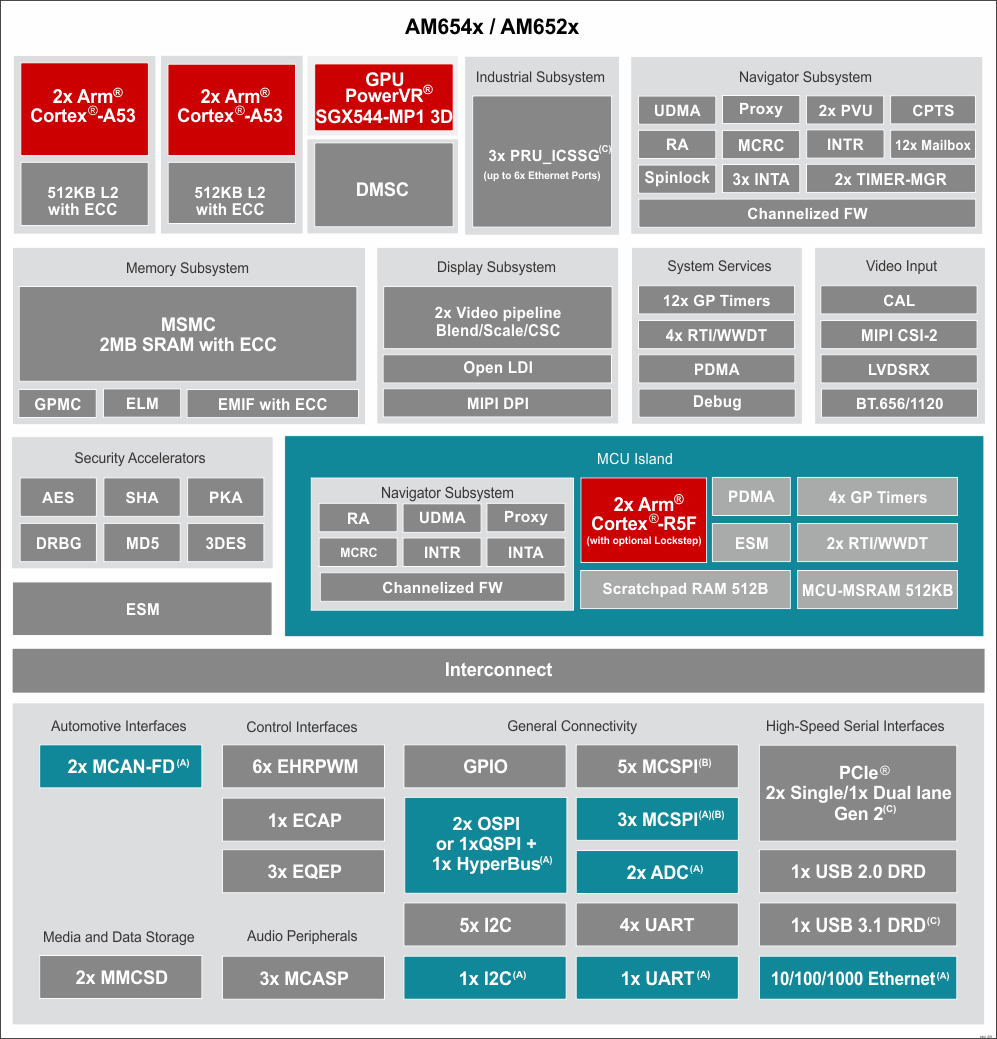
AM6526Dual Arm® Cortex®-A53 and dual Arm Cortex-R5F Sitara™ processor with gigabit PRU-ICSS | Microprocessors | 2 | Active | AM654x and AM652xSitara™ processorsare Arm applications processors built to meet the complex processing needs of modern industry 4.0 embedded products.
The AM654x and AM652x devices combine four or two Arm Cortex-A53 cores with a dual Arm Cortex-R5F MCU subsystem which includes features intended to help customers achieve their functional safety goals for their end products and three Gigabit industrial communications subsystems (PRU_ICSSG) to create a SoC capable of high-performance industrial controls with industrial connectivity and processing for functional safety applications. AM65xx is currently undergoing assessment to be certified by TÜV SÜD according to IEC 61508.
The four Arm Cortex-A53 cores in the AM654x are arranged in two dual-core clusters with shared L2 memory to create two processing channels. The two Arm Cortex-A53 cores in the AM652x are available in a single dual-core cluster and two single-core cluster options. Extensive ECC is included on on-chip memory, peripherals, and interconnect for reliability. The SoC as a whole includes features intended to help customers design systems that can achieve their functional safety goals (assessment pending with TÜV SÜD). Cryptographic acceleration and secure boot are available on some AM654x and AM652x devices in addition to granular firewalls managed by the DMSC.
Programmability is provided by the Arm Cortex-A53 RISC CPUs with Arm Neon™ extension, and the dual Arm Cortex-R5F MCU subsystem is available for general purpose use as two cores or it can be used in lockstep to help meet the needs of functional safety applications. The PRU_ICSSG subsystems can be used to provide up to six ports of industrial Ethernet such as Profinet IRT, TSN, Ethernet/IP or EtherCAT (among many others), or they can be used for standard Gigabit Ethernet connectivity.
TI provides a complete set of software and development tools for the Arm cores including Processor SDK Linux, Linux-RT, RTOS, and Android as well as C compilers and a debugging interface for visibility into source code execution. Applicable functional safety and security documentation will be made available to assist customers in developing their functional safety or security related systems.
AM654x and AM652xSitara™ processorsare Arm applications processors built to meet the complex processing needs of modern industry 4.0 embedded products.
The AM654x and AM652x devices combine four or two Arm Cortex-A53 cores with a dual Arm Cortex-R5F MCU subsystem which includes features intended to help customers achieve their functional safety goals for their end products and three Gigabit industrial communications subsystems (PRU_ICSSG) to create a SoC capable of high-performance industrial controls with industrial connectivity and processing for functional safety applications. AM65xx is currently undergoing assessment to be certified by TÜV SÜD according to IEC 61508.
The four Arm Cortex-A53 cores in the AM654x are arranged in two dual-core clusters with shared L2 memory to create two processing channels. The two Arm Cortex-A53 cores in the AM652x are available in a single dual-core cluster and two single-core cluster options. Extensive ECC is included on on-chip memory, peripherals, and interconnect for reliability. The SoC as a whole includes features intended to help customers design systems that can achieve their functional safety goals (assessment pending with TÜV SÜD). Cryptographic acceleration and secure boot are available on some AM654x and AM652x devices in addition to granular firewalls managed by the DMSC.
Programmability is provided by the Arm Cortex-A53 RISC CPUs with Arm Neon™ extension, and the dual Arm Cortex-R5F MCU subsystem is available for general purpose use as two cores or it can be used in lockstep to help meet the needs of functional safety applications. The PRU_ICSSG subsystems can be used to provide up to six ports of industrial Ethernet such as Profinet IRT, TSN, Ethernet/IP or EtherCAT (among many others), or they can be used for standard Gigabit Ethernet connectivity.
TI provides a complete set of software and development tools for the Arm cores including Processor SDK Linux, Linux-RT, RTOS, and Android as well as C compilers and a debugging interface for visibility into source code execution. Applicable functional safety and security documentation will be made available to assist customers in developing their functional safety or security related systems. |
AM6548Quad Arm® Cortex®-A53 and dual Arm Cortex-R5F Sitara™ processor with gigabit PRU-ICSS, 3D graphics | Integrated Circuits (ICs) | 1 | Active | AM654x and AM652xSitara™ processorsare Arm applications processors built to meet the complex processing needs of modern industry 4.0 embedded products.
The AM654x and AM652x devices combine four or two Arm Cortex-A53 cores with a dual Arm Cortex-R5F MCU subsystem which includes features intended to help customers achieve their functional safety goals for their end products and three Gigabit industrial communications subsystems (PRU_ICSSG) to create a SoC capable of high-performance industrial controls with industrial connectivity and processing for functional safety applications. AM65xx is currently undergoing assessment to be certified by TÜV SÜD according to IEC 61508.
The four Arm Cortex-A53 cores in the AM654x are arranged in two dual-core clusters with shared L2 memory to create two processing channels. The two Arm Cortex-A53 cores in the AM652x are available in a single dual-core cluster and two single-core cluster options. Extensive ECC is included on on-chip memory, peripherals, and interconnect for reliability. The SoC as a whole includes features intended to help customers design systems that can achieve their functional safety goals (assessment pending with TÜV SÜD). Cryptographic acceleration and secure boot are available on some AM654x and AM652x devices in addition to granular firewalls managed by the DMSC.
Programmability is provided by the Arm Cortex-A53 RISC CPUs with Arm Neon™ extension, and the dual Arm Cortex-R5F MCU subsystem is available for general purpose use as two cores or it can be used in lockstep to help meet the needs of functional safety applications. The PRU_ICSSG subsystems can be used to provide up to six ports of industrial Ethernet such as Profinet IRT, TSN, Ethernet/IP or EtherCAT (among many others), or they can be used for standard Gigabit Ethernet connectivity.
TI provides a complete set of software and development tools for the Arm cores including Processor SDK Linux, Linux-RT, RTOS, and Android as well as C compilers and a debugging interface for visibility into source code execution. Applicable functional safety and security documentation will be made available to assist customers in developing their functional safety or security related systems.
AM654x and AM652xSitara™ processorsare Arm applications processors built to meet the complex processing needs of modern industry 4.0 embedded products.
The AM654x and AM652x devices combine four or two Arm Cortex-A53 cores with a dual Arm Cortex-R5F MCU subsystem which includes features intended to help customers achieve their functional safety goals for their end products and three Gigabit industrial communications subsystems (PRU_ICSSG) to create a SoC capable of high-performance industrial controls with industrial connectivity and processing for functional safety applications. AM65xx is currently undergoing assessment to be certified by TÜV SÜD according to IEC 61508.
The four Arm Cortex-A53 cores in the AM654x are arranged in two dual-core clusters with shared L2 memory to create two processing channels. The two Arm Cortex-A53 cores in the AM652x are available in a single dual-core cluster and two single-core cluster options. Extensive ECC is included on on-chip memory, peripherals, and interconnect for reliability. The SoC as a whole includes features intended to help customers design systems that can achieve their functional safety goals (assessment pending with TÜV SÜD). Cryptographic acceleration and secure boot are available on some AM654x and AM652x devices in addition to granular firewalls managed by the DMSC.
Programmability is provided by the Arm Cortex-A53 RISC CPUs with Arm Neon™ extension, and the dual Arm Cortex-R5F MCU subsystem is available for general purpose use as two cores or it can be used in lockstep to help meet the needs of functional safety applications. The PRU_ICSSG subsystems can be used to provide up to six ports of industrial Ethernet such as Profinet IRT, TSN, Ethernet/IP or EtherCAT (among many others), or they can be used for standard Gigabit Ethernet connectivity.
TI provides a complete set of software and development tools for the Arm cores including Processor SDK Linux, Linux-RT, RTOS, and Android as well as C compilers and a debugging interface for visibility into source code execution. Applicable functional safety and security documentation will be made available to assist customers in developing their functional safety or security related systems. |
AM68General Purpose SoC with dual core 64-bit Arm Cortex-A72, graphics, 1-port PCIe Gen3, USB3.0 | Integrated Circuits (ICs) | 1 | Active | The AM68 scalable processor family is based on the evolutionary Jacinto™ 7 architecture, targeted at Smart Vision Camera and General Compute applications and built on extensive market knowledge accumulated over a decade of TI’s leadership in the Vision processor market. The AM68x family is built for a broad set of cost-sensitive high-performance compute applications in Factory Automation, Building Automation, and other markets.
The AM68 provides high performance compute technology for both traditional and deep learning algorithms at industry leading power/performance ratios with a high level of system integration to enable scalability and lower costs for advanced vision camera applications. Key cores include the latest Arm and GPU processors for general compute, next generation DSP with scalar and vector cores, dedicated deep learning and traditional algorithm accelerators, an integrated next generation imaging subsystem (ISP), video codec, and isolated MCU island. All protected by industrial-grade safety and security hardware accelerators.
General Compute Cores and Integration Overview: Separate dual core cluster configuration of Arm® Cortex®-A72 facilitates multi-OS applications with minimal need for a software hypervisor. Up to two Arm® Cortex®-R5F subsystems enable low-level, timing critical processing tasks to leave the Arm® Cortex®-A72 core’s unencumbered for applications. Building on the existing world-class ISP, TI’s 7th generation ISP includes flexibility to process a broader sensor suite, support for higher bit depth, and features targeting analytics applications. Integrated diagnostics and safety features support operations up to SIL-2 levels while the integrated security features protect data against modern day attacks. CSI2.0 ports enable multi sensor inputs.
Key Performance Cores Overview: The C7000™ DSP next generation core ("C7x") combines TI’s industry leading DSP and EVE cores into a single higher performance core and adds floating-point vector calculation capabilities, enabling backward compatibility for legacy code while simplifying software programming. The new "MMA" deep learning accelerator enables performance up to 8 Trillion Operations Per Second (TOPS) within the lowest power envelope in the industry even when operating even at the worst case junction temperatures of 105°C and 125°C. The dedicated Vision hardware accelerators provide vision pre-processing with no impact on system performance. The C7x/MMA cores are available only for deep learning function in the AM68 class of processors.
The AM68 scalable processor family is based on the evolutionary Jacinto™ 7 architecture, targeted at Smart Vision Camera and General Compute applications and built on extensive market knowledge accumulated over a decade of TI’s leadership in the Vision processor market. The AM68x family is built for a broad set of cost-sensitive high-performance compute applications in Factory Automation, Building Automation, and other markets.
The AM68 provides high performance compute technology for both traditional and deep learning algorithms at industry leading power/performance ratios with a high level of system integration to enable scalability and lower costs for advanced vision camera applications. Key cores include the latest Arm and GPU processors for general compute, next generation DSP with scalar and vector cores, dedicated deep learning and traditional algorithm accelerators, an integrated next generation imaging subsystem (ISP), video codec, and isolated MCU island. All protected by industrial-grade safety and security hardware accelerators.
General Compute Cores and Integration Overview: Separate dual core cluster configuration of Arm® Cortex®-A72 facilitates multi-OS applications with minimal need for a software hypervisor. Up to two Arm® Cortex®-R5F subsystems enable low-level, timing critical processing tasks to leave the Arm® Cortex®-A72 core’s unencumbered for applications. Building on the existing world-class ISP, TI’s 7th generation ISP includes flexibility to process a broader sensor suite, support for higher bit depth, and features targeting analytics applications. Integrated diagnostics and safety features support operations up to SIL-2 levels while the integrated security features protect data against modern day attacks. CSI2.0 ports enable multi sensor inputs.
Key Performance Cores Overview: The C7000™ DSP next generation core ("C7x") combines TI’s industry leading DSP and EVE cores into a single higher performance core and adds floating-point vector calculation capabilities, enabling backward compatibility for legacy code while simplifying software programming. The new "MMA" deep learning accelerator enables performance up to 8 Trillion Operations Per Second (TOPS) within the lowest power envelope in the industry even when operating even at the worst case junction temperatures of 105°C and 125°C. The dedicated Vision hardware accelerators provide vision pre-processing with no impact on system performance. The C7x/MMA cores are available only for deep learning function in the AM68 class of processors. |
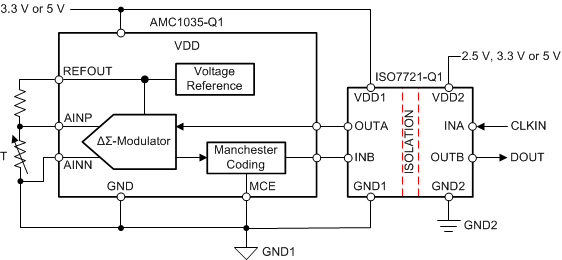
AMC1035-Q1Automotive precision delta-sigma modulator with ±1-V bipolar input and 2.5-V reference output | Integrated Circuits (ICs) | 3 | Active | The AMC1035-Q1 is a precision, delta-sigma (ΔΣ) modulator that operates from a single 3.0-V to 5.5-V supply and with an externally supplied clock signal in the range of 9 MHz to 21 MHz. In Manchester mode, the specified clock range is 9 MHz to 11 MHz. The differential ±1-V input structure of the device is optimized for voltage and temperature sensing applications.
Select the output bitstream of the AMC1035-Q1 to be Manchester coded to prevent setup and hold time requirement considerations of the receiving device and to reduce overall circuit layout efforts. When used with a digital filter (such as integrated in theTMS320F28004x,TMS320F2807x, orTMS320F2837xmicrocontroller families) to decimate the output bitstream, the device can achieve 16 bits of resolution with a dynamic range of 87 dB at a data rate of 82 kSPS.
The internal reference source of the AMC1035-Q1 supports a ratiometric circuit architecture to minimize the negative impact of the supply voltage variation and temperature drift on the accuracy of the measurement.
The AMC1035-Q1 can also be used for high common-mode AC voltage sensing with a digital isolator and isolated power supply.
The AMC1035-Q1 is a precision, delta-sigma (ΔΣ) modulator that operates from a single 3.0-V to 5.5-V supply and with an externally supplied clock signal in the range of 9 MHz to 21 MHz. In Manchester mode, the specified clock range is 9 MHz to 11 MHz. The differential ±1-V input structure of the device is optimized for voltage and temperature sensing applications.
Select the output bitstream of the AMC1035-Q1 to be Manchester coded to prevent setup and hold time requirement considerations of the receiving device and to reduce overall circuit layout efforts. When used with a digital filter (such as integrated in theTMS320F28004x,TMS320F2807x, orTMS320F2837xmicrocontroller families) to decimate the output bitstream, the device can achieve 16 bits of resolution with a dynamic range of 87 dB at a data rate of 82 kSPS.
The internal reference source of the AMC1035-Q1 supports a ratiometric circuit architecture to minimize the negative impact of the supply voltage variation and temperature drift on the accuracy of the measurement.
The AMC1035-Q1 can also be used for high common-mode AC voltage sensing with a digital isolator and isolated power supply. |
AMC1100±250-mV input, precision current sensing low-cost basic isolated amplifier | Development Boards, Kits, Programmers | 4 | Active | The AMC1100 is a precision isolation amplifier with an output separated from the input circuitry by a silicon dioxide (SiO2) barrier that is highly resistant to magnetic interference. This barrier is certified to provide galvanic isolation of up to 4250 VPEAK, according to DIN VDE V 0884-11: 2017-01 and UL1577. Used in conjunction with isolated power supplies, this device prevents noise currents on a high common-mode voltage line from entering the local ground and interfering with or damaging sensitive circuitry.
The AMC1100 input is optimized for direct connection to shunt resistors or other low voltage level signal sources. The excellent performance of the device enables accurate current and voltage measurement in energy-metering applications. The output signal common-mode voltage is automatically adjusted to either the 3-V or 5-V low-side supply.
The AMC1100 is fully specified over the extended industrial temperature range of –40°C to +105°C and is available in the SMD-type, wide-body SOIC-8 (DWV) and gullwing-8 (DUB) packages.
The AMC1100 is a precision isolation amplifier with an output separated from the input circuitry by a silicon dioxide (SiO2) barrier that is highly resistant to magnetic interference. This barrier is certified to provide galvanic isolation of up to 4250 VPEAK, according to DIN VDE V 0884-11: 2017-01 and UL1577. Used in conjunction with isolated power supplies, this device prevents noise currents on a high common-mode voltage line from entering the local ground and interfering with or damaging sensitive circuitry.
The AMC1100 input is optimized for direct connection to shunt resistors or other low voltage level signal sources. The excellent performance of the device enables accurate current and voltage measurement in energy-metering applications. The output signal common-mode voltage is automatically adjusted to either the 3-V or 5-V low-side supply.
The AMC1100 is fully specified over the extended industrial temperature range of –40°C to +105°C and is available in the SMD-type, wide-body SOIC-8 (DWV) and gullwing-8 (DUB) packages. |