SN74LV4T125Single Power Supply Quadruple Buffer GATE w/ 3-State Output CMOS Logic Level Shifter | Integrated Circuits (ICs) | 2 | Active | SN74LV4T125 is a low-voltage CMOS buffer gate that operates at a wider voltage range for portable, telecom, industrial, and automotive applications. The output level is referenced to the supply voltage and is able to support 1.8-V, 2.5-V, 3.3-V, and 5-V CMOS levels.
The input is designed with a lower threshold circuit to match 1.8-V input logic at VCC= 3.3 V and can be used in 1.8 V to 3.3 V level-up translation. In addition, the 5-V tolerant input pins enable down translation (for example, 3.3 V to 2.5 V output at VCC= 2.5 V). The wide VCCrange of 1.8 V to 5.5 V allows the generation of desired output levels to connect to controllers or processors.
The SN74LV4T125 device is designed with current-drive capability of 8 mA to reduce line reflections, overshoot, and undershoot caused by high-drive outputs.
SN74LV4T125 is a low-voltage CMOS buffer gate that operates at a wider voltage range for portable, telecom, industrial, and automotive applications. The output level is referenced to the supply voltage and is able to support 1.8-V, 2.5-V, 3.3-V, and 5-V CMOS levels.
The input is designed with a lower threshold circuit to match 1.8-V input logic at VCC= 3.3 V and can be used in 1.8 V to 3.3 V level-up translation. In addition, the 5-V tolerant input pins enable down translation (for example, 3.3 V to 2.5 V output at VCC= 2.5 V). The wide VCCrange of 1.8 V to 5.5 V allows the generation of desired output levels to connect to controllers or processors.
The SN74LV4T125 device is designed with current-drive capability of 8 mA to reduce line reflections, overshoot, and undershoot caused by high-drive outputs. |
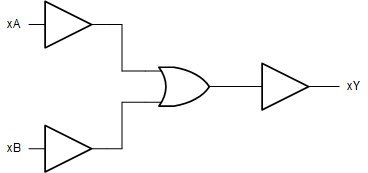
SN74LV4T321.8-V to 5.5-V single power supply quadruple OR gates | Integrated Circuits (ICs) | 2 | Active | The SN74LV4T32 contains four independent 2-input OR Gates with Schmitt-trigger inputs. Each gate performs the Boolean function Y = A + B in positive logic. The output level is referenced to the supply voltage (V CC) and supports 1.8-V, 2.5-V, 3.3-V, and 5-V CMOS levels.
The input is designed with a lower threshold circuit to support up translation for lower voltage CMOS inputs (for example, 1.2 V input to 1.8 V output or 1.8 V input to 3.3 V output). In addition, the 5-V tolerant input pins enable down translation (for example, 3.3 V to 2.5 V output).
The SN74LV4T32 contains four independent 2-input OR Gates with Schmitt-trigger inputs. Each gate performs the Boolean function Y = A + B in positive logic. The output level is referenced to the supply voltage (V CC) and supports 1.8-V, 2.5-V, 3.3-V, and 5-V CMOS levels.
The input is designed with a lower threshold circuit to support up translation for lower voltage CMOS inputs (for example, 1.2 V input to 1.8 V output or 1.8 V input to 3.3 V output). In addition, the 5-V tolerant input pins enable down translation (for example, 3.3 V to 2.5 V output). |
SN74LV4T32-EPEnhanced-product four-channel two-input OR gate with integrated level shifter | Logic | 2 | Active | The SN74LV4T32-EP contains four independent 2-input OR Gates with Schmitt-trigger inputs. Each gate performs the Boolean function Y = A + B in positive logic. The output level is referenced to the supply voltage (V CC) and supports 1.8-V, 2.5-V, 3.3-V, and 5-V CMOS levels.
The input is designed with a lower threshold circuit to support up translation for lower voltage CMOS inputs (for example, 1.2 V input to 1.8 V output or 1.8 V input to 3.3 V output). In addition, the 5-V tolerant input pins enable down translation (for example, 3.3 V to 2.5 V output).
The SN74LV4T32-EP contains four independent 2-input OR Gates with Schmitt-trigger inputs. Each gate performs the Boolean function Y = A + B in positive logic. The output level is referenced to the supply voltage (V CC) and supports 1.8-V, 2.5-V, 3.3-V, and 5-V CMOS levels.
The input is designed with a lower threshold circuit to support up translation for lower voltage CMOS inputs (for example, 1.2 V input to 1.8 V output or 1.8 V input to 3.3 V output). In addition, the 5-V tolerant input pins enable down translation (for example, 3.3 V to 2.5 V output). |
SN74LV4T32-Q1Automotive 1.8-V to 5.5-V single power supply quadruple OR gates | Logic | 1 | Active | The SN74LV4T32-Q1 contains four independent 2-input OR Gates with Schmitt-trigger inputs. Each gate performs the Boolean function Y = A + B in positive logic. The output level is referenced to the supply voltage (V CC) and supports 1.8-V, 2.5-V, 3.3-V, and 5-V CMOS levels.
The input is designed with a lower threshold circuit to support up translation for lower voltage CMOS inputs (for example, 1.2 V input to 1.8 V output or 1.8 V input to 3.3 V output). In addition, the 5-V tolerant input pins enable down translation (for example, 3.3 V to 2.5 V output).
The SN74LV4T32-Q1 contains four independent 2-input OR Gates with Schmitt-trigger inputs. Each gate performs the Boolean function Y = A + B in positive logic. The output level is referenced to the supply voltage (V CC) and supports 1.8-V, 2.5-V, 3.3-V, and 5-V CMOS levels.
The input is designed with a lower threshold circuit to support up translation for lower voltage CMOS inputs (for example, 1.2 V input to 1.8 V output or 1.8 V input to 3.3 V output). In addition, the 5-V tolerant input pins enable down translation (for example, 3.3 V to 2.5 V output). |
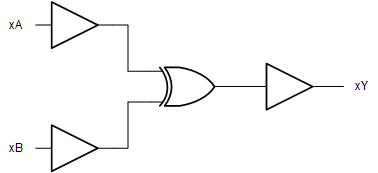
SN74LV4T86-EPEnhanced-product four-channel two-input XOR gate with integrated level shifter | Integrated Circuits (ICs) | 2 | Active | The SN74LV4T86-EP contains four independent 2-input XOR Gates with Schmitt-trigger inputs with extended voltage operation to allow for level translation. Each gate performs the Boolean function Y = A ⊕ B in positive logic. The output level is referenced to the supply voltage (V CC) and supports 1.2-V, 1.8-V, 2.5-V, 3.3-V, and 5-V CMOS levels.
The input is designed with a lower threshold circuit to support up translation for lower voltage CMOS inputs (for example 1.2 V input to 1.8 V output or 1.8 V input to 3.3 V output). Additionally, the 5-V tolerant input pins enable down translation (for example 3.3 V to 2.5 V output).
The SN74LV4T86-EP contains four independent 2-input XOR Gates with Schmitt-trigger inputs with extended voltage operation to allow for level translation. Each gate performs the Boolean function Y = A ⊕ B in positive logic. The output level is referenced to the supply voltage (V CC) and supports 1.2-V, 1.8-V, 2.5-V, 3.3-V, and 5-V CMOS levels.
The input is designed with a lower threshold circuit to support up translation for lower voltage CMOS inputs (for example 1.2 V input to 1.8 V output or 1.8 V input to 3.3 V output). Additionally, the 5-V tolerant input pins enable down translation (for example 3.3 V to 2.5 V output). |
SN74LV540A8-ch, 2-V to 5.5-V inverters with 3-state outputs | Logic | 8 | Active | The SN74LV540A device is an octal buffer/driver designed for 2 V to 5.5 V V CC operation.
This device is ideal for driving bus lines or buffer memory address registers. It features inputs and outputs on opposite sides of the package to facilitate printed circuit board layout.
The SN74LV540A device is an octal buffer/driver designed for 2 V to 5.5 V V CC operation.
This device is ideal for driving bus lines or buffer memory address registers. It features inputs and outputs on opposite sides of the package to facilitate printed circuit board layout. |
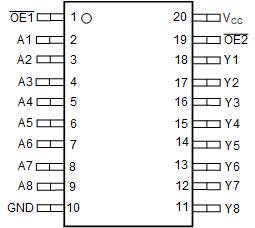
SN74LV541A-Q1Automotive, eight-channel, 2-V to 5.5-V buffers with tri-state outputs | Integrated Circuits (ICs) | 1 | Active | The SN74LV541A-Q1 device is an octal buffer/driver designed for 2 V to 5.5 V VCCoperation. The active low output enable pins (OE1andOE2) control all eight channels, and are configured so that both must be low for the outputs to be active.
The SN74LV541A-Q1 device is an octal buffer/driver designed for 2 V to 5.5 V VCCoperation. The active low output enable pins (OE1andOE2) control all eight channels, and are configured so that both must be low for the outputs to be active. |
SN74LV541AT8-ch, 4.5-V to 5.5-V buffers with TTL-compatible CMOS inputs and 3-state outputs | Integrated Circuits (ICs) | 22 | Active | The SN74LV541AT is designed for 4.5-V to 5.5-V VCCoperation. The inputs are TTL-voltage compatible, which allows them to be interfaced with bipolar outputs and 3.3-V devices. The device also can be used to translate from 3.3 V to 5 V.
This device is ideal for driving bus lines or buffer memory address registers. It features inputs and outputs on opposite sides of the package to facilitate printed circuit board layout.
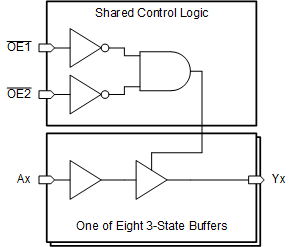
The 3-state control gate is a two-input AND gate with active-low inputs so that, if either output-enable (OE1orOE2) input is high, all corresponding outputs are in the high-impedance state. The outputs provide noninverted data when they are not in the high-impedance state.
To ensure the high-impedance state during power up or power down,OEshall be tied to VCC through a pullup resistor; the minimum value of the resistor is determined by the current-sinking capability of the driver.
This device is fully specified for partial-power-down applications using Ioff. The Ioffcircuitry disables the outputs, preventing damaging current backflow through the device when it is powered down.
The SN74LV541AT is designed for 4.5-V to 5.5-V VCCoperation. The inputs are TTL-voltage compatible, which allows them to be interfaced with bipolar outputs and 3.3-V devices. The device also can be used to translate from 3.3 V to 5 V.
This device is ideal for driving bus lines or buffer memory address registers. It features inputs and outputs on opposite sides of the package to facilitate printed circuit board layout.
The 3-state control gate is a two-input AND gate with active-low inputs so that, if either output-enable (OE1orOE2) input is high, all corresponding outputs are in the high-impedance state. The outputs provide noninverted data when they are not in the high-impedance state.
To ensure the high-impedance state during power up or power down,OEshall be tied to VCC through a pullup resistor; the minimum value of the resistor is determined by the current-sinking capability of the driver.
This device is fully specified for partial-power-down applications using Ioff. The Ioffcircuitry disables the outputs, preventing damaging current backflow through the device when it is powered down. |
| Integrated Circuits (ICs) | 1 | Obsolete | |
SN74LV573ATOctal Transparent D-Type Latches With 3-State Outputs | Integrated Circuits (ICs) | 22 | Active | The SN74LV573AT is an octal transparent D-type latch. When the latch-enable (LE) input is high, the Q outputs follow the data (D) inputs. When LE is low, the Q outputs are latched at the logic levels of the D inputs.
A buffered output-enable (OE) input can be used to place the eight outputs in either a normal logic state (high or low) or the high-impedance state. In the high-impedance state, the outputs neither load nor drive the bus lines significantly. The high-impedance state and increased drive provide the capability to drive bus lines without interface or pullup components.
To ensure the high-impedance state during power up or power down,OEshall be tied to VCCthrough a pullup resistor; the minimum value of the resistor is determined by the current-sinking capability of the driver.
OEdoes not affect the internal operations of the latches. Old data can be retained or new data can be entered while the outputs are in the high-impedance state.
This device is fully specified for partial-power-down applications using Ioff. The Ioffcircuitry disables the outputs, preventing damaging current backflow through the device when it is powered down.
The SN74LV573AT is an octal transparent D-type latch. When the latch-enable (LE) input is high, the Q outputs follow the data (D) inputs. When LE is low, the Q outputs are latched at the logic levels of the D inputs.
A buffered output-enable (OE) input can be used to place the eight outputs in either a normal logic state (high or low) or the high-impedance state. In the high-impedance state, the outputs neither load nor drive the bus lines significantly. The high-impedance state and increased drive provide the capability to drive bus lines without interface or pullup components.
To ensure the high-impedance state during power up or power down,OEshall be tied to VCCthrough a pullup resistor; the minimum value of the resistor is determined by the current-sinking capability of the driver.
OEdoes not affect the internal operations of the latches. Old data can be retained or new data can be entered while the outputs are in the high-impedance state.
This device is fully specified for partial-power-down applications using Ioff. The Ioffcircuitry disables the outputs, preventing damaging current backflow through the device when it is powered down. |