T
Texas Instruments
| Series | Category | # Parts | Status | Description |
|---|---|---|---|---|
| Part | Spec A | Spec B | Spec C | Spec D | Description |
|---|---|---|---|---|---|



| Series | Category | # Parts | Status | Description |
|---|---|---|---|---|
| Part | Spec A | Spec B | Spec C | Spec D | Description |
|---|---|---|---|---|---|
| Part | Category | Description |
|---|---|---|
 Texas Instruments BQ2002CSNTRG4Unknown | Integrated Circuits (ICs) | LINEAR BATTERY CHARGER NICD/NIMH 2000MA 0V TO 6V 8-PIN SOIC T/R |
 Texas Instruments LM3676SDX-3.3Obsolete | Integrated Circuits (ICs) | IC REG BUCK 3.3V 600MA 8WSON |
 Texas Instruments | Integrated Circuits (ICs) | TMX320DRE311 179PIN UBGA 200MHZ |
 Texas Instruments UCC3580N-1G4Obsolete | Integrated Circuits (ICs) | IC REG CTRLR FWRD CONV 16DIP |
 Texas Instruments LM2831YMF EVALObsolete | Development Boards Kits Programmers | EVAL BOARD FOR LM2831 |
 Texas Instruments | Integrated Circuits (ICs) | BUFFER/LINE DRIVER 8-CH NON-INVERTING 3-ST CMOS 20-PIN SSOP T/R |
 Texas Instruments | Integrated Circuits (ICs) | ANALOG OTHER PERIPHERALS |
Texas Instruments | Integrated Circuits (ICs) | RADIATION-HARDENED, QMLP 60V HAL |
 Texas Instruments SN75LVDS051DRObsolete | Integrated Circuits (ICs) | IC TRANSCEIVER FULL 2/2 16SOIC |
 Texas Instruments | Integrated Circuits (ICs) | AUTOMOTIVE OCTAL D-TYPE FLIP-FLO |
| Series | Category | # Parts | Status | Description |
|---|---|---|---|---|
| Power Management (PMIC) | 3 | NRND | ||
| Integrated Circuits (ICs) | 4 | Active | ||
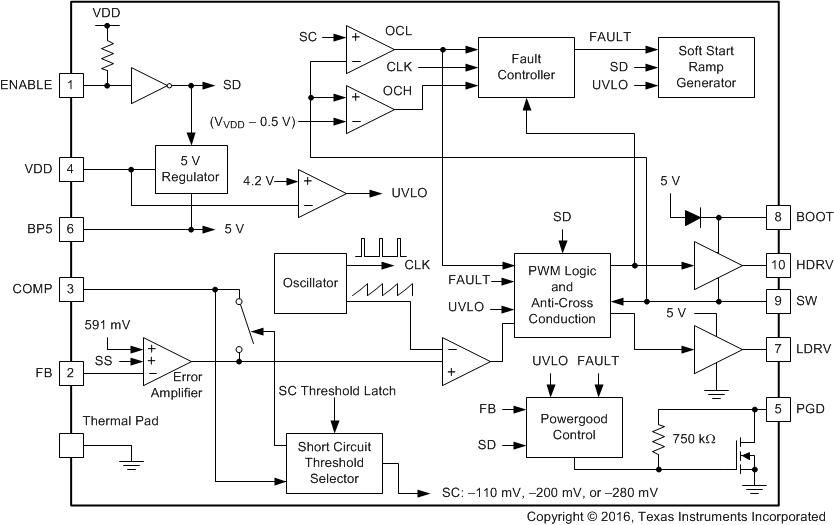
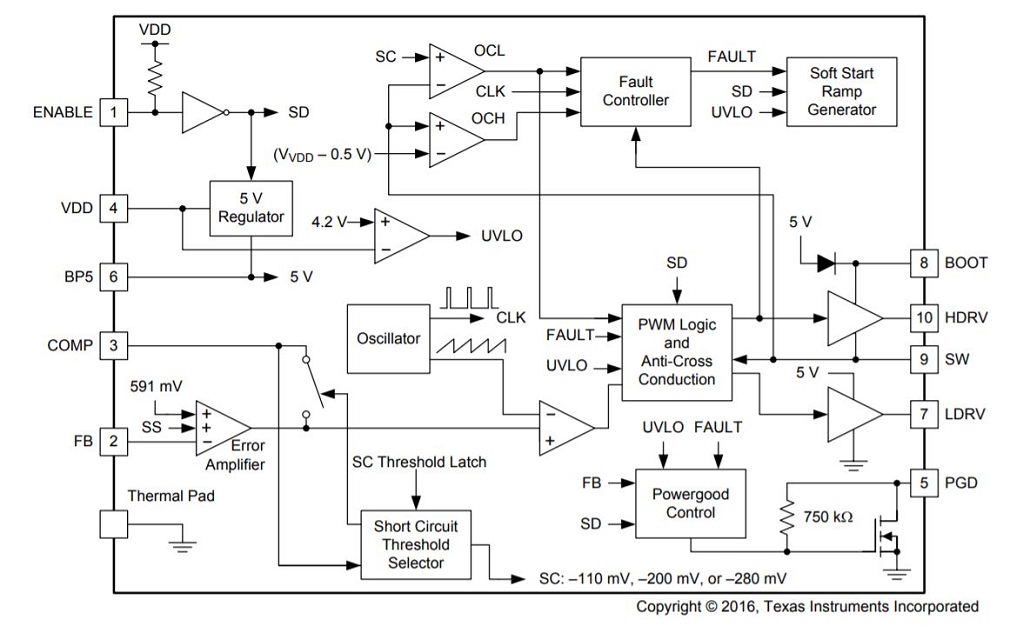
TPS401924.5-V to 18-V, 20-A, 600-kHz synchronous buck controller with power good | Integrated Circuits (ICs) | 2 | Active | TPS40192 and TPS40193 are cost-optimized synchronous buck controllers that operate from 4.5 V to 18 V input. These controllers implement a voltage-mode control architecture with the switching frequency fixed at either 600 kHz (TPS40192) or 300 kHz (TPS40193). The higher switching frequency facilitates the use of smaller inductor and output capacitors, thereby providing a compact power-supply solution. An adaptive anti-cross conduction scheme is used to prevent shoot through current in the power FETs.
Short circuit detection is done by sensing the voltage drop across the low-side MOSFET when it is on and comparing it with a user selected threshold of 100 mV, 200 mV or 280 mV. The threshold is set with a single external resistor connected from COMP to GND. This resistor is sensed at startup and the selected threshold is latched. Pulse-by-pulse limiting (to prevent current runaway) is provided by sensing the voltage across the high-side MOSFET when it is on and terminating the cycle when the voltage drop rises above a fixed threshold of 550 mV. When the controller senses an output short circuit, both MOSFETs are turned off and a timeout period is observed before attempting to restart. This behavior provides limited power dissipation in the event of a sustained fault.
TPS40192 and TPS40193 are cost-optimized synchronous buck controllers that operate from 4.5 V to 18 V input. These controllers implement a voltage-mode control architecture with the switching frequency fixed at either 600 kHz (TPS40192) or 300 kHz (TPS40193). The higher switching frequency facilitates the use of smaller inductor and output capacitors, thereby providing a compact power-supply solution. An adaptive anti-cross conduction scheme is used to prevent shoot through current in the power FETs.
Short circuit detection is done by sensing the voltage drop across the low-side MOSFET when it is on and comparing it with a user selected threshold of 100 mV, 200 mV or 280 mV. The threshold is set with a single external resistor connected from COMP to GND. This resistor is sensed at startup and the selected threshold is latched. Pulse-by-pulse limiting (to prevent current runaway) is provided by sensing the voltage across the high-side MOSFET when it is on and terminating the cycle when the voltage drop rises above a fixed threshold of 550 mV. When the controller senses an output short circuit, both MOSFETs are turned off and a timeout period is observed before attempting to restart. This behavior provides limited power dissipation in the event of a sustained fault. |
| Integrated Circuits (ICs) | 3 | Active | ||
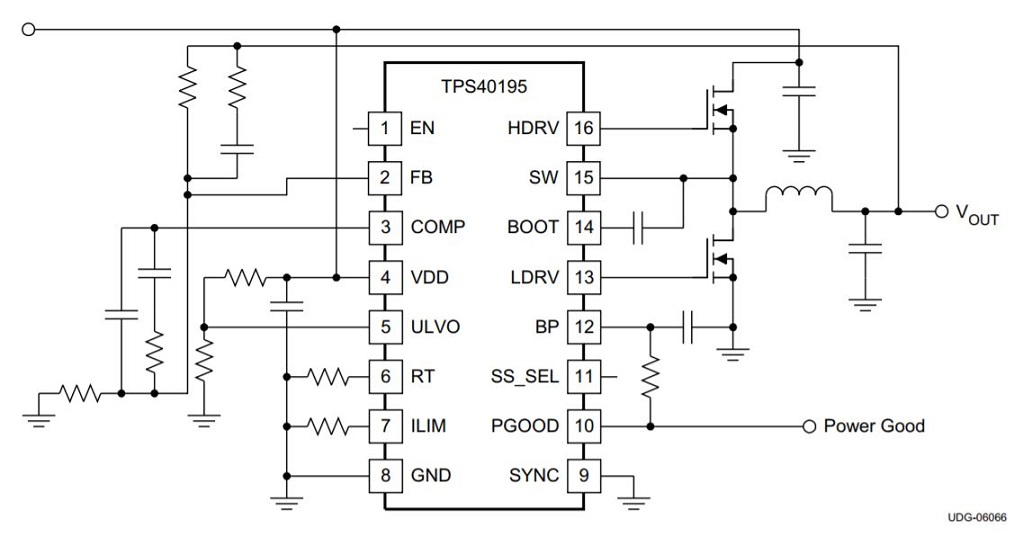
TPS401954.5-V to 20-V, 20-A, synchronous buck controller with power good and synchronization | Integrated Circuits (ICs) | 5 | Active | The TPS40195 is a flexible synchronous buck controller that operates from a nominal 4.5-V to 20-V supply. This controller implements voltage mode control with the switching frequency adjustable from 100 kHz to 600 kHz. Flexible features found on this device include selectable soft-start time, programmable short-circuit limit, programmable undervoltage lockout (UVLO) and synchronization capability. An adaptive anti-cross conduction scheme is used to prevent shoot through current in the power FETs. Overcurrent detection is done by sensing the voltage drop across the low-side MOSFET when it is on, and comparing it with a user-programmable threshold.
The threshold is set with a single external resistor connected from ILIM to GND. Pulse-by-pulse limiting (to prevent current runaway) is provided by sensing the voltage across the high-side MOSFET when it is on and terminating the cycle when the voltage drop rises above a fixed threshold of 550 mV. When the controller senses an output short circuit, both MOSFETs are turned off and a timeout period is observed before attempting to restart. This provides limited power dissipation in the event of a sustained fault. Synchronization on this device is bi-directional. Devices can be synchronized 180° out of phase to a chosen master TPS40195 running at a fixed 250 kHz or 500 kHz, or can be synchronized to an outside clock source anywhere in the 100 kHz to 600 kHz range.
The TPS40195 is a flexible synchronous buck controller that operates from a nominal 4.5-V to 20-V supply. This controller implements voltage mode control with the switching frequency adjustable from 100 kHz to 600 kHz. Flexible features found on this device include selectable soft-start time, programmable short-circuit limit, programmable undervoltage lockout (UVLO) and synchronization capability. An adaptive anti-cross conduction scheme is used to prevent shoot through current in the power FETs. Overcurrent detection is done by sensing the voltage drop across the low-side MOSFET when it is on, and comparing it with a user-programmable threshold.
The threshold is set with a single external resistor connected from ILIM to GND. Pulse-by-pulse limiting (to prevent current runaway) is provided by sensing the voltage across the high-side MOSFET when it is on and terminating the cycle when the voltage drop rises above a fixed threshold of 550 mV. When the controller senses an output short circuit, both MOSFETs are turned off and a timeout period is observed before attempting to restart. This provides limited power dissipation in the event of a sustained fault. Synchronization on this device is bi-directional. Devices can be synchronized 180° out of phase to a chosen master TPS40195 running at a fixed 250 kHz or 500 kHz, or can be synchronized to an outside clock source anywhere in the 100 kHz to 600 kHz range. |
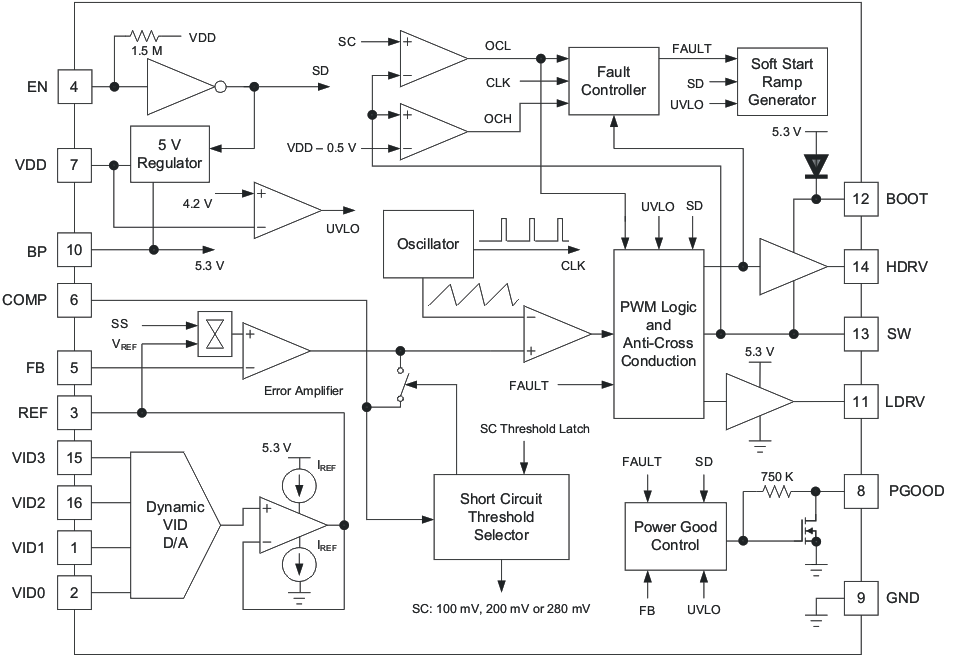
TPS401974.5-V to 14-V, 6-A synchronous buck controller with 4-bit VID interface | Power Management (PMIC) | 2 | Active | The TPS40197 is a synchronous buck controller that operates from 4.5 V to 14 V input supply nominally. The controller implements voltage-mode control architecture with the switching frequency fixed at 520 kHz. The higher switching frequency facilitates the use of smaller inductor and output capacitors, thereby providing a compact power-supply solution. An adaptive anti-cross conduction scheme is used to prevent shoot through current in the power FETs.
The TPS40197 integrates the PWM control and 4-bit VID interface in a single chip to allow seamless on-the-fly VID changes with programmable transition rate. It provides a simple power solution for Smart-Reflex™ DSP cores.
Short-circuit detection is done by sensing the voltage drop across the low-side FET when it is on and comparing it with a user selected threshold of 100 mV, 200 mV or 280 mV. The threshold is set with a single external resistor connected from COMP to GND. This resistor is sensed at startup and the selected threshold is latched. Pulse by pulse limiting (to prevent current runaway) is provided by sensing the voltage across the high-side FET when it is on and terminating the cycle when the voltage drop rises above a fixed threshold of 550 mV. When the controller senses an output short circuit, both FETs are turned off and a timeout period is observed before attempting to restart. This provides limited power dissipation in the event of a sustained fault.
The TPS40197 is a synchronous buck controller that operates from 4.5 V to 14 V input supply nominally. The controller implements voltage-mode control architecture with the switching frequency fixed at 520 kHz. The higher switching frequency facilitates the use of smaller inductor and output capacitors, thereby providing a compact power-supply solution. An adaptive anti-cross conduction scheme is used to prevent shoot through current in the power FETs.
The TPS40197 integrates the PWM control and 4-bit VID interface in a single chip to allow seamless on-the-fly VID changes with programmable transition rate. It provides a simple power solution for Smart-Reflex™ DSP cores.
Short-circuit detection is done by sensing the voltage drop across the low-side FET when it is on and comparing it with a user selected threshold of 100 mV, 200 mV or 280 mV. The threshold is set with a single external resistor connected from COMP to GND. This resistor is sensed at startup and the selected threshold is latched. Pulse by pulse limiting (to prevent current runaway) is provided by sensing the voltage across the high-side FET when it is on and terminating the cycle when the voltage drop rises above a fixed threshold of 550 mV. When the controller senses an output short circuit, both FETs are turned off and a timeout period is observed before attempting to restart. This provides limited power dissipation in the event of a sustained fault. |
TPS40200Automotive 4.5V to 52V Non-Synchronous Voltage Mode Buck Controller with P-Channel FET Driver | Evaluation Boards | 13 | Active | The TPS40200 is a flexible, non-synchronous controller with a built-in 200-mA driver for P-channel FETs. The circuit operates with inputs up to 52 V with a power-saving feature that turns off driver current once the external FET has been fully turned on. This feature extends the flexibility of the device, allowing it to operate with an input voltage up to 52 V without dissipating excessive power. The circuit operates with voltage-mode feedback and has feed-forward input voltage compensation that responds instantly to input voltage change. The integral 700-mV reference is trimmed to 2%, providing the means to accurately control low voltages. The TPS40200 is available in an 8-pin SOIC and an 8-pin VSON package and supports many of the features of more complex controllers. Clock frequency, soft-start, and overcurrent limits are each easily programmed by a single, external component. The part has undervoltage lockout, and can be easily synchronized to other controllers or a system clock to satisfy sequencing and/or noise-reduction requirements.
The TPS40200 is a flexible, non-synchronous controller with a built-in 200-mA driver for P-channel FETs. The circuit operates with inputs up to 52 V with a power-saving feature that turns off driver current once the external FET has been fully turned on. This feature extends the flexibility of the device, allowing it to operate with an input voltage up to 52 V without dissipating excessive power. The circuit operates with voltage-mode feedback and has feed-forward input voltage compensation that responds instantly to input voltage change. The integral 700-mV reference is trimmed to 2%, providing the means to accurately control low voltages. The TPS40200 is available in an 8-pin SOIC and an 8-pin VSON package and supports many of the features of more complex controllers. Clock frequency, soft-start, and overcurrent limits are each easily programmed by a single, external component. The part has undervoltage lockout, and can be easily synchronized to other controllers or a system clock to satisfy sequencing and/or noise-reduction requirements. |
TPS40200-HTHigh Temperature Wide Input Non-Synchronous Buck DC/DC Controller | Power Management (PMIC) | 3 | Active | The TPS40200 is a flexible nonsynchronous controller with a built-in 200-mA driver for P-channel FETs. The circuit operates with inputs up to 52 V, with a power-saving feature that turns off driver current once the external FET has been fully turned on. This feature extends the flexibility of the device, allowing it to operate with an input voltage up to 52 V, without dissipating excessive power. The circuit operates with voltage-mode feedback and has feed-forward input-voltage compensation that responds instantly to input-voltage change. The integral 700-mV reference is trimmed to 2%, providing the means to accurately control low voltages. Clock frequency, soft start, and overcurrent limit each are easily programmed by a single, external component. The part has undervoltage lockout, and can be easily synchronized to other controllers or a system clock to satisfy sequencing and/or noise-reduction requirements.
The TPS40200 is a flexible nonsynchronous controller with a built-in 200-mA driver for P-channel FETs. The circuit operates with inputs up to 52 V, with a power-saving feature that turns off driver current once the external FET has been fully turned on. This feature extends the flexibility of the device, allowing it to operate with an input voltage up to 52 V, without dissipating excessive power. The circuit operates with voltage-mode feedback and has feed-forward input-voltage compensation that responds instantly to input-voltage change. The integral 700-mV reference is trimmed to 2%, providing the means to accurately control low voltages. Clock frequency, soft start, and overcurrent limit each are easily programmed by a single, external component. The part has undervoltage lockout, and can be easily synchronized to other controllers or a system clock to satisfy sequencing and/or noise-reduction requirements. |
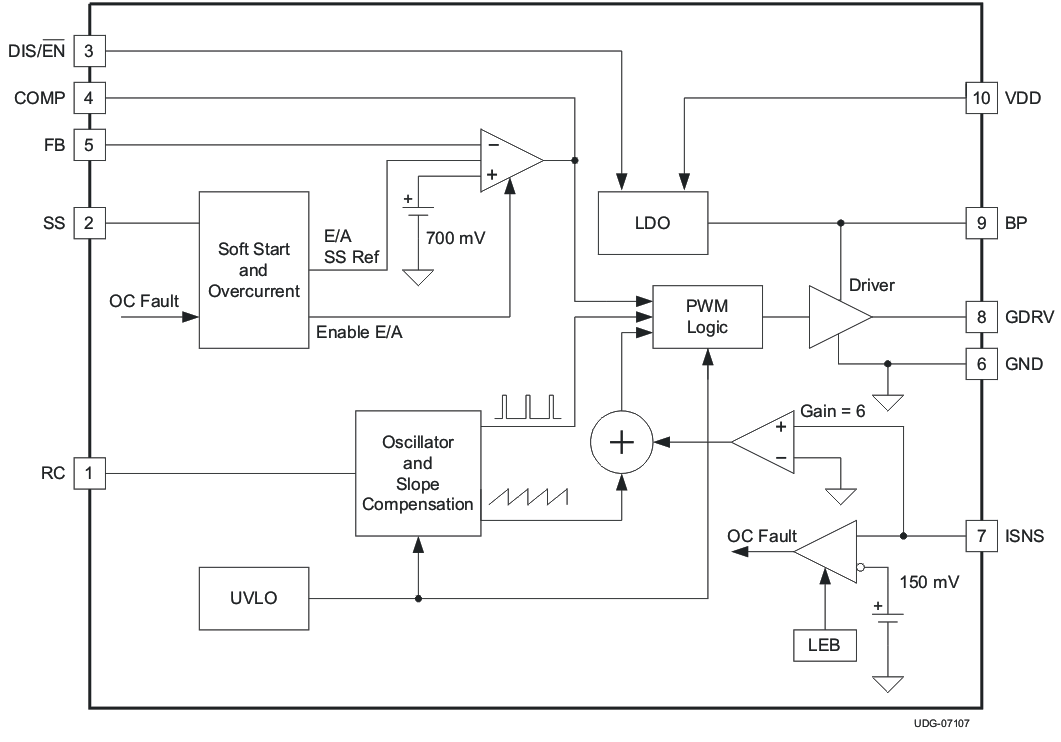
TPS40210Enhanced Product 4.5-V to 52-V Input Current Mode Boost Controller | Development Boards, Kits, Programmers | 11 | Active | The TPS40210 and TPS40211 are wide-input voltage (4.5 V to 52 V), nonsynchronous boost controllers. They are suitable for topologies which require a grounded source N-channel FET including boost, flyback, SEPIC, and various LED Driver applications. The device features include programmable soft start, overcurrent protection with automatic retry, and programmable oscillator frequency. Current mode control provides improved transient response and simplified loop compensation. The main difference between the two parts is the reference voltage to which the error amplifier regulates the FB pin.
The TPS40210 and TPS40211 are wide-input voltage (4.5 V to 52 V), nonsynchronous boost controllers. They are suitable for topologies which require a grounded source N-channel FET including boost, flyback, SEPIC, and various LED Driver applications. The device features include programmable soft start, overcurrent protection with automatic retry, and programmable oscillator frequency. Current mode control provides improved transient response and simplified loop compensation. The main difference between the two parts is the reference voltage to which the error amplifier regulates the FB pin. |
TPS402114.5-V to 52-V wide input range current mode boost controller with 260-mV reference voltage | Evaluation Boards | 7 | Active | The TPS40210 and TPS40211 are wide-input voltage (4.5 V to 52 V), nonsynchronous boost controllers. They are suitable for topologies which require a grounded source N-channel FET including boost, flyback, SEPIC, and various LED Driver applications. The device features include programmable soft start, overcurrent protection with automatic retry, and programmable oscillator frequency. Current mode control provides improved transient response and simplified loop compensation. The main difference between the two parts is the reference voltage to which the error amplifier regulates the FB pin.
The TPS40210 and TPS40211 are wide-input voltage (4.5 V to 52 V), nonsynchronous boost controllers. They are suitable for topologies which require a grounded source N-channel FET including boost, flyback, SEPIC, and various LED Driver applications. The device features include programmable soft start, overcurrent protection with automatic retry, and programmable oscillator frequency. Current mode control provides improved transient response and simplified loop compensation. The main difference between the two parts is the reference voltage to which the error amplifier regulates the FB pin. |