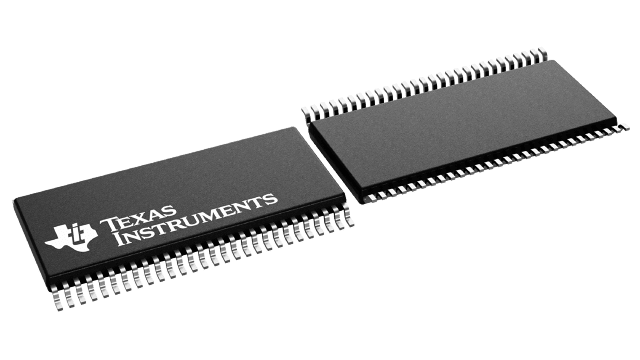
| Integrated Circuits (ICs) | 3 | Obsolete | |
| Integrated Circuits (ICs) | 2 | Obsolete | |
| Universal Bus Functions | 6 | Active | |
| Integrated Circuits (ICs) | 3 | Active | |
| Logic | 3 | Obsolete | |
| Universal Bus Functions | 2 | Obsolete | |
74ALVCH1660118-bit universal bus transceiver with 3-state outputs | Logic | 3 | Active | This 18-bit universal bus transceiver is designed for 1.65-V to 3.6-V VCCoperation.
The SN74ALVCH16601 combines D-type latches and D-type flip-flops to allow data flow in transparent, latched, and clocked modes.
Data flow in each direction is controlled by output-enable (OEAB\ and OEBA\), latch-enable (LEAB and LEBA), and clock (CLKAB and CLKBA) inputs. The clock can be controlled by the clock-enable (CLKENAB\ and CLKENBA\) inputs. For A-to-B data flow, the device operates in the transparent mode when LEAB is high. When LEAB is low, the A data is latched if CLKAB is held at a high or low logic level. If LEAB is low, the A data is stored in the latch/flip-flop on the low-to-high transition of CLKAB. Output enable OEAB\ is active low. When OEAB\ is low, the outputs are active. When OEAB\ is high, the outputs are in the high-impedance state.
Data flow for B to A is similar to that of A to B, but uses OEBA\, LEBA, CLKBA, and CLKENBA\.
To ensure the high-impedance state during power up or power down, OE should be tied to VCCthrough a pullup resistor; the minimum value of the resistor is determined by the current-sinking capability of the driver.
Active bus-hold circuitry is provided to hold unused or floating data inputs at a valid logic level.
The SN74ALVCH16601 is characterized for operation from –40°C to 85°C.
This 18-bit universal bus transceiver is designed for 1.65-V to 3.6-V VCCoperation.
The SN74ALVCH16601 combines D-type latches and D-type flip-flops to allow data flow in transparent, latched, and clocked modes.
Data flow in each direction is controlled by output-enable (OEAB\ and OEBA\), latch-enable (LEAB and LEBA), and clock (CLKAB and CLKBA) inputs. The clock can be controlled by the clock-enable (CLKENAB\ and CLKENBA\) inputs. For A-to-B data flow, the device operates in the transparent mode when LEAB is high. When LEAB is low, the A data is latched if CLKAB is held at a high or low logic level. If LEAB is low, the A data is stored in the latch/flip-flop on the low-to-high transition of CLKAB. Output enable OEAB\ is active low. When OEAB\ is low, the outputs are active. When OEAB\ is high, the outputs are in the high-impedance state.
Data flow for B to A is similar to that of A to B, but uses OEBA\, LEBA, CLKBA, and CLKENBA\.
To ensure the high-impedance state during power up or power down, OE should be tied to VCCthrough a pullup resistor; the minimum value of the resistor is determined by the current-sinking capability of the driver.
Active bus-hold circuitry is provided to hold unused or floating data inputs at a valid logic level.
The SN74ALVCH16601 is characterized for operation from –40°C to 85°C. |
74ALVCH1664616-Bit Bus Transceiver And Register With 3-State Outputs | Buffers, Drivers, Receivers, Transceivers | 5 | Active | This 16-bit bus transceiver and register is designed for 1.65-V to 3.6-V VCCoperation.
The SN74ALVCH16646 can be used as two 8-bit transceivers or one 16-bit transceiver. Data on the A or B bus is clocked into the registers on the low-to-high transition of the appropriate clock (CLKAB or CLKBA) input. Figure 1 illustrates the four fundamental bus-management functions that can be performed with the SN74ALVCH16646.
Output-enable (OE\) and direction-control (DIR) inputs are provided to control the transceiver functions. In the transceiver mode, data present at the high-impedance port may be stored in either register or in both. The select-control (SAB and SBA) inputs can multiplex stored and real-time (transparent mode) data. The circuitry used for select control eliminates the typical decoding glitch that occurs in a multiplexer during the transition between stored and real-time data. DIR determines which bus receives data when OE\ is low. In the isolation mode (OE\ high), A data may be stored in one register and/or B data may be stored in the other register.
When an output function is disabled, the input function is still enabled and may be used to store and transmit data. Only one of the two buses, A or B, can be driven at a time.
To ensure the high-impedance state during power up or power down, OE\ should be tied to VCCthrough a pullup resistor; the minimum value of the resistor is determined by the current-sinking capability of the driver.
Active bus-hold circuitry is provided to hold unused or floating data inputs at a valid logic level.
The SN74ALVCH16646 is characterized for operation from –40°C to 85°C.
This 16-bit bus transceiver and register is designed for 1.65-V to 3.6-V VCCoperation.
The SN74ALVCH16646 can be used as two 8-bit transceivers or one 16-bit transceiver. Data on the A or B bus is clocked into the registers on the low-to-high transition of the appropriate clock (CLKAB or CLKBA) input. Figure 1 illustrates the four fundamental bus-management functions that can be performed with the SN74ALVCH16646.
Output-enable (OE\) and direction-control (DIR) inputs are provided to control the transceiver functions. In the transceiver mode, data present at the high-impedance port may be stored in either register or in both. The select-control (SAB and SBA) inputs can multiplex stored and real-time (transparent mode) data. The circuitry used for select control eliminates the typical decoding glitch that occurs in a multiplexer during the transition between stored and real-time data. DIR determines which bus receives data when OE\ is low. In the isolation mode (OE\ high), A data may be stored in one register and/or B data may be stored in the other register.
When an output function is disabled, the input function is still enabled and may be used to store and transmit data. Only one of the two buses, A or B, can be driven at a time.
To ensure the high-impedance state during power up or power down, OE\ should be tied to VCCthrough a pullup resistor; the minimum value of the resistor is determined by the current-sinking capability of the driver.
Active bus-hold circuitry is provided to hold unused or floating data inputs at a valid logic level.
The SN74ALVCH16646 is characterized for operation from –40°C to 85°C. |
| Flip Flops | 5 | Active | This 20-bit flip-flop is designed specifically for 1.65-V to 3.6-V VCCoperation.
The 20 flip-flops of the SN74ALVCH16721 are edge-triggered D-type flip-flops with qualified clock storage. On the positive transition of the clock (CLK) input, the device provides true data at the Q outputs if the clock-enable (CLKEN)\ input is low. If CLKEN\ is high, no data is stored.
A buffered output-enable (OE)\ input places the 20 outputs in either a normal logic state (high or low) or the high-impedance state. In the high-impedance state, the outputs neither load nor drive the bus lines significantly. The high-impedance state and increased drive provide the capability to drive bus lines without need for interface or pullup components. OE\ does not affect the internal operation of the flip-flops. Old data can be retained or new data can be entered while the outputs are in the high-impedance state.
To ensure the high-impedance state during power up or power down, OE\ should be tied to VCCthrough a pullup resistor; the minimum value of the resistor is determined by the current-sinking capability of the driver.
Active bus-hold circuitry is provided to hold unused or floating data inputs at a valid logic level.
The SN74ALVCH16721 is characterized for operation from –40°C to 85°C.
This 20-bit flip-flop is designed specifically for 1.65-V to 3.6-V VCCoperation.
The 20 flip-flops of the SN74ALVCH16721 are edge-triggered D-type flip-flops with qualified clock storage. On the positive transition of the clock (CLK) input, the device provides true data at the Q outputs if the clock-enable (CLKEN)\ input is low. If CLKEN\ is high, no data is stored.
A buffered output-enable (OE)\ input places the 20 outputs in either a normal logic state (high or low) or the high-impedance state. In the high-impedance state, the outputs neither load nor drive the bus lines significantly. The high-impedance state and increased drive provide the capability to drive bus lines without need for interface or pullup components. OE\ does not affect the internal operation of the flip-flops. Old data can be retained or new data can be entered while the outputs are in the high-impedance state.
To ensure the high-impedance state during power up or power down, OE\ should be tied to VCCthrough a pullup resistor; the minimum value of the resistor is determined by the current-sinking capability of the driver.
Active bus-hold circuitry is provided to hold unused or floating data inputs at a valid logic level.
The SN74ALVCH16721 is characterized for operation from –40°C to 85°C. |
74ALVCH168203.3-V 10-Bit Flip-Flop with Dual Outputs and 3-State Outputs | Integrated Circuits (ICs) | 3 | Active | This 10-bit flip-flop is designed for 1.65-V to 3.6-V VCCoperation.
The flip-flops of the SN74ALVCH16820 are edge-triggered D-type flip-flops. On the positive transition of the clock (CLK) input, the device provides true data at the Q outputs.
A buffered output-enable (OE)\ input can be used to place the ten outputs in either a normal logic state (high or low logic level) or the high-impedance state. In the high-impedance state, the outputs neither load nor drive the bus lines significantly. The high-impedance state and increased drive provide the capability to drive bus lines without need for interface or pullup components.
OE\ input does not affect the internal operation of the flip-flops. Old data can be retained or new data can be entered while the outputs are in the high-impedance state.
To ensure the high-impedance state during power up or power down, OE\ should be tied to VCCthrough a pullup resistor; the minimum value of the resistor is determined by the current-sinking capability of the driver.
Active bus-hold circuitry is provided to hold unused or undriven inputs at a valid logic level. Use of pullup or pulldown resistors with the bus-hold circuitry is not recommended.
This 10-bit flip-flop is designed for 1.65-V to 3.6-V VCCoperation.
The flip-flops of the SN74ALVCH16820 are edge-triggered D-type flip-flops. On the positive transition of the clock (CLK) input, the device provides true data at the Q outputs.
A buffered output-enable (OE)\ input can be used to place the ten outputs in either a normal logic state (high or low logic level) or the high-impedance state. In the high-impedance state, the outputs neither load nor drive the bus lines significantly. The high-impedance state and increased drive provide the capability to drive bus lines without need for interface or pullup components.
OE\ input does not affect the internal operation of the flip-flops. Old data can be retained or new data can be entered while the outputs are in the high-impedance state.
To ensure the high-impedance state during power up or power down, OE\ should be tied to VCCthrough a pullup resistor; the minimum value of the resistor is determined by the current-sinking capability of the driver.
Active bus-hold circuitry is provided to hold unused or undriven inputs at a valid logic level. Use of pullup or pulldown resistors with the bus-hold circuitry is not recommended. |