TLC59116-Q116-bit Fast-Mode Plus (FM+) I2C-Bus constant-current LED sink driver | Evaluation Boards | 6 | Active | The TLC59116-Q1 is an I2C-Bus controlled 16-channel LED driver that is optimized for red/green/blue/amber (RGBA) color mixing and backlight application. Each LED output has its own 8-bit resolution (256 steps) fixed-frequency individual PWM controller that operates at 97-kHz, with a duty cycle that is adjustable from 0% to 99.6%.
The individual PWM controller allows each LED to be set to a specific brightness value. An additional 8-bit resolution (256 steps) group PWM controller has both a fixed frequency of 190-Hz and an adjustable frequency between 24-Hz to once every 10.73 seconds, with a duty cycle that is adjustable from 0% to 99.6%. The group PWM controller dims or blinks all LEDs with the same value.
Each LED output can be off, on (no PWM control), or set at its individual PWM controller value at both individual and group PWM controller values.
The TLC59116-Q1 operates with a supply voltage range of 3 V to 5.5 V and the outputs are 17 V tolerant. LEDs can be directly connected to the TLC59116-Q1 device outputs.
Software programmable LED Group and three Sub Call I2C-Bus addresses allow all or defined groups of TLC59116-Q1 devices to respond to a common I2C Bus address, allowing for example, all the same color LEDs to be turned on or off at the same time or marquee chasing effect, thus minimizing I2C Bus commands.
Four hardware address pins allow up to 14 devices on the same Bus.
The Software Reset (SWRST) Call allows the master to perform a reset of the TLC59116-Q1 through the I2C Bus, identical to the Power-On Reset (POR) that initializes the registers to their default state causing the outputs to be set high (LED off). This allows an easy and quick way to reconfigure all device registers to the same condition.
The TLC59116-Q1 is an I2C-Bus controlled 16-channel LED driver that is optimized for red/green/blue/amber (RGBA) color mixing and backlight application. Each LED output has its own 8-bit resolution (256 steps) fixed-frequency individual PWM controller that operates at 97-kHz, with a duty cycle that is adjustable from 0% to 99.6%.
The individual PWM controller allows each LED to be set to a specific brightness value. An additional 8-bit resolution (256 steps) group PWM controller has both a fixed frequency of 190-Hz and an adjustable frequency between 24-Hz to once every 10.73 seconds, with a duty cycle that is adjustable from 0% to 99.6%. The group PWM controller dims or blinks all LEDs with the same value.
Each LED output can be off, on (no PWM control), or set at its individual PWM controller value at both individual and group PWM controller values.
The TLC59116-Q1 operates with a supply voltage range of 3 V to 5.5 V and the outputs are 17 V tolerant. LEDs can be directly connected to the TLC59116-Q1 device outputs.
Software programmable LED Group and three Sub Call I2C-Bus addresses allow all or defined groups of TLC59116-Q1 devices to respond to a common I2C Bus address, allowing for example, all the same color LEDs to be turned on or off at the same time or marquee chasing effect, thus minimizing I2C Bus commands.
Four hardware address pins allow up to 14 devices on the same Bus.
The Software Reset (SWRST) Call allows the master to perform a reset of the TLC59116-Q1 through the I2C Bus, identical to the Power-On Reset (POR) that initializes the registers to their default state causing the outputs to be set high (LED off). This allows an easy and quick way to reconfigure all device registers to the same condition. |
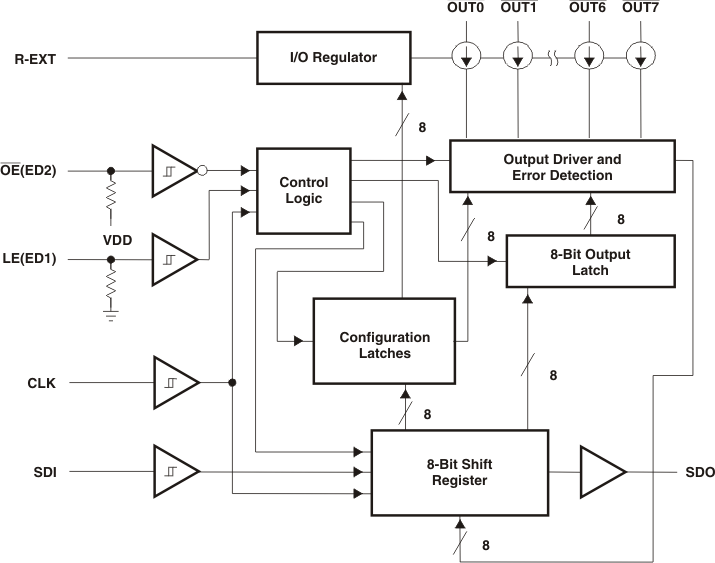
TLC5916-Q1Automotive 8-bit constant-current LED sink drivers | Integrated Circuits (ICs) | 8 | Active | The TLC591x-Q1 Constant-Current LED Sink Drivers is designed to work alone or cascaded. Because each output is independently controlled, they can be programmed to be on or off by the user. The high LED voltage (VLED) allows for the use of one LED per output or multiple LEDs on a single string. With independently controlled outputs supplied with constant current, the LEDs can be combined in parallel to create higher currents on a single string. The constant sink current for all channels is set through a single external resistor. This allows different LED drivers in the same application to sink various currents which provides optional implementation of multicolor LEDs. An additional advantage of the independent outputs is the ability to leave unused channels floating. The flexibility of the TLC591x-Q1 LED driver is ideal for applications such as (but not limited to): automotive LED lighting, 7-segment displays, scrolling single-color displays, gaming machines, white goods, video billboards, and video panels.
The TLC591x-Q1 Constant-Current LED Sink Drivers is designed to work alone or cascaded. Because each output is independently controlled, they can be programmed to be on or off by the user. The high LED voltage (VLED) allows for the use of one LED per output or multiple LEDs on a single string. With independently controlled outputs supplied with constant current, the LEDs can be combined in parallel to create higher currents on a single string. The constant sink current for all channels is set through a single external resistor. This allows different LED drivers in the same application to sink various currents which provides optional implementation of multicolor LEDs. An additional advantage of the independent outputs is the ability to leave unused channels floating. The flexibility of the TLC591x-Q1 LED driver is ideal for applications such as (but not limited to): automotive LED lighting, 7-segment displays, scrolling single-color displays, gaming machines, white goods, video billboards, and video panels. |
TLC5917-Q1Automotive 8-bit constant-current LED sink drivers with Vled Short detection | Power Management (PMIC) | 6 | Active | The TLC591x-Q1 Constant-Current LED Sink Drivers is designed to work alone or cascaded. Because each output is independently controlled, they can be programmed to be on or off by the user. The high LED voltage (VLED) allows for the use of one LED per output or multiple LEDs on a single string. With independently controlled outputs supplied with constant current, the LEDs can be combined in parallel to create higher currents on a single string. The constant sink current for all channels is set through a single external resistor. This allows different LED drivers in the same application to sink various currents which provides optional implementation of multicolor LEDs. An additional advantage of the independent outputs is the ability to leave unused channels floating. The flexibility of the TLC591x-Q1 LED driver is ideal for applications such as (but not limited to): automotive LED lighting, 7-segment displays, scrolling single-color displays, gaming machines, white goods, video billboards, and video panels.
The TLC591x-Q1 Constant-Current LED Sink Drivers is designed to work alone or cascaded. Because each output is independently controlled, they can be programmed to be on or off by the user. The high LED voltage (VLED) allows for the use of one LED per output or multiple LEDs on a single string. With independently controlled outputs supplied with constant current, the LEDs can be combined in parallel to create higher currents on a single string. The constant sink current for all channels is set through a single external resistor. This allows different LED drivers in the same application to sink various currents which provides optional implementation of multicolor LEDs. An additional advantage of the independent outputs is the ability to leave unused channels floating. The flexibility of the TLC591x-Q1 LED driver is ideal for applications such as (but not limited to): automotive LED lighting, 7-segment displays, scrolling single-color displays, gaming machines, white goods, video billboards, and video panels. |
| Development Boards, Kits, Programmers | 1 | Obsolete | |
TLC592016-channel LED driver with 10Mhz data transfer rate | Power Management (PMIC) | 2 | Active | The TLC5920 is an LED driver incorporating a 16-channel shift register, data latch, and constant current circuitry with current value control and 8-channel common driver into a single chip. The constant output current is capable of 30 mA for 16 bits simultaneously, and the current value can be set by one external register. This device also includes a 16-bit segment driver and 8-bit common driver; therefore, the monocolor LED array with 16 × 8 dots can be driven by only one TLC5920, and a two-color LED array with 16 x 16 dots can be driven by two TLC5920s.
The TLC5920 is an LED driver incorporating a 16-channel shift register, data latch, and constant current circuitry with current value control and 8-channel common driver into a single chip. The constant output current is capable of 30 mA for 16 bits simultaneously, and the current value can be set by one external register. This device also includes a 16-bit segment driver and 8-bit common driver; therefore, the monocolor LED array with 16 × 8 dots can be driven by only one TLC5920, and a two-color LED array with 16 x 16 dots can be driven by two TLC5920s. |
TLC59208F8-bit Fast-Mode Plus (FM+) I2C-Bus LED driver | Integrated Circuits (ICs) | 1 | Active | The TLC59208F is an I2C bus controlled 8-bit LED driver optimized for red/green/blue/amber (RGBA) color mixing applications. Each LED output has its own 8-bit resolution (256 steps) fixed frequency individual PWM controller that operates at 97 kHz with a duty cycle that is adjustable from 0% to 99.6% to allow the LED to be set to a specific brightness value.
An additional 8-bit resolution (256 steps) group PWM controller has both a fixed frequency of 190 Hz and an adjustable frequency between 24 Hz to once every 10.73 seconds with a duty cycle that is adjustable from 0% to 99.6% that is used to either dim or blink all LEDs with the same value.
Each LED output can be off, on (no PWM control), set at its individual PWM controller value or at both individual and group PWM controller values. The TLC59208F operates with a supply voltage range of 3 V to 5.5 V and the outputs are 17 V tolerant. LEDs can be directly connected to the TLC59208F device outputs.
Software programmable LED Group and three Sub Call I2C bus addresses allow all or defined groups of TLC59208F devices to respond to a common I2C bus address, allowing for example, all the same color LEDs to be turned on or off at the same time or marquee chasing effect, thus minimizing I2C bus commands.
Three hardware address pins allow up to 64 devices on the same bus.
The software reset (SWRST) Call allows the master to perform a reset of the TLC59208F through the I2C bus, identical to the power-on reset (POR) that initializes the registers to their default state causing the outputs to be set high (LED off). This allows an easy and quick way to reconfigure all device registers to the same condition.
The TLC59208F is an I2C bus controlled 8-bit LED driver optimized for red/green/blue/amber (RGBA) color mixing applications. Each LED output has its own 8-bit resolution (256 steps) fixed frequency individual PWM controller that operates at 97 kHz with a duty cycle that is adjustable from 0% to 99.6% to allow the LED to be set to a specific brightness value.
An additional 8-bit resolution (256 steps) group PWM controller has both a fixed frequency of 190 Hz and an adjustable frequency between 24 Hz to once every 10.73 seconds with a duty cycle that is adjustable from 0% to 99.6% that is used to either dim or blink all LEDs with the same value.
Each LED output can be off, on (no PWM control), set at its individual PWM controller value or at both individual and group PWM controller values. The TLC59208F operates with a supply voltage range of 3 V to 5.5 V and the outputs are 17 V tolerant. LEDs can be directly connected to the TLC59208F device outputs.
Software programmable LED Group and three Sub Call I2C bus addresses allow all or defined groups of TLC59208F devices to respond to a common I2C bus address, allowing for example, all the same color LEDs to be turned on or off at the same time or marquee chasing effect, thus minimizing I2C bus commands.
Three hardware address pins allow up to 64 devices on the same bus.
The software reset (SWRST) Call allows the master to perform a reset of the TLC59208F through the I2C bus, identical to the power-on reset (POR) that initializes the registers to their default state causing the outputs to be set high (LED off). This allows an easy and quick way to reconfigure all device registers to the same condition. |
TLC592116-channel LED driver with 20Mhz data transfer rate | LED Drivers | 2 | Active | The TLC5921 is a current-sink constant current driver incorporating shift register and data latch. The current value at constant current output can be set by one external register. The device also incorporates thermal shutdown (TSD) circuitry which turns constant current output off when the junction temperature exceeds the limit, and LED open detection (LOD) circuitry to report the LED was disconnected.
The TLC5921 is a current-sink constant current driver incorporating shift register and data latch. The current value at constant current output can be set by one external register. The device also incorporates thermal shutdown (TSD) circuitry which turns constant current output off when the junction temperature exceeds the limit, and LED open detection (LOD) circuitry to report the LED was disconnected. |
TLC592108-bit DMOS sink driver with Latch | Integrated Circuits (ICs) | 1 | Active | The TLC59210 is an 8-bit flip-flop driver for LED and solenoid with Schmitt-trigger buffers. Each channel can sink up to 200mA and support an output voltage up to 30V. The TLC59210 is designed for VCCand operation from 3.3V to 5.5V.
Each output channel is controlled by a positive-edge-triggered D-type flip-flops with a direct clear (CLR) input. Information at the data (D) input meeting the setup time requirements is transferred to the Y output on the positive-going edge of the clock (CLK) pulse. Clock triggering occurs at a particular voltage level and is not directly related to the transition time of the positive-going pulse. When CLK is at either the high or low level, the D input has no effect at the output.
The TLC59210 is characterized for operation from –40°C to 85°C.
The TLC59210 is an 8-bit flip-flop driver for LED and solenoid with Schmitt-trigger buffers. Each channel can sink up to 200mA and support an output voltage up to 30V. The TLC59210 is designed for VCCand operation from 3.3V to 5.5V.
Each output channel is controlled by a positive-edge-triggered D-type flip-flops with a direct clear (CLR) input. Information at the data (D) input meeting the setup time requirements is transferred to the Y output on the positive-going edge of the clock (CLK) pulse. Clock triggering occurs at a particular voltage level and is not directly related to the transition time of the positive-going pulse. When CLK is at either the high or low level, the D input has no effect at the output.
The TLC59210 is characterized for operation from –40°C to 85°C. |
| Power Management (PMIC) | 2 | Active | The TLC59211 is an 8-bit LED and solenoid driver designed for 5-V VCCoperation.
The TLC59211 is characterized for operation from –40°C to 85°C.
The TLC59211 is an 8-bit LED and solenoid driver designed for 5-V VCCoperation.
The TLC59211 is characterized for operation from –40°C to 85°C. |
TLC592128-bit open-collector driver with Latch | Logic | 2 | Active | The TLC59212 device is an 8-bit open-collector driver with latch designed for 5-V VCCoperation.
These circuits are positive-edge-triggered D-type flip-flops with a direct clear (CLR) input. Information at the data (D) input meeting the setup time requirements is transferred to theYoutput on the positive-going edge of the clock (CLK) pulse. Clock triggering occurs at a particular voltage level and is not directly related to the transition time of the positive-going pulse. When CLK is at either the high or low level, the D-input has no effect at the output.
The TLC59212 is characterized for operation from –40°C to 85°C.
The TLC59212 device is an 8-bit open-collector driver with latch designed for 5-V VCCoperation.
These circuits are positive-edge-triggered D-type flip-flops with a direct clear (CLR) input. Information at the data (D) input meeting the setup time requirements is transferred to theYoutput on the positive-going edge of the clock (CLK) pulse. Clock triggering occurs at a particular voltage level and is not directly related to the transition time of the positive-going pulse. When CLK is at either the high or low level, the D-input has no effect at the output.
The TLC59212 is characterized for operation from –40°C to 85°C. |