SN74AVC2T245Dual-Bit, 2-DIR pin Dual-Supply Bus Transceiver w/ Configurable Voltage Translation, 3-State Output | Logic | 1 | Active | This dual-bit noninverting bus transceiver uses two separate configurable power-supply rails. The A port is designed to track VCCA. VCCA accepts any supply voltage from 1.2V to 3.6V. The B port is designed to track VCCB. VCCB accepts any supply voltage from 1.2V to 3.6V. This allows for universal low-voltage bidirectional translation between any of the 1.2V, 1.5V, 1.8V, 2.5V, and 3.3V voltage nodes.
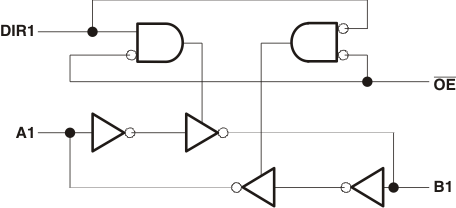
The SN74AVC2T245 is designed for asynchronous communication between two data buses. The logic levels of the direction-control (DIR) input and the output-enable ( OE) activate either the B-port outputs or the A-port outputs or place both output ports into the high-impedance mode . The device transmits data from the A bus to the B bus when the B-port outputs are activated and from the B bus to the A bus when the A-port outputs are activated. The input circuitry on both A and B ports always is active and must have a logic HIGH or LOW level applied to prevent excess ICC and ICCZ.
The SN74AVC2T245 control pins (DIR1, DIR2, and OE) are supplied by VCCA.
This device is fully specified for partial-power-down applications using Ioff. The Ioff circuitry disables the outputs, preventing damaging current backflow through the device when it is powered down.
The VCC isolation feature ensures that if either VCC input is at GND, both ports are in the high-impedance state.
To ensure the high-impedance state during power up or power down, OE must be connected to VCC through a pull-up resistor; the minimum value of the resistor is determined by the current-sinking capability of the driver.
This dual-bit noninverting bus transceiver uses two separate configurable power-supply rails. The A port is designed to track VCCA. VCCA accepts any supply voltage from 1.2V to 3.6V. The B port is designed to track VCCB. VCCB accepts any supply voltage from 1.2V to 3.6V. This allows for universal low-voltage bidirectional translation between any of the 1.2V, 1.5V, 1.8V, 2.5V, and 3.3V voltage nodes.
The SN74AVC2T245 is designed for asynchronous communication between two data buses. The logic levels of the direction-control (DIR) input and the output-enable ( OE) activate either the B-port outputs or the A-port outputs or place both output ports into the high-impedance mode . The device transmits data from the A bus to the B bus when the B-port outputs are activated and from the B bus to the A bus when the A-port outputs are activated. The input circuitry on both A and B ports always is active and must have a logic HIGH or LOW level applied to prevent excess ICC and ICCZ.
The SN74AVC2T245 control pins (DIR1, DIR2, and OE) are supplied by VCCA.
This device is fully specified for partial-power-down applications using Ioff. The Ioff circuitry disables the outputs, preventing damaging current backflow through the device when it is powered down.
The VCC isolation feature ensures that if either VCC input is at GND, both ports are in the high-impedance state.
To ensure the high-impedance state during power up or power down, OE must be connected to VCC through a pull-up resistor; the minimum value of the resistor is determined by the current-sinking capability of the driver. |
SN74AVC2T45Dual-bit dual-supply bus transceiver with configurable voltage translation and 3-state outputs | Translators, Level Shifters | 9 | Active | This 2-bit non-inverting bus transceiver uses two separate configurable power-supply rails. The A ports are designed to track VCCA and accepts any supply voltage from 1.2V to 3.6V. The B ports are designed to track VCCB and accepts any supply voltage from 1.2V to 3.6V. This allows for universal low-voltage bidirectional translation and level-shifting between any of the 1.2V, 1.5V, 1.8V, 2.5V, and 3.3V voltage nodes.
The SN74AVC2T45 is designed for asynchronous communication between two data buses. The logic levels of the direction-control (DIR pin) input activate either the B-port outputs or the A-port outputs. The device transmits data from the A bus to the B bus when the B-port outputs are activated and from the B bus to the A bus when the A-port outputs are activated. The input circuitry on both A and B ports always is active and must have a logic HIGH or LOW level applied to prevent excess leakage current on the internal CMOS structure.
This 2-bit non-inverting bus transceiver uses two separate configurable power-supply rails. The A ports are designed to track VCCA and accepts any supply voltage from 1.2V to 3.6V. The B ports are designed to track VCCB and accepts any supply voltage from 1.2V to 3.6V. This allows for universal low-voltage bidirectional translation and level-shifting between any of the 1.2V, 1.5V, 1.8V, 2.5V, and 3.3V voltage nodes.
The SN74AVC2T45 is designed for asynchronous communication between two data buses. The logic levels of the direction-control (DIR pin) input activate either the B-port outputs or the A-port outputs. The device transmits data from the A bus to the B bus when the B-port outputs are activated and from the B bus to the A bus when the A-port outputs are activated. The input circuitry on both A and B ports always is active and must have a logic HIGH or LOW level applied to prevent excess leakage current on the internal CMOS structure. |
SN74AVC2T45-Q1Automotive Dual-Bit Dual-Supply Bus Transceiver with Config Voltage Translation and 3-State | Integrated Circuits (ICs) | 1 | Active | This dual-bit noninverting bus transceiver uses two separate configurable power-supply rails. The A port is designed to track VCCA. VCCA accepts any supply voltage from 1.2V to 3.6V. The B port is designed to track VCCB. VCCB accepts any supply voltage from 1.2V to 3.6V. This allows for universal low-voltage bidirectional translation between any of the 1.2V, 1.5V, 1.8V, 2.5V, and 3.3V voltage nodes.
The SN74AVC2T45 is designed for asynchronous communication between two data buses. The logic levels of the direction-control (DIR) input activate either the B-port outputs or the A-port outputs. The device transmits data from the A bus to the B bus when the B-port outputs are activated and from the B bus to the A bus when the A-port outputs are activated. The input circuitry on both A and B ports always is active and must have a logic HIGH or LOW level applied to prevent excess ICC and ICCZ.
The SN74AVC2T45 is designed so that the DIR input is powered by VCCA.
This device is fully specified for partial-power-down applications using Ioff. The Ioff circuitry disables the outputs, preventing damaging current backflow through the device when powered down.
The VCC isolation feature makes sure that if either VCC input is at GND, both ports are in the high-impedance state.
This dual-bit noninverting bus transceiver uses two separate configurable power-supply rails. The A port is designed to track VCCA. VCCA accepts any supply voltage from 1.2V to 3.6V. The B port is designed to track VCCB. VCCB accepts any supply voltage from 1.2V to 3.6V. This allows for universal low-voltage bidirectional translation between any of the 1.2V, 1.5V, 1.8V, 2.5V, and 3.3V voltage nodes.
The SN74AVC2T45 is designed for asynchronous communication between two data buses. The logic levels of the direction-control (DIR) input activate either the B-port outputs or the A-port outputs. The device transmits data from the A bus to the B bus when the B-port outputs are activated and from the B bus to the A bus when the A-port outputs are activated. The input circuitry on both A and B ports always is active and must have a logic HIGH or LOW level applied to prevent excess ICC and ICCZ.
The SN74AVC2T45 is designed so that the DIR input is powered by VCCA.
This device is fully specified for partial-power-down applications using Ioff. The Ioff circuitry disables the outputs, preventing damaging current backflow through the device when powered down.
The VCC isolation feature makes sure that if either VCC input is at GND, both ports are in the high-impedance state. |
SN74AVC32T24532-Bit Dual-Supply Bus Transceiver with Configurable Voltage Translation and 3-State Outputs | Buffers, Drivers, Receivers, Transceivers | 5 | Active | This 32-bit noninverting bus transceiver uses two separate, configurable power-supply rails. The SN74AVC32T245 device is optimized to operate with VCCA/VCCBset from 1.4 V to 3.6 V. It is operational with VCCA/VCCBas low as 1.2 V. The A port is designed to track VCCA. VCCAand accepts any supply voltage from 1.2 V to 3.6 V. The B port is designed to track VCCB. VCCBand accepts any supply voltage from 1.2 V to 3.6 V. This allows for universal low-voltage bidirectional translation between any of the 1.2 V, 1.5 V, 1.8 V, 2.5 V, and 3.3 V voltage nodes.
The SN74AVC32T245 is designed for asynchronous communication between data buses. The device transmits data from the A bus to the B bus or from the B bus to the A bus, depending on the logic level at the direction-control (DIR) input. The output-enable (OE) input can disable the outputs so the buses are effectively isolated.
The SN74AVC32T245 is designed so that the control pins (1DIR, 2DIR, 3DIR, 4DIR, 1OE, 2OE, 3OE, and 4OE) are supplied by VCCA.
This device is fully specified for partial-power-down applications using Ioff. The Ioffcircuitry disables the outputs, preventing damaging current backflow through the device when it is powered down.
The VCCisolation feature ensures that if either VCCinput is at GND, then both ports are in the high-impedance state.
To ensure the high-impedance state during power up or power down,OEshould be tied to VCCthrough a pullup resistor; the minimum value of the resistor is determined by the current-sinking capability of the driver.
This 32-bit noninverting bus transceiver uses two separate, configurable power-supply rails. The SN74AVC32T245 device is optimized to operate with VCCA/VCCBset from 1.4 V to 3.6 V. It is operational with VCCA/VCCBas low as 1.2 V. The A port is designed to track VCCA. VCCAand accepts any supply voltage from 1.2 V to 3.6 V. The B port is designed to track VCCB. VCCBand accepts any supply voltage from 1.2 V to 3.6 V. This allows for universal low-voltage bidirectional translation between any of the 1.2 V, 1.5 V, 1.8 V, 2.5 V, and 3.3 V voltage nodes.
The SN74AVC32T245 is designed for asynchronous communication between data buses. The device transmits data from the A bus to the B bus or from the B bus to the A bus, depending on the logic level at the direction-control (DIR) input. The output-enable (OE) input can disable the outputs so the buses are effectively isolated.
The SN74AVC32T245 is designed so that the control pins (1DIR, 2DIR, 3DIR, 4DIR, 1OE, 2OE, 3OE, and 4OE) are supplied by VCCA.
This device is fully specified for partial-power-down applications using Ioff. The Ioffcircuitry disables the outputs, preventing damaging current backflow through the device when it is powered down.
The VCCisolation feature ensures that if either VCCinput is at GND, then both ports are in the high-impedance state.
To ensure the high-impedance state during power up or power down,OEshould be tied to VCCthrough a pullup resistor; the minimum value of the resistor is determined by the current-sinking capability of the driver. |
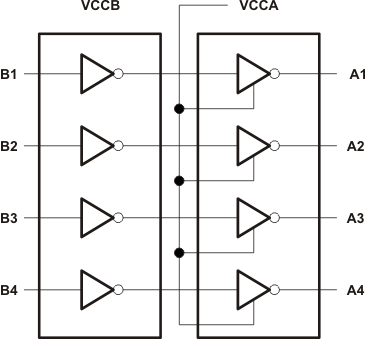
SN74AVC4T2344-bit dual-supply bus transceiver with config voltage translation | Integrated Circuits (ICs) | 2 | Active | This 4-bit non-inverting bus transceiver uses two separate configurable power-supply rails to enable asynchronous communication between B-port inputs and A-port outputs. The A port is designed to track VCCAwhile the B port is designed to track VCCB. Both VCCAand VCCBare configurable from 0.9 V to 3.6 V.
The SN74AVC4T234 solution offers the industry’s low-power needs in battery-powered portable applications by ensuring both a very low static and dynamic power consumption across the entire VCCrange of 0.9 V to 3.6 V, resulting in an increased battery life. This product also maintains excellent signal integrity.
This device is fully specified for partial-power-down applications using Ioff. The Ioffcircuitry disables the outputs, preventing damaging current backflow through the device when it is powered down.
The VCCisolation feature ensures that if either VCCinput is at GND, then A-side ports are in the high-impedance state.
This 4-bit non-inverting bus transceiver uses two separate configurable power-supply rails to enable asynchronous communication between B-port inputs and A-port outputs. The A port is designed to track VCCAwhile the B port is designed to track VCCB. Both VCCAand VCCBare configurable from 0.9 V to 3.6 V.
The SN74AVC4T234 solution offers the industry’s low-power needs in battery-powered portable applications by ensuring both a very low static and dynamic power consumption across the entire VCCrange of 0.9 V to 3.6 V, resulting in an increased battery life. This product also maintains excellent signal integrity.
This device is fully specified for partial-power-down applications using Ioff. The Ioffcircuitry disables the outputs, preventing damaging current backflow through the device when it is powered down.
The VCCisolation feature ensures that if either VCCinput is at GND, then A-side ports are in the high-impedance state. |
SN74AVC4T245Four-bit dual-supply bus transceiver with configurable voltage-level shifting | Buffers, Drivers, Receivers, Transceivers | 11 | Active | This 4-bit noninverting bus transceiver uses two separate configurable power-supply rails. The A port is designed to track VCCA. VCCA accepts any supply voltage from 1.2V to 3.6V. The B port is designed to track VCCB. VCCB accepts any supply voltage from 1.2V to 3.6V. The SN74AVC4T245 is optimized to operate with VCCA/VCCB set at 1.4V to 3.6V. It is operational with VCCA/VCCB as low as 1.2V. This allows for universal low-voltage bidirectional translation between any of the 1.2V, 1.5V, 1.8V, 2.5V, and 3.3V voltage nodes.
The SN74AVC4T245 device is designed for asynchronous communication between two data buses. The logic levels of the direction-control (DIR) input and the output-enable (OE) input activate either the B-port outputs or the A-port outputs or place both output ports into the high-impedance mode. The device transmits data from the A bus to the B bus when the B-port outputs are activated, and from the B bus to the A bus when the A-port outputs are activated. The input circuitry on both A and B ports is always active and must have a logic HIGH or LOW level applied to prevent excess ICC and ICCZ.
The SN74AVC4T245 device is designed so that VCCA supplies the control pins (1DIR, 2DIR, 1 OE, and 2 OE).
This device is fully specified for partial-power-down applications using Ioff. The Ioff circuitry disables the outputs, preventing damaging current backflow through the device when it is powered down.
The VCC isolation feature is designed so that if either VCC input is at GND, then both ports are in the high-impedance state.
To put the device in the high-impedance state during power up or power down, tie OE to VCC through a pullup resistor; the current-sinking capability of the driver determines the minimum value of the resistor.
This 4-bit noninverting bus transceiver uses two separate configurable power-supply rails. The A port is designed to track VCCA. VCCA accepts any supply voltage from 1.2V to 3.6V. The B port is designed to track VCCB. VCCB accepts any supply voltage from 1.2V to 3.6V. The SN74AVC4T245 is optimized to operate with VCCA/VCCB set at 1.4V to 3.6V. It is operational with VCCA/VCCB as low as 1.2V. This allows for universal low-voltage bidirectional translation between any of the 1.2V, 1.5V, 1.8V, 2.5V, and 3.3V voltage nodes.
The SN74AVC4T245 device is designed for asynchronous communication between two data buses. The logic levels of the direction-control (DIR) input and the output-enable (OE) input activate either the B-port outputs or the A-port outputs or place both output ports into the high-impedance mode. The device transmits data from the A bus to the B bus when the B-port outputs are activated, and from the B bus to the A bus when the A-port outputs are activated. The input circuitry on both A and B ports is always active and must have a logic HIGH or LOW level applied to prevent excess ICC and ICCZ.
The SN74AVC4T245 device is designed so that VCCA supplies the control pins (1DIR, 2DIR, 1 OE, and 2 OE).
This device is fully specified for partial-power-down applications using Ioff. The Ioff circuitry disables the outputs, preventing damaging current backflow through the device when it is powered down.
The VCC isolation feature is designed so that if either VCC input is at GND, then both ports are in the high-impedance state.
To put the device in the high-impedance state during power up or power down, tie OE to VCC through a pullup resistor; the current-sinking capability of the driver determines the minimum value of the resistor. |
SN74AVC4T774Four-bit dual-supply bus transceiver with configurable voltage-level shifting and tri-state outputs | Logic | 5 | Active | This 4-bit noninverting bus transceiver uses two separate configurable power-supply rails. The A port is designed to track VCCA. VCCA accepts any supply voltage from 1.1V to 3.6V. The B port is designed to track VCCB. VCCB accepts any supply voltage from 1.1 to 3.6V. The SN74AVC4T774 is optimized to operate with VCCA/VCCB set at 1.4V to 3.6V. It is operational with VCCA/VCCB as low as 1.2V. This allows for universal low-voltage bi-directional translation between any of the 1.2V, 1.5V, 1.8V, 2.5V, and 3.3V voltage nodes.
The SN74AVC4T774 is designed for asynchronous communication between data buses. The logic levels of the direction-control (DIR) input and the output-enable (OE) input activate either the B-port outputs or the A-port outputs or place both output ports in the high-impedance mode. The device transmits data from the A bus to the B bus when the B outputs are activated, and from the B bus to the A bus when the A outputs are activated. The input circuitry on both A and B ports is always active and must have a logic HIGH or LOW level applied to prevent excess ICC and ICCZ.
The SN74AVC4T774 is designed so that the control pins (DIR1, DIR2, DIR3, DIR4, and OE) are supplied by VCCA. This device is fully specified for partial-power-down applications using Ioff. The Ioff circuitry disables the outputs, preventing damaging current backflow through the device when it is powered down. The VCC isolation feature ensures that if either VCC input is at GND, then both ports are in the high-impedance state.
For a high-impedance state during power-up or power-down, OE should be tied to VCCA through a pullup resistor; the minimum value of the resistor is determined by the current-sinking capability of the driver. Since this device has CMOS inputs, it is very important to not allow them to float. If the inputs are not driven to either a high VCC state, or a low-GND state, an undesirable larger than expected ICC current may result. Since the input voltage settlement is governed by many factors (for example, capacitance, board-layout, package inductance, surrounding conditions, and so forth), ensuring that they these inputs are kept out of erroneous switching states and tying them to either a high or a low level minimizes the leakage-current.
This 4-bit noninverting bus transceiver uses two separate configurable power-supply rails. The A port is designed to track VCCA. VCCA accepts any supply voltage from 1.1V to 3.6V. The B port is designed to track VCCB. VCCB accepts any supply voltage from 1.1 to 3.6V. The SN74AVC4T774 is optimized to operate with VCCA/VCCB set at 1.4V to 3.6V. It is operational with VCCA/VCCB as low as 1.2V. This allows for universal low-voltage bi-directional translation between any of the 1.2V, 1.5V, 1.8V, 2.5V, and 3.3V voltage nodes.
The SN74AVC4T774 is designed for asynchronous communication between data buses. The logic levels of the direction-control (DIR) input and the output-enable (OE) input activate either the B-port outputs or the A-port outputs or place both output ports in the high-impedance mode. The device transmits data from the A bus to the B bus when the B outputs are activated, and from the B bus to the A bus when the A outputs are activated. The input circuitry on both A and B ports is always active and must have a logic HIGH or LOW level applied to prevent excess ICC and ICCZ.
The SN74AVC4T774 is designed so that the control pins (DIR1, DIR2, DIR3, DIR4, and OE) are supplied by VCCA. This device is fully specified for partial-power-down applications using Ioff. The Ioff circuitry disables the outputs, preventing damaging current backflow through the device when it is powered down. The VCC isolation feature ensures that if either VCC input is at GND, then both ports are in the high-impedance state.
For a high-impedance state during power-up or power-down, OE should be tied to VCCA through a pullup resistor; the minimum value of the resistor is determined by the current-sinking capability of the driver. Since this device has CMOS inputs, it is very important to not allow them to float. If the inputs are not driven to either a high VCC state, or a low-GND state, an undesirable larger than expected ICC current may result. Since the input voltage settlement is governed by many factors (for example, capacitance, board-layout, package inductance, surrounding conditions, and so forth), ensuring that they these inputs are kept out of erroneous switching states and tying them to either a high or a low level minimizes the leakage-current. |
SN74AVC6T622Audio Codec AC'97 Voltage-Translation Transceiver | Integrated Circuits (ICs) | 3 | Active | The SN74AVC6T622 is a voltage-level transceiver for interfacing 1.8 V audio codec (AC’97) controllers, the audio/analog modem functionality found in personal computers, with 3.3V AC’97 codec links. With the digital switching levels of today’s AC’97 codecs lowering to 1.8-V logic levels, the SN74AVC6T622 device can be used to bridge the gap between legacy 3.3-V AC’97 codecs and AC’97 controllers that are now operating at 1.8 V. The 6-bit wide SN74AVC6T622 device complies with the AC’97 electrical interface (both levels and timing) specification.
Two supply-voltage pins allow the A-port and B-port input switching thresholds to be configured separately. The A port is designed to track VCCA, while the B port is designed to track VCCB. VCCAand VCCBcan accept any supply voltage from 1.2 V to 3.6 V.
If either VCCis switched off (VCCA= 0 V and/or VCCB= 0 V), all outputs are placed in the high-impedance state to conserve power.
The SN74AVC6T622 is available in two 0.5-mm-pitch ball grid array (BGA) packages. The 20-ball package has dimensions of 3 mm × 2.5 mm, and the 24-ball package measures 3 mm × 3 mm. Memory cards are widely used in mobile phones, PDAs, digital cameras, personal media players, camcorders, set-top boxes, etc. Low static power consumption and small package size make the SN74AVC6T622 an ideal choice for these applications.
The SN74AVC6T622 is a voltage-level transceiver for interfacing 1.8 V audio codec (AC’97) controllers, the audio/analog modem functionality found in personal computers, with 3.3V AC’97 codec links. With the digital switching levels of today’s AC’97 codecs lowering to 1.8-V logic levels, the SN74AVC6T622 device can be used to bridge the gap between legacy 3.3-V AC’97 codecs and AC’97 controllers that are now operating at 1.8 V. The 6-bit wide SN74AVC6T622 device complies with the AC’97 electrical interface (both levels and timing) specification.
Two supply-voltage pins allow the A-port and B-port input switching thresholds to be configured separately. The A port is designed to track VCCA, while the B port is designed to track VCCB. VCCAand VCCBcan accept any supply voltage from 1.2 V to 3.6 V.
If either VCCis switched off (VCCA= 0 V and/or VCCB= 0 V), all outputs are placed in the high-impedance state to conserve power.
The SN74AVC6T622 is available in two 0.5-mm-pitch ball grid array (BGA) packages. The 20-ball package has dimensions of 3 mm × 2.5 mm, and the 24-ball package measures 3 mm × 3 mm. Memory cards are widely used in mobile phones, PDAs, digital cameras, personal media players, camcorders, set-top boxes, etc. Low static power consumption and small package size make the SN74AVC6T622 an ideal choice for these applications. |
SN74AVC8T245-Q1Automotive Catalog 8-Bit Dual-Supply Bus Transceiver w/ Configurable Voltage Transl., 3-State Output | Integrated Circuits (ICs) | 8 | Active | This 8-bit noninverting bus transceiver uses two separate configurable power-supply rails. The SN74AVC8T245 is optimized to operate with V CCA/V CCB set at 1.4 V to 3.6 V. The device is operational with V CCA and V CCB as low as 1.2 V. The A port is designed to track V CCA. V CCA accepts any supply voltage from 1.2 V to 3.6 V. The B port is designed to track V CCB. V CCB accepts any supply voltage from 1.2 V to 3.6 V. This allows for universal low-voltage bidirectional translation between any of the 1.2-V, 1.5-V, 1.8-V, 2.5-V, and 3.3-V voltage nodes.
The SN74AVC8T245 is designed for asynchronous communication between data buses. The device transmits data from the A bus to the B bus or from the B bus to the A bus, depending on the logic level at the direction-control (DIR) input. The output-enable ( OE) input can be used to disable the outputs so the buses are effectively isolated.
The SN74AVC8T245 is designed so that the control pins (DIR and OE) are supplied by V CCA.
The SN74AVC8T245 is compatible with a single-supply system and can be replaced later with a ’245 function, with minimal printed circuit board redesign.
This device is fully specified for partial-power-down applications using I off. The I off circuitry disables the outputs, thus preventing damaging current backflow through the device when it is powered down.
The V CC isolation feature allows both ports to be in the high-impedance state when either V CC input is at GND.
To put the device into the high-impedance state during power up or power down, tie OE to V CC through a pullup resistor; the current-sinking capability of the driver determines the minimum value of the resistor.
This 8-bit noninverting bus transceiver uses two separate configurable power-supply rails. The SN74AVC8T245 is optimized to operate with V CCA/V CCB set at 1.4 V to 3.6 V. The device is operational with V CCA and V CCB as low as 1.2 V. The A port is designed to track V CCA. V CCA accepts any supply voltage from 1.2 V to 3.6 V. The B port is designed to track V CCB. V CCB accepts any supply voltage from 1.2 V to 3.6 V. This allows for universal low-voltage bidirectional translation between any of the 1.2-V, 1.5-V, 1.8-V, 2.5-V, and 3.3-V voltage nodes.
The SN74AVC8T245 is designed for asynchronous communication between data buses. The device transmits data from the A bus to the B bus or from the B bus to the A bus, depending on the logic level at the direction-control (DIR) input. The output-enable ( OE) input can be used to disable the outputs so the buses are effectively isolated.
The SN74AVC8T245 is designed so that the control pins (DIR and OE) are supplied by V CCA.
The SN74AVC8T245 is compatible with a single-supply system and can be replaced later with a ’245 function, with minimal printed circuit board redesign.
This device is fully specified for partial-power-down applications using I off. The I off circuitry disables the outputs, thus preventing damaging current backflow through the device when it is powered down.
The V CC isolation feature allows both ports to be in the high-impedance state when either V CC input is at GND.
To put the device into the high-impedance state during power up or power down, tie OE to V CC through a pullup resistor; the current-sinking capability of the driver determines the minimum value of the resistor. |
SN74AVCA16424516-Bit Dual-Supply Bus Transceive W/Configurable Voltage Translation and 3-State | Translators, Level Shifters | 6 | Active | This 16-bit (dual-octal) noninverting bus transceiver uses two separate configurable power-supply rails. The A-port is designed to track VCCA. VCCAaccepts any supply voltage from 1.4 V to 3.6 V. The B-port is designed to track VCCB. VCCBaccepts any supply voltage from 1.4 V to 3.6 V. This allows for universal low-voltage bidirectional translation between any of the 1.5-V, 1.8-V, 2.5-V, and 3.3-V voltage nodes.
The SN74AVCA164245 is designed for asynchronous communication between data buses. The device transmits data from the A bus to the B bus or from the B bus to the A bus, depending on the logic level at the direction-control (DIR) input. The output-enable (OE)\ input can be used to disable the outputs so the buses are effectively isolated.
The SN74AVCA164245 is designed so that the control pins (1DIR, 2DIR, 1OE\, and 2OE\) are supplied by VCCA.
To ensure the high-impedance state during power up or power down, OE\ should be tied to VCCAthrough a pullup resistor; the minimum value of the resistor is determined by the current-sinking capability of the driver.
This device is fully specified for partial-power-down applications using Ioff. The Ioffcircuitry disables the outputs, preventing damaging current backflow through the device when it is powered down. If either VCCinput is at GND, then both ports are in the high-impedance state.
This 16-bit (dual-octal) noninverting bus transceiver uses two separate configurable power-supply rails. The A-port is designed to track VCCA. VCCAaccepts any supply voltage from 1.4 V to 3.6 V. The B-port is designed to track VCCB. VCCBaccepts any supply voltage from 1.4 V to 3.6 V. This allows for universal low-voltage bidirectional translation between any of the 1.5-V, 1.8-V, 2.5-V, and 3.3-V voltage nodes.
The SN74AVCA164245 is designed for asynchronous communication between data buses. The device transmits data from the A bus to the B bus or from the B bus to the A bus, depending on the logic level at the direction-control (DIR) input. The output-enable (OE)\ input can be used to disable the outputs so the buses are effectively isolated.
The SN74AVCA164245 is designed so that the control pins (1DIR, 2DIR, 1OE\, and 2OE\) are supplied by VCCA.
To ensure the high-impedance state during power up or power down, OE\ should be tied to VCCAthrough a pullup resistor; the minimum value of the resistor is determined by the current-sinking capability of the driver.
This device is fully specified for partial-power-down applications using Ioff. The Ioffcircuitry disables the outputs, preventing damaging current backflow through the device when it is powered down. If either VCCinput is at GND, then both ports are in the high-impedance state. |