| Integrated Circuits (ICs) | 1 | Active | This 16-bit universal bus driver is designed for 1.65-V to 3.6-V VCCoperation.
Data flow from A to Y is controlled by the output-enable (OE\) input. The device operates in the transparent mode when the latch-enable (LE\) input is low. When LE\ is high, the A data is latched if the clock (CLK) input is held at a high or low logic level. If LE\ is high, the A data is stored in the latch/flip-flop on the low-to-high transition of CLK. When OE\ is high, the outputs are in the high-impedance state.
To ensure the high-impedance state during power up or power down, OE\ should be tied to VCCthrough a pullup resistor; the minimum value of the resistor is determined by the current-sinking capability of the driver.
This 16-bit universal bus driver is designed for 1.65-V to 3.6-V VCCoperation.
Data flow from A to Y is controlled by the output-enable (OE\) input. The device operates in the transparent mode when the latch-enable (LE\) input is low. When LE\ is high, the A data is latched if the clock (CLK) input is held at a high or low logic level. If LE\ is high, the A data is stored in the latch/flip-flop on the low-to-high transition of CLK. When OE\ is high, the outputs are in the high-impedance state.
To ensure the high-impedance state during power up or power down, OE\ should be tied to VCCthrough a pullup resistor; the minimum value of the resistor is determined by the current-sinking capability of the driver. |
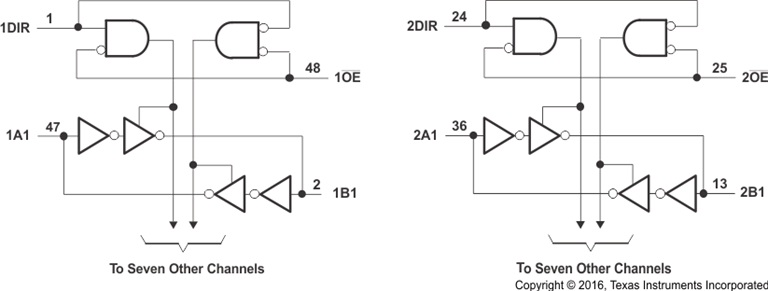
SN74ALVC16424516-Bit 2.5-V to 3.3-V/3.3-V To 5-V Level Shifting Transceiver With 3-State Outputs | Logic | 10 | Active | This 16-bit (dual-octal) noninverting bus transceiver contains two separate supply rails. B port has VCCB, which is set to operate at 3.3 V and 5 V. A port has VCCA, which is set to operate at 2.5 V and 3.3 V. This allows for translation from a 2.5-V to a 3.3-V environment, and vice versa, or from a 3.3-V to a 5-V environment, and vice versa.
The SN74ALVC164245 is designed for asynchronous communication between data buses. The control circuitry (1DIR, 2DIR, 1OE, and 2OE) is powered by VCCA.
To ensure the high-impedance state during power up or power down, the output-enable (OE) input should be tied to VCCthrough a pullup resistor; the minimum value of the resistor is determined by the current-sinking capability of the driver.
The logic levels of the direction-control (DIR) input and the output-enable (OE) input activate either the B-port outputs or the A-port outputs or place both output ports into the high-impedance mode. The device transmits data from the A bus to the B bus when the B-port outputs are activated, and from the B bus to the A bus when the A-port outputs are activated. The input circuitry on both A and B ports always is active and must have a logic HIGH or LOW level applied to prevent excess ICCand ICCZ.
This 16-bit (dual-octal) noninverting bus transceiver contains two separate supply rails. B port has VCCB, which is set to operate at 3.3 V and 5 V. A port has VCCA, which is set to operate at 2.5 V and 3.3 V. This allows for translation from a 2.5-V to a 3.3-V environment, and vice versa, or from a 3.3-V to a 5-V environment, and vice versa.
The SN74ALVC164245 is designed for asynchronous communication between data buses. The control circuitry (1DIR, 2DIR, 1OE, and 2OE) is powered by VCCA.
To ensure the high-impedance state during power up or power down, the output-enable (OE) input should be tied to VCCthrough a pullup resistor; the minimum value of the resistor is determined by the current-sinking capability of the driver.
The logic levels of the direction-control (DIR) input and the output-enable (OE) input activate either the B-port outputs or the A-port outputs or place both output ports into the high-impedance mode. The device transmits data from the A bus to the B bus when the B-port outputs are activated, and from the B bus to the A bus when the A-port outputs are activated. The input circuitry on both A and B ports always is active and must have a logic HIGH or LOW level applied to prevent excess ICCand ICCZ. |
SN74ALVC164245-EPEnhanced Product 16-Bit 2.5-V To 3.3-V/3.3-V To 5-V Level Shifting Transceiver, 3-State | Integrated Circuits (ICs) | 5 | Active | This 16-bit (dual-octal) noninverting bus transceiver contains two separate supply rails. B port has VCCB, which is set to operate at 3.3 V and 5 V. A port has VCCA, which is set to operate at 2.5 V and 3.3 V. This allows for translation from a 2.5-V to a 3.3-V environment, and vice versa, or from a 3.3-V to a 5-V environment, and vice versa.
The SN74ALVC164245 is designed for asynchronous communication between data buses. The control circuitry (1DIR, 2DIR, 1OE, and 2OE) is powered by VCCA.
To ensure the high-impedance state during power up or power down, the output-enable (OE) input should be tied to VCCthrough a pullup resistor; the minimum value of the resistor is determined by the current-sinking capability of the driver.
This 16-bit (dual-octal) noninverting bus transceiver contains two separate supply rails. B port has VCCB, which is set to operate at 3.3 V and 5 V. A port has VCCA, which is set to operate at 2.5 V and 3.3 V. This allows for translation from a 2.5-V to a 3.3-V environment, and vice versa, or from a 3.3-V to a 5-V environment, and vice versa.
The SN74ALVC164245 is designed for asynchronous communication between data buses. The control circuitry (1DIR, 2DIR, 1OE, and 2OE) is powered by VCCA.
To ensure the high-impedance state during power up or power down, the output-enable (OE) input should be tied to VCCthrough a pullup resistor; the minimum value of the resistor is determined by the current-sinking capability of the driver. |
| Integrated Circuits (ICs) | 4 | Active | This 18-bit universal bus driver is designed for 1.65-V to 3.6-V VCCoperation.
Data flow from A to Y is controlled by the output-enable (OE)\ input. The device operates in the transparent mode when the latch-enable (LE) input is high. The A data is latched if the clock (CLK) input is held at a high or low logic level. If LE is low, the A data is stored in the latch/flip-flop on the low-to-high transition of CLK. When OE\ is high, the outputs are in the high-impedance state.
To ensure the high-impedance state during power up or power down, OE\ should be tied to VCCthrough a pullup resistor; the minimum value of the resistor is determined by the current-sinking capability of the driver.
This 18-bit universal bus driver is designed for 1.65-V to 3.6-V VCCoperation.
Data flow from A to Y is controlled by the output-enable (OE)\ input. The device operates in the transparent mode when the latch-enable (LE) input is high. The A data is latched if the clock (CLK) input is held at a high or low logic level. If LE is low, the A data is stored in the latch/flip-flop on the low-to-high transition of CLK. When OE\ is high, the outputs are in the high-impedance state.
To ensure the high-impedance state during power up or power down, OE\ should be tied to VCCthrough a pullup resistor; the minimum value of the resistor is determined by the current-sinking capability of the driver. |
SN74ALVC244-EPEnhanced product 8-ch, 1.65-V to 3.6-V buffers with bus-hold and 3-state outputs | Integrated Circuits (ICs) | 11 | Active | This octal buffer/line driver is designed for 1.65-V to 3.6-V VCCoperation.
The SN74ALVC244 is organized as two 4-bit line drivers with separate output-enable (OE)\ inputs. When OE\ is low, the device passes data from the A inputs to the Y outputs. When OE\ is high, the outputs are in the high-impedance state.
To ensure the high-impedance state during power up or power down, OE\ should be tied to VCCthrough a pullup resistor; the minimum value of the resistor is determined by the current-sinking capability of the driver.
This octal buffer/line driver is designed for 1.65-V to 3.6-V VCCoperation.
The SN74ALVC244 is organized as two 4-bit line drivers with separate output-enable (OE)\ inputs. When OE\ is low, the device passes data from the A inputs to the Y outputs. When OE\ is high, the outputs are in the high-impedance state.
To ensure the high-impedance state during power up or power down, OE\ should be tied to VCCthrough a pullup resistor; the minimum value of the resistor is determined by the current-sinking capability of the driver. |
| Logic | 10 | Active | This octal bus transceiver is designed for 1.65-V to 3.6-V VCCoperation.
The SN74ALVC245 is designed for asynchronous communication between data buses. The device transmits data from the A bus to the B bus or from the B bus to the A bus, depending on the logic level at the direction-control (DIR) input. The output-enable (OE)\ input can be used to disable the device so the buses are effectively isolated.
To ensure the high-impedance state during power up or power down, OE\ should be tied to VCCthrough a pullup resistor; the minimum value of the resistor is determined by the current-sinking capability of the driver.
This octal bus transceiver is designed for 1.65-V to 3.6-V VCCoperation.
The SN74ALVC245 is designed for asynchronous communication between data buses. The device transmits data from the A bus to the B bus or from the B bus to the A bus, depending on the logic level at the direction-control (DIR) input. The output-enable (OE)\ input can be used to disable the device so the buses are effectively isolated.
To ensure the high-impedance state during power up or power down, OE\ should be tied to VCCthrough a pullup resistor; the minimum value of the resistor is determined by the current-sinking capability of the driver. |
SN74ALVC324-ch, 2-input 1.65-V to 3.6-V ultra-high-speed (3 ns) OR gate | Logic | 6 | Active | This quadruple 2-input positive-OR gate is designed for 1.65-V to 3.6-V VCCoperation.
The SN74ALVC32 performs the Boolean function Y = (A\ • B\)\ OR Y = A + B in positive logic.
This quadruple 2-input positive-OR gate is designed for 1.65-V to 3.6-V VCCoperation.
The SN74ALVC32 performs the Boolean function Y = (A\ • B\)\ OR Y = A + B in positive logic. |
| Logic | 4 | Active | A FIFO memory is a storage device that allows data to be written into and read from its array at independent data rates. The SN74ALVC7804 is an 18-bit FIFO with high speed and fast access times. Data is processed at rates up to 40 MHz with access times of 18 ns in a bit-parallel format. The SN74ALVC7804 is designed for 3-V to 3.6-V VCCoperation.
Data is written into memory on a low-to-high transition of the load clock (LDCK) and is read out on a low-to-high transition of the unload clock (UNCK). The memory is full when the number of words clocked in exceeds the number of words clocked out by 512. When the memory is full, LDCK has no effect on the data residing in memory. When the memory is empty, UNCK has no effect.
Status of the FIFO memory is monitored by the full (), empty (), half-full (HF), and almost- full/almost-empty (AF/AE) flags. Theoutput is low when the memory is full and high when the memory is not full. Theoutput is low when the memory is empty and high when it is not empty. The HF output is high whenever the FIFO contains 256 or more words and is low when it contains 255 or less words. The AF/AE status flag is a programmable flag. The first one or two low-to-high transitions of LDCK after reset are used to program the almost-empty offset value (X) and the almost-full offset value (Y), if program enable () is low. The AF/AE flag is high when the FIFO contains X or less words or (512 minus Y) or more words. The AF/AE flag is low when the FIFO contains between (X plus 1) and (511 minus Y) words.
A low level on the reset () resets the internal stack pointers and setshigh, AF/AE high, HF low, andlow. The Q outputs are not reset to any specific logic level. The FIFO must be reset upon power up. The first word loaded into empty memory causesto go high and the data to appear on the Q outputs. The data outputs are in the high-impedance state when the output-enable () is high.
A FIFO memory is a storage device that allows data to be written into and read from its array at independent data rates. The SN74ALVC7804 is an 18-bit FIFO with high speed and fast access times. Data is processed at rates up to 40 MHz with access times of 18 ns in a bit-parallel format. The SN74ALVC7804 is designed for 3-V to 3.6-V VCCoperation.
Data is written into memory on a low-to-high transition of the load clock (LDCK) and is read out on a low-to-high transition of the unload clock (UNCK). The memory is full when the number of words clocked in exceeds the number of words clocked out by 512. When the memory is full, LDCK has no effect on the data residing in memory. When the memory is empty, UNCK has no effect.
Status of the FIFO memory is monitored by the full (), empty (), half-full (HF), and almost- full/almost-empty (AF/AE) flags. Theoutput is low when the memory is full and high when the memory is not full. Theoutput is low when the memory is empty and high when it is not empty. The HF output is high whenever the FIFO contains 256 or more words and is low when it contains 255 or less words. The AF/AE status flag is a programmable flag. The first one or two low-to-high transitions of LDCK after reset are used to program the almost-empty offset value (X) and the almost-full offset value (Y), if program enable () is low. The AF/AE flag is high when the FIFO contains X or less words or (512 minus Y) or more words. The AF/AE flag is low when the FIFO contains between (X plus 1) and (511 minus Y) words.
A low level on the reset () resets the internal stack pointers and setshigh, AF/AE high, HF low, andlow. The Q outputs are not reset to any specific logic level. The FIFO must be reset upon power up. The first word loaded into empty memory causesto go high and the data to appear on the Q outputs. The data outputs are in the high-impedance state when the output-enable () is high. |
| Logic | 2 | Active | A FIFO memory is a storage device that allows data to be written into and read from its array at independent data rates. The SN74ALVC7806 is an 18-bit FIFO with high speed and fast access times. Data is processed at rates up to 40 MHz with access times of 18 ns in a bit-parallel format. These memories are designed for 3-V to 3.6-V VCCoperation.
Data is written into memory on a low-to-high transition of the load clock (LDCK) and is read out on a low-to-high transition of the unload clock
(UNCK). The memory is full when the number of words clocked in exceeds the number of words clocked out by 256. When the memory is full, LDCK has no effect on the data residing in memory. When the memory is empty, UNCK has no effect.
Status of the FIFO memory is monitored by the full (FULL\), empty (EMPTY\), half-full (HF), and almost- full/almost-empty (AF/AE) flags. The FULL\ output is low when the memory is full and high when the memory is not full. The EMPTY\ output is low when the memory is empty and high when it is not empty. The HF output is high whenever the FIFO contains 128 or more words and low when it contains 127 or fewer words. The AF/AE status flag is a programmable flag. The first one or two low-to-high transitions of LDCK after reset are used to program the almost-empty offset value (X) and the almost-full offset value (Y) if program enable (PEN\) is low. The AF/AE flag is high when the FIFO contains X or fewer words or (256 - Y) or more words. The AF/AE flag is low when the FIFO contains between (X + 1) and (255 - Y) words.
A low level on the reset (RESET\) resets the internal stack pointers and sets FULL\ high, AF/AE high, HF low, and EMPTY\ low. The Q outputs are not reset to any specific logic level. The FIFO must be reset on power up. The first word loaded into empty memory causes EMPTY\ to go high and the data to appear on the Q outputs. The data outputs are in the high-impedance state when the output-enable (OE\) is high.
The SN74ALVC7806 is characterized for operation from 0°C to 70°C.
A FIFO memory is a storage device that allows data to be written into and read from its array at independent data rates. The SN74ALVC7806 is an 18-bit FIFO with high speed and fast access times. Data is processed at rates up to 40 MHz with access times of 18 ns in a bit-parallel format. These memories are designed for 3-V to 3.6-V VCCoperation.
Data is written into memory on a low-to-high transition of the load clock (LDCK) and is read out on a low-to-high transition of the unload clock
(UNCK). The memory is full when the number of words clocked in exceeds the number of words clocked out by 256. When the memory is full, LDCK has no effect on the data residing in memory. When the memory is empty, UNCK has no effect.
Status of the FIFO memory is monitored by the full (FULL\), empty (EMPTY\), half-full (HF), and almost- full/almost-empty (AF/AE) flags. The FULL\ output is low when the memory is full and high when the memory is not full. The EMPTY\ output is low when the memory is empty and high when it is not empty. The HF output is high whenever the FIFO contains 128 or more words and low when it contains 127 or fewer words. The AF/AE status flag is a programmable flag. The first one or two low-to-high transitions of LDCK after reset are used to program the almost-empty offset value (X) and the almost-full offset value (Y) if program enable (PEN\) is low. The AF/AE flag is high when the FIFO contains X or fewer words or (256 - Y) or more words. The AF/AE flag is low when the FIFO contains between (X + 1) and (255 - Y) words.
A low level on the reset (RESET\) resets the internal stack pointers and sets FULL\ high, AF/AE high, HF low, and EMPTY\ low. The Q outputs are not reset to any specific logic level. The FIFO must be reset on power up. The first word loaded into empty memory causes EMPTY\ to go high and the data to appear on the Q outputs. The data outputs are in the high-impedance state when the output-enable (OE\) is high.
The SN74ALVC7806 is characterized for operation from 0°C to 70°C. |
| Logic | 4 | Active | This 18-bit universal bus driver is designed for 2.3-V to 3.6-V VCCoperation.
Data flow from A to Y is controlled by the output-enable (OE)\ input. The device operates in the transparent mode when the latch-enable (LE)\ input is low. When LE\ is high, the A data is latched if the clock (CLK) input is held at a high or low logic level. If LE\ is high, the A data is stored in the latch/flip-flop on the low-to-high transition of CLK. When OE\ is high, the outputs are in the high-impedance state.
The ALVCF162834 has series damping resistors in the device output structure that reduce switching noise in 128-MB and 256-MB SDRAM modules. Designed with a drive capability of ±18 mA, this device is a midway drive between the ALVC162834 (±12 mA) and ALVC16834 (±24 mA).
The SN74ALVCF162834 is a faster version of the SN74ALVC162834. It is suitable for PC133 applications, particularly for SDRAM modules clocked at 133 MHz.
To ensure the high-impedance state during power up or power down, OE\ should be tied to VCCthrough a pullup resistor; the minimum value of the resistor is determined by the current-sinking capability of the driver.
This 18-bit universal bus driver is designed for 2.3-V to 3.6-V VCCoperation.
Data flow from A to Y is controlled by the output-enable (OE)\ input. The device operates in the transparent mode when the latch-enable (LE)\ input is low. When LE\ is high, the A data is latched if the clock (CLK) input is held at a high or low logic level. If LE\ is high, the A data is stored in the latch/flip-flop on the low-to-high transition of CLK. When OE\ is high, the outputs are in the high-impedance state.
The ALVCF162834 has series damping resistors in the device output structure that reduce switching noise in 128-MB and 256-MB SDRAM modules. Designed with a drive capability of ±18 mA, this device is a midway drive between the ALVC162834 (±12 mA) and ALVC16834 (±24 mA).
The SN74ALVCF162834 is a faster version of the SN74ALVC162834. It is suitable for PC133 applications, particularly for SDRAM modules clocked at 133 MHz.
To ensure the high-impedance state during power up or power down, OE\ should be tied to VCCthrough a pullup resistor; the minimum value of the resistor is determined by the current-sinking capability of the driver. |