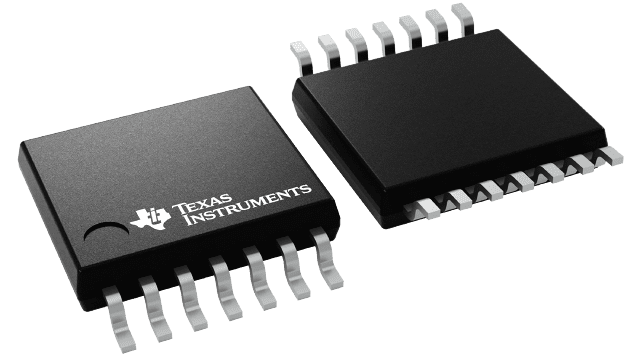
SN74ALS84110-Bit Bus-Interface D-Type Latches With 3-State Outputs | Buffers, Drivers, Receivers, Transceivers | 4 | Active | These 10-bit latches feature 3-state outputs designed specifically for driving highly capacitive or relatively low-impedance loads. They are particularly suitable for implementing buffer registers, I/O ports, bidirectional bus drivers, and working registers.
The ten latches are transparent D-type latches. The SN74ALS841 and SN74AS841A have noninverting data (D) inputs. The SN74ALS842 has inverting D\ inputs.
A buffered output-enable () input places the ten outputs in either a normal logic state (high or low logic levels) or a high-impedance state. In the high-impedance state, the outputs neither load nor drive the bus lines significantly. The high-impedance state and increased drive provide the capability to drive bus lines without interface or pullup components.
does not affect the internal operation of the latches. Previously stored data can be retained or new data can be entered while the outputs are off.
The SN74ALS841, SN74AS841A, and SN74ALS842 are characterized for operation from 0°C to 70°C.
These 10-bit latches feature 3-state outputs designed specifically for driving highly capacitive or relatively low-impedance loads. They are particularly suitable for implementing buffer registers, I/O ports, bidirectional bus drivers, and working registers.
The ten latches are transparent D-type latches. The SN74ALS841 and SN74AS841A have noninverting data (D) inputs. The SN74ALS842 has inverting D\ inputs.
A buffered output-enable () input places the ten outputs in either a normal logic state (high or low logic levels) or a high-impedance state. In the high-impedance state, the outputs neither load nor drive the bus lines significantly. The high-impedance state and increased drive provide the capability to drive bus lines without interface or pullup components.
does not affect the internal operation of the latches. Previously stored data can be retained or new data can be entered while the outputs are off.
The SN74ALS841, SN74AS841A, and SN74ALS842 are characterized for operation from 0°C to 70°C. |
SN74ALS8439-Bit Bus-Interface D-Type Latches With 3-State Outputs | Integrated Circuits (ICs) | 1 | Obsolete | This 9-bit bus-interface D-type latch features 3-state outputs designed specifically for driving
highly capacitive or relatively low-impedance loads. It is particularly suitable for implementing buffer registers, I/O ports, bidirectional bus drivers, and working registers.
The nine latches are transparent D-type latches with noninverting data (D) inputs.
A buffered output-enable () input places the nine outputs in either a normal logic state (high or low logic levels) or a high-impedance state. In the high-impedance state, the outputs neither load nor drive the bus lines significantly. The high-impedance state and increased drive provide the capability to drive bus lines without interface or pullup components.
does not affect the internal operation of the latches. Previously stored data can be retained or new data can be entered while the outputs are off.
The SN74ALS843 is characterized for operation from 0°C to 70°C.
This 9-bit bus-interface D-type latch features 3-state outputs designed specifically for driving
highly capacitive or relatively low-impedance loads. It is particularly suitable for implementing buffer registers, I/O ports, bidirectional bus drivers, and working registers.
The nine latches are transparent D-type latches with noninverting data (D) inputs.
A buffered output-enable () input places the nine outputs in either a normal logic state (high or low logic levels) or a high-impedance state. In the high-impedance state, the outputs neither load nor drive the bus lines significantly. The high-impedance state and increased drive provide the capability to drive bus lines without interface or pullup components.
does not affect the internal operation of the latches. Previously stored data can be retained or new data can be entered while the outputs are off.
The SN74ALS843 is characterized for operation from 0°C to 70°C. |
SN74ALS864-ch, 2-input, 4.5-V to 5.5-V bipolar XOR (exclusive OR) gates | Gates and Inverters | 5 | Active | These devices contain four independent 2-input exclusive-OR gates. They perform the Boolean functions Y = AB or Y = A\B + AB\ in positive logic.
A common application is as a true/complement element. If one of the inputs is low, the other input is reproduced in true form at the output. If one of the inputs is high, the signal on the other input is reproduced inverted at the output.
The SN54ALS86 and SN54AS86A are characterized for operation over the full military temperature range of -55°C to 125°C. The SN74ALS86 and SN74AS86A are characterized for operation from 0°C to 70°C.
These devices contain four independent 2-input exclusive-OR gates. They perform the Boolean functions Y = AB or Y = A\B + AB\ in positive logic.
A common application is as a true/complement element. If one of the inputs is low, the other input is reproduced in true form at the output. If one of the inputs is high, the signal on the other input is reproduced inverted at the output.
The SN54ALS86 and SN54AS86A are characterized for operation over the full military temperature range of -55°C to 125°C. The SN74ALS86 and SN74AS86A are characterized for operation from 0°C to 70°C. |
| Counters, Dividers | 4 | Active | These synchronous, presettable, 8-bit up/down counters feature internal-carry look-ahead circuitry for cascading in high-speed counting applications. Synchronous operation is provided by having all flip-flops clocked simultaneously so that the outputs change coincidentally with each other when so instructed by the count-enable (,) inputs and internal gating. This mode of operation eliminates the output counting spikes normally associated with asynchronous (ripple-clock) counters. A buffered clock (CLK) input triggers the eight flip-flops on the rising (positive-going) edge of the clock waveform.
These counters are fully programmable; they may be preset to any number between 0 and 255. The load-input circuitry allows parallel loading of the cascaded counters. Because loading is synchronous, selecting the load mode disables the counter and causes the outputs to agree with the data inputs after the next clock pulse.
The carry look-ahead circuitry provides for cascading counters for n-bit synchronous applications without additional gating. Two count-enable (and) inputs and a ripple-carry () output are instrumental in accomplishing this function. Bothandmust be low to count. The direction of the count is determined by the levels of the select (S0, S1) inputs as shown in the function table.is fed forward to enable.thus enabled produces a low-level pulse while the count is zero (all outputs low) counting down or 255 counting up (all outputs high). This low-level overflow-carry pulse can be used to enable successive cascaded stages. Transitions atandare allowed regardless of the level of CLK. All inputs are diode clamped to minimize transmission-line effects, thereby simplifying system design.
These counters feature a fully independent clock circuit. With the exception of the asynchronous clear on the SN74ALS867A and ´AS867, changes at S0 and S1 that modify the operating mode have no effect on the Q outputs until clocking occurs. For the ´AS867 and ´AS869, any time ENP\ and/or ENT\ is taken high,either goes or remains high. For the SN74ALS867A and SN74ALS869, any timeis taken high,either goes or remains high. The function of the counter (whether enabled, disabled, loading, or counting) is dictated solely by the conditions meeting the stable setup and hold times.
The SN54AS867 and SN54AS869 are characterized for operation over the full military temperature range of -55°C to 125°C. The SN74ALS867A, SN74ALS869, SN74AS867, and SN74AS869 are characterized for operation from 0°C to 70°C.
These synchronous, presettable, 8-bit up/down counters feature internal-carry look-ahead circuitry for cascading in high-speed counting applications. Synchronous operation is provided by having all flip-flops clocked simultaneously so that the outputs change coincidentally with each other when so instructed by the count-enable (,) inputs and internal gating. This mode of operation eliminates the output counting spikes normally associated with asynchronous (ripple-clock) counters. A buffered clock (CLK) input triggers the eight flip-flops on the rising (positive-going) edge of the clock waveform.
These counters are fully programmable; they may be preset to any number between 0 and 255. The load-input circuitry allows parallel loading of the cascaded counters. Because loading is synchronous, selecting the load mode disables the counter and causes the outputs to agree with the data inputs after the next clock pulse.
The carry look-ahead circuitry provides for cascading counters for n-bit synchronous applications without additional gating. Two count-enable (and) inputs and a ripple-carry () output are instrumental in accomplishing this function. Bothandmust be low to count. The direction of the count is determined by the levels of the select (S0, S1) inputs as shown in the function table.is fed forward to enable.thus enabled produces a low-level pulse while the count is zero (all outputs low) counting down or 255 counting up (all outputs high). This low-level overflow-carry pulse can be used to enable successive cascaded stages. Transitions atandare allowed regardless of the level of CLK. All inputs are diode clamped to minimize transmission-line effects, thereby simplifying system design.
These counters feature a fully independent clock circuit. With the exception of the asynchronous clear on the SN74ALS867A and ´AS867, changes at S0 and S1 that modify the operating mode have no effect on the Q outputs until clocking occurs. For the ´AS867 and ´AS869, any time ENP\ and/or ENT\ is taken high,either goes or remains high. For the SN74ALS867A and SN74ALS869, any timeis taken high,either goes or remains high. The function of the counter (whether enabled, disabled, loading, or counting) is dictated solely by the conditions meeting the stable setup and hold times.
The SN54AS867 and SN54AS869 are characterized for operation over the full military temperature range of -55°C to 125°C. The SN74ALS867A, SN74ALS869, SN74AS867, and SN74AS869 are characterized for operation from 0°C to 70°C. |
SN74ALS873BDual 4-Bit D-Type Latches With 3-State Outputs | Integrated Circuits (ICs) | 2 | Obsolete | These dual 4-bit D-type latches feature 3-state outputs designed specifically for bus driving. These devices are particularly suitable for implementing buffer registers, I/O ports, bidirectional bus drivers, and working registers.
The dual 4-bit latches are transparent D-type latches. While the latch-enable (LE) input is high, the Q outputs follow the data (D) inputs in true form, according to the function table. When LE is low, the outputs are latched. When the clear () input goes low, the Q outputs go low independently of LE. The outputs are in the high-impedance state when the output-enable () input is at a high logic level.
The SN54ALS873B and SN54AS873A are characterized for operation over the full military temperature range of -55°C to 125°C. The SN74ALS873B and SN74AS873A are characterized for operation from 0°C to 70°C.
These dual 4-bit D-type latches feature 3-state outputs designed specifically for bus driving. These devices are particularly suitable for implementing buffer registers, I/O ports, bidirectional bus drivers, and working registers.
The dual 4-bit latches are transparent D-type latches. While the latch-enable (LE) input is high, the Q outputs follow the data (D) inputs in true form, according to the function table. When LE is low, the outputs are latched. When the clear () input goes low, the Q outputs go low independently of LE. The outputs are in the high-impedance state when the output-enable () input is at a high logic level.
The SN54ALS873B and SN54AS873A are characterized for operation over the full military temperature range of -55°C to 125°C. The SN74ALS873B and SN74AS873A are characterized for operation from 0°C to 70°C. |
SN74ALS874BDual 4-Bit D-Type Edge-Triggered Flip-Flops With 3-State Outputs | Buffers, Drivers, Receivers, Transceivers | 3 | Active | These dual 4-bit D-type edge-triggered flip-flops feature 3-state outputs designed specifically as bus drivers. They are particularly suitable for implementing buffer registers, I/O ports, bidirectional bus drivers, and working registers.
The edge-triggered flip-flops enter data on the low-to-high transition of the clock (CLK) input. The SN54ALS874B, SN74ALS874B, and SN74AS874 have clear () inputs and noninverting Q outputs. The SN74ALS876A and SN74AS876 have preset () inputs and inverting Q\ outputs; takinglow causes the four Q or Q\ outputs to go low independently of the clock.
The SN54ALS874B is characterized for operation over the full military temperature range of -55°C to 125°C. The SN74ALS874B, SN74ALS876A, SN74AS874, and SN74AS876 devices are characterized for operation from 0°C to 70°C.
These dual 4-bit D-type edge-triggered flip-flops feature 3-state outputs designed specifically as bus drivers. They are particularly suitable for implementing buffer registers, I/O ports, bidirectional bus drivers, and working registers.
The edge-triggered flip-flops enter data on the low-to-high transition of the clock (CLK) input. The SN54ALS874B, SN74ALS874B, and SN74AS874 have clear () inputs and noninverting Q outputs. The SN74ALS876A and SN74AS876 have preset () inputs and inverting Q\ outputs; takinglow causes the four Q or Q\ outputs to go low independently of the clock.
The SN54ALS874B is characterized for operation over the full military temperature range of -55°C to 125°C. The SN74ALS874B, SN74ALS876A, SN74AS874, and SN74AS876 devices are characterized for operation from 0°C to 70°C. |
SN74ALS990Octal D-Type Transparent Read-Back Latches | Latches | 4 | Active | This 8-bit latch is designed specifically for storing the contents of the input data bus and providing the capability of reading back the stored data onto the input data bus.
The eight latches are transparent D-type latches. While the latch-enable (LE) input is high, the Q outputs follow the data (D) inputs.
Read back is provided through the output-enable () input. Whenis taken low, the data present at the output of the data latches is allowed to pass back onto the input data bus. Whenis taken high, the output of the data latches is isolated from the D inputs.does not affect the internal operation of the latches; however, precautions should be taken not to create a bus conflict.
The SN74ALS990 is characterized for operation from 0°C to 70°C.
This 8-bit latch is designed specifically for storing the contents of the input data bus and providing the capability of reading back the stored data onto the input data bus.
The eight latches are transparent D-type latches. While the latch-enable (LE) input is high, the Q outputs follow the data (D) inputs.
Read back is provided through the output-enable () input. Whenis taken low, the data present at the output of the data latches is allowed to pass back onto the input data bus. Whenis taken high, the output of the data latches is isolated from the D inputs.does not affect the internal operation of the latches; however, precautions should be taken not to create a bus conflict.
The SN74ALS990 is characterized for operation from 0°C to 70°C. |
SN74ALS9929-Bit D-Type Transparent Read-Back Latches With 3-State Outputs | Buffers, Drivers, Receivers, Transceivers | 5 | Active | This 9-bit latch is designed specifically for storing the contents of the input data bus and providing the capability of reading back the stored data onto the input data bus. In addition, this device provides a 3-state buffer-type output and is easily implemented in parity applications.
The nine latches are transparent D-type latches. While the latch-enable (LE) input is high, the Q outputs follow the data (D) inputs. The Q outputs are in the 3-state condition when the output-enable () input is high.
Read back is provided through the output-enable () input. Whenis taken low, the data present at the output of the data latches is allowed to pass back onto the input data bus. Whenis taken high, the output of the data latches is isolated from the D inputs.does not affect the internal operation of the latches; however, precautions should be taken not to create a bus conflict.
The SN74ALS992 is characterized for operation from 0°C to 70°C.
This 9-bit latch is designed specifically for storing the contents of the input data bus and providing the capability of reading back the stored data onto the input data bus. In addition, this device provides a 3-state buffer-type output and is easily implemented in parity applications.
The nine latches are transparent D-type latches. While the latch-enable (LE) input is high, the Q outputs follow the data (D) inputs. The Q outputs are in the 3-state condition when the output-enable () input is high.
Read back is provided through the output-enable () input. Whenis taken low, the data present at the output of the data latches is allowed to pass back onto the input data bus. Whenis taken high, the output of the data latches is isolated from the D inputs.does not affect the internal operation of the latches; however, precautions should be taken not to create a bus conflict.
The SN74ALS992 is characterized for operation from 0°C to 70°C. |
SN74ALS996Octal D-Type Edge-Triggered Read-Back Latches | Buffers, Drivers, Receivers, Transceivers | 6 | Active | These 8-bit latches are designed specifically for storing the contents of the input data bus and providing the capability of reading back the stored data onto the input data bus. The Q outputs are designed with bus-driving capability.
The edge-triggered flip-flops enter the data on the low-to-high transition of the clock (CLK) input when the enable () input is low. Data can be read back onto the data inputs by taking the read () input low, in addition to havinglow. When EN\ is high, both the read-back and write modes are disabled. Transitions onshould only be made with CLK high to prevent false clocking.
The polarity of the Q outputs can be controlled by the polarity (T/C\) input. When T/C\ is high, Q is the same as is stored in the flip-flops. When T/C\ is low, the output data is inverted. The Q outputs can be placed in the high-impedance state by taking the output-enable () input high.does not affect the internal operation of the register. Old data can be retained or new data can be entered while the outputs are off.
A low level at the clear () input resets the internal registers low. The clear function is asynchronous and overrides all other register functions.
The -1 version of the SN74ALS996 is identical to the standard version, except that the recommended maximum IOLfor the -1 version is increased to 48 mA. There is no -1 version of the SN54ALS996.
The SN54ALS996 is characterized for operation over the full military temperature range of -55°C to 125°C. The SN74ALS996 is characterized for operation from 0°C to 70°C.
These 8-bit latches are designed specifically for storing the contents of the input data bus and providing the capability of reading back the stored data onto the input data bus. The Q outputs are designed with bus-driving capability.
The edge-triggered flip-flops enter the data on the low-to-high transition of the clock (CLK) input when the enable () input is low. Data can be read back onto the data inputs by taking the read () input low, in addition to havinglow. When EN\ is high, both the read-back and write modes are disabled. Transitions onshould only be made with CLK high to prevent false clocking.
The polarity of the Q outputs can be controlled by the polarity (T/C\) input. When T/C\ is high, Q is the same as is stored in the flip-flops. When T/C\ is low, the output data is inverted. The Q outputs can be placed in the high-impedance state by taking the output-enable () input high.does not affect the internal operation of the register. Old data can be retained or new data can be entered while the outputs are off.
A low level at the clear () input resets the internal registers low. The clear function is asynchronous and overrides all other register functions.
The -1 version of the SN74ALS996 is identical to the standard version, except that the recommended maximum IOLfor the -1 version is increased to 48 mA. There is no -1 version of the SN54ALS996.
The SN54ALS996 is characterized for operation over the full military temperature range of -55°C to 125°C. The SN74ALS996 is characterized for operation from 0°C to 70°C. |
SN74ALVC00-EPEnhanced product 4-ch, 2-input, 1.65-V to 3.6-V NAND gates | Logic | 11 | Active | The SN74ALVC00 quadruple 2-input positive-NAND gate is designed for 1.65-V to 3.6-V VCCoperation.
The device performs the Boolean function Y = (A • B)\ or Y = A\ + B\ in positive logic.
The SN74ALVC00 quadruple 2-input positive-NAND gate is designed for 1.65-V to 3.6-V VCCoperation.
The device performs the Boolean function Y = (A • B)\ or Y = A\ + B\ in positive logic. |