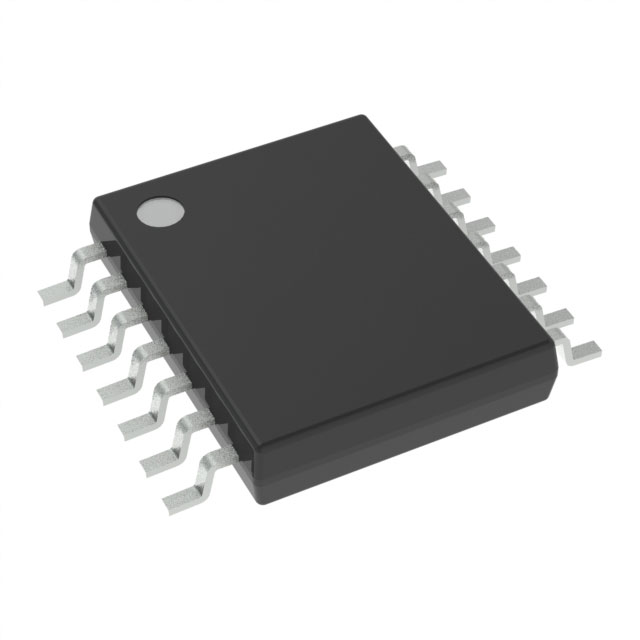
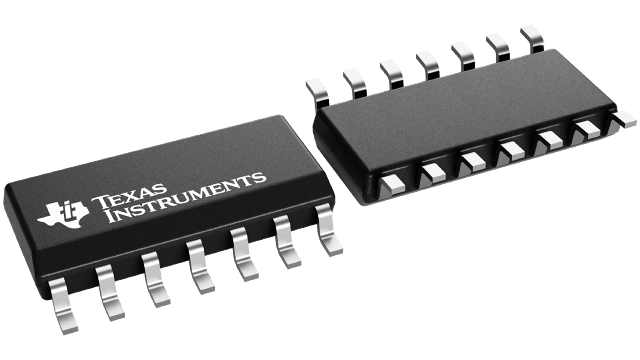
SN74AHCT08Q-Q14-ch, 2-input 4.5-V to 5.5-V high-speed (7.1 ns) AND gate with TTL-compatible inputs | Integrated Circuits (ICs) | 18 | Active | The SN74AHCT08 is a quadruple 2-input positive-AND gate. This device performs the Boolean function Y = A • B or Y = (A\ + B\)\ in positive logic.
The SN74AHCT08 is a quadruple 2-input positive-AND gate. This device performs the Boolean function Y = A • B or Y = (A\ + B\)\ in positive logic. |
| Logic | 4 | Active | These edge-triggered multivibrators feature output pulse-duration control by three methods. In the first method, the A input is low, and the B input goes high. In the second method, the B input is high, and the A input goes low. In the third method, the A input is low, the B input is high, and the clear (CLR) input goes high.
The output pulse duration is programmed by selecting external resistance and capacitance values. The external timing capacitor must be connected between Cext and Rext/Cext (positive) and an external resistor connected between Rext/Cext and VCC. To obtain variable pulse durations, connect an external variable resistance between Rext/Cext and VCC. The output pulse duration also can be reduced by taking CLR low.
These edge-triggered multivibrators feature output pulse-duration control by three methods. In the first method, the A input is low, and the B input goes high. In the second method, the B input is high, and the A input goes low. In the third method, the A input is low, the B input is high, and the clear (CLR) input goes high.
The output pulse duration is programmed by selecting external resistance and capacitance values. The external timing capacitor must be connected between Cext and Rext/Cext (positive) and an external resistor connected between Rext/Cext and VCC. To obtain variable pulse durations, connect an external variable resistance between Rext/Cext and VCC. The output pulse duration also can be reduced by taking CLR low. |
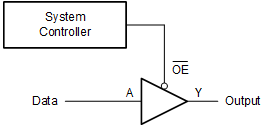
SN74AHCT125-EPEnhanced product 4-ch, 4.5-V to 5.5-V buffers with TTL-compatible CMOS inputs and 3-state outputs | Logic | 15 | Active | The SN74AHCT125-Q1 devices are quadruple bus buffer gates featuring independent line drivers with 3-state outputs. Each output is disabled when the associated output-enable ( OE) input is high. When OE is low, the respective gate passes the data from the A input to its Y output.
To ensure the high-impedance state during power up or power down, OE should be tied to V CC through a pullup resistor; the minimum value of the resistor is determined by the current-sinking capability of the driver.
The SN74AHCT125-Q1 devices are quadruple bus buffer gates featuring independent line drivers with 3-state outputs. Each output is disabled when the associated output-enable ( OE) input is high. When OE is low, the respective gate passes the data from the A input to its Y output.
To ensure the high-impedance state during power up or power down, OE should be tied to V CC through a pullup resistor; the minimum value of the resistor is determined by the current-sinking capability of the driver. |
SN74AHCT126-Q1Enhanced product 4-ch, 4.5-V to 5.5-V buffers with TTL-compatible CMOS inputs and 3-state outputs | Buffers, Drivers, Receivers, Transceivers | 15 | Active | The SN74AHCT126-Q1 device is a quadruple bus buffer gate featuring independent line drivers with 3-state outputs. Each output is disabled when the associated output-enable (OE) input is low. When OE is high, the respective gate passes the data from the A input to its Y output.
To ensure the high-impedance state during power up or power down, OE should be tied to GND through a pulldown resistor; the minimum value of the resistor is determined by the current-sourcing capability of the driver.
The SN74AHCT126-Q1 device is a quadruple bus buffer gate featuring independent line drivers with 3-state outputs. Each output is disabled when the associated output-enable (OE) input is low. When OE is high, the respective gate passes the data from the A input to its Y output.
To ensure the high-impedance state during power up or power down, OE should be tied to GND through a pulldown resistor; the minimum value of the resistor is determined by the current-sourcing capability of the driver. |
SN74AHCT1324-ch, 4-input, 4.5-V to 5.5-V NAND gates with Schmitt-Trigger inputs | Integrated Circuits (ICs) | 11 | Active | The ’AHCT132 devices are quadruple positive-NAND gates. These devices perform the Boolean function Y = A • B or Y = A + B in positive logic.
Each circuit functions as a NAND gate, but because of the Schmitt action, it has different input threshold levels for positive- and negative-going signals. These circuits are temperature compensated and can be triggered from the slowest of input ramps and still give clean jitter-free output signals.
The ’AHCT132 devices are quadruple positive-NAND gates. These devices perform the Boolean function Y = A • B or Y = A + B in positive logic.
Each circuit functions as a NAND gate, but because of the Schmitt action, it has different input threshold levels for positive- and negative-going signals. These circuits are temperature compensated and can be triggered from the slowest of input ramps and still give clean jitter-free output signals. |
| Signal Switches, Multiplexers, Decoders | 12 | Active | The SN74AHCT138 3-line to 8-line decoder/demultiplexer is designed to be used in high-performance memory-decoding and data-routing applications that require very short propagation-delay times. In high-performance memory systems, this decoder can be used to minimize the effects of system decoding. When employed with high-speed memories utilizing a fast enable circuit, the delay times of this decoder and the enable time of the memory usually are less than the typical access time of the memory. This means that the effective system delay introduced by the decoder is negligible.
The conditions at the binary-select inputs and the three enable inputs select one of eight output lines. Two active-low and one active-high enable inputs reduce the need for external gates or inverters when expanding. A 24-line decoder can be implemented without external inverters and a 32-line decoder requires only one inverter. An enable input can be used as a data input for demultiplexing applications.
The SN74AHCT138 3-line to 8-line decoder/demultiplexer is designed to be used in high-performance memory-decoding and data-routing applications that require very short propagation-delay times. In high-performance memory systems, this decoder can be used to minimize the effects of system decoding. When employed with high-speed memories utilizing a fast enable circuit, the delay times of this decoder and the enable time of the memory usually are less than the typical access time of the memory. This means that the effective system delay introduced by the decoder is negligible.
The conditions at the binary-select inputs and the three enable inputs select one of eight output lines. Two active-low and one active-high enable inputs reduce the need for external gates or inverters when expanding. A 24-line decoder can be implemented without external inverters and a 32-line decoder requires only one inverter. An enable input can be used as a data input for demultiplexing applications. |
SN74AHCT139Dual 2-Line To 4-Line Decoders / Demultiplexers | Signal Switches, Multiplexers, Decoders | 8 | Active | The ’AHCT139 devices are dual 2-line to 4-line decoders/demultiplexers designed for 4.5-V to 5.5-V VCCoperation. These devices are designed to be used in high-performance memory-decoding or data-routing applications requiring very short propagation delay times. In high-performance memory systems, these decoders can be used to minimize the effects of system decoding. When used with high-speed memories utilizing a fast enable circuit, the delay times of these decoders and the enable time of the memory usually are less than the typical access time of the memory. This means that the effective system delay introduced by the decoders is negligible.
The active-low enable (G)\ input can be used as a data line in demultiplexing applications. These decoders/demultiplexers feature fully buffered inputs, each of which represents only one normalized load to its driving circuit.
The ’AHCT139 devices are dual 2-line to 4-line decoders/demultiplexers designed for 4.5-V to 5.5-V VCCoperation. These devices are designed to be used in high-performance memory-decoding or data-routing applications requiring very short propagation delay times. In high-performance memory systems, these decoders can be used to minimize the effects of system decoding. When used with high-speed memories utilizing a fast enable circuit, the delay times of these decoders and the enable time of the memory usually are less than the typical access time of the memory. This means that the effective system delay introduced by the decoders is negligible.
The active-low enable (G)\ input can be used as a data line in demultiplexing applications. These decoders/demultiplexers feature fully buffered inputs, each of which represents only one normalized load to its driving circuit. |
SN74AHCT139-Q1Automotive dual 2-line to 4-line decoders or demultiplexers with TTL inputs | Signal Switches, Multiplexers, Decoders | 1 | Active | The SN74AHCT139-Q1 contains two 2-line to 4-line decoders/demultiplexers. These devices are designed to be used in high-performance memory-decoding or data-routing applications requiring very short propagation delay times. In high-performance memory systems, these decoders can be used to minimize the effects of system decoding. When used with high-speed memories utilizing a fast enable circuit, the delay times of these decoders and the enable time of the memory usually are less than the typical access time of the memory. This means that the effective system delay introduced by the decoders is negligible.
The SN74AHCT139-Q1 contains two 2-line to 4-line decoders/demultiplexers. These devices are designed to be used in high-performance memory-decoding or data-routing applications requiring very short propagation delay times. In high-performance memory systems, these decoders can be used to minimize the effects of system decoding. When used with high-speed memories utilizing a fast enable circuit, the delay times of these decoders and the enable time of the memory usually are less than the typical access time of the memory. This means that the effective system delay introduced by the decoders is negligible. |
SN74AHCT14Q-Q1Enhanced product 6-ch, 4.5-V to 5.5-V inverters with Schmitt-Trigger inputs | Logic | 15 | Active | The SN74AHCT14 contains six independent inverters. This device performs the Boolean function Y = A\.
Each circuit functions as an independent inverter, but because of the Schmitt action, the inverters have different input threshold levels for positive-going (VT+) and for negative-going (VT–) signals.
The SN74AHCT14 contains six independent inverters. This device performs the Boolean function Y = A\.
Each circuit functions as an independent inverter, but because of the Schmitt action, the inverters have different input threshold levels for positive-going (VT+) and for negative-going (VT–) signals. |
SN74AHCT157Quadruple 2-Line To 1-Line Data Selectors / Multiplexers | Logic | 7 | Active | These quadruple 2-line to 1-line data selectors/multiplexers are designed for 4.5V to 5.5V VCC operation.
The SNx4AHCT157 devices feature a common strobe (G) input. When the strobe is high, all outputs are low. When the strobe is low, a 4-bit word is selected from one of two sources and is routed to the four outputs. The devices provide true data.
These quadruple 2-line to 1-line data selectors/multiplexers are designed for 4.5V to 5.5V VCC operation.
The SNx4AHCT157 devices feature a common strobe (G) input. When the strobe is high, all outputs are low. When the strobe is low, a 4-bit word is selected from one of two sources and is routed to the four outputs. The devices provide true data. |