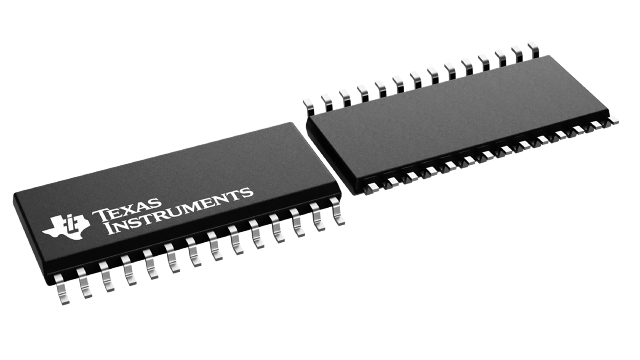
| Logic | 1 | Active | |
| Integrated Circuits (ICs) | 7 | Obsolete | |
| FIFOs Memory | 7 | Obsolete | |
| Integrated Circuits (ICs) | 6 | Active | A FIFO memory is a storage device that allows data to be written into and read from its array at independent data rates. The SN74ACT7814 is a 64-word by 18-bit FIFO for high speed and fast access times. It processes data at rates up to 50 MHz and access times of 15 ns in a bit-parallel format.
Data is written into memory on a low-to-high transition at the load clock (LDCK) input and is read out on a low-to-high transition at the unload clock (UNCK) input. The memory is full when the number of words clocked in exceeds the number of words clocked out by 64. When the memory is full, LDCK signals have no effect on the data residing in memory. When the memory is empty, UNCK signals have no effect.
Status of the FIFO memory is monitored by the full (FULL\), empty (EMPTY\), half-full (HF), and almost-full/almost-empty (AF/AE) flags. The FULL\ output is low when the memory is full and high when the memory is not full. The EMPTY\ output is low when the memory is empty and high when it is not empty. The HF output is high when the FIFO contains 32 or more words and is low when it contains 31 or fewer words. The AF/AE status flag is a programmable flag. The first one or two low-to-high transitions of LDCK after reset are used to program the almost-empty offset value (X) and the almost-full offset value (Y) if program enable (PEN\) is low. The AF/AE flag is high when the FIFO contains X or fewer words or (64 - Y) or more words. The AF/AE flag is low when the FIFO contains between (X + 1) and (63 - Y) words.
A low level on the reset (RESET\) input resets the internal stack pointers and sets FULL\ high, HF low, and EMPTY\ low. The Q outputs are not reset to any specific logic level. The FIFO must be reset upon power up. The first word loaded into empty memory causes EMPTY\ to go high and the data to appear on the Q outputs. It is important to note that the first word does not have to be unloaded. The data outputs are noninverting with respect to the data inputs and are in the high-impedance state when the output-enable (OE\) input is high.
The SN74ACT7814 is characterized for operation from 0°C to 70°C.
A FIFO memory is a storage device that allows data to be written into and read from its array at independent data rates. The SN74ACT7814 is a 64-word by 18-bit FIFO for high speed and fast access times. It processes data at rates up to 50 MHz and access times of 15 ns in a bit-parallel format.
Data is written into memory on a low-to-high transition at the load clock (LDCK) input and is read out on a low-to-high transition at the unload clock (UNCK) input. The memory is full when the number of words clocked in exceeds the number of words clocked out by 64. When the memory is full, LDCK signals have no effect on the data residing in memory. When the memory is empty, UNCK signals have no effect.
Status of the FIFO memory is monitored by the full (FULL\), empty (EMPTY\), half-full (HF), and almost-full/almost-empty (AF/AE) flags. The FULL\ output is low when the memory is full and high when the memory is not full. The EMPTY\ output is low when the memory is empty and high when it is not empty. The HF output is high when the FIFO contains 32 or more words and is low when it contains 31 or fewer words. The AF/AE status flag is a programmable flag. The first one or two low-to-high transitions of LDCK after reset are used to program the almost-empty offset value (X) and the almost-full offset value (Y) if program enable (PEN\) is low. The AF/AE flag is high when the FIFO contains X or fewer words or (64 - Y) or more words. The AF/AE flag is low when the FIFO contains between (X + 1) and (63 - Y) words.
A low level on the reset (RESET\) input resets the internal stack pointers and sets FULL\ high, HF low, and EMPTY\ low. The Q outputs are not reset to any specific logic level. The FIFO must be reset upon power up. The first word loaded into empty memory causes EMPTY\ to go high and the data to appear on the Q outputs. It is important to note that the first word does not have to be unloaded. The data outputs are noninverting with respect to the data inputs and are in the high-impedance state when the output-enable (OE\) input is high.
The SN74ACT7814 is characterized for operation from 0°C to 70°C. |
| FIFOs Memory | 5 | Obsolete | |
| Integrated Circuits (ICs) | 6 | Obsolete | |
74ACT86Enhanced product 4-ch, 2-input, 4.5-V to 5.5-V XOR (exclusive OR) gates with TTL-compatible CMOS inp | Integrated Circuits (ICs) | 13 | Active | The ’ACT86 devices are quadruple 2-input exclusive-OR gates. These devices perform the Boolean function Y = AB or Y = A\B + AB\ in positive logic.
A common application is as a true/complement element. If one of the inputs is low, the other input is reproduced in true form at the output. If one of the inputs is high, the signal on the other input is reproduced inverted at the output.
The ’ACT86 devices are quadruple 2-input exclusive-OR gates. These devices perform the Boolean function Y = AB or Y = A\B + AB\ in positive logic.
A common application is as a true/complement element. If one of the inputs is low, the other input is reproduced in true form at the output. If one of the inputs is high, the signal on the other input is reproduced inverted at the output. |
74ACT8990Test-Bus Controllers IEEE Std 1149.1 (JTAG) TAP Masters With 16-Bit Generic Host Interfaces | Logic | 2 | Active | The 'ACT8990 test-bus controllers (TBC) are members of the Texas Instruments SCOPETMtestability integrated-circuit family. This family of components supports IEEE Standard 1149.1-1990 (JTAG) boundary scan to facilitate testing of complex circuit-board assemblies. The 'ACT8990 differ from other SCOPETMintegrated circuits. Their function is to control the JTAG serial-test bus rather than being target boundary-scannable devices.
The required signals of the JTAG serial-test bus - test clock (TCK), test mode select (TMS), test data input (TDI), and test data output (TDO) can be connected from the TBC to a target device without additional logic. This is done as a chain of IEEE Standard 1149.1-1990 boundary-scannable components that share the same serial-test bus. The TBC generates TMS and TDI signals for its target(s), receives TDO signals from its target(s), and buffers its test clock input (TCKI) to a test clock output (TCKO) for distribution to its target(s). The TMS, TDI, and TDO signals can be connected to a target directly or via a pipeline, with a retiming delay of up to 31 bits. Since the TBC can be configured to generate up to six separate TMS signals [TMS (5-0)], it can be used to control up to six target scan paths that are connected in parallel (i.e., sharing common TCK, TDI, and TDO signals).
While most operations of the TBC are synchronous to TCKI, a test-off (TOFF\) input is provided for output control of the target interface, and a test-reset (TRST\) input is provided for hardware/software reset of the TBC. In addition, four event [EVENT (3-0)] I/Os are provided for asynchronous communication to target device(s). Each event has its own event generation/detection logic, and detected events can be counted by two 16-bit counters.
The TBC operates under the control of a host microprocessor/microcontroller via the 5-bit address bus [ADRS (4-0)] and the 16-bit read/write data bus [DATA (15-0)]. Read (RD\) and write (WR\) strobes are implemented such that the critical host-interface timing is independent of the TCKI period. Any one of 24 registers can be addressed for read and/or write operations. In addition to control and status registers, the TBC contains two command registers, a read buffer, and a write buffer. Status of the TBC is transmitted to the host via ready (RDY\) and interrupt (INT\) outputs.
Major commands can be issued by the host to cause the TBC to generate the TMS sequences necessary to move the target(s) from any stable test-access-port (TAP) controller state to any other stable TAP state, to execute instructions in the Run-Test/Idle TAP state, or to scan instruction or test data through the target(s). A 32-bit counter can be preset to allow a predetermined number of execution or scan operations.
Serial data that appears at the selected TDI input (TDI1 or TDI0) is transferred into the read buffer, which can be read by the host to obtain up to 16 bits of the serial-data stream. Serial data that is transmitted from the TDO output is written by the host to the write buffer.
The SN54ACT8990 is characterized for operation over the full military temperature range of -55°C to 125°C. The SN74ACT8990 is characterized for operation from 0°C to 70°C.
NC - No internal connection
The 'ACT8990 test-bus controllers (TBC) are members of the Texas Instruments SCOPETMtestability integrated-circuit family. This family of components supports IEEE Standard 1149.1-1990 (JTAG) boundary scan to facilitate testing of complex circuit-board assemblies. The 'ACT8990 differ from other SCOPETMintegrated circuits. Their function is to control the JTAG serial-test bus rather than being target boundary-scannable devices.
The required signals of the JTAG serial-test bus - test clock (TCK), test mode select (TMS), test data input (TDI), and test data output (TDO) can be connected from the TBC to a target device without additional logic. This is done as a chain of IEEE Standard 1149.1-1990 boundary-scannable components that share the same serial-test bus. The TBC generates TMS and TDI signals for its target(s), receives TDO signals from its target(s), and buffers its test clock input (TCKI) to a test clock output (TCKO) for distribution to its target(s). The TMS, TDI, and TDO signals can be connected to a target directly or via a pipeline, with a retiming delay of up to 31 bits. Since the TBC can be configured to generate up to six separate TMS signals [TMS (5-0)], it can be used to control up to six target scan paths that are connected in parallel (i.e., sharing common TCK, TDI, and TDO signals).
While most operations of the TBC are synchronous to TCKI, a test-off (TOFF\) input is provided for output control of the target interface, and a test-reset (TRST\) input is provided for hardware/software reset of the TBC. In addition, four event [EVENT (3-0)] I/Os are provided for asynchronous communication to target device(s). Each event has its own event generation/detection logic, and detected events can be counted by two 16-bit counters.
The TBC operates under the control of a host microprocessor/microcontroller via the 5-bit address bus [ADRS (4-0)] and the 16-bit read/write data bus [DATA (15-0)]. Read (RD\) and write (WR\) strobes are implemented such that the critical host-interface timing is independent of the TCKI period. Any one of 24 registers can be addressed for read and/or write operations. In addition to control and status registers, the TBC contains two command registers, a read buffer, and a write buffer. Status of the TBC is transmitted to the host via ready (RDY\) and interrupt (INT\) outputs.
Major commands can be issued by the host to cause the TBC to generate the TMS sequences necessary to move the target(s) from any stable test-access-port (TAP) controller state to any other stable TAP state, to execute instructions in the Run-Test/Idle TAP state, or to scan instruction or test data through the target(s). A 32-bit counter can be preset to allow a predetermined number of execution or scan operations.
Serial data that appears at the selected TDI input (TDI1 or TDI0) is transferred into the read buffer, which can be read by the host to obtain up to 16 bits of the serial-data stream. Serial data that is transmitted from the TDO output is written by the host to the write buffer.
The SN54ACT8990 is characterized for operation over the full military temperature range of -55°C to 125°C. The SN74ACT8990 is characterized for operation from 0°C to 70°C.
NC - No internal connection |
74ACT8997Scan Path Linkers With 4-Bit Identification Buses Scan-Controlled TAP Concatenators | Logic | 2 | Active | The 'ACT8997 are members of the Texas Instruments SCOPETMtestability integrated-circuit family. This family of components facilitates testing of complex circuit-board assemblies.
The 'ACT8997 enhance the scan capability of TI's SCOPETMfamily by allowing augmentation of a system's primary scan path with secondary scan paths (SSPs), which can be individually selected by the 'ACT8997 for inclusion in the primary scan path. These devices also provide buffering of test signals to reduce the need for external logic.
By loading the proper values into the instruction register and data registers, the user can select up to four SSPs to be included in a primary scan path. Any combination of the SSPs can be selected at a time. Any of the device's six data registers or the instruction register can be placed in the device's scan path, i.e., placed between test data input (TDI) and test data output (TDO) for subsequent shift and scan operations.
All operations of the device except counting are synchronous to the test clock pin (TCK). The 8-bit programmable up/down counter can be used to count transitions on the device condition input (DCI) pin and output interrupt signals via the device condition output (DCO) pin. The device can be configured to count on either the rising or falling edge of DCI.
The test access port (TAP) controller is a finite-state machine compatible with IEEE Standard 1149.1.
The SN54ACT8997 is characterized for operation over the full military temperature range of -55°C to 125°C. The SN74ACT8997 is characterized for operation from 0°C to 70°C.
The 'ACT8997 are members of the Texas Instruments SCOPETMtestability integrated-circuit family. This family of components facilitates testing of complex circuit-board assemblies.
The 'ACT8997 enhance the scan capability of TI's SCOPETMfamily by allowing augmentation of a system's primary scan path with secondary scan paths (SSPs), which can be individually selected by the 'ACT8997 for inclusion in the primary scan path. These devices also provide buffering of test signals to reduce the need for external logic.
By loading the proper values into the instruction register and data registers, the user can select up to four SSPs to be included in a primary scan path. Any combination of the SSPs can be selected at a time. Any of the device's six data registers or the instruction register can be placed in the device's scan path, i.e., placed between test data input (TDI) and test data output (TDO) for subsequent shift and scan operations.
All operations of the device except counting are synchronous to the test clock pin (TCK). The 8-bit programmable up/down counter can be used to count transitions on the device condition input (DCI) pin and output interrupt signals via the device condition output (DCO) pin. The device can be configured to count on either the rising or falling edge of DCI.
The test access port (TAP) controller is a finite-state machine compatible with IEEE Standard 1149.1.
The SN54ACT8997 is characterized for operation over the full military temperature range of -55°C to 125°C. The SN74ACT8997 is characterized for operation from 0°C to 70°C. |
| Buffers, Drivers, Receivers, Transceivers | 1 | Active | |