74ACT222664 x 1 x 2 dual independent synchronous FIFO memories | Logic | 2 | Active | The SN74ACT2226 and SN74ACT2228 are dual FIFOs suited for a wide range of serial-data buffering applications, including elastic stores for frequencies up to T2 telecommunication rates. Each FIFO on the chip is arranged as 64 × 1 (SN74ACT2226) or 256 × 1 (SN74ACT2228) and has control signals and status flags for independent operation. Output flags for each FIFO include input ready (1IR or 2IR), output ready (1OR or 2OR), half full (1HF or 2HF), and almost full/almost empty (1AF/AE or 2AF/AE).
Serial data is written into a FIFO on the low-to-high transition of the write-clock (1WRTCLK or 2WRTCLK) input when the write-enable (1WRTEN or 2WRTEN) input and input-ready flag (1IR or 2IR) output are both high. Serial data is read from a FIFO on the low-to-high transition of the read-clock (1RDCLK or 2RDCLK) input when the read-enable (1RDEN or 2RDEN) input and output-ready flag (1OR or 2OR) output are both high. The read and write clocks of a FIFO can be asynchronous to one another.
Each input-ready flag (1IR or 2IR) is synchronized by two flip-flop stages to its write clock (1WRTCLK or 2WRTCLK), and each output-ready flag (1OR or 2OR) is synchronized by three flip-flop stages to its read clock (1RDCLK or 2RDCLK). This multistage synchronization ensures reliable flag-output states when data is written and read asynchronously.
A half-full flag (1HF or 2HF) is high when the number of bits stored in its FIFO is greater than or equal to half the depth of the FIFO. An almost-full/almost-empty flag (1AF/AE or 2AF/AE) is high when eight or fewer bits are stored in its FIFO and when eight or fewer empty locations are left in the FIFO. A bit present on the data output is not stored in the FIFO.
The SN74ACT2226 and SN74ACT2228 are characterized for operation from -40°C to 85°C.
For more information on this device family, see the application reportFIFOs With a Word Width of One Bit(literature number SCAA006).
The SN74ACT2226 and SN74ACT2228 are dual FIFOs suited for a wide range of serial-data buffering applications, including elastic stores for frequencies up to T2 telecommunication rates. Each FIFO on the chip is arranged as 64 × 1 (SN74ACT2226) or 256 × 1 (SN74ACT2228) and has control signals and status flags for independent operation. Output flags for each FIFO include input ready (1IR or 2IR), output ready (1OR or 2OR), half full (1HF or 2HF), and almost full/almost empty (1AF/AE or 2AF/AE).
Serial data is written into a FIFO on the low-to-high transition of the write-clock (1WRTCLK or 2WRTCLK) input when the write-enable (1WRTEN or 2WRTEN) input and input-ready flag (1IR or 2IR) output are both high. Serial data is read from a FIFO on the low-to-high transition of the read-clock (1RDCLK or 2RDCLK) input when the read-enable (1RDEN or 2RDEN) input and output-ready flag (1OR or 2OR) output are both high. The read and write clocks of a FIFO can be asynchronous to one another.
Each input-ready flag (1IR or 2IR) is synchronized by two flip-flop stages to its write clock (1WRTCLK or 2WRTCLK), and each output-ready flag (1OR or 2OR) is synchronized by three flip-flop stages to its read clock (1RDCLK or 2RDCLK). This multistage synchronization ensures reliable flag-output states when data is written and read asynchronously.
A half-full flag (1HF or 2HF) is high when the number of bits stored in its FIFO is greater than or equal to half the depth of the FIFO. An almost-full/almost-empty flag (1AF/AE or 2AF/AE) is high when eight or fewer bits are stored in its FIFO and when eight or fewer empty locations are left in the FIFO. A bit present on the data output is not stored in the FIFO.
The SN74ACT2226 and SN74ACT2228 are characterized for operation from -40°C to 85°C.
For more information on this device family, see the application reportFIFOs With a Word Width of One Bit(literature number SCAA006). |
| FIFOs Memory | 2 | Obsolete | |
| FIFOs Memory | 1 | Obsolete | |
| Integrated Circuits (ICs) | 7 | Active | |
74ACT2408-ch, 4.5-V to 5.5-V inverters with TTL-compatible CMOS inputs and 3-state outputs | Buffers, Drivers, Receivers, Transceivers | 14 | Active | The RCA CD54/74AC240, CD54/74AC241, and CD54/74AC244 and the CD54/74ACT240, CD54/74ACT241, and CD54/74ACT244 3-state octal buffer/line drivers use the RCA ADVANCED CMOS technology.
The RCA CD54/74AC240, CD54/74AC241, and CD54/74AC244 and the CD54/74ACT240, CD54/74ACT241, and CD54/74ACT244 3-state octal buffer/line drivers use the RCA ADVANCED CMOS technology. |
74ACT2418-ch, 4.5-V to 5.5-V buffers with TTL-compatible CMOS inputs and 3-state outputs | Integrated Circuits (ICs) | 9 | Active | These octal buffers and line drivers are designed specifically to improve the performance and density of 3-state memory address drivers, clock drivers, and bus-oriented receivers and transmitters.
These octal buffers and line drivers are designed specifically to improve the performance and density of 3-state memory address drivers, clock drivers, and bus-oriented receivers and transmitters. |
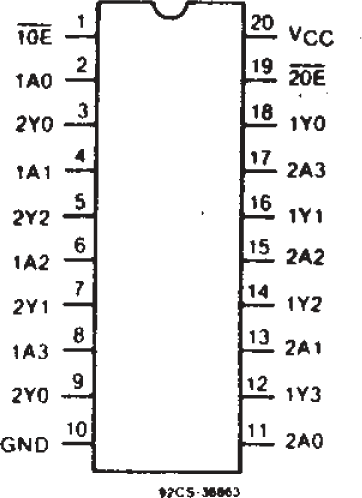
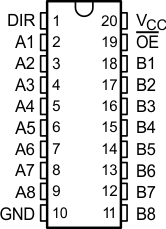
74ACT244Automotive eight-channel 4.5-V to 5.5-V buffers with TTL-compatible CMOS inputs and 3-state outputs | Logic | 29 | Active | The SN74ACT244-EP octal buffer/driver is designed specifically to improve the performance and density of 3-state memory address drivers, clock drivers, and bus-oriented receivers and transmitters.
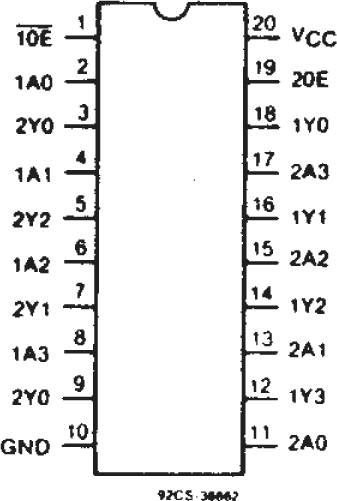
The device is organized as two 4-bit buffers/drivers with separate output-enable (OE) inputs. WhenOEis low, the device passes noninverted data from the A inputs to the Y outputs. WhenOEis high, the outputs are in the high-impedance state.
To ensure the high-impedance state during power up or power down,OEshould be tied to VCCthrough a pullup resistor; the minimum value of the resistor is determined by the current-sinking capability of the driver.
The SN74ACT244-EP octal buffer/driver is designed specifically to improve the performance and density of 3-state memory address drivers, clock drivers, and bus-oriented receivers and transmitters.
The device is organized as two 4-bit buffers/drivers with separate output-enable (OE) inputs. WhenOEis low, the device passes noninverted data from the A inputs to the Y outputs. WhenOEis high, the outputs are in the high-impedance state.
To ensure the high-impedance state during power up or power down,OEshould be tied to VCCthrough a pullup resistor; the minimum value of the resistor is determined by the current-sinking capability of the driver. |
| Buffers, Drivers, Receivers, Transceivers | 17 | Active | |
| Integrated Circuits (ICs) | 4 | Active | |
| Integrated Circuits (ICs) | 1 | Unknown | |