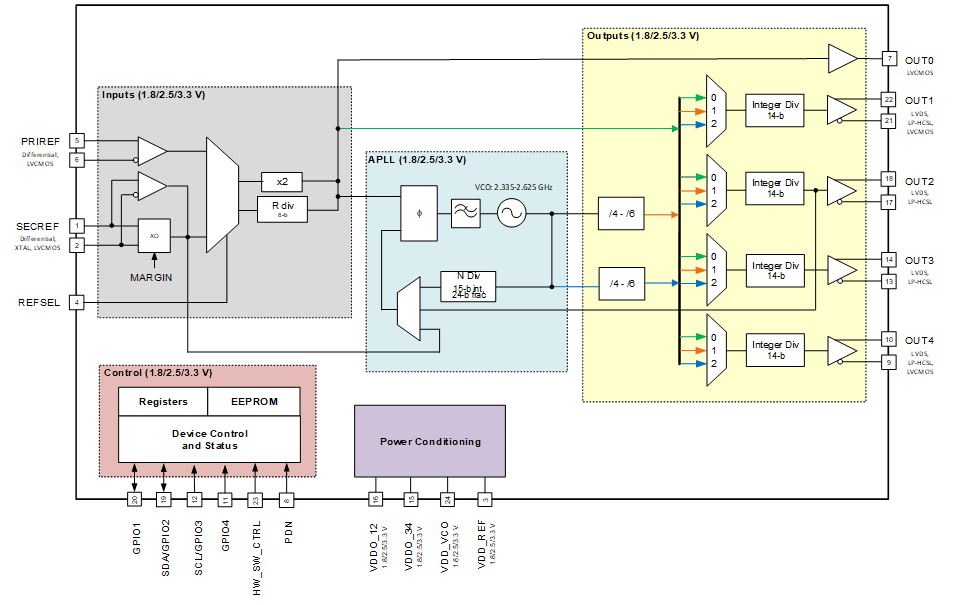
CDCE6214-Q1Ultra-low power clock generator supporting PCIe gen 1-5 with 2 inputs, 4 outputs and internal EEPROM | Evaluation Boards | 5 | Active | The CDCE6214 is a four-channel, ultra-low power, medium grade jitter, clock generator that can generate five independent clock outputs selectable between various modes of drivers. The input source could be a single-ended or differential input clock source, or a crystal. The CDCE6214 features a frac-N PLL to synthesize unrelated base frequency from any input frequency. The CDCE6214 can be configured through the I2C interface. In the absence of the serial interface, the GPIO pins can be used in Pin Mode to configure the product into distinctive configurations.
On-chip EEPROM can be used to change the configuration, which is pre-selectable through the pins. The device provides frequency margining options with glitch-free operation to support system design verification tests (DVT) and Ethernet Audio-Video Bridging (eAVB). Fine frequency margining is available on any output channel by steering the fractional feedback divider in DCO mode.
Internal power conditioning provides excellent power supply ripple rejection (PSRR), reducing the cost and complexity of the power delivery network. The analog and digital core blocks operate from either a 1.8-V, 2.5-V, or 3.3-V ±5% supply, and output blocks operate from a 1.8-V, 2.5-V, or 3.3-V ±5% supply.
The CDCE6214 enables high-performance clock trees from a single reference at ultra-low power with a small footprint. The factory- and user-programmable EEPROM features make the CDCE6214 an easy-to-use, instant-on clocking device with a low power consumption.
The CDCE6214 is a four-channel, ultra-low power, medium grade jitter, clock generator that can generate five independent clock outputs selectable between various modes of drivers. The input source could be a single-ended or differential input clock source, or a crystal. The CDCE6214 features a frac-N PLL to synthesize unrelated base frequency from any input frequency. The CDCE6214 can be configured through the I2C interface. In the absence of the serial interface, the GPIO pins can be used in Pin Mode to configure the product into distinctive configurations.
On-chip EEPROM can be used to change the configuration, which is pre-selectable through the pins. The device provides frequency margining options with glitch-free operation to support system design verification tests (DVT) and Ethernet Audio-Video Bridging (eAVB). Fine frequency margining is available on any output channel by steering the fractional feedback divider in DCO mode.
Internal power conditioning provides excellent power supply ripple rejection (PSRR), reducing the cost and complexity of the power delivery network. The analog and digital core blocks operate from either a 1.8-V, 2.5-V, or 3.3-V ±5% supply, and output blocks operate from a 1.8-V, 2.5-V, or 3.3-V ±5% supply.
The CDCE6214 enables high-performance clock trees from a single reference at ultra-low power with a small footprint. The factory- and user-programmable EEPROM features make the CDCE6214 an easy-to-use, instant-on clocking device with a low power consumption. |
CDCE6214Q1TMUltra-low power clock generator supporting PCIe® gen 1-5 with active low output enable | Clock Generators, PLLs, Frequency Synthesizers | 1 | Active | The CDCE6214Q1TM is a 4-channel, ultra-low power, medium grade jitter, clock generator for automotive application that can generate five independent clock outputs selectable between various modes of drivers. The input source can be a single-ended or differential input clock source, or a crystal. The CDCE6214Q1TM features a frac-N PLL to synthesize unrelated base frequency from any input frequency.
The CDCE6214Q1TM is a 4-channel, ultra-low power, medium grade jitter, clock generator for automotive application that can generate five independent clock outputs selectable between various modes of drivers. The input source can be a single-ended or differential input clock source, or a crystal. The CDCE6214Q1TM features a frac-N PLL to synthesize unrelated base frequency from any input frequency. |
CDCE706300-MHz, LVCMOS, programmable 3-PLL clock synthesizer / multiplier / divider | Clock Generators, PLLs, Frequency Synthesizers | 4 | Active | The CDCE706 is one of the smallest and powerful PLL synthesizer / multiplier / divider available today. Despite its small physical outlines, the CDCE706 is very flexible. It has the capability to produce an almost independent output frequency from a given input frequency.
The input frequency can be derived from a LVCMOS, differential input clock, or a single crystal. The appropriate input waveform can be selected via the SMBus data interface controller.
To achieve an independent output frequency the reference divider M and the feedback divider N for each PLL can be set to values from 1 up to 511 for the M-Divider and from 1 up to 4095 for the N-Divider. The PLL-VCO (voltage controlled oscillator) frequency than is routed to the free programmable output switching matrix to any of the six outputs. The switching matrix includes an additional 7-bit post-divider (1-to-127) and an inverting logic for each output.
The deep M/N divider ratio allows the generation of zero ppm clocks from any reference input frequency (e.g., a 27-MHz).
The CDCE706 includes three PLLs of those one supports SSC (spread-spectrum clocking). PLL1, PLL2, and PLL3 are designed for frequencies up to 300 MHz and optimized for zero-ppm applications with wide divider factors.
PLL2 also supports center-spread and down-spread spectrum clocking (SSC). This is a common technique to reduce electro-magnetic interference. Also, the slew-rate controllable (SRC) output edges minimize EMI noise.
Based on the PLL frequency and the divider settings, the internal loop filter components will be automatically adjusted to achieve high stability and optimized jitter transfer characteristic of the PLL.
The device supports non-volatile EEPROM programming for easy-customized application. It is preprogrammed with a factory default configuration (see Figure 13) and can be reprogrammed to a different application configuration before it goes onto the PCB or re-programmed by in-system programming. A different device setting is programmed via the serial SMBus Interface.
Two free programmable inputs, S0 and S1, can be used to control for each application the most demanding logic control settings (outputs disable to low, outputs 3-state, power down, PLL bypass, etc).
The CDCE706 has three power supply pins, VCC, VCCOUT1, and VCCOUT2. VCCis the power supply for the device. It operates from a single 3.3-V supply voltage. VCCOUT1and VCCOUT2are the power supply pins for the outputs. VCCOUT1supplies the outputs Y0 and Y1 and VCCOUT2supplies the outputs Y2, Y3, Y4, and Y5. Both outputs supplies can be 2.3 V to 3.6 V. At output voltages lower than 3.3 V, the output drive current is limited.
The CDCE706 is characterized for operation from -40°C to 85°C.
The CDCE706 is one of the smallest and powerful PLL synthesizer / multiplier / divider available today. Despite its small physical outlines, the CDCE706 is very flexible. It has the capability to produce an almost independent output frequency from a given input frequency.
The input frequency can be derived from a LVCMOS, differential input clock, or a single crystal. The appropriate input waveform can be selected via the SMBus data interface controller.
To achieve an independent output frequency the reference divider M and the feedback divider N for each PLL can be set to values from 1 up to 511 for the M-Divider and from 1 up to 4095 for the N-Divider. The PLL-VCO (voltage controlled oscillator) frequency than is routed to the free programmable output switching matrix to any of the six outputs. The switching matrix includes an additional 7-bit post-divider (1-to-127) and an inverting logic for each output.
The deep M/N divider ratio allows the generation of zero ppm clocks from any reference input frequency (e.g., a 27-MHz).
The CDCE706 includes three PLLs of those one supports SSC (spread-spectrum clocking). PLL1, PLL2, and PLL3 are designed for frequencies up to 300 MHz and optimized for zero-ppm applications with wide divider factors.
PLL2 also supports center-spread and down-spread spectrum clocking (SSC). This is a common technique to reduce electro-magnetic interference. Also, the slew-rate controllable (SRC) output edges minimize EMI noise.
Based on the PLL frequency and the divider settings, the internal loop filter components will be automatically adjusted to achieve high stability and optimized jitter transfer characteristic of the PLL.
The device supports non-volatile EEPROM programming for easy-customized application. It is preprogrammed with a factory default configuration (see Figure 13) and can be reprogrammed to a different application configuration before it goes onto the PCB or re-programmed by in-system programming. A different device setting is programmed via the serial SMBus Interface.
Two free programmable inputs, S0 and S1, can be used to control for each application the most demanding logic control settings (outputs disable to low, outputs 3-state, power down, PLL bypass, etc).
The CDCE706 has three power supply pins, VCC, VCCOUT1, and VCCOUT2. VCCis the power supply for the device. It operates from a single 3.3-V supply voltage. VCCOUT1and VCCOUT2are the power supply pins for the outputs. VCCOUT1supplies the outputs Y0 and Y1 and VCCOUT2supplies the outputs Y2, Y3, Y4, and Y5. Both outputs supplies can be 2.3 V to 3.6 V. At output voltages lower than 3.3 V, the output drive current is limited.
The CDCE706 is characterized for operation from -40°C to 85°C. |
CDCE7201010 outputs low jitter clock synchronizer and jitter cleaner | Evaluation Boards | 3 | Active | The CDCE72010 is a high-performance, low phase noise, and low skew clock synchronizer that synchronizes a VCXO (Voltage Controlled Crystal Oscillator) or VCO (Voltage Controlled Oscillator) frequency to one of two reference clocks. The clock path is fully programmable providing the user with a high degree of flexibility. The following relationship applies to the dividers:
Frequency (VCXO_IN or AUX_IN) / Frequency (PRI_REF or SEC_REF) = (P*N)/(R*M)
The VC(X)O_IN clock operates up to 1.5GHz through the selection of external VC(X)O and loop filter components. The PLL loop bandwidth and damping factor can be adjusted to meet different system requirements.
The CDCE72010 can lock to one of two reference clock inputs (PRI_REF and SEC_REF) and supports frequency hold-over mode for fail-safe and system redundancy. The outputs of the CDCE72010 are user definable and can be any combination of up to 10 LVPECL/LVDS outputs or up to 20 LVCMOS outputs. The built-in synchronization latches ensure that all outputs are synchronized for very low output skew.
All device settings, including output signaling, divider value selection, input selection, and many more, are programmable with the SPI (4-wire Serial Peripheral Interface). The SPI allows individual control of the device settings.
The device operates in a 3.3V environment and is characterized for operation from –40°C to +85°C.
The CDCE72010 is available in a 64-pin lead-free "green" plastic quad flatpack package with enhanced bottom thermal pad for heat dissipation. The Texas Instruments package designator is RGC (S-PQFP-N64).
The CDCE72010 is a high-performance, low phase noise, and low skew clock synchronizer that synchronizes a VCXO (Voltage Controlled Crystal Oscillator) or VCO (Voltage Controlled Oscillator) frequency to one of two reference clocks. The clock path is fully programmable providing the user with a high degree of flexibility. The following relationship applies to the dividers:
Frequency (VCXO_IN or AUX_IN) / Frequency (PRI_REF or SEC_REF) = (P*N)/(R*M)
The VC(X)O_IN clock operates up to 1.5GHz through the selection of external VC(X)O and loop filter components. The PLL loop bandwidth and damping factor can be adjusted to meet different system requirements.
The CDCE72010 can lock to one of two reference clock inputs (PRI_REF and SEC_REF) and supports frequency hold-over mode for fail-safe and system redundancy. The outputs of the CDCE72010 are user definable and can be any combination of up to 10 LVPECL/LVDS outputs or up to 20 LVCMOS outputs. The built-in synchronization latches ensure that all outputs are synchronized for very low output skew.
All device settings, including output signaling, divider value selection, input selection, and many more, are programmable with the SPI (4-wire Serial Peripheral Interface). The SPI allows individual control of the device settings.
The device operates in a 3.3V environment and is characterized for operation from –40°C to +85°C.
The CDCE72010 is available in a 64-pin lead-free "green" plastic quad flatpack package with enhanced bottom thermal pad for heat dissipation. The Texas Instruments package designator is RGC (S-PQFP-N64). |
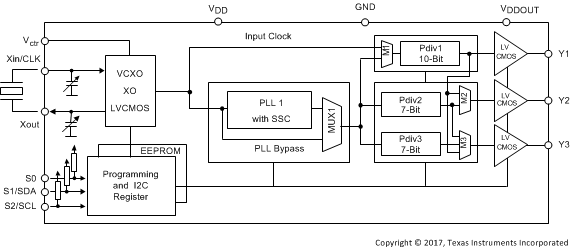
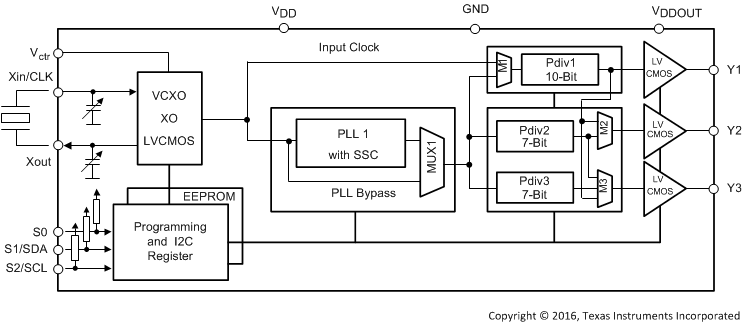
CDCE813-Q1Programmable 1-PLL clock synthesizer and jitter cleaner with 2.5-V and 3.3-V outputs | Integrated Circuits (ICs) | 2 | Active | The CDCE813-Q1 device is a modular Phase-locked-loop-based (PLL), low-cost, high-performance, programmable clock synthesizers. They generate up to three output clocks from a single input frequency. Each output can be programmed in-system for any clock frequency up to 230MHz, using the integrated configurable PLL.
The CDCE813-Q1 has separate output supply pins, VDDOUT, providing 2.5V to 3.3V.
The input accepts an external crystal or LVCMOS clock signal. A selectable on-chip VCXO allows synchronization of the output frequency to an external control signal.
The PLL supports SSC (spread-spectrum clocking) for better electromagnetic interference (EMI) performance.
The device supports nonvolatile EEPROM programming for easy customization of the device to the application. All device settings are programmable through the I2C bus, a 2-wire serial interface.
The CDCE813-Q1 operates in a 1.8V core environment as well as eliminating the need for additional, independent XTAL oscillators which reduces component count and board size. The device operates in a temperature range of –40°C to 105°C.
The CDCE813-Q1 device is a modular Phase-locked-loop-based (PLL), low-cost, high-performance, programmable clock synthesizers. They generate up to three output clocks from a single input frequency. Each output can be programmed in-system for any clock frequency up to 230MHz, using the integrated configurable PLL.
The CDCE813-Q1 has separate output supply pins, VDDOUT, providing 2.5V to 3.3V.
The input accepts an external crystal or LVCMOS clock signal. A selectable on-chip VCXO allows synchronization of the output frequency to an external control signal.
The PLL supports SSC (spread-spectrum clocking) for better electromagnetic interference (EMI) performance.
The device supports nonvolatile EEPROM programming for easy customization of the device to the application. All device settings are programmable through the I2C bus, a 2-wire serial interface.
The CDCE813-Q1 operates in a 1.8V core environment as well as eliminating the need for additional, independent XTAL oscillators which reduces component count and board size. The device operates in a temperature range of –40°C to 105°C. |
| Clock/Timing | 2 | Active | |
CDCE913-Q1Automotive catalog programmable 1-PLL VCXO clock synthesizer with 2.5-V or 3.3-V LVCMOS outputs | Evaluation and Demonstration Boards and Kits | 4 | Active | The CDCE913-Q1 and CDCEL913-Q1 devices are modular, phase-locked loop (PLL)-based programmable clock synthesizers. These devices provide flexible and programmable options, such as output clocks, input signals, and control pins, so that the user can configure the CDCE913-Q1 and CDCEL913-Q1 for their own specifications.
The CDCE913-Q1 and CDCEL913-Q1 generate up to three output clocks from a single input frequency to enable both board space and cost savings. Additionally, with multiple outputs, the clock generator can replace multiple crystals with one clock generator. This makes the device well-suited for head unit and telematics applications in infotainment and camera systems in ADAS, as these platforms are evolving into smaller and more cost effective systems.
Also, each output can be programmed in-system for any clock frequency up to 230MHz through the integrated, configurable PLL. The PLL also supports spread-spectrum clocking (SSC) with programmable down and center spread. This provides better electromagnetic interference (EMI) performance to enable customers to pass industry standards such as CISPR-25.
Customization of frequency programming and SSC are accessed using three, user-defined control pins. This eliminates the need to use an additional interface to control the clock. Specific power-up and power-down sequences can also be defined to the user’s needs.
The CDCE913-Q1 and CDCEL913-Q1 devices are modular, phase-locked loop (PLL)-based programmable clock synthesizers. These devices provide flexible and programmable options, such as output clocks, input signals, and control pins, so that the user can configure the CDCE913-Q1 and CDCEL913-Q1 for their own specifications.
The CDCE913-Q1 and CDCEL913-Q1 generate up to three output clocks from a single input frequency to enable both board space and cost savings. Additionally, with multiple outputs, the clock generator can replace multiple crystals with one clock generator. This makes the device well-suited for head unit and telematics applications in infotainment and camera systems in ADAS, as these platforms are evolving into smaller and more cost effective systems.
Also, each output can be programmed in-system for any clock frequency up to 230MHz through the integrated, configurable PLL. The PLL also supports spread-spectrum clocking (SSC) with programmable down and center spread. This provides better electromagnetic interference (EMI) performance to enable customers to pass industry standards such as CISPR-25.
Customization of frequency programming and SSC are accessed using three, user-defined control pins. This eliminates the need to use an additional interface to control the clock. Specific power-up and power-down sequences can also be defined to the user’s needs. |
CDCE925Programmable 2-PLL VCXO clock synthesizer with 2.5-V or 3.3-V LVCMOS outputs | Clock/Timing | 3 | Active | The CDCE925 and CDCEL925 are modular PLL-based low-cost, high-performance, programmable clock synthesizers, multipliers, and dividers. They generate up to five output clocks from a single input frequency. Each output can be programmed in-system for any clock frequency up to 230 MHz, using up to two independent configurable PLLs.
The CDCEx925 has a separate output supply pin, VDDOUT, which is 1.8 V for CDCEL925 and 2.5 V to 3.3 V for CDCE925.
The input accepts an external crystal or LVCMOS clock signal. In case of a crystal input, an on-chip load capacitor is adequate for most applications. The value of the load capacitor is programmable from 0 to 20 pF. Additionally, an on-chip VCXO is selectable which allows synchronization of the output frequency to an external control signal, that is, PWM signal.
The deep M/N divider ratio allows the generation of zero-ppm audio/video, networking (WLAN, Bluetooth, Ethernet, GPS), or interface (USB, IEEE1394, memory stick) clocks from a 27-MHz reference input frequency, for example.
All PLLs support SSC (spread-spectrum clocking). SSC can be center-spread or down-spread clocking, which is a common technique to reduce electromagnetic interference (EMI).
Based on the PLL frequency and the divider settings, the internal loop filter components are automatically adjusted to achieve high stability and optimized jitter transfer characteristic of each PLL.
The device supports nonvolatile EEPROM programming for easy customization of the device in the application. It is preset to a factory default configuration and can be reprogrammed to a different application configuration before it goes onto the PCB or reprogrammed by in-system programming. All device settings are programmable through the SDA/SCL bus, a 2-wire serial interface.
Three, free programmable control inputs, S0, S1, and S2, can be used to select different frequencies, or change the SSC setting for lowering EMI, or other control features like outputs disable to low, outputs in high-impedance state, power down, PLL bypass, and so forth.
The CDCx925 operates in a 1.8-V environment and in a temperature range of –40°C to 85°C.
The CDCE925 and CDCEL925 are modular PLL-based low-cost, high-performance, programmable clock synthesizers, multipliers, and dividers. They generate up to five output clocks from a single input frequency. Each output can be programmed in-system for any clock frequency up to 230 MHz, using up to two independent configurable PLLs.
The CDCEx925 has a separate output supply pin, VDDOUT, which is 1.8 V for CDCEL925 and 2.5 V to 3.3 V for CDCE925.
The input accepts an external crystal or LVCMOS clock signal. In case of a crystal input, an on-chip load capacitor is adequate for most applications. The value of the load capacitor is programmable from 0 to 20 pF. Additionally, an on-chip VCXO is selectable which allows synchronization of the output frequency to an external control signal, that is, PWM signal.
The deep M/N divider ratio allows the generation of zero-ppm audio/video, networking (WLAN, Bluetooth, Ethernet, GPS), or interface (USB, IEEE1394, memory stick) clocks from a 27-MHz reference input frequency, for example.
All PLLs support SSC (spread-spectrum clocking). SSC can be center-spread or down-spread clocking, which is a common technique to reduce electromagnetic interference (EMI).
Based on the PLL frequency and the divider settings, the internal loop filter components are automatically adjusted to achieve high stability and optimized jitter transfer characteristic of each PLL.
The device supports nonvolatile EEPROM programming for easy customization of the device in the application. It is preset to a factory default configuration and can be reprogrammed to a different application configuration before it goes onto the PCB or reprogrammed by in-system programming. All device settings are programmable through the SDA/SCL bus, a 2-wire serial interface.
Three, free programmable control inputs, S0, S1, and S2, can be used to select different frequencies, or change the SSC setting for lowering EMI, or other control features like outputs disable to low, outputs in high-impedance state, power down, PLL bypass, and so forth.
The CDCx925 operates in a 1.8-V environment and in a temperature range of –40°C to 85°C. |
CDCE937-Q1Automotive catalog programmable 3-PLL VCXO clock synthesizer with 2.5-V or 3.3-V LVCMOS outputs | Integrated Circuits (ICs) | 4 | Active | The CDCE937-Q1 and CDCEL937-Q1 devices are modular, phase-locked loop (PLL) based programmable clock synthesizers. These devices provide flexible and programmable options, such as output clocks, input signals, and control pins, so that the user can configure the CDCEx937-Q1 for their own specifications.
The CDCEx937-Q1 generates up to seven output clocks from a single input frequency to enable both board space and cost savings. Additionally, with multiple outputs, the clock generator can replace multiple crystals with one clock generator. This makes the device well-suited for head unit and telematics applications in infotainment and camera systems in ADAS as these platforms are evolving into smaller and more cost effective systems.
Furthermore, each output can be programmed in-system for any clock frequency up to 230 MHz through the integrated, configurable PLL. The PLL also supports spread-spectrum clocking (SSC) with programmable down and center spread. This provides better electromagnetic interference (EMI) performance to enable customers to pass industry standards such as CISPR-25.
Customization of frequency programming and SSC are accessed using three user-defined control pins. This eliminates the additional interface requirement to control the clock. Specific power-up and power-down sequences can also be defined to the userΩs needs.
The CDCE937-Q1 and CDCEL937-Q1 devices are modular, phase-locked loop (PLL) based programmable clock synthesizers. These devices provide flexible and programmable options, such as output clocks, input signals, and control pins, so that the user can configure the CDCEx937-Q1 for their own specifications.
The CDCEx937-Q1 generates up to seven output clocks from a single input frequency to enable both board space and cost savings. Additionally, with multiple outputs, the clock generator can replace multiple crystals with one clock generator. This makes the device well-suited for head unit and telematics applications in infotainment and camera systems in ADAS as these platforms are evolving into smaller and more cost effective systems.
Furthermore, each output can be programmed in-system for any clock frequency up to 230 MHz through the integrated, configurable PLL. The PLL also supports spread-spectrum clocking (SSC) with programmable down and center spread. This provides better electromagnetic interference (EMI) performance to enable customers to pass industry standards such as CISPR-25.
Customization of frequency programming and SSC are accessed using three user-defined control pins. This eliminates the additional interface requirement to control the clock. Specific power-up and power-down sequences can also be defined to the userΩs needs. |
CDCE949-Q1AEC-Q100 programmable 4-PLL VCXO clock synthesizer with 2.5-V or 3.3-V LVCMOS outputs | Evaluation and Demonstration Boards and Kits | 3 | Active | The CDCE949 and CDCEL949 are modular PLL-based low cost, high-performance, programmable clock synthesizers, multipliers and dividers. These devices generate up to nine output clocks from a single input frequency. Each output can be programmed in-system for any clock frequency up to 230MHz, using up to four independent configurable PLLs.
The CDCEx949 has separate output supply pins (VDDOUT): 1.8V for the CDCEL949 and 2.5V to 3.3V for the CDCE949.
The input accepts an external crystal or LVCMOS clock signal. If an external crystal is used, an on-chip load capacitor is adequate for most applications. The value of the load capacitor is programmable from 0pF to 20pF. Additionally, an on-chip VCXO is selectable, allowing synchronization of the output frequency to an external control signal, that is, a PWM signal.
The deep M/N divider ratio allows the generation of 0ppm audio or video, networking (WLAN, BlueTooth™, Ethernet, GPS) or Interface (USB, IEEE1394, Memory Stick) clocks from a reference input frequency, such as 27MHz.
All PLLs support SSC (Spread-Spectrum Clocking). SSC can be Center-Spread or Down-Spread clocking. This is a common technique to reduce electro-magnetic interference (EMI).
Based on the PLL frequency and the divider settings, the internal loop-filter components are automatically adjusted to achieve high stability, and to optimize the jitter-transfer characteristics of each PLL.
The device supports non-volatile EEPROM programming for easy customization of the device to the application. The CDCEx949 is preset to a factory-default configuration. The device can be reprogrammed to a different application configuration before PCB assembly, or reprogrammed by in-system programming. All device settings are programmable through the SDA and SCL bus, a 2-wire serial interface.
Three programmable control inputs, S0, S1 and S2, can be used to control various aspects of operation including frequency selection, changing the SSC parameters to lower EMI, PLL bypass, power down, and choosing between low level or 3-state for the output-disable function.
The CDCEx949 operates in a 1.8V environment within a temperature range of –40°C to 85°C.
The CDCE949 and CDCEL949 are modular PLL-based low cost, high-performance, programmable clock synthesizers, multipliers and dividers. These devices generate up to nine output clocks from a single input frequency. Each output can be programmed in-system for any clock frequency up to 230MHz, using up to four independent configurable PLLs.
The CDCEx949 has separate output supply pins (VDDOUT): 1.8V for the CDCEL949 and 2.5V to 3.3V for the CDCE949.
The input accepts an external crystal or LVCMOS clock signal. If an external crystal is used, an on-chip load capacitor is adequate for most applications. The value of the load capacitor is programmable from 0pF to 20pF. Additionally, an on-chip VCXO is selectable, allowing synchronization of the output frequency to an external control signal, that is, a PWM signal.
The deep M/N divider ratio allows the generation of 0ppm audio or video, networking (WLAN, BlueTooth™, Ethernet, GPS) or Interface (USB, IEEE1394, Memory Stick) clocks from a reference input frequency, such as 27MHz.
All PLLs support SSC (Spread-Spectrum Clocking). SSC can be Center-Spread or Down-Spread clocking. This is a common technique to reduce electro-magnetic interference (EMI).
Based on the PLL frequency and the divider settings, the internal loop-filter components are automatically adjusted to achieve high stability, and to optimize the jitter-transfer characteristics of each PLL.
The device supports non-volatile EEPROM programming for easy customization of the device to the application. The CDCEx949 is preset to a factory-default configuration. The device can be reprogrammed to a different application configuration before PCB assembly, or reprogrammed by in-system programming. All device settings are programmable through the SDA and SCL bus, a 2-wire serial interface.
Three programmable control inputs, S0, S1 and S2, can be used to control various aspects of operation including frequency selection, changing the SSC parameters to lower EMI, PLL bypass, power down, and choosing between low level or 3-state for the output-disable function.
The CDCEx949 operates in a 1.8V environment within a temperature range of –40°C to 85°C. |