T
Texas Instruments
| Series | Category | # Parts | Status | Description |
|---|---|---|---|---|
| Part | Spec A | Spec B | Spec C | Spec D | Description |
|---|---|---|---|---|---|



| Series | Category | # Parts | Status | Description |
|---|---|---|---|---|
| Part | Spec A | Spec B | Spec C | Spec D | Description |
|---|---|---|---|---|---|
| Part | Category | Description |
|---|---|---|
 Texas Instruments BQ2002CSNTRG4Unknown | Integrated Circuits (ICs) | LINEAR BATTERY CHARGER NICD/NIMH 2000MA 0V TO 6V 8-PIN SOIC T/R |
 Texas Instruments LM3676SDX-3.3Obsolete | Integrated Circuits (ICs) | IC REG BUCK 3.3V 600MA 8WSON |
 Texas Instruments | Integrated Circuits (ICs) | TMX320DRE311 179PIN UBGA 200MHZ |
 Texas Instruments UCC3580N-1G4Obsolete | Integrated Circuits (ICs) | IC REG CTRLR FWRD CONV 16DIP |
 Texas Instruments LM2831YMF EVALObsolete | Development Boards Kits Programmers | EVAL BOARD FOR LM2831 |
 Texas Instruments | Integrated Circuits (ICs) | BUFFER/LINE DRIVER 8-CH NON-INVERTING 3-ST CMOS 20-PIN SSOP T/R |
 Texas Instruments | Integrated Circuits (ICs) | ANALOG OTHER PERIPHERALS |
Texas Instruments | Integrated Circuits (ICs) | RADIATION-HARDENED, QMLP 60V HAL |
 Texas Instruments SN75LVDS051DRObsolete | Integrated Circuits (ICs) | IC TRANSCEIVER FULL 2/2 16SOIC |
 Texas Instruments | Integrated Circuits (ICs) | AUTOMOTIVE OCTAL D-TYPE FLIP-FLO |
| Series | Category | # Parts | Status | Description |
|---|---|---|---|---|
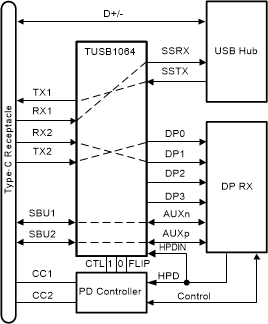
TUSB1064-Q1Automotive USB Type-C® 10Gbps DP Alt mode linear redriver crosspoint switch for sink side | Signal Buffers, Repeaters, Splitters | 2 | Active | The TUSB1064-Q1 is a VESA DisplayPort™ Alt Mode over USB-C redriving switch that supports USB 3.2 data rates up to 10Gbps and DisplayPort 1.4 up to 8.1Gbps for upstream facing port (Sink). The device is used for UFP_D pin assignments C, D, and E from the VESA® DisplayPort™ Alt Mode over USB Type-C® Standard.
The TUSB1064-Q1 provides several levels of receive linear equalization to compensate for inter symbol interference (ISI) due to cable and board trace loss. The TUSB1064-Q1 operates on a single 3.3V supply and comes in an automotive grade 2 temperature range.
The TUSB1064-Q1 is a VESA DisplayPort™ Alt Mode over USB-C redriving switch that supports USB 3.2 data rates up to 10Gbps and DisplayPort 1.4 up to 8.1Gbps for upstream facing port (Sink). The device is used for UFP_D pin assignments C, D, and E from the VESA® DisplayPort™ Alt Mode over USB Type-C® Standard.
The TUSB1064-Q1 provides several levels of receive linear equalization to compensate for inter symbol interference (ISI) due to cable and board trace loss. The TUSB1064-Q1 operates on a single 3.3V supply and comes in an automotive grade 2 temperature range. |
TUSB1104USB Type-C™ 10-Gbps 3.2 x2 adaptive linear redriver | Development Boards, Kits, Programmers | 5 | Active | The TUSB1104 is a 10Gbps USB 3.2 x2 linear redriver for USB-C applications enabling up to 20Gbps total data throughput. The TUSB1104 is intended to reside between a Host and a USB-C receptacle or between a USB device and a USB-C receptacle. The TUSB1104 supports both USB 3.2 Gen2 (10Gbps) and Gen1 (5Gbps) as well as USB 3.2 low power states (Disconnect, U1, U2, and U3).
The TUSB1104 incorporates an adaptive receiver equalization (AEQ) feature. The AEQ feature automatically determines what the best ISI compensation settings are between the TUSB1104 and USB device plugged into the USB connector resulting in improved interoperability.
The TUSB1104 operates from a single 3.3V supply and is available in a 40-pin WQFN package.
The TUSB1104 is a 10Gbps USB 3.2 x2 linear redriver for USB-C applications enabling up to 20Gbps total data throughput. The TUSB1104 is intended to reside between a Host and a USB-C receptacle or between a USB device and a USB-C receptacle. The TUSB1104 supports both USB 3.2 Gen2 (10Gbps) and Gen1 (5Gbps) as well as USB 3.2 low power states (Disconnect, U1, U2, and U3).
The TUSB1104 incorporates an adaptive receiver equalization (AEQ) feature. The AEQ feature automatically determines what the best ISI compensation settings are between the TUSB1104 and USB device plugged into the USB connector resulting in improved interoperability.
The TUSB1104 operates from a single 3.3V supply and is available in a 40-pin WQFN package. |
| Integrated Circuits (ICs) | 3 | Active | ||
TUSB1106Automotive Advanced Universal Serial Bus Transcievers | Integrated Circuits (ICs) | 6 | Active | The TUSB1105 and TUSB1106 universal serial bus (USB) transceivers are compliant with the Universal Serial Bus Specification Rev. 2.0. These devices can transmit and receive serial data at both full-speed (12-Mbit/s) and low-speed (1.5-Mbit/s) data rates. The TUSB1105 and TUSB1106 can be used as USB device transceivers or USB host transceivers.
The devices allow USB application-specific ICs (ASICs) and programmable logic devices (PLDs), with power-supply voltages from 1.65 V to 3.6 V, to interface with the physical layer (PHY) of the universal serial bus. They have an integrated 5-V to 3.3-V voltage regulator for direct powering via the USB supply VBUS.
The TUSB1105 allows single-ended and differential input modes selectable by a mode (MODE) input and is available in RGT and RTZ packages. The TUSB1106 allows only differential input mode and is available in PW, RGT, RSV, and RTZ packages.
The TUSB1105 and TUSB1106 are ideal for portable electronic devices, such as mobile phones, personal digital assistants, information appliances, and digital still cameras.
The TUSB1105 and TUSB1106 universal serial bus (USB) transceivers are compliant with the Universal Serial Bus Specification Rev. 2.0. These devices can transmit and receive serial data at both full-speed (12-Mbit/s) and low-speed (1.5-Mbit/s) data rates. The TUSB1105 and TUSB1106 can be used as USB device transceivers or USB host transceivers.
The devices allow USB application-specific ICs (ASICs) and programmable logic devices (PLDs), with power-supply voltages from 1.65 V to 3.6 V, to interface with the physical layer (PHY) of the universal serial bus. They have an integrated 5-V to 3.3-V voltage regulator for direct powering via the USB supply VBUS.
The TUSB1105 allows single-ended and differential input modes selectable by a mode (MODE) input and is available in RGT and RTZ packages. The TUSB1106 allows only differential input mode and is available in PW, RGT, RSV, and RTZ packages.
The TUSB1105 and TUSB1106 are ideal for portable electronic devices, such as mobile phones, personal digital assistants, information appliances, and digital still cameras. |
TUSB1142USB Type-C™ 10-Gbps 3.2 adaptive linear redriver with 2:1/1:2 mux/demux | Interface | 4 | Active | The TUSB1142 is a 10Gbps USB 3.2 linear redriver with 1:2 DeMUX or 2:1 Mux function for USB-C applications. The TUSB1142 is intended to reside between a Host and a USB-C receptacle or between a USB device and a USB-C receptacle. The TUSB1142 supports both USB 3.2 Gen2 (10Gbps) and Gen1 (5Gbps) as well as USB 3.2 low power states (Disconnect, U1, U2, and U3).
The TUSB1142 incorporates an adaptive receiver equalization (AEQ) feature. The AEQ feature automatically determines what the best ISI compensation settings are between the TUSB1142 and USB device plugged into the USB connector resulting in improved interoperability.
The TUSB1142 operates from a single 3.3V supply and is available in a 40-pin WQFN package.
The TUSB1142 is a 10Gbps USB 3.2 linear redriver with 1:2 DeMUX or 2:1 Mux function for USB-C applications. The TUSB1142 is intended to reside between a Host and a USB-C receptacle or between a USB device and a USB-C receptacle. The TUSB1142 supports both USB 3.2 Gen2 (10Gbps) and Gen1 (5Gbps) as well as USB 3.2 low power states (Disconnect, U1, U2, and U3).
The TUSB1142 incorporates an adaptive receiver equalization (AEQ) feature. The AEQ feature automatically determines what the best ISI compensation settings are between the TUSB1142 and USB device plugged into the USB connector resulting in improved interoperability.
The TUSB1142 operates from a single 3.3V supply and is available in a 40-pin WQFN package. |
| Interface | 4 | Active | ||
| Integrated Circuits (ICs) | 2 | Obsolete | ||
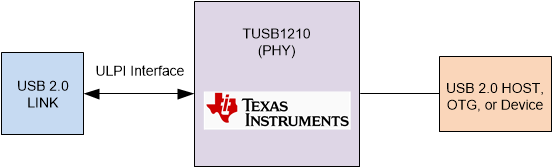
TUSB1210High-speed 480-Mbps USB 2.0 OTG transceiver | Development Boards, Kits, Programmers | 5 | Active | The TUSB1210 is a USB2.0 transceiver chip, designed to interface with a USB controller through a ULPI interface. The device supports all USB2.0 data rates (high-speed 480 Mbps, full-speed 12 Mbps, and low-speed 1.5 Mbps), and is compliant to both host and peripheral modes. The device additionally supports a UART mode and legacy ULPI serial modes. TUSB1210 also supports the OTG (Ver1.3) optional addendum to the USB 2.0 Specification, including HNP and SRP.
The DP/DM external component compensation in the transmitter compensates for variations in the series impendence in order to match with the data line impedance and the receiver input impedance, to limit data reflections and thereby improve eye diagrams.
The TUSB1210 is a USB2.0 transceiver chip, designed to interface with a USB controller through a ULPI interface. The device supports all USB2.0 data rates (high-speed 480 Mbps, full-speed 12 Mbps, and low-speed 1.5 Mbps), and is compliant to both host and peripheral modes. The device additionally supports a UART mode and legacy ULPI serial modes. TUSB1210 also supports the OTG (Ver1.3) optional addendum to the USB 2.0 Specification, including HNP and SRP.
The DP/DM external component compensation in the transmitter compensates for variations in the series impendence in order to match with the data line impedance and the receiver input impedance, to limit data reflections and thereby improve eye diagrams. |
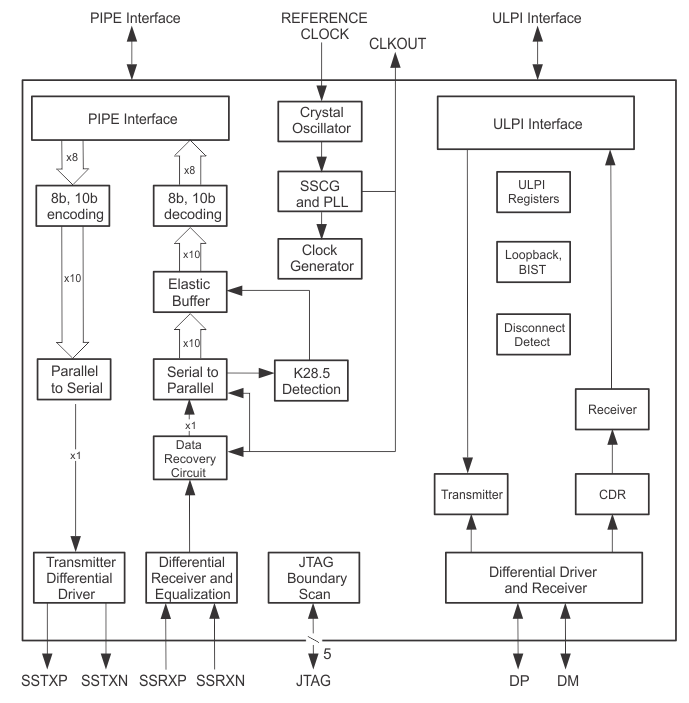
TUSB1310SuperSpeed USB Transceiver with PIPE3 and ULPI Interfaces | Drivers, Receivers, Transceivers | 1 | NRND | The TUSB1310 is a single port, 5.0-Gbps USB 3.0 physical layer transceiver operating off of a single crystal or an external reference clock. The reference clock frequencies are selectable from 20, 25, 30, and 40 MHz. The TUSB1310 provides a clock to USB link layer controllers. The single reference clock allows the TUSB1310 to provide a cost effective USB 3.0 solution with few external components and a minimum implementation cost.
Link controller interfaces to the TUSB1310 are via a PIPE (SuperSpeed) and a ULPI (USB2.0) interface. The 16-bit PIPE operates with a 250-MHz interface clock. The ULPI supports 8-bit operations with a 60-MHz interface clock.
USB 3.0 reduces active power and idle power by improving power management. The PIPE interface controls the TUSB1310 low power states which minimizes power consumption.
SuperSpeed USB leverages existing USB software infrastructure by keeping the existing software interfaces and software drivers. In addition the SuperSpeed USB retains backward compatibility at the Type-A connector with USB2.0 based PCs and with USB2.0 cables.
The TUSB1310 is a single port, 5.0-Gbps USB 3.0 physical layer transceiver operating off of a single crystal or an external reference clock. The reference clock frequencies are selectable from 20, 25, 30, and 40 MHz. The TUSB1310 provides a clock to USB link layer controllers. The single reference clock allows the TUSB1310 to provide a cost effective USB 3.0 solution with few external components and a minimum implementation cost.
Link controller interfaces to the TUSB1310 are via a PIPE (SuperSpeed) and a ULPI (USB2.0) interface. The 16-bit PIPE operates with a 250-MHz interface clock. The ULPI supports 8-bit operations with a 60-MHz interface clock.
USB 3.0 reduces active power and idle power by improving power management. The PIPE interface controls the TUSB1310 low power states which minimizes power consumption.
SuperSpeed USB leverages existing USB software infrastructure by keeping the existing software interfaces and software drivers. In addition the SuperSpeed USB retains backward compatibility at the Type-A connector with USB2.0 based PCs and with USB2.0 cables. |
TUSB1310ASuperSpeed 5 Gbps USB 3.0 Transceiver with PIPE and ULPI Interfaces | Integrated Circuits (ICs) | 2 | NRND | The TUSB1310A device is one port, 5.0-Gbps USB 3.0 physical layer transceiver that operates off of one reference clock, which is provided by either a crystal or an external reference clock. The reference clock frequencies are selectable from 20, 25, 30, and 40 MHz. The TUSB1310A device provides the clock to the USB controller. The use of one reference clock allows the TUSB1310A device to provide a cost-effective USB 3.0 solution with few external components and a low implementation cost.
The USB controller interfaces to the TUSB1310A device through a PIPE (SuperSpeed) and a ULPI (USB 2.0) interface. The 16-bit PIPE operates off of a 250-MHz interface clock. The ULPI supports 8-bit operations with a 60-MHz interface clock.
USB 3.0 reduces active and idle power consumption with improved power-management features. The low-power states of the TUSB1310A device are controlled by the USB controller through the PIPE interface.
SuperSpeed USB uses existing USB software infrastructure by keeping the existing software interfaces and software drivers intact. In addition, SuperSpeed USB retains backward compatibility with USB 2.0 based products by using the same form-factor Type-A connector and cables. Existing USB 2.0 devices work with new USB 3.0 hosts and new USB 3.0 devices with work with legacy USB 2.0 hosts.
The TUSB1310A device is one port, 5.0-Gbps USB 3.0 physical layer transceiver that operates off of one reference clock, which is provided by either a crystal or an external reference clock. The reference clock frequencies are selectable from 20, 25, 30, and 40 MHz. The TUSB1310A device provides the clock to the USB controller. The use of one reference clock allows the TUSB1310A device to provide a cost-effective USB 3.0 solution with few external components and a low implementation cost.
The USB controller interfaces to the TUSB1310A device through a PIPE (SuperSpeed) and a ULPI (USB 2.0) interface. The 16-bit PIPE operates off of a 250-MHz interface clock. The ULPI supports 8-bit operations with a 60-MHz interface clock.
USB 3.0 reduces active and idle power consumption with improved power-management features. The low-power states of the TUSB1310A device are controlled by the USB controller through the PIPE interface.
SuperSpeed USB uses existing USB software infrastructure by keeping the existing software interfaces and software drivers intact. In addition, SuperSpeed USB retains backward compatibility with USB 2.0 based products by using the same form-factor Type-A connector and cables. Existing USB 2.0 devices work with new USB 3.0 hosts and new USB 3.0 devices with work with legacy USB 2.0 hosts. |