T
Texas Instruments
| Series | Category | # Parts | Status | Description |
|---|---|---|---|---|
| Part | Spec A | Spec B | Spec C | Spec D | Description |
|---|---|---|---|---|---|



| Series | Category | # Parts | Status | Description |
|---|---|---|---|---|
| Part | Spec A | Spec B | Spec C | Spec D | Description |
|---|---|---|---|---|---|
| Part | Category | Description |
|---|---|---|
 Texas Instruments BQ2002CSNTRG4Unknown | Integrated Circuits (ICs) | LINEAR BATTERY CHARGER NICD/NIMH 2000MA 0V TO 6V 8-PIN SOIC T/R |
 Texas Instruments LM3676SDX-3.3Obsolete | Integrated Circuits (ICs) | IC REG BUCK 3.3V 600MA 8WSON |
 Texas Instruments | Integrated Circuits (ICs) | TMX320DRE311 179PIN UBGA 200MHZ |
 Texas Instruments UCC3580N-1G4Obsolete | Integrated Circuits (ICs) | IC REG CTRLR FWRD CONV 16DIP |
 Texas Instruments LM2831YMF EVALObsolete | Development Boards Kits Programmers | EVAL BOARD FOR LM2831 |
 Texas Instruments | Integrated Circuits (ICs) | BUFFER/LINE DRIVER 8-CH NON-INVERTING 3-ST CMOS 20-PIN SSOP T/R |
 Texas Instruments | Integrated Circuits (ICs) | ANALOG OTHER PERIPHERALS |
Texas Instruments | Integrated Circuits (ICs) | RADIATION-HARDENED, QMLP 60V HAL |
 Texas Instruments SN75LVDS051DRObsolete | Integrated Circuits (ICs) | IC TRANSCEIVER FULL 2/2 16SOIC |
 Texas Instruments | Integrated Circuits (ICs) | AUTOMOTIVE OCTAL D-TYPE FLIP-FLO |
| Series | Category | # Parts | Status | Description |
|---|---|---|---|---|
TPS25730Sink-only USB Type-C® and USB Power Delivery (PD) controller with no firmware development required | Power Management (PMIC) | 2 | Active | The TPS25730 is a highly integrated stand-alone USB Type-C and Power Delivery (PD) controller optimized for sink only applications supporting USB-C PD Power. The TPS25730 integrates a fully managed power path with robust protection for a complete USB-C PD solution. The TPS25730 also has the ability to control an external power path through the use of internal gate drivers. The TPS25730 is best suited for sink only applications that may have previously been powered by a barrel jack. Using resistor pin strapping, a user can implement a fully featured USB Type-C PD port with the TPS25730 on their platform. There is no need for an external EEPROM, an external microcontroller, or any type of firmware development.
The TPS25730 is intended to make setting up a sink only USB Type-C application simple yet robust. A user has all of the benefits of a barrel jack port, while now taking advantage of the benefits that USB Type-C and USB Type-C PD can bring to their system.
The TPS25730 is a highly integrated stand-alone USB Type-C and Power Delivery (PD) controller optimized for sink only applications supporting USB-C PD Power. The TPS25730 integrates a fully managed power path with robust protection for a complete USB-C PD solution. The TPS25730 also has the ability to control an external power path through the use of internal gate drivers. The TPS25730 is best suited for sink only applications that may have previously been powered by a barrel jack. Using resistor pin strapping, a user can implement a fully featured USB Type-C PD port with the TPS25730 on their platform. There is no need for an external EEPROM, an external microcontroller, or any type of firmware development.
The TPS25730 is intended to make setting up a sink only USB Type-C application simple yet robust. A user has all of the benefits of a barrel jack port, while now taking advantage of the benefits that USB Type-C and USB Type-C PD can bring to their system. |
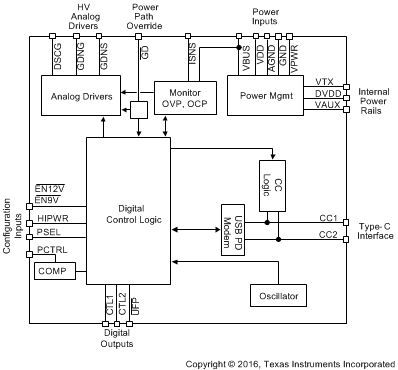
TPS25740TPS25740 USB Type-C™ Rev 1.2 and USB PD 2.0 Source Controller (5V/12V/20V) | Evaluation Boards | 8 | NRND | The TPS25740, TPS25740A implements a source that is compliant to USB Power Delivery 2.0 version 1.2 and Type-C revision 1.2. It monitors the CC pin to detect when a USB Type-C sink is attached, then it enables a N-ch MOSFET gate driver to turn on VBUS. The device then offers up to three different voltages using USB Power Delivery. Four input pins (PSEL, HIPWR, PCTRL, and (EN12VorEN9V) are used to configure the voltages and currents advertised. The device uses the CTL1 and CTL2 pins to select one of three voltages from the power supply based on the voltage requested by the attached sink. The device automatically handles discharging the VBUS output per USB PD requirements.
The TPS25740, TPS25740A typically draws 8.5 µA (or 5.8 µA if VDD = 3.3 V) when no device is attached. Additional system power saving is achievable by using the Port Attachment Indicator (UFP) output to disable the power source when no device is attached.
Protection features include overvoltage protection, overcurrent protection, over-temperature protection, IEC for CC pins, and system override to disable the gate driver (GD).
The TPS25740, TPS25740A implements a source that is compliant to USB Power Delivery 2.0 version 1.2 and Type-C revision 1.2. It monitors the CC pin to detect when a USB Type-C sink is attached, then it enables a N-ch MOSFET gate driver to turn on VBUS. The device then offers up to three different voltages using USB Power Delivery. Four input pins (PSEL, HIPWR, PCTRL, and (EN12VorEN9V) are used to configure the voltages and currents advertised. The device uses the CTL1 and CTL2 pins to select one of three voltages from the power supply based on the voltage requested by the attached sink. The device automatically handles discharging the VBUS output per USB PD requirements.
The TPS25740, TPS25740A typically draws 8.5 µA (or 5.8 µA if VDD = 3.3 V) when no device is attached. Additional system power saving is achievable by using the Port Attachment Indicator (UFP) output to disable the power source when no device is attached.
Protection features include overvoltage protection, overcurrent protection, over-temperature protection, IEC for CC pins, and system override to disable the gate driver (GD). |
TPS25741USB Type-C™ Rev 1.2 and USB PD Source Controllers | Power Management - Specialized | 6 | Active | The TPS25741, TPS25741A implements a source compliant to USB Power Delivery 2.0 and USB Type-C revision 1.2. It can be used in either a power mux or DC-DC implementation shown in the figure below.
The device monitors the CC pin to detect a USB Type-C sink attachment, then enables the GDNG and G5V gate drivers to apply 5 V to VBUS(refer to figure below). It then offers up to three voltages using USB Power Delivery. In order to source the second voltage the G5V gate driver is disabled and the GDPG gate driver is enabled. In power mux implementations all gate drivers are used and the CTL pins are not necessary. In DC-DC implementations only the GDNG gate driver is necessary and the CTL pins program the power supply for the required voltage. The device automatically discharges VBUSper USB Power Delivery requirements. The PSEL, HIPWR, PCTRL, and EN9V/EN12V pins are used to configure the voltages and currents advertised.
The device typically draws 5.4 µA (8 µA if VDD = 0 V) when no device is attached. The Port Attachment indicator (UFPor DVDD) outputs may be used to disable the power source until a sink is attached for more system power savings.
Protection features include over-voltage, over-current, over-temperature, IEC for CC pins, and system override of gate drivers (GD).
The TPS25741, TPS25741A implements a source compliant to USB Power Delivery 2.0 and USB Type-C revision 1.2. It can be used in either a power mux or DC-DC implementation shown in the figure below.
The device monitors the CC pin to detect a USB Type-C sink attachment, then enables the GDNG and G5V gate drivers to apply 5 V to VBUS(refer to figure below). It then offers up to three voltages using USB Power Delivery. In order to source the second voltage the G5V gate driver is disabled and the GDPG gate driver is enabled. In power mux implementations all gate drivers are used and the CTL pins are not necessary. In DC-DC implementations only the GDNG gate driver is necessary and the CTL pins program the power supply for the required voltage. The device automatically discharges VBUSper USB Power Delivery requirements. The PSEL, HIPWR, PCTRL, and EN9V/EN12V pins are used to configure the voltages and currents advertised.
The device typically draws 5.4 µA (8 µA if VDD = 0 V) when no device is attached. The Port Attachment indicator (UFPor DVDD) outputs may be used to disable the power source until a sink is attached for more system power savings.
Protection features include over-voltage, over-current, over-temperature, IEC for CC pins, and system override of gate drivers (GD). |
TPS25750Highly integrated USB Type-C® and USB Power Delivery controller with pre-configured GUI | Integrated Circuits (ICs) | 2 | Active | The TPS25750 is a highly integrated stand-alone USB Type-C and Power Delivery (PD) controller optimized for applications supporting USB-C PD Power. The TPS25750 integrates fully managed power paths with robust protection for a complete USB-C PD solution. The TPS25750 also integrates control for external battery charger ICs for added ease of use and reduced time to market. The intuitive web based GUI will ask the user a few simple questions on the applications needs using clear block diagrams and simple multiple-choice questions. As a result, the GUI will create the configuration image for the user’s application, reducing much of the complexity associated with competitive USB PD solutions.
The TPS25750 is a highly integrated stand-alone USB Type-C and Power Delivery (PD) controller optimized for applications supporting USB-C PD Power. The TPS25750 integrates fully managed power paths with robust protection for a complete USB-C PD solution. The TPS25750 also integrates control for external battery charger ICs for added ease of use and reduced time to market. The intuitive web based GUI will ask the user a few simple questions on the applications needs using clear block diagrams and simple multiple-choice questions. As a result, the GUI will create the configuration image for the user’s application, reducing much of the complexity associated with competitive USB PD solutions. |
TPS25751USB-C® Power Delivery 3.1 controller with moisture detection and programmable power-supply | Power Management - Specialized | 2 | Active | The TPS25751 is a highly integrated stand-alone USB Type-C and Power Delivery (PD) controller optimized for applications supporting USB-C PD Power. The TPS25751 integrates fully managed power paths with robust protection for a complete USB-C PD solution. The TPS25751 also integrates control for external battery charger ICs for added ease of use and reduced time to market. The intuitive web based GUI asks the user a few simple questions on the applications needs using clear block diagrams and simple multiple-choice questions. As a result, the GUI creates the configuration image for the user’s application, reducing much of the complexity associated with competitive USB PD solutions.
The TPS25751 is a highly integrated stand-alone USB Type-C and Power Delivery (PD) controller optimized for applications supporting USB-C PD Power. The TPS25751 integrates fully managed power paths with robust protection for a complete USB-C PD solution. The TPS25751 also integrates control for external battery charger ICs for added ease of use and reduced time to market. The intuitive web based GUI asks the user a few simple questions on the applications needs using clear block diagrams and simple multiple-choice questions. As a result, the GUI creates the configuration image for the user’s application, reducing much of the complexity associated with competitive USB PD solutions. |
TPS25762-Q1Automotive USB Type-C® PD controller with integrated buck-boost regulator | Power Management (PMIC) | 3 | Active | The TPS25762-Q1 is a fully integrated USB Type-C® Power Delivery (PD) solution with integrated Buck-Boost converter for automotive single USB port applications. Functionality includes: integrated Buck-Boost converter with 4 power switches; an ARM Cortex-M0; USB port controller with Type-C cable plug and orientation detection; USB Battery Charging Specification Version 1.2 (BC1.2) detection; USB Endpoint PHY; device power management and supervisory circuitry; and connector pin over-voltage and short-circuit protection.
An intelligent System Power Management (SPM) Engine maximizes delivered USB power while protecting the system from automotive battery transient and over-temperature conditions.
Device configuration settings are selected through an intuitivegraphical user interface (GUI).
The TPS25762-Q1 is a fully integrated USB Type-C® Power Delivery (PD) solution with integrated Buck-Boost converter for automotive single USB port applications. Functionality includes: integrated Buck-Boost converter with 4 power switches; an ARM Cortex-M0; USB port controller with Type-C cable plug and orientation detection; USB Battery Charging Specification Version 1.2 (BC1.2) detection; USB Endpoint PHY; device power management and supervisory circuitry; and connector pin over-voltage and short-circuit protection.
An intelligent System Power Management (SPM) Engine maximizes delivered USB power while protecting the system from automotive battery transient and over-temperature conditions.
Device configuration settings are selected through an intuitivegraphical user interface (GUI). |
TPS25763-Q1Automotive single-port USB Type-C® PD controller with buck-boost regulator and DisplayPort Alt mode | Power Management (PMIC) | 1 | Active | The TPS25763-Q1 is a fully integrated USB Type-C® Power Delivery (PD) solution with integrated Buck-Boost converter and DisplayPort™ Alternate (Alt) Mode over USB-C® for automotive single USB port applications. Functionality includes: integrated Buck-Boost converter with 4 power switches; an ARM Cortex-M0; USB port controller with Type-C cable plug and orientation detection; DisplayPort Alt Mode; USB Battery Charging Specification Version 1.2 (BC1.2) detection; USB Endpoint PHY; device power management and supervisory circuitry; and connector pin over-voltage and short-circuit protection.
An intelligent System Power Management (SPM) Engine maximizes delivered USB power while protecting the system from automotive battery transient and over-temperature conditions.
Device configuration settings are selected through an intuitivegraphical user interface (GUI).
The TPS25763-Q1 is a fully integrated USB Type-C® Power Delivery (PD) solution with integrated Buck-Boost converter and DisplayPort™ Alternate (Alt) Mode over USB-C® for automotive single USB port applications. Functionality includes: integrated Buck-Boost converter with 4 power switches; an ARM Cortex-M0; USB port controller with Type-C cable plug and orientation detection; DisplayPort Alt Mode; USB Battery Charging Specification Version 1.2 (BC1.2) detection; USB Endpoint PHY; device power management and supervisory circuitry; and connector pin over-voltage and short-circuit protection.
An intelligent System Power Management (SPM) Engine maximizes delivered USB power while protecting the system from automotive battery transient and over-temperature conditions.
Device configuration settings are selected through an intuitivegraphical user interface (GUI). |
| Evaluation and Demonstration Boards and Kits | 2 | Active | ||
TPS25772-Q1Automotive dual-port USB Type-C® PD controller with buck-boost regulator and smart power management | Power Management (PMIC) | 3 | Active | The TPS25772-Q1 is a fully integrated dual-port USB Type-C® Power Delivery (PD) solution with integrated buck-boost converter for automotive dual USB port applications. Functionality includes: integrated Buck-Boost converter with 4 power switches; an ARM Cortex-M0; USB port controller with Type-C cable plug and orientation detection; USB Battery Charging Specification Version 1.2 (BC1.2) detection; USB Endpoint PHY; device power management and supervisory circuitry; and connector pin over-voltage and short-circuit protection;
An intelligent System Power Management (SPM) Engine maximizes delivered USB power while protecting the system from automotive battery transient and over-temperature conditions.
Device configuration settings are selected through an intuitivegraphical user interface (GUI).
The TPS25772-Q1 is a fully integrated dual-port USB Type-C® Power Delivery (PD) solution with integrated buck-boost converter for automotive dual USB port applications. Functionality includes: integrated Buck-Boost converter with 4 power switches; an ARM Cortex-M0; USB port controller with Type-C cable plug and orientation detection; USB Battery Charging Specification Version 1.2 (BC1.2) detection; USB Endpoint PHY; device power management and supervisory circuitry; and connector pin over-voltage and short-circuit protection;
An intelligent System Power Management (SPM) Engine maximizes delivered USB power while protecting the system from automotive battery transient and over-temperature conditions.
Device configuration settings are selected through an intuitivegraphical user interface (GUI). |
TPS25810USB Type-C® source controller and 3A power switch with VCONN | Evaluation and Demonstration Boards and Kits | 5 | Active | The TPS25810-Q1 device is a USB Type-C downstream-facing port (DFP) controller with an integrated 3-A rated USB power switch. The TPS25810-Q1 device monitors the Type-C configuration channel (CC) lines to determine when a USB device is attached. If an upstream-facing port (UFP) device is attached, the TPS25810-Q1 device applies power to VBUSand communicates the selectable VBUScurrent-sourcing capability to the UFP via the pass-through CC line. If the UFP is attached using an electronically marked cable, the TPS25810‑Q1 device also applies VCONNpower to the cable CC pin. The TPS25810-Q1 device also identifies when Type-C audio or debug accessories are attached.
The TPS25810-Q1 device draws less than 0.7 µA (typ) when no device is attached. Additional system power saving is achievable in the S4 and S5 system power states by using theUFPoutput to disable the high-power 5-V supply when no UFP is attached. In this mode, the device is capable of running from an auxiliary supply (AUX), which can be a lower-voltage supply (3.3 V), typically powering the system µC in low-power states (S4 and S5).
The TPS25810-Q1 34-mΩ power switch has two selectable fixed-current limits that align with the Type‑C current levels. TheFAULToutput signals when the switch is in an overcurrent or overtemperature condition. TheLD_DEToutput controls power management to multiple high-current Type-C ports in an environment where all ports cannot simultaneously provide high current (3 A).
The TPS25810-Q1 device is a USB Type-C downstream-facing port (DFP) controller with an integrated 3-A rated USB power switch. The TPS25810-Q1 device monitors the Type-C configuration channel (CC) lines to determine when a USB device is attached. If an upstream-facing port (UFP) device is attached, the TPS25810-Q1 device applies power to VBUSand communicates the selectable VBUScurrent-sourcing capability to the UFP via the pass-through CC line. If the UFP is attached using an electronically marked cable, the TPS25810‑Q1 device also applies VCONNpower to the cable CC pin. The TPS25810-Q1 device also identifies when Type-C audio or debug accessories are attached.
The TPS25810-Q1 device draws less than 0.7 µA (typ) when no device is attached. Additional system power saving is achievable in the S4 and S5 system power states by using theUFPoutput to disable the high-power 5-V supply when no UFP is attached. In this mode, the device is capable of running from an auxiliary supply (AUX), which can be a lower-voltage supply (3.3 V), typically powering the system µC in low-power states (S4 and S5).
The TPS25810-Q1 34-mΩ power switch has two selectable fixed-current limits that align with the Type‑C current levels. TheFAULToutput signals when the switch is in an overcurrent or overtemperature condition. TheLD_DEToutput controls power management to multiple high-current Type-C ports in an environment where all ports cannot simultaneously provide high current (3 A). |