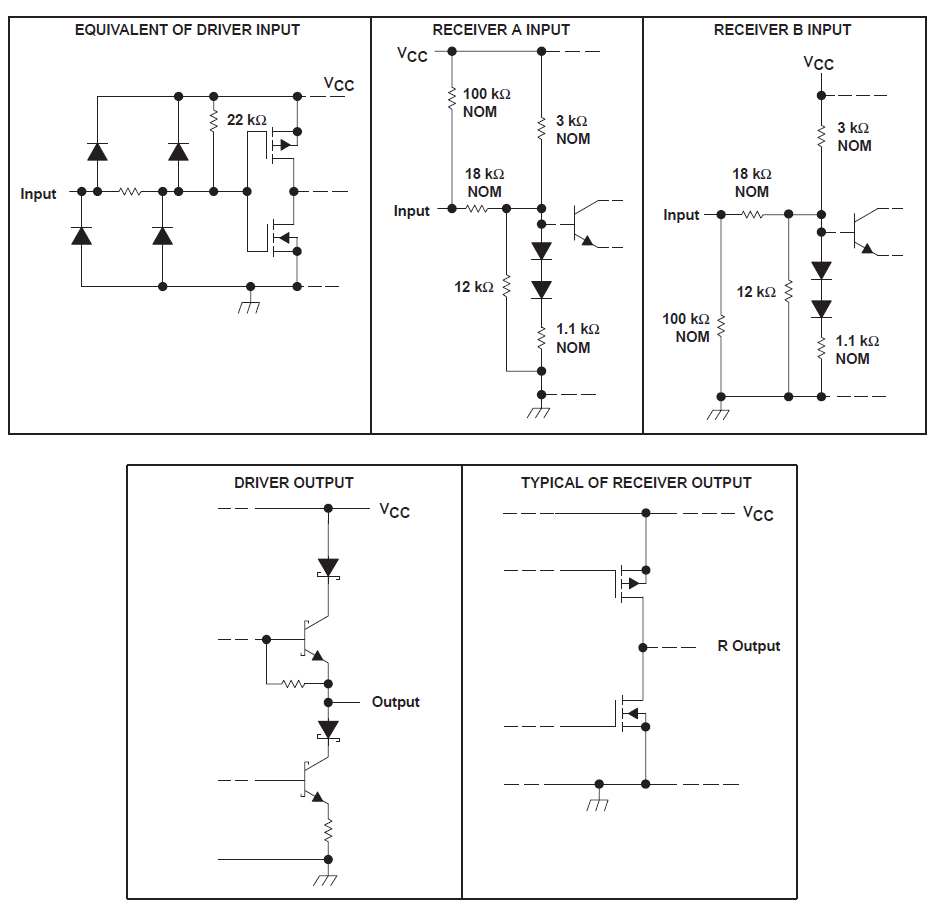
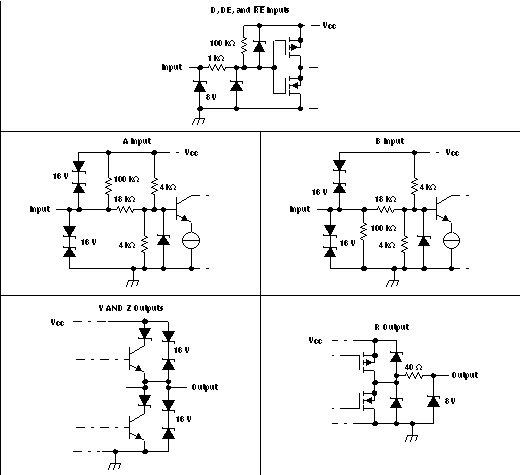
SN65LBC031QHigh-Speed Controller Area Network (CAN) Transceiver | Integrated Circuits (ICs) | 4 | Active | The SN75LBC031 is a CAN transceiver used as an interface between a CAN controller and the physical bus for high speed applications of up to 500 kBaud. The device provides transmit capability to the differential bus and differential receive capability to the controller. The transmitter outputs (CANH and CANL), feature internal transition regulation to provide controlled symmetry resulting in low EMI emissions. Both transmitter outputs are fully protected against battery short circuits and electrical transients that can occur on the bus lines. In the event of excessive device power dissipation the output drivers are disabled by the thermal shutdown circuitry at a junction temperature of approximately 160°C. The inclusion of an internal pullup resistor on the transmitter input ensures a defined output during power up and protocol controller reset. For normal operation at 500 kBaud the ASC terminal is open or tied to GND. For slower speed operation at 125 kBaud the bus output transition times can be increased to reduce EMI by connecting the ASC terminal to VCC. The receiver includes an integrated filter that suppresses the signal into pulses less than 30 ns wide.
The SN75LBC031 is characterized for operation from -40°C to 85°C. The SN65LBC031 is characterized for operation from -40°C to 125°C. The SN65LBC031Q is characterized for operation over the automotive temperature range of -40°C to 125°C.
The SN75LBC031 is a CAN transceiver used as an interface between a CAN controller and the physical bus for high speed applications of up to 500 kBaud. The device provides transmit capability to the differential bus and differential receive capability to the controller. The transmitter outputs (CANH and CANL), feature internal transition regulation to provide controlled symmetry resulting in low EMI emissions. Both transmitter outputs are fully protected against battery short circuits and electrical transients that can occur on the bus lines. In the event of excessive device power dissipation the output drivers are disabled by the thermal shutdown circuitry at a junction temperature of approximately 160°C. The inclusion of an internal pullup resistor on the transmitter input ensures a defined output during power up and protocol controller reset. For normal operation at 500 kBaud the ASC terminal is open or tied to GND. For slower speed operation at 125 kBaud the bus output transition times can be increased to reduce EMI by connecting the ASC terminal to VCC. The receiver includes an integrated filter that suppresses the signal into pulses less than 30 ns wide.
The SN75LBC031 is characterized for operation from -40°C to 85°C. The SN65LBC031 is characterized for operation from -40°C to 125°C. The SN65LBC031Q is characterized for operation over the automotive temperature range of -40°C to 125°C. |
| Integrated Circuits (ICs) | 2 | Active | The SN65LBC170 and SN75LBC170 are monolithic integrated circuits designed for bidirectional data communication on multipoint bus-transmission lines. Potential applications include serial or parallel data transmission, cabled peripheral buses with twin axial, ribbon, or twisted-pair cabling. These devices are suitable for FAST-20 SCSI and can transmit or receive data pulses as short as 25 ns, with skew less than 3 ns.
These devices combine three 3-state differential line drivers and three differential input line receivers, all of which operate from a single 5-V power supply.
The driver differential outputs and the receiver differential inputs are connected internally to form three differential input/output (I/O) bus ports that are designed to offer minimum loading to the bus whenever the driver is disabled or VCC= 0. These ports feature a wide common-mode voltage range making the device suitable for party-line applications over long cable runs.
The driver’s active-high enable and the receiver’s active-low enable are tied together internally and provide a direction input for each driver/receiver pair.
The SN75LBC170 is characterized for operation over the temperature range of 0°C to 70°C. The SN65LBC170 is characterized for operation over the temperature range of –40°C to 85°C.
The SN65LBC170 and SN75LBC170 are monolithic integrated circuits designed for bidirectional data communication on multipoint bus-transmission lines. Potential applications include serial or parallel data transmission, cabled peripheral buses with twin axial, ribbon, or twisted-pair cabling. These devices are suitable for FAST-20 SCSI and can transmit or receive data pulses as short as 25 ns, with skew less than 3 ns.
These devices combine three 3-state differential line drivers and three differential input line receivers, all of which operate from a single 5-V power supply.
The driver differential outputs and the receiver differential inputs are connected internally to form three differential input/output (I/O) bus ports that are designed to offer minimum loading to the bus whenever the driver is disabled or VCC= 0. These ports feature a wide common-mode voltage range making the device suitable for party-line applications over long cable runs.
The driver’s active-high enable and the receiver’s active-low enable are tied together internally and provide a direction input for each driver/receiver pair.
The SN75LBC170 is characterized for operation over the temperature range of 0°C to 70°C. The SN65LBC170 is characterized for operation over the temperature range of –40°C to 85°C. |
| Interface | 2 | Active | The SN65LBC171 and SN75LBC171 are monolithic integrated circuits designed for bidirectional data communication on multipoint bus-transmission lines. Potential applications include serial or parallel data transmission, cabled peripheral buses with twin axial, ribbon, or twisted-pair cabling. These devices are suitable for FAST-20 SCSI and can transmit or receive data pulses as short as 25 ns, with skew less than 3 ns.
These devices combine three 3-state differential line drivers and three differential input line receivers, all of which operate from a single 5-V power supply.
The driver differential outputs and the receiver differential inputs are connected internally to form three differential input/output (I/O) bus ports that are designed to offer minimum loading to the bus whenever the driver is disabled or VCC= 0. These ports feature a wide common-mode voltage range making the device suitable for party-line applications over long cable runs.
The SN75LBC171 is characterized for operation over the temperature range of 0°C to 70°C. The SN65LBC171 is characterized for operation over the temperature range of -40°C to 85°C.
The SN65LBC171 and SN75LBC171 are monolithic integrated circuits designed for bidirectional data communication on multipoint bus-transmission lines. Potential applications include serial or parallel data transmission, cabled peripheral buses with twin axial, ribbon, or twisted-pair cabling. These devices are suitable for FAST-20 SCSI and can transmit or receive data pulses as short as 25 ns, with skew less than 3 ns.
These devices combine three 3-state differential line drivers and three differential input line receivers, all of which operate from a single 5-V power supply.
The driver differential outputs and the receiver differential inputs are connected internally to form three differential input/output (I/O) bus ports that are designed to offer minimum loading to the bus whenever the driver is disabled or VCC= 0. These ports feature a wide common-mode voltage range making the device suitable for party-line applications over long cable runs.
The SN75LBC171 is characterized for operation over the temperature range of 0°C to 70°C. The SN65LBC171 is characterized for operation over the temperature range of -40°C to 85°C. |
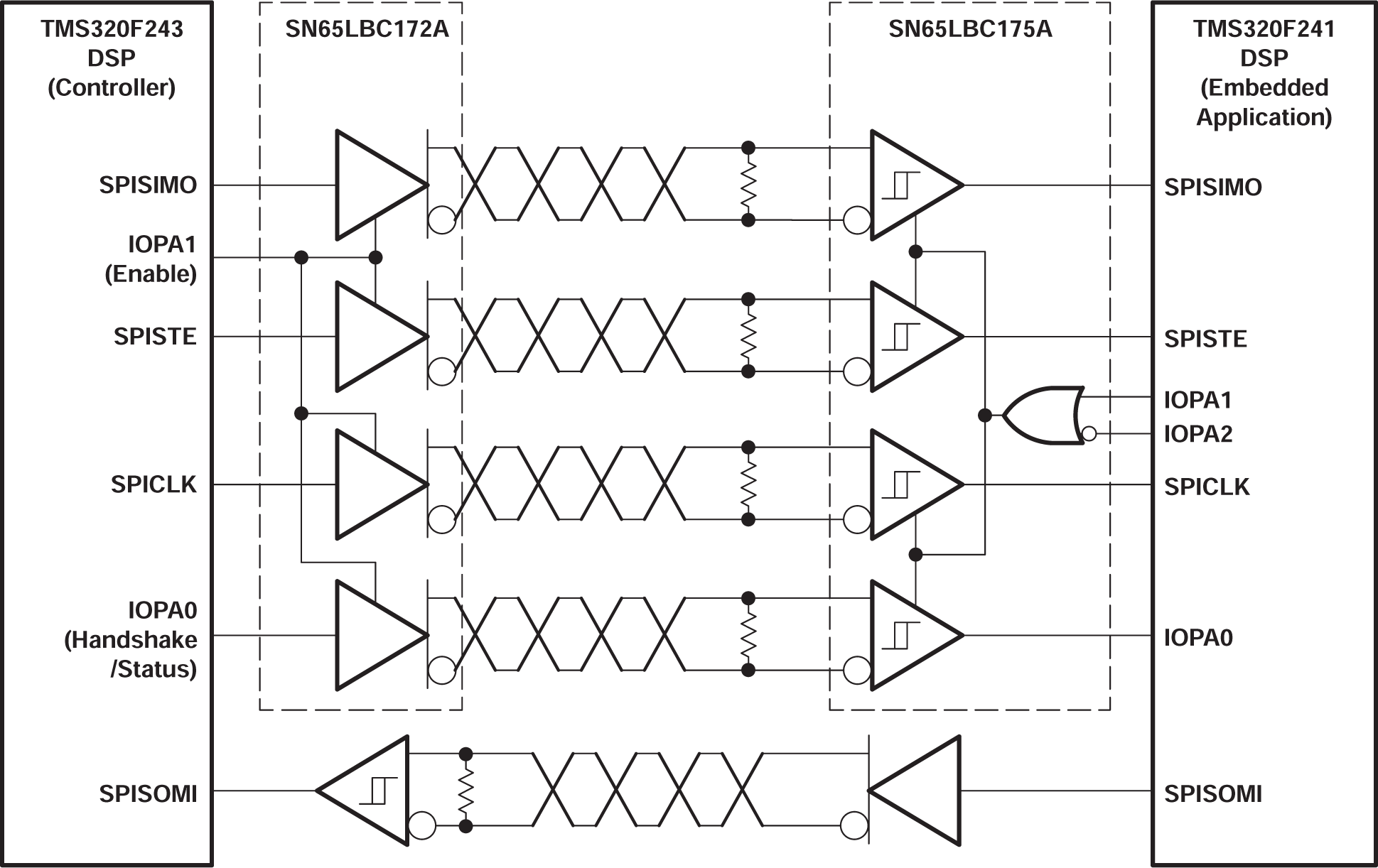
SN65LBC172AQuadruple Low-Power Differential Line Driver | Interface | 7 | Active | The SN65LBC172 and SN75LBC172 are monolithic quadruple differential line drivers with three-state outputs. Both devices are designed to meet the requirements of EIA Standard RS-485. These devices are optimized for balanced multipoint bus transmission at data rates up to and exceeding 10 million bits per second. Each driver features wide positive and negative common- mode output voltage ranges, current limiting, and thermal-shutdown circuitry which provides a party-line application in noisy environments. Both devices are designed using LinBiCMOS™, facilitating ultra-low power consumption and inherent robustness.
Both the SN65LBC172 and SN75LBC172 provide positive- and negative-current limiting and thermal shutdown for protection from line fault conditions on the transmission bus line. These devices offer optimum performance when used with the SN75LBC173 or SN75LBC175 quadruple line receivers. The SN65LBC172 and SN75LBC172 are available in the 16-pin DIP package (N) and the 20-pin wide-body small-outline inline-circuit (SOIC) package (DW).
The SN75LBC172 is characterized for operation over the commercial temperature range of 0°C to 70°C. The SN65LBC172 is characterized over the industrial temperature range of −40°C to 85°C.
The SN65LBC172 and SN75LBC172 are monolithic quadruple differential line drivers with three-state outputs. Both devices are designed to meet the requirements of EIA Standard RS-485. These devices are optimized for balanced multipoint bus transmission at data rates up to and exceeding 10 million bits per second. Each driver features wide positive and negative common- mode output voltage ranges, current limiting, and thermal-shutdown circuitry which provides a party-line application in noisy environments. Both devices are designed using LinBiCMOS™, facilitating ultra-low power consumption and inherent robustness.
Both the SN65LBC172 and SN75LBC172 provide positive- and negative-current limiting and thermal shutdown for protection from line fault conditions on the transmission bus line. These devices offer optimum performance when used with the SN75LBC173 or SN75LBC175 quadruple line receivers. The SN65LBC172 and SN75LBC172 are available in the 16-pin DIP package (N) and the 20-pin wide-body small-outline inline-circuit (SOIC) package (DW).
The SN75LBC172 is characterized for operation over the commercial temperature range of 0°C to 70°C. The SN65LBC172 is characterized over the industrial temperature range of −40°C to 85°C. |
SN65LBC173A-EPQuadruple RS-485 Differential Line Receiver, SN65LBC173A-EP | Drivers, Receivers, Transceivers | 6 | Active | The SN65LBC173A and SN75LBC173A are quadruple differential line receivers with 3-state outputs, designed for TIA/EIA-485 (RS-485), TIA/EIA-422 (RS-422), and ISO 8482 (Euro RS-485) applications.
These devices are optimized for balanced multipoint bus communication at data rates up to and exceeding 50 million bits per second. The transmission media may be twisted-pair cables, printed-circuit board traces, or backplanes. The ultimate rate and distance of data transfer is dependent upon the attenuation characteristics of the media and the noise coupling to the environment.
Each receiver operates over a wide range of positive and negative common-mode input voltages, and features ESD protection to 6 kV, making it suitable for high-speed multipoint data transmission applications in harsh environments. These devices are designed using LinBiCMOSt, facilitating low power consumption and robustness.
The G and G inputs provide enable control logic for either positive- or negative-logic enabling all four drivers. When disabled or powered off, the receiver inputs present a high-impedance to the bus for reduced system loading.
The SN75LBC173A is characterized for operation over the temperature range of 0°C to 70°C. The SN65LBC173A is characterized over the temperature range from −40°C to 85°C.
The SN65LBC173A and SN75LBC173A are quadruple differential line receivers with 3-state outputs, designed for TIA/EIA-485 (RS-485), TIA/EIA-422 (RS-422), and ISO 8482 (Euro RS-485) applications.
These devices are optimized for balanced multipoint bus communication at data rates up to and exceeding 50 million bits per second. The transmission media may be twisted-pair cables, printed-circuit board traces, or backplanes. The ultimate rate and distance of data transfer is dependent upon the attenuation characteristics of the media and the noise coupling to the environment.
Each receiver operates over a wide range of positive and negative common-mode input voltages, and features ESD protection to 6 kV, making it suitable for high-speed multipoint data transmission applications in harsh environments. These devices are designed using LinBiCMOSt, facilitating low power consumption and robustness.
The G and G inputs provide enable control logic for either positive- or negative-logic enabling all four drivers. When disabled or powered off, the receiver inputs present a high-impedance to the bus for reduced system loading.
The SN75LBC173A is characterized for operation over the temperature range of 0°C to 70°C. The SN65LBC173A is characterized over the temperature range from −40°C to 85°C. |
SN65LBC174A-EPEnhanced Product quad RS-485/RS-422 differential line drivers | Drivers, Receivers, Transceivers | 8 | Active | The SN65LBC174 and SN75LBC174 are monolithic, quadruple, differential line drivers with 3-state outputs. Both devices are designed to meet the requirements of the Electronics Industry Association Standard EIA-485. These devices are optimized for balanced multipoint bus transmission at data rates up to and exceeding 10 million bits per second. Each driver features wide positive and negative common-mode output voltage ranges, current limiting, and thermal- shutdown protection, making it suitable for party-line applications in noisy environments. Both devices are designed using LinBiCMOS™, facilitating ultralow power consumption and inherent robustness.
Both the SN65LBC174 and SN75LBC174 provide positive- and negative-current limiting and thermal shutdown for protection from line fault conditions on the transmission bus line. These devices offer optimum performance when used with the SN75LBC173 or SN75LBC175 quadruple line receivers. The SN65LBC174 and SN75LBC174 are available in the 16-terminal DIP package (N) and the 20-terminal wide-body small outline integrated circuit (SOIC) package (DW).
The SN75LBC174 is characterized for operation over the commercial temperature range of 0°C to 70°C. The SN65LBC174 is characterized over the industrial temperature range of –40°C to 85°C.
The SN65LBC174 and SN75LBC174 are monolithic, quadruple, differential line drivers with 3-state outputs. Both devices are designed to meet the requirements of the Electronics Industry Association Standard EIA-485. These devices are optimized for balanced multipoint bus transmission at data rates up to and exceeding 10 million bits per second. Each driver features wide positive and negative common-mode output voltage ranges, current limiting, and thermal- shutdown protection, making it suitable for party-line applications in noisy environments. Both devices are designed using LinBiCMOS™, facilitating ultralow power consumption and inherent robustness.
Both the SN65LBC174 and SN75LBC174 provide positive- and negative-current limiting and thermal shutdown for protection from line fault conditions on the transmission bus line. These devices offer optimum performance when used with the SN75LBC173 or SN75LBC175 quadruple line receivers. The SN65LBC174 and SN75LBC174 are available in the 16-terminal DIP package (N) and the 20-terminal wide-body small outline integrated circuit (SOIC) package (DW).
The SN75LBC174 is characterized for operation over the commercial temperature range of 0°C to 70°C. The SN65LBC174 is characterized over the industrial temperature range of –40°C to 85°C. |
| Integrated Circuits (ICs) | 11 | Active | The SN65LBC175 and SN75LBC175 are monolithic, quadruple, differential line receivers with 3-state outputs designed to meet the requirements of the EIA standards RS-422-A, RS-423-A, RS-485, and CCITT Recommendation V.11. The devices are optimized for balanced multipoint bus transmission at data rates up to and exceeding 10 million bits per second. The receivers are enabled in pairs, with an active-high enable input. Each differential receiver input features high impedance, hysteresis for increased noise immunity, and sensitivity of ±200 mV over a common-mode input voltage range of 12 V to −7 V. The fail-safe design ensures that when the inputs are open-circuited, the outputs are always high. Both devices are designed using the TI proprietary LinBiCMOS™ technology allowing low power consumption, high switching speeds, and robustness.
These devices offer optimum performance when used with the SN75LBC172 or SN75LBC174 quadruple line drivers. The SN65LBC175 is available in the 16-pin DIP (N), small-outline package (D), and the wide small-outline package (DW). The SN75LBC175 is available in the 16-pin DIP (N) and the small-outline package (D).
The SN65LBC175 is characterized over the industrial temperature range of −40°C to 85°C. The SN75LBC175 is characterized for operation over the commercial temperature range of 0°C to 70°C.
The SN65LBC175 and SN75LBC175 are monolithic, quadruple, differential line receivers with 3-state outputs designed to meet the requirements of the EIA standards RS-422-A, RS-423-A, RS-485, and CCITT Recommendation V.11. The devices are optimized for balanced multipoint bus transmission at data rates up to and exceeding 10 million bits per second. The receivers are enabled in pairs, with an active-high enable input. Each differential receiver input features high impedance, hysteresis for increased noise immunity, and sensitivity of ±200 mV over a common-mode input voltage range of 12 V to −7 V. The fail-safe design ensures that when the inputs are open-circuited, the outputs are always high. Both devices are designed using the TI proprietary LinBiCMOS™ technology allowing low power consumption, high switching speeds, and robustness.
These devices offer optimum performance when used with the SN75LBC172 or SN75LBC174 quadruple line drivers. The SN65LBC175 is available in the 16-pin DIP (N), small-outline package (D), and the wide small-outline package (DW). The SN75LBC175 is available in the 16-pin DIP (N) and the small-outline package (D).
The SN65LBC175 is characterized over the industrial temperature range of −40°C to 85°C. The SN75LBC175 is characterized for operation over the commercial temperature range of 0°C to 70°C. |
| Drivers, Receivers, Transceivers | 13 | Active | The SN65LBC176A-EP differential bus transceiver is a monolithic, integrated circuits designed for bidirectional data communication on multipoint bus-transmission lines. The SN65LBC176A-EP is designed for balanced transmission lines and is compatible with ANSI standard TIA/EIA-485-A and ISO 8482. The SN65LBC176A-EP offers improved switching performance over its predecessors without sacrificing significantly more power.
The SN65LBC176A-EP combines a 3-state, differential line driver and a differential input line receiver, both of which operate from a single 5-V power supply. The driver and receiver have active-high and active-low enables, respectively, which can externally connect together to function as a direction control. The driver differential outputs and the receiver differential inputs connect internally to form a differential input/output (I/O) bus port that is designed to offer minimum loading to the bus whenever the driver is disabled or VCC= 0. This port features wide positive and negative common-mode voltage ranges, making the device suitable for party-line applications. Low device supply current can be achieved by disabling the driver and the receiver.
The SN65LBC176A-EP differential bus transceiver is a monolithic, integrated circuits designed for bidirectional data communication on multipoint bus-transmission lines. The SN65LBC176A-EP is designed for balanced transmission lines and is compatible with ANSI standard TIA/EIA-485-A and ISO 8482. The SN65LBC176A-EP offers improved switching performance over its predecessors without sacrificing significantly more power.
The SN65LBC176A-EP combines a 3-state, differential line driver and a differential input line receiver, both of which operate from a single 5-V power supply. The driver and receiver have active-high and active-low enables, respectively, which can externally connect together to function as a direction control. The driver differential outputs and the receiver differential inputs connect internally to form a differential input/output (I/O) bus port that is designed to offer minimum loading to the bus whenever the driver is disabled or VCC= 0. This port features wide positive and negative common-mode voltage ranges, making the device suitable for party-line applications. Low device supply current can be achieved by disabling the driver and the receiver. |
SN65LBC179ALow-Power Differential Line Driver And Receiver Pairs | Interface | 8 | Active | Low-Power Differential Line Driver And Receiver Pairs |
SN65LBC180ALow-Power Differential Line Driver And Receiver Pair | Drivers, Receivers, Transceivers | 12 | Active | The SN55LBC180, SN65LBC180 and SN75LBC180 combine a differential line driver and receiver with 3-state outputs and operate from a single 5-V supply. The driver and receiver have active-high and active-low enables, respectively, which can be externally connected to function as a direction control. The driver differential outputs and the receiver differential inputs are connected to separate terminals for full-duplex operation and are designed to present minimum loading to the bus whether disabled or powered off (VCC= 0). These parts feature a wide common-mode voltage range making them suitable for point-to-point or multipoint data-bus applications.
The devices also provide positive and negative output-current limiting and thermal shutdown for protection from line fault conditions. The line driver shuts down at a junction temperature of approximately 172°C.
The SN75LBC180 is characterized for operation over the commercial temperature range of 0°C to 70°C. The SN65LBC180 is characterized over the industrial temperature range of –40°C to 85°C.
The SN55LBC180 is characterized for operation over the military temperature range of –55°C to 125°C.
The SN55LBC180, SN65LBC180 and SN75LBC180 combine a differential line driver and receiver with 3-state outputs and operate from a single 5-V supply. The driver and receiver have active-high and active-low enables, respectively, which can be externally connected to function as a direction control. The driver differential outputs and the receiver differential inputs are connected to separate terminals for full-duplex operation and are designed to present minimum loading to the bus whether disabled or powered off (VCC= 0). These parts feature a wide common-mode voltage range making them suitable for point-to-point or multipoint data-bus applications.
The devices also provide positive and negative output-current limiting and thermal shutdown for protection from line fault conditions. The line driver shuts down at a junction temperature of approximately 172°C.
The SN75LBC180 is characterized for operation over the commercial temperature range of 0°C to 70°C. The SN65LBC180 is characterized over the industrial temperature range of –40°C to 85°C.
The SN55LBC180 is characterized for operation over the military temperature range of –55°C to 125°C. |