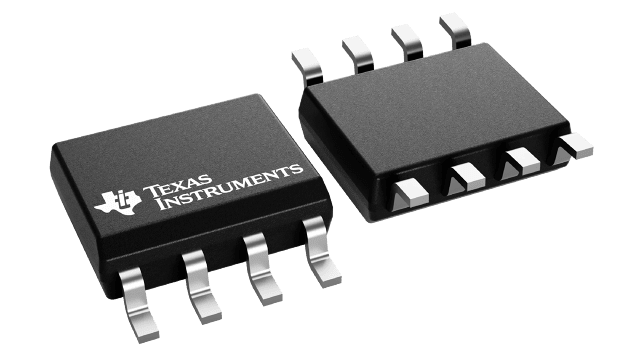
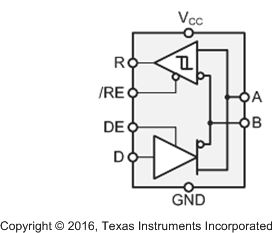
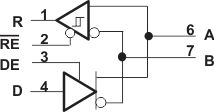
SN65HVD773.3V, Full-Duplex RS-485, 12kV IEC ESD, 50Mbps data rate, No Enables | Integrated Circuits (ICs) | 3 | Active | These devices extend the RS-485 portfolio with a family of full-duplex transceivers with robust 3.3-V drivers and receivers and high levels of ESD protection. The ESD protection includes > ±30-kV HBM and > ±12-kV IEC61000-4-2 contact discharge. The large receiver hysteresis of the SN65HVD7x devices provides immunity to conducted differential noise and the wide operating temperature enables reliability in harsh operating environments. The SN65HVD7x devices are offered in a standard SOIC package as well as in a small-footprint MSOP package.
These devices each combine a differential driver and a differential receiver, which operate from a single 3.3-V power supply. Each driver and receiver has separate input and output pins for full-duplex bus communication designs. These devices all feature a wide common-mode voltage range which makes the devices suitable for multi-point applications over long cable runs.
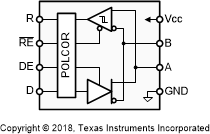
The SN65HVD71, SN65HVD74, and SN65HVD77 devices are fully enabled with no external enabling pins.
The SN65HVD70, SN65HVD73, and SN65HVD76 devices have active-high driver enables and active-low receiver enables. A low, less than 5-µA standby current can be achieved by disabling both the driver and receiver.
These devices are characterized from –40°C to 125°C.
These devices extend the RS-485 portfolio with a family of full-duplex transceivers with robust 3.3-V drivers and receivers and high levels of ESD protection. The ESD protection includes > ±30-kV HBM and > ±12-kV IEC61000-4-2 contact discharge. The large receiver hysteresis of the SN65HVD7x devices provides immunity to conducted differential noise and the wide operating temperature enables reliability in harsh operating environments. The SN65HVD7x devices are offered in a standard SOIC package as well as in a small-footprint MSOP package.
These devices each combine a differential driver and a differential receiver, which operate from a single 3.3-V power supply. Each driver and receiver has separate input and output pins for full-duplex bus communication designs. These devices all feature a wide common-mode voltage range which makes the devices suitable for multi-point applications over long cable runs.
The SN65HVD71, SN65HVD74, and SN65HVD77 devices are fully enabled with no external enabling pins.
The SN65HVD70, SN65HVD73, and SN65HVD76 devices have active-high driver enables and active-low receiver enables. A low, less than 5-µA standby current can be achieved by disabling both the driver and receiver.
These devices are characterized from –40°C to 125°C. |
SN65HVD783.3 V Half-Duplex RS-485, with IEC ESD, 50 Mbps | Interface | 6 | Active | These devices have robust 3.3-V drivers and receivers in a small package for demanding industrial applications. The bus pins are robust to ESD events with high levels of protection to Human-Body Model and IEC Contact Discharge specifications.
Each of these devices combines a differential driver and a differential receiver which operate from a single 3.3-V power supply. The driver differential outputs and the receiver differential inputs are connected internally to form a bus port suitable for half-duplex (two-wire bus) communication. These devices feature a wide common-mode voltage range making the devices suitable for multi-point applications over long cable runs. These devices are characterized from –40°C to 125°C.
These devices have robust 3.3-V drivers and receivers in a small package for demanding industrial applications. The bus pins are robust to ESD events with high levels of protection to Human-Body Model and IEC Contact Discharge specifications.
Each of these devices combines a differential driver and a differential receiver which operate from a single 3.3-V power supply. The driver differential outputs and the receiver differential inputs are connected internally to form a bus port suitable for half-duplex (two-wire bus) communication. These devices feature a wide common-mode voltage range making the devices suitable for multi-point applications over long cable runs. These devices are characterized from –40°C to 125°C. |
SN65HVD825V-Supply RS-485 with IEC ESD Protection | Interface | 2 | Active | This device has robust drivers and receivers for demanding industrial applications. The bus pins are robust to ESD events, with high levels of protection to Human-Body Model, Air-Gap Discharge, and Contact Discharge specifications.
The device combines a differential driver and a differential receiver, which operate from a single 5-V power supply. The driver differential outputs and the receiver differential inputs are connected internally to form a bus port suitable for half-duplex (two-wire bus) communication. The device features a wide common-mode voltage range making the device suitable for multi-point applications over long cable runs. The device is characterized from –40°C to 85°C.
This device has robust drivers and receivers for demanding industrial applications. The bus pins are robust to ESD events, with high levels of protection to Human-Body Model, Air-Gap Discharge, and Contact Discharge specifications.
The device combines a differential driver and a differential receiver, which operate from a single 5-V power supply. The driver differential outputs and the receiver differential inputs are connected internally to form a bus port suitable for half-duplex (two-wire bus) communication. The device features a wide common-mode voltage range making the device suitable for multi-point applications over long cable runs. The device is characterized from –40°C to 85°C. |
SN65HVD888Bus-Polarity Correcting RS-485 Transceiver with IEC-ESD Protection | Interface | 1 | Active | The SN65HVD888 is a low-power RS-485 transceiver with automatic bus-polarity correction and transient protection. Upon hot plug-in, the device detects and corrects the bus polarity within the first 76 ms of bus idling. On-chip transient protection protects the device against IEC61000 ESD and EFT transients. This device has robust drivers and receivers for demanding industrial applications. The bus pins are robust to electrostatic discharge (ESD) events, with high levels of protection to Human-Body Model (HBM), Air-Gap Discharge, and Contact Discharge specifications.
The device combines a differential driver and a differential receiver, which operate together from a single 5-V power supply. The driver differential outputs and the receiver differential inputs are connected internally to form a bus port suitable for half-duplex (two-wire bus) communication. The device features a wide common-mode voltage range making the device suitable for multi-point applications over long cable runs. The SN65HVD888 is available in an SOIC-8 package, and is characterized from –40°C to 125°C.
The SN65HVD888 is a low-power RS-485 transceiver with automatic bus-polarity correction and transient protection. Upon hot plug-in, the device detects and corrects the bus polarity within the first 76 ms of bus idling. On-chip transient protection protects the device against IEC61000 ESD and EFT transients. This device has robust drivers and receivers for demanding industrial applications. The bus pins are robust to electrostatic discharge (ESD) events, with high levels of protection to Human-Body Model (HBM), Air-Gap Discharge, and Contact Discharge specifications.
The device combines a differential driver and a differential receiver, which operate together from a single 5-V power supply. The driver differential outputs and the receiver differential inputs are connected internally to form a bus port suitable for half-duplex (two-wire bus) communication. The device features a wide common-mode voltage range making the device suitable for multi-point applications over long cable runs. The SN65HVD888 is available in an SOIC-8 package, and is characterized from –40°C to 125°C. |
| Development Boards, Kits, Programmers | 2 | Active | The SN65HVD96 is specifically designed to meet the requirements for a transceiver which operates with no errors if the twisted-pair signal wires are connected normally or reversed. This allows for error free operation in applications where the signal wires may become inadvertently reversed during installation or maintenance. This feature is corrected internally so no intervention from the controller or operator is required. The SN65HVD96 complies with the requirements of ANSI/TIA-4963,Electrical Characteristics of Reversible Balanced Voltage Digital Interface Circuits.
Similar to RS-485, these transceivers can be used for point-to-point, multi-drop, or multi-point networks. Sympol devices are not backwards compatible with, but are an upgrade to, existing RS-485 networks. The pin-out is identical to the industry-standard SN75176 transceiver, allowing direct upgrade from RS-485 to SymPol. Current-limited differential outputs protect in case of driver contention on a party-line bus. High receiver input impedance allows connection of at least 32 nodes. Several fault tolerant features are integrated into the device to protect from operational hazards. Current limiting on the driver outputs protects against short-circuit faults, and operates independently on each driver output. An automatic thermal shutdown protects the driver circuits against over temperature conditions. The receiver output enters a deterministic failsafe state if the bus connection is left disconnected or if the bus wires are shorted together.
The small outline integrated circuit (SOIC) package saves board space compared to equivalent discrete implementations. These devices are fully characterized for operation over the industrial temperature range of –40°C to 85°C.
The SN65HVD96 is specifically designed to meet the requirements for a transceiver which operates with no errors if the twisted-pair signal wires are connected normally or reversed. This allows for error free operation in applications where the signal wires may become inadvertently reversed during installation or maintenance. This feature is corrected internally so no intervention from the controller or operator is required. The SN65HVD96 complies with the requirements of ANSI/TIA-4963,Electrical Characteristics of Reversible Balanced Voltage Digital Interface Circuits.
Similar to RS-485, these transceivers can be used for point-to-point, multi-drop, or multi-point networks. Sympol devices are not backwards compatible with, but are an upgrade to, existing RS-485 networks. The pin-out is identical to the industry-standard SN75176 transceiver, allowing direct upgrade from RS-485 to SymPol. Current-limited differential outputs protect in case of driver contention on a party-line bus. High receiver input impedance allows connection of at least 32 nodes. Several fault tolerant features are integrated into the device to protect from operational hazards. Current limiting on the driver outputs protects against short-circuit faults, and operates independently on each driver output. An automatic thermal shutdown protects the driver circuits against over temperature conditions. The receiver output enters a deterministic failsafe state if the bus connection is left disconnected or if the bus wires are shorted together.
The small outline integrated circuit (SOIC) package saves board space compared to equivalent discrete implementations. These devices are fully characterized for operation over the industrial temperature range of –40°C to 85°C. |
| Interface | 3 | Active | The SN65HVDA1040B-Q1 device meets or exceeds the specifications of the ISO 11898 standard for use in applications employing a controller area network (CAN). As a CAN transceiver, this device provides differential transmit capability to the bus and differential receive capability to a CAN controller at signaling rates up to 1 megabit per second (Mbps). The signaling rate of a line is the number of voltage transitions that are made per second, expressed in the units bps (bits per second).
The device is designed for operation in especially harsh environments and includes many device protection features such as undervoltage lock out (UVLO), over-temperature thermal shutdown, wide common-mode range, and loss of ground protection. The bus pins are also protected against external cross-wiring, shorts to –27 V to 40 V, and voltage transients according to ISO 7637. The device is qualified for use in automotive applications.
The SN65HVDA1040B-Q1 device meets or exceeds the specifications of the ISO 11898 standard for use in applications employing a controller area network (CAN). As a CAN transceiver, this device provides differential transmit capability to the bus and differential receive capability to a CAN controller at signaling rates up to 1 megabit per second (Mbps). The signaling rate of a line is the number of voltage transitions that are made per second, expressed in the units bps (bits per second).
The device is designed for operation in especially harsh environments and includes many device protection features such as undervoltage lock out (UVLO), over-temperature thermal shutdown, wide common-mode range, and loss of ground protection. The bus pins are also protected against external cross-wiring, shorts to –27 V to 40 V, and voltage transients according to ISO 7637. The device is qualified for use in automotive applications. |
| Integrated Circuits (ICs) | 1 | Active | The SN65HVDA1050A-Q1 meets or exceeds the specifications of the ISO 11898 standard for use in applications employing a controller area network (CAN). The device is qualified for use in automotive applications. As a CAN bus transceiver, this device provides differential transmit capability to the bus and differential receive capability to a CAN controller at signaling rates up to 1 megabit per second (Mbps). The signaling rate of a line is the number of voltage transitions that are made per second expressed in bits per second (bps).
The SN65HVDA1050A-Q1 device is designed for operation in especially harsh environments and includes many device protection features such as undervoltage lockout, overtemperature thermal shutdown, wide common-mode range, and loss of ground protection. The bus pins are also protected against external cross-wiring, shorts to sources from –27 V to 40 V, and voltage transients according to ISO 7637.
The SN65HVDA1050A-Q1 meets or exceeds the specifications of the ISO 11898 standard for use in applications employing a controller area network (CAN). The device is qualified for use in automotive applications. As a CAN bus transceiver, this device provides differential transmit capability to the bus and differential receive capability to a CAN controller at signaling rates up to 1 megabit per second (Mbps). The signaling rate of a line is the number of voltage transitions that are made per second expressed in bits per second (bps).
The SN65HVDA1050A-Q1 device is designed for operation in especially harsh environments and includes many device protection features such as undervoltage lockout, overtemperature thermal shutdown, wide common-mode range, and loss of ground protection. The bus pins are also protected against external cross-wiring, shorts to sources from –27 V to 40 V, and voltage transients according to ISO 7637. |
SN65HVDA195-Q1Automotive Catalog LIN, MOST ECL, and K-Line Physical Interface | Drivers, Receivers, Transceivers | 1 | Active | The SN65HVDA195 device is the Local Interconnect Network (LIN) physical interface and MOST ECL interface, which integrates the serial transceiver with wake-up and protection features. The bus is a single-wire bidirectional bus typically used for low-speed in-vehicle networks using data rates to 20 kbps. The device can transmit with an effective data rate of 0 kbps because it does not have dominant state time-out. The protocol output data stream on TXD is converted by the SN65HVDA195 into the bus signal through a current-limited wave-shaping driver as outlined by the LIN physical layer specification revision 2.0. The receiver converts the data stream from the bus and outputs the data stream through RXD. The bus has two states: dominant state (voltage near ground) and the recessive state (voltage near battery). In the recessive state, the bus is pulled high by the SN65HVDA195 internal pullup resistor and series diode, so no external pullup components are required for responder applications. Commander applications require an external pullup resistor (1 kΩ) plus a series diode per the LIN specification.
The SN65HVDA195 device is the Local Interconnect Network (LIN) physical interface and MOST ECL interface, which integrates the serial transceiver with wake-up and protection features. The bus is a single-wire bidirectional bus typically used for low-speed in-vehicle networks using data rates to 20 kbps. The device can transmit with an effective data rate of 0 kbps because it does not have dominant state time-out. The protocol output data stream on TXD is converted by the SN65HVDA195 into the bus signal through a current-limited wave-shaping driver as outlined by the LIN physical layer specification revision 2.0. The receiver converts the data stream from the bus and outputs the data stream through RXD. The bus has two states: dominant state (voltage near ground) and the recessive state (voltage near battery). In the recessive state, the bus is pulled high by the SN65HVDA195 internal pullup resistor and series diode, so no external pullup components are required for responder applications. Commander applications require an external pullup resistor (1 kΩ) plus a series diode per the LIN specification. |
SN65HVDA5405-V CAN Transceiver With I/O Level Shifting and Supply Optimization | Integrated Circuits (ICs) | 1 | Active | The SN65HVDA540/SN65HVDA541 meets or exceeds the specifications of the ISO 11898 standard for use in applications employing a Controller Area Network (CAN). The device is qualified for use in automotive applications.
As a CAN transceiver, this device provides differential transmit capability to the bus and differential receive capability to a CAN controller at signaling rates up to 1 megabit per second (Mbps)(1).
Designed for operation in especially harsh environments, the SN65HVDA540/SN65HVDA541 features cross-wire, bus over voltage, loss of ground protection, over temperature thermal shut down protection, and a wide common-mode range.
The SN65HVDA540/SN65HVDA541 has an I/O supply voltage input pin (VIO, pin 5) to ratiometrically level shift the digital logic input and output levels with repsect to VIOfor compatibility with protocol controllers having I/O supply voltages between 3 V and 5.25 V. The VIOsupply also powers the low-power bus monitor and wake-up receiver of the SN65HVDA541 allowing the 5 V (VCC) supply to be switched off for additional power savings at the system level during standby mode for either the SN65HVDA540 or SN65HVDA541. The 5 V (VCC) supply needs to be reactivated by the local protocol controller at any time to resume high speed operation if it has been turned off for low-power standby operation. Both of the supply pins have undervoltage detection which place the device in standby mode to protect the bus during an undervoltage event on either the VCCor VIOsupply pins. If VIOis undervoltage the RXD pin is 3-statedn and the device does not pass any wake-up signals from the bus to the RXD pin.
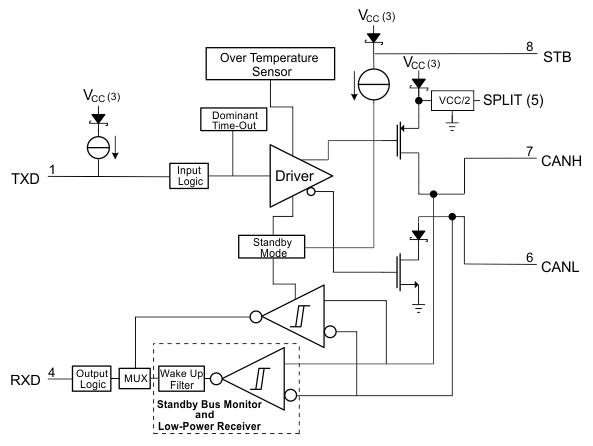
STB (pin 8) provides for two different modes of operation: normal mode or low-power standby mode. The normal mode of operation is selected by applying a low logic level to STB. If a high logic level is applied to STB, the device enters standby mode (see Figure 1 and Figure 2). In standby mode, the SN65HVDA541 provides a wake-up receiver and monitor that remains active supplied via the VIOpin so that VCCmay be removed allowing a system level reduction in standby current. A dominant signal on the bus longer than the wake-up signal time (tBUS) is passed to the receiver output (RXD, pin 4) by the wake-up bus monitor circuit. The local protocol controller may then return the device to normal mode when the system needs to transmit or fully monitor the messages on the bus. If the bus has a fault condition where it is stuck dominant while the SN65HVDA541 is placed into standby mode, the device locks out the wake-up receiver output to RXD until the fault has been removed to prevent false wake-up signals in the system. Because the SN65HVDA540 does not have a low-power bus monitor and wake-up receiver, it provides a logic high output (recessive) on RXD while in standby mode.
A dominant time-out circuit prevents the driver from blocking network communication in event of a hardware or software failure. The dominant time out circuit is triggered by a falling edge on TXD (pin 1). If no rising edge is seen before the time-out constant of the circuit expires, the driver is disabled. The circuit is reset by the next rising edge on TXD.
The SN65HVDA540/SN65HVDA541 meets or exceeds the specifications of the ISO 11898 standard for use in applications employing a Controller Area Network (CAN). The device is qualified for use in automotive applications.
As a CAN transceiver, this device provides differential transmit capability to the bus and differential receive capability to a CAN controller at signaling rates up to 1 megabit per second (Mbps)(1).
Designed for operation in especially harsh environments, the SN65HVDA540/SN65HVDA541 features cross-wire, bus over voltage, loss of ground protection, over temperature thermal shut down protection, and a wide common-mode range.
The SN65HVDA540/SN65HVDA541 has an I/O supply voltage input pin (VIO, pin 5) to ratiometrically level shift the digital logic input and output levels with repsect to VIOfor compatibility with protocol controllers having I/O supply voltages between 3 V and 5.25 V. The VIOsupply also powers the low-power bus monitor and wake-up receiver of the SN65HVDA541 allowing the 5 V (VCC) supply to be switched off for additional power savings at the system level during standby mode for either the SN65HVDA540 or SN65HVDA541. The 5 V (VCC) supply needs to be reactivated by the local protocol controller at any time to resume high speed operation if it has been turned off for low-power standby operation. Both of the supply pins have undervoltage detection which place the device in standby mode to protect the bus during an undervoltage event on either the VCCor VIOsupply pins. If VIOis undervoltage the RXD pin is 3-statedn and the device does not pass any wake-up signals from the bus to the RXD pin.
STB (pin 8) provides for two different modes of operation: normal mode or low-power standby mode. The normal mode of operation is selected by applying a low logic level to STB. If a high logic level is applied to STB, the device enters standby mode (see Figure 1 and Figure 2). In standby mode, the SN65HVDA541 provides a wake-up receiver and monitor that remains active supplied via the VIOpin so that VCCmay be removed allowing a system level reduction in standby current. A dominant signal on the bus longer than the wake-up signal time (tBUS) is passed to the receiver output (RXD, pin 4) by the wake-up bus monitor circuit. The local protocol controller may then return the device to normal mode when the system needs to transmit or fully monitor the messages on the bus. If the bus has a fault condition where it is stuck dominant while the SN65HVDA541 is placed into standby mode, the device locks out the wake-up receiver output to RXD until the fault has been removed to prevent false wake-up signals in the system. Because the SN65HVDA540 does not have a low-power bus monitor and wake-up receiver, it provides a logic high output (recessive) on RXD while in standby mode.
A dominant time-out circuit prevents the driver from blocking network communication in event of a hardware or software failure. The dominant time out circuit is triggered by a falling edge on TXD (pin 1). If no rising edge is seen before the time-out constant of the circuit expires, the driver is disabled. The circuit is reset by the next rising edge on TXD. |
| Drivers, Receivers, Transceivers | 1 | Active | The SN65HVDA54x-Q1 and SN65HVDA54x-5-Q1 devices, known as the HVDA54x and HVDA54x-5 respectively, are designed and qualified for use in automotive applications and meets or exceeds the specifications of the ISO 11898 High Speed CAN (Controller Area Network) Physical Layer standard (transceiver).
The SN65HVDA54x-Q1 and SN65HVDA54x-5-Q1 devices, known as the HVDA54x and HVDA54x-5 respectively, are designed and qualified for use in automotive applications and meets or exceeds the specifications of the ISO 11898 High Speed CAN (Controller Area Network) Physical Layer standard (transceiver). |