| Logic | 3 | Active | |
| Drivers, Receivers, Transceivers | 10 | Obsolete | |
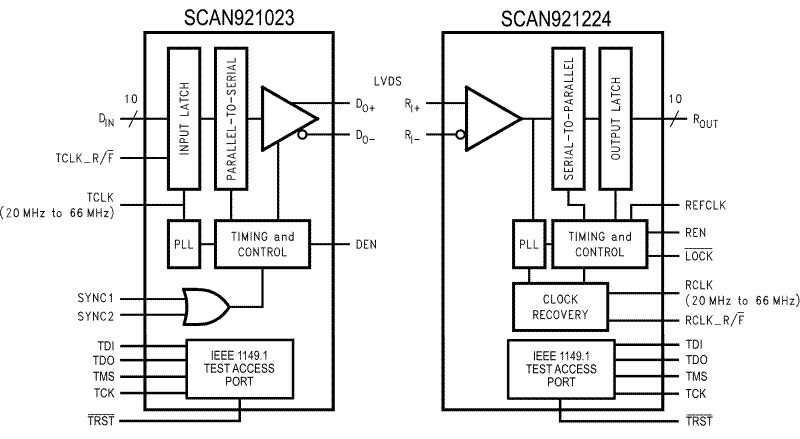
SCAN92102320 to 66-MHz 10-bit serializer with IEEE 1149.1 test access | Interface | 1 | NRND | The SCAN921023 transforms a 10-bit wide parallel LVCMOS/LVTTL data bus into a single high speed Bus LVDS serial data stream with embedded clock. The SCAN921224 receives the Bus LVDS serial data stream and transforms it back into a 10-bit wide parallel data bus and recovers parallel clock. Both devices are compliant with IEEE 1149.1 Standard Test Access Port and Boundary Scan Architecture with the incorporation of the defined boundary-scan test logic and test access port consisting of Test Data Input (TDI), Test Data Out (TDO), Test Mode Select (TMS), Test Clock (TCK), and the optional Test Reset (TRST). IEEE 1149.1 features provide the designer or test engineer access to the backplane or cable interconnects and the ability to verify differential signal integrity to enhance their system test strategy. The pair of devices also features an at-speed BIST mode which allows the interconnects between the Serializer and Deserializer to be verified at-speed.
The SCAN921023 transmits data over backplanes or cable. The single differential pair data path makes PCB design easier. In addition, the reduced cable, PCB trace count, and connector size tremendously reduce cost. Since one output transmits clock and data bits serially, it eliminates clock-to-data and data-to-data skew. The powerdown pin saves power by reducing supply current when not using either device. Upon power up of the Serializer, you can choose to activate synchronization mode or allow the Deserializer to use the synchronization-to-random-data feature. By using the synchronization mode, the Deserializer will establish lock to a signal within specified lock times. In addition, the embedded clock ensures a transition on the bus every 12-bit cycle. This eliminates transmission errors due to charged cable conditions. Furthermore, you may put the SCAN921023 output pins into TRI-STATE to achieve a high impedance state. The PLL can lock to frequencies between 20 MHz and 66 MHz.
The SCAN921023 transforms a 10-bit wide parallel LVCMOS/LVTTL data bus into a single high speed Bus LVDS serial data stream with embedded clock. The SCAN921224 receives the Bus LVDS serial data stream and transforms it back into a 10-bit wide parallel data bus and recovers parallel clock. Both devices are compliant with IEEE 1149.1 Standard Test Access Port and Boundary Scan Architecture with the incorporation of the defined boundary-scan test logic and test access port consisting of Test Data Input (TDI), Test Data Out (TDO), Test Mode Select (TMS), Test Clock (TCK), and the optional Test Reset (TRST). IEEE 1149.1 features provide the designer or test engineer access to the backplane or cable interconnects and the ability to verify differential signal integrity to enhance their system test strategy. The pair of devices also features an at-speed BIST mode which allows the interconnects between the Serializer and Deserializer to be verified at-speed.
The SCAN921023 transmits data over backplanes or cable. The single differential pair data path makes PCB design easier. In addition, the reduced cable, PCB trace count, and connector size tremendously reduce cost. Since one output transmits clock and data bits serially, it eliminates clock-to-data and data-to-data skew. The powerdown pin saves power by reducing supply current when not using either device. Upon power up of the Serializer, you can choose to activate synchronization mode or allow the Deserializer to use the synchronization-to-random-data feature. By using the synchronization mode, the Deserializer will establish lock to a signal within specified lock times. In addition, the embedded clock ensures a transition on the bus every 12-bit cycle. This eliminates transmission errors due to charged cable conditions. Furthermore, you may put the SCAN921023 output pins into TRI-STATE to achieve a high impedance state. The PLL can lock to frequencies between 20 MHz and 66 MHz. |
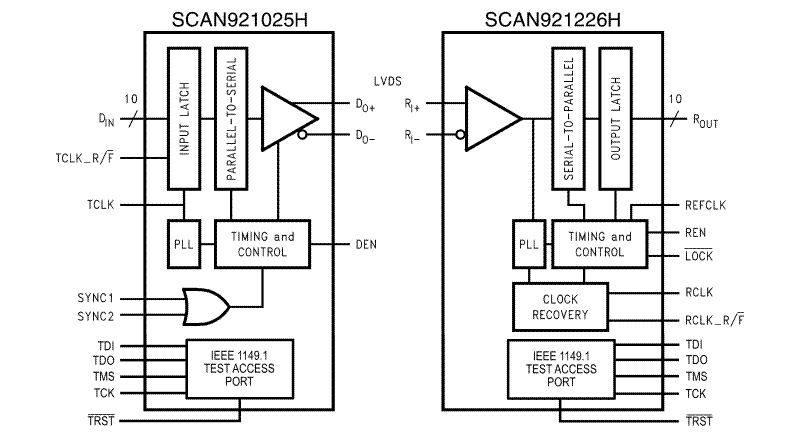
SCAN921025HHigh temperature 20 to 80-MHz 10-bit serializer with IEEE 1149.1 test access | Interface | 4 | Active | The SCAN921025H transforms a 10-bit wide parallel LVCMOS/LVTTL data bus into a single high speed Bus LVDS serial data stream with embedded clock. The SCAN921226H receives the Bus LVDS serial data stream and transforms it back into a 10-bit wide parallel data bus and recovers parallel clock.
Both devices are compliant with IEEE 1149.1 Standard for Boundary Scan Test. IEEE 1149.1 features provide the design or test engineer access via a standard Test Access Port (TAP) to the backplane or cable interconnects and the ability to verify differential signal integrity. The pair of devices also features an at-speed BIST mode which allows the interconnects between the Serializer and Deserializer to be verified at-speed.
The SCAN921025H transmits data over backplanes or cable. The single differential pair data path makes PCB design easier. In addition, the reduced cable, PCB trace count, and connector size tremendously reduce cost. Since one output transmits clock and data bits serially, it eliminates clock-to-data and data-to-data skew. The powerdown pin saves power by reducing supply current when not using either device. Upon power up of the Serializer, you can choose to activate synchronization mode or allow the Deserializer to use the synchronization-to-random-data feature. By using the synchronization mode, the Deserializer will establish lock to a signal within specified lock times. In addition, the embedded clock ensures a transition on the bus every 12-bit cycle. This eliminates transmission errors due to charged cable conditions. Furthermore, you may put the SCAN921025H output pins into tri-state to achieve a high impedance state. The PLL can lock to frequencies between 20 MHz and 80 MHz.
The SCAN921025H transforms a 10-bit wide parallel LVCMOS/LVTTL data bus into a single high speed Bus LVDS serial data stream with embedded clock. The SCAN921226H receives the Bus LVDS serial data stream and transforms it back into a 10-bit wide parallel data bus and recovers parallel clock.
Both devices are compliant with IEEE 1149.1 Standard for Boundary Scan Test. IEEE 1149.1 features provide the design or test engineer access via a standard Test Access Port (TAP) to the backplane or cable interconnects and the ability to verify differential signal integrity. The pair of devices also features an at-speed BIST mode which allows the interconnects between the Serializer and Deserializer to be verified at-speed.
The SCAN921025H transmits data over backplanes or cable. The single differential pair data path makes PCB design easier. In addition, the reduced cable, PCB trace count, and connector size tremendously reduce cost. Since one output transmits clock and data bits serially, it eliminates clock-to-data and data-to-data skew. The powerdown pin saves power by reducing supply current when not using either device. Upon power up of the Serializer, you can choose to activate synchronization mode or allow the Deserializer to use the synchronization-to-random-data feature. By using the synchronization mode, the Deserializer will establish lock to a signal within specified lock times. In addition, the embedded clock ensures a transition on the bus every 12-bit cycle. This eliminates transmission errors due to charged cable conditions. Furthermore, you may put the SCAN921025H output pins into tri-state to achieve a high impedance state. The PLL can lock to frequencies between 20 MHz and 80 MHz. |
SCAN92122420 to 66-MHz 10-bit deserializer with IEEE 1149.1 test access | Integrated Circuits (ICs) | 1 | NRND | The SCAN921023 transforms a 10-bit wide parallel LVCMOS/LVTTL data bus into a single high speed Bus LVDS serial data stream with embedded clock. The SCAN921224 receives the Bus LVDS serial data stream and transforms it back into a 10-bit wide parallel data bus and recovers parallel clock. Both devices are compliant with IEEE 1149.1 Standard Test Access Port and Boundary Scan Architecture with the incorporation of the defined boundary-scan test logic and test access port consisting of Test Data Input (TDI), Test Data Out (TDO), Test Mode Select (TMS), Test Clock (TCK), and the optional Test Reset (TRST). IEEE 1149.1 features provide the designer or test engineer access to the backplane or cable interconnects and the ability to verify differential signal integrity to enhance their system test strategy. The pair of devices also features an at-speed BIST mode which allows the interconnects between the Serializer and Deserializer to be verified at-speed.
The SCAN921023 transmits data over backplanes or cable. The single differential pair data path makes PCB design easier. In addition, the reduced cable, PCB trace count, and connector size tremendously reduce cost. Since one output transmits clock and data bits serially, it eliminates clock-to-data and data-to-data skew. The powerdown pin saves power by reducing supply current when not using either device. Upon power up of the Serializer, you can choose to activate synchronization mode or allow the Deserializer to use the synchronization-to-random-data feature. By using the synchronization mode, the Deserializer will establish lock to a signal within specified lock times. In addition, the embedded clock ensures a transition on the bus every 12-bit cycle. This eliminates transmission errors due to charged cable conditions. Furthermore, you may put the SCAN921023 output pins into TRI-STATE to achieve a high impedance state. The PLL can lock to frequencies between 20 MHz and 66 MHz.
The SCAN921023 transforms a 10-bit wide parallel LVCMOS/LVTTL data bus into a single high speed Bus LVDS serial data stream with embedded clock. The SCAN921224 receives the Bus LVDS serial data stream and transforms it back into a 10-bit wide parallel data bus and recovers parallel clock. Both devices are compliant with IEEE 1149.1 Standard Test Access Port and Boundary Scan Architecture with the incorporation of the defined boundary-scan test logic and test access port consisting of Test Data Input (TDI), Test Data Out (TDO), Test Mode Select (TMS), Test Clock (TCK), and the optional Test Reset (TRST). IEEE 1149.1 features provide the designer or test engineer access to the backplane or cable interconnects and the ability to verify differential signal integrity to enhance their system test strategy. The pair of devices also features an at-speed BIST mode which allows the interconnects between the Serializer and Deserializer to be verified at-speed.
The SCAN921023 transmits data over backplanes or cable. The single differential pair data path makes PCB design easier. In addition, the reduced cable, PCB trace count, and connector size tremendously reduce cost. Since one output transmits clock and data bits serially, it eliminates clock-to-data and data-to-data skew. The powerdown pin saves power by reducing supply current when not using either device. Upon power up of the Serializer, you can choose to activate synchronization mode or allow the Deserializer to use the synchronization-to-random-data feature. By using the synchronization mode, the Deserializer will establish lock to a signal within specified lock times. In addition, the embedded clock ensures a transition on the bus every 12-bit cycle. This eliminates transmission errors due to charged cable conditions. Furthermore, you may put the SCAN921023 output pins into TRI-STATE to achieve a high impedance state. The PLL can lock to frequencies between 20 MHz and 66 MHz. |
SCAN921226HHigh temperature 20 to 80-MHz 10-bit deserializer with IEEE 1149.1 test access | Interface | 2 | Active | The SCAN921025H transforms a 10-bit wide parallel LVCMOS/LVTTL data bus into a single high speed Bus LVDS serial data stream with embedded clock. The SCAN921226H receives the Bus LVDS serial data stream and transforms it back into a 10-bit wide parallel data bus and recovers parallel clock.
Both devices are compliant with IEEE 1149.1 Standard for Boundary Scan Test. IEEE 1149.1 features provide the design or test engineer access via a standard Test Access Port (TAP) to the backplane or cable interconnects and the ability to verify differential signal integrity. The pair of devices also features an at-speed BIST mode which allows the interconnects between the Serializer and Deserializer to be verified at-speed.
The SCAN921025H transmits data over backplanes or cable. The single differential pair data path makes PCB design easier. In addition, the reduced cable, PCB trace count, and connector size tremendously reduce cost. Since one output transmits clock and data bits serially, it eliminates clock-to-data and data-to-data skew. The powerdown pin saves power by reducing supply current when not using either device. Upon power up of the Serializer, you can choose to activate synchronization mode or allow the Deserializer to use the synchronization-to-random-data feature. By using the synchronization mode, the Deserializer will establish lock to a signal within specified lock times. In addition, the embedded clock ensures a transition on the bus every 12-bit cycle. This eliminates transmission errors due to charged cable conditions. Furthermore, you may put the SCAN921025H output pins into tri-state to achieve a high impedance state. The PLL can lock to frequencies between 20 MHz and 80 MHz.
The SCAN921025H transforms a 10-bit wide parallel LVCMOS/LVTTL data bus into a single high speed Bus LVDS serial data stream with embedded clock. The SCAN921226H receives the Bus LVDS serial data stream and transforms it back into a 10-bit wide parallel data bus and recovers parallel clock.
Both devices are compliant with IEEE 1149.1 Standard for Boundary Scan Test. IEEE 1149.1 features provide the design or test engineer access via a standard Test Access Port (TAP) to the backplane or cable interconnects and the ability to verify differential signal integrity. The pair of devices also features an at-speed BIST mode which allows the interconnects between the Serializer and Deserializer to be verified at-speed.
The SCAN921025H transmits data over backplanes or cable. The single differential pair data path makes PCB design easier. In addition, the reduced cable, PCB trace count, and connector size tremendously reduce cost. Since one output transmits clock and data bits serially, it eliminates clock-to-data and data-to-data skew. The powerdown pin saves power by reducing supply current when not using either device. Upon power up of the Serializer, you can choose to activate synchronization mode or allow the Deserializer to use the synchronization-to-random-data feature. By using the synchronization mode, the Deserializer will establish lock to a signal within specified lock times. In addition, the embedded clock ensures a transition on the bus every 12-bit cycle. This eliminates transmission errors due to charged cable conditions. Furthermore, you may put the SCAN921025H output pins into tri-state to achieve a high impedance state. The PLL can lock to frequencies between 20 MHz and 80 MHz. |
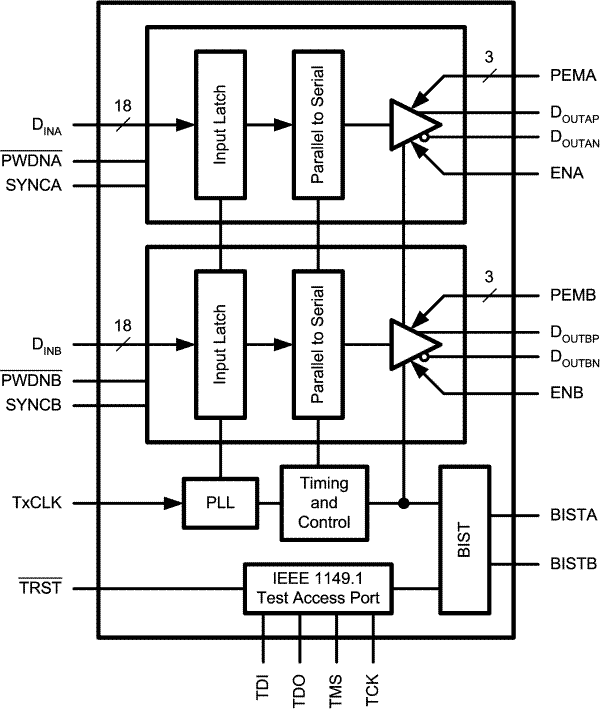
SCAN921821Dual 18-bit serializer with pre-emphasis, IEEE 1149.1 (JTAG), and at-speed BIST | Interface | 1 | Active | The SCAN921821 is a dual channel 18-bit serializer featuring signal conditioning, boundary SCAN, and at-speed BIST. Each serializer block transforms an 18-bit parallel LVCMOS/LVTTL data bus into a single Bus LVDS data stream with embedded clock. This single serial data stream with embedded clock simplifies PCB design and reduces PCB cost by narrowing data paths that in turn reduce PCB size and layers. The single serial data stream also reduces cable size, the number of connectors, and eliminates clock-to-data and data-to-data skew.
Each channel also has an 8-level selectable pre-emphasis feature that significantly extends performance over lossy interconnect. Each channel also has its own powerdown pin that saves power by reducing supply current when the channel is not being used.
The SCAN921821 also incorporates advanced testability features including IEEE 1149.1 and at-speed BIST PRBS pattern generation to facilitate verification of board and link integrity
The SCAN921821 is a dual channel 18-bit serializer featuring signal conditioning, boundary SCAN, and at-speed BIST. Each serializer block transforms an 18-bit parallel LVCMOS/LVTTL data bus into a single Bus LVDS data stream with embedded clock. This single serial data stream with embedded clock simplifies PCB design and reduces PCB cost by narrowing data paths that in turn reduce PCB size and layers. The single serial data stream also reduces cable size, the number of connectors, and eliminates clock-to-data and data-to-data skew.
Each channel also has an 8-level selectable pre-emphasis feature that significantly extends performance over lossy interconnect. Each channel also has its own powerdown pin that saves power by reducing supply current when the channel is not being used.
The SCAN921821 also incorporates advanced testability features including IEEE 1149.1 and at-speed BIST PRBS pattern generation to facilitate verification of board and link integrity |
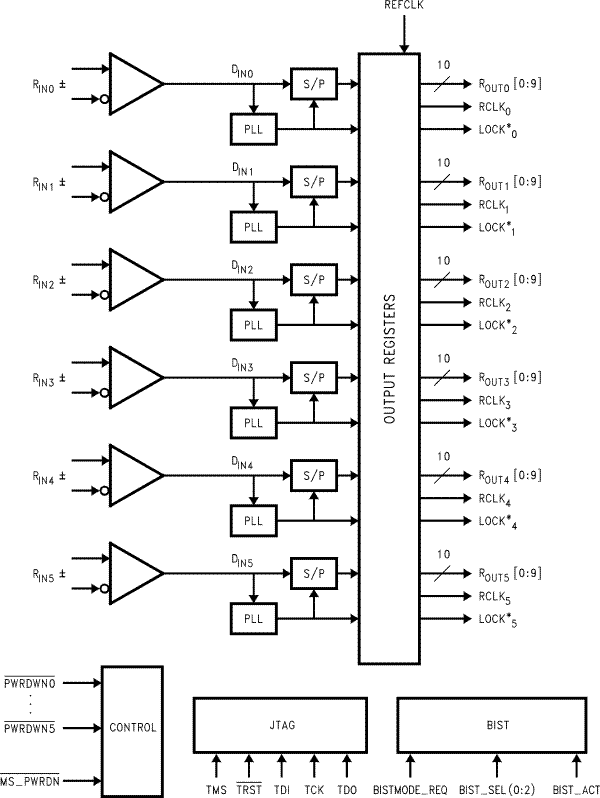
SCAN926260Six 1 to 10 bus LVDS deserializers with IEEE 1149.1 and at-speed BIST | Integrated Circuits (ICs) | 3 | Active | The SCAN926260 integrates six 10-bit deserializer devices into a single chip. The SCAN926260 can simultaneously deserialize up to six data streams that have been serialized by TI’s 10-bit Bus LVDS serializers. In addition, the SCAN926260 is compliant with IEEE standard 1149.1 and also features an At-Speed Built-In Self Test (BIST). For more details, please see the sections titled IEEE 1149.1 Test Modes and BIST Alone Test Modes.
Each deserializer block in the SCAN926260 has it’s own powerdown pin (PWRDWN[n])and operates independently with its own clock recovery circuitry and lock-detect signaling. In addition, a master powerdown pin (MS_PWRDWN) which puts all the entire device into sleep mode is provided.
The SCAN926260 uses a single +3.3V power supply and consumes 1.2W at 3.3V with a PRBS-15 pattern on all channels at 660Mbps.
The SCAN926260 integrates six 10-bit deserializer devices into a single chip. The SCAN926260 can simultaneously deserialize up to six data streams that have been serialized by TI’s 10-bit Bus LVDS serializers. In addition, the SCAN926260 is compliant with IEEE standard 1149.1 and also features an At-Speed Built-In Self Test (BIST). For more details, please see the sections titled IEEE 1149.1 Test Modes and BIST Alone Test Modes.
Each deserializer block in the SCAN926260 has it’s own powerdown pin (PWRDWN[n])and operates independently with its own clock recovery circuitry and lock-detect signaling. In addition, a master powerdown pin (MS_PWRDWN) which puts all the entire device into sleep mode is provided.
The SCAN926260 uses a single +3.3V power supply and consumes 1.2W at 3.3V with a PRBS-15 pattern on all channels at 660Mbps. |
SCAN9280288-channel 10:1 serializer with IEEE 1149.1 and at-speed BIST | Integrated Circuits (ICs) | 1 | Active | The SCAN928028 integrates eight serializer devices into a single chip. The SCAN928028 can simultaneously serialize up to eight 10-bit data streams. The 10-bit parallel inputs are LVTTL signal levels. The serialized outputs are LVDS signals with extra drive current for point-to-point and lightly loaded multidrop applications. Each serializer block in the SCAN928028 operates independently by using strobes from a single shared PLL.
The SCAN928028 uses a single +3.3V power supply with a typical power dissipation of 740mW (3.3V / PRBS / 66 MHz). Each serializer channel has a unique power down control to further conserve power consumption.
For high-speed LVDS serial data transmission, line quality is essential, thus the SCAN928028 includes an @SPEED TEST function. Each Serializer channel has the ability to internally generate a PRBS data pattern. This pattern is received by specific deserializers (SCAN921224) which have the complement PRBS verification circuit. The deserializer checks the data pattern for bit errors and reports any errors on the test verification pins on the deserializer.
For additional information - please see the Application Information section in this datasheet.
The SCAN928028 integrates eight serializer devices into a single chip. The SCAN928028 can simultaneously serialize up to eight 10-bit data streams. The 10-bit parallel inputs are LVTTL signal levels. The serialized outputs are LVDS signals with extra drive current for point-to-point and lightly loaded multidrop applications. Each serializer block in the SCAN928028 operates independently by using strobes from a single shared PLL.
The SCAN928028 uses a single +3.3V power supply with a typical power dissipation of 740mW (3.3V / PRBS / 66 MHz). Each serializer channel has a unique power down control to further conserve power consumption.
For high-speed LVDS serial data transmission, line quality is essential, thus the SCAN928028 includes an @SPEED TEST function. Each Serializer channel has the ability to internally generate a PRBS data pattern. This pattern is received by specific deserializers (SCAN921224) which have the complement PRBS verification circuit. The deserializer checks the data pattern for bit errors and reports any errors on the test verification pins on the deserializer.
For additional information - please see the Application Information section in this datasheet. |
SCAN92LV0909-channel bus LVDS transceiver with boundary scan | Integrated Circuits (ICs) | 3 | Active | The SCAN92LV090A is one in a series of Bus LVDS transceivers designed specifically for the high speed, low power proprietary backplane or cable interfaces. The device operates from a single 3.3V power supply and includes nine differential line drivers and nine receivers. To minimize bus loading, the driver outputs and receiver inputs are internally connected. The separate I/O of the logic side allows for loop back support. The device also features a flow through pin out which allows easy PCB routing for short stubs between its pins and the connector.
The driver translates 3V TTL levels (single-ended) to differential Bus LVDS (BLVDS) output levels. This allows for high speed operation, while consuming minimal power with reduced EMI. In addition, the differential signaling provides common mode noise rejection of ±1V.
The receiver threshold is less than ±100 mV over a ±1V common mode range and translates the differential Bus LVDS to standard (TTL/CMOS) levels.
This device is compliant with IEEE 1149.1 Standard Test Access Port and Boundary Scan Architecture with the incorporation of the defined boundary-scan test logic and test access port consisting of Test Data Input (TDI), Test Data Out (TDO), Test Mode Select (TMS), Test Clock (TCK), and the optional Test Reset (TRST).
The SCAN92LV090A is one in a series of Bus LVDS transceivers designed specifically for the high speed, low power proprietary backplane or cable interfaces. The device operates from a single 3.3V power supply and includes nine differential line drivers and nine receivers. To minimize bus loading, the driver outputs and receiver inputs are internally connected. The separate I/O of the logic side allows for loop back support. The device also features a flow through pin out which allows easy PCB routing for short stubs between its pins and the connector.
The driver translates 3V TTL levels (single-ended) to differential Bus LVDS (BLVDS) output levels. This allows for high speed operation, while consuming minimal power with reduced EMI. In addition, the differential signaling provides common mode noise rejection of ±1V.
The receiver threshold is less than ±100 mV over a ±1V common mode range and translates the differential Bus LVDS to standard (TTL/CMOS) levels.
This device is compliant with IEEE 1149.1 Standard Test Access Port and Boundary Scan Architecture with the incorporation of the defined boundary-scan test logic and test access port consisting of Test Data Input (TDI), Test Data Out (TDO), Test Mode Select (TMS), Test Clock (TCK), and the optional Test Reset (TRST). |