| Interface | 1 | Obsolete | |
| Evaluation and Demonstration Boards and Kits | 5 | Obsolete | |
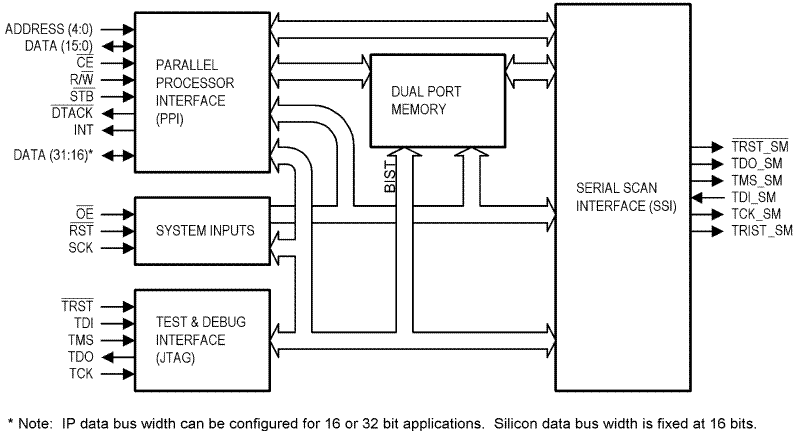
SCANSTA101Low voltage IEEE 1149.1 system test access (STA) master | Integrated Circuits (ICs) | 2 | Active | The SCANSTA101 is designed to function as a test master for an IEEE 1149.1 boundary scan test system. It is suitable for use in embedded IEEE 1149.1 applications and as a component in a stand-alone boundary scan tester.
The SCANSTA101 is an enhanced version of, and a replacement for, the SCANPSC100. The SCANSTA101 supports the IEEE 1149.1 Test Access Port (TAP) standard and the IEEE 1532 standard for in-system configuration of programmable devices.
The SCANSTA101 improves test vector throughput and reduces software overhead in the system processor. The SCANSTA101 presents a simple, register-based interface to the system processor. Texas Instruments provides C-language source code which can be included in the embedded system software. The combination of the SCANSTA101 and its support software comprises a simple API for boundary scan operations.
The interface from the SCANSTA101 to the system processor is implemented by reading and writing registers, some of which map to locations in the SCANSTA101 memory. Hardware handshaking and interrupt lines are provided as part of the processor interface.
The SCANSTA101 is available as a stand-alone device packaged in a 49-pin NFBGA package. It is also available as an IP macro for synthesis in programmable logic devices.
The SCANSTA101 is designed to function as a test master for an IEEE 1149.1 boundary scan test system. It is suitable for use in embedded IEEE 1149.1 applications and as a component in a stand-alone boundary scan tester.
The SCANSTA101 is an enhanced version of, and a replacement for, the SCANPSC100. The SCANSTA101 supports the IEEE 1149.1 Test Access Port (TAP) standard and the IEEE 1532 standard for in-system configuration of programmable devices.
The SCANSTA101 improves test vector throughput and reduces software overhead in the system processor. The SCANSTA101 presents a simple, register-based interface to the system processor. Texas Instruments provides C-language source code which can be included in the embedded system software. The combination of the SCANSTA101 and its support software comprises a simple API for boundary scan operations.
The interface from the SCANSTA101 to the system processor is implemented by reading and writing registers, some of which map to locations in the SCANSTA101 memory. Hardware handshaking and interrupt lines are provided as part of the processor interface.
The SCANSTA101 is available as a stand-alone device packaged in a 49-pin NFBGA package. It is also available as an IP macro for synthesis in programmable logic devices. |
SCANSTA111Enhanced scan bridge multidrop addressable IEEE 1149.1 (JTAG) port | Specialized | 5 | Active | The SCANSTA111 extends the IEEE Std. 1149.1 test bus into a multidrop test bus environment. The advantage of a multidrop approach over a single serial scan chain is improved test throughput and the ability to remove a board from the system and retain test access to the remaining modules. Each SCANSTA111 supports up to 3 local IEEE 1149.1 scan rings which can be accessed individually or combined serially. Addressing is accomplished by loading the instruction register with a value matching that of the Slot inputs. Backplane and inter-board testing can easily be accomplished by parking the local TAP Controllers in one of the stable TAP Controller states via a Park instruction. The 32-bit TCK counter enables built in self test operations to be performed on one port while other scan chains are simultaneously tested.
The SCANSTA111 extends the IEEE Std. 1149.1 test bus into a multidrop test bus environment. The advantage of a multidrop approach over a single serial scan chain is improved test throughput and the ability to remove a board from the system and retain test access to the remaining modules. Each SCANSTA111 supports up to 3 local IEEE 1149.1 scan rings which can be accessed individually or combined serially. Addressing is accomplished by loading the instruction register with a value matching that of the Slot inputs. Backplane and inter-board testing can easily be accomplished by parking the local TAP Controllers in one of the stable TAP Controller states via a Park instruction. The 32-bit TCK counter enables built in self test operations to be performed on one port while other scan chains are simultaneously tested. |
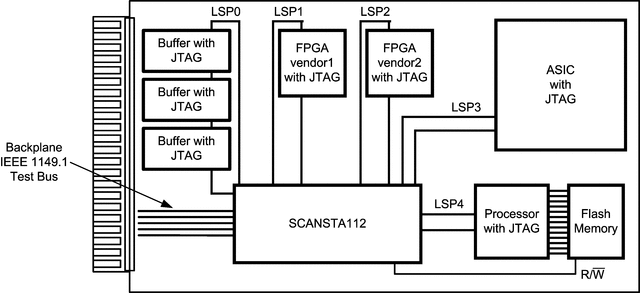
SCANSTA1127-port multidrop IEEE 1149.1 (JTAG) multiplexer | Interface | 2 | NRND | The SCANSTA112 extends the IEEE Std. 1149.1 test bus into a multidrop test bus environment. The advantage of a multidrop approach over a single serial scan chain is improved test throughput and the ability to remove a board from the system and retain test access to the remaining modules. Each SCANSTA112 supports up to 7 local IEEE1149.1 scan chains which can be accessed individually or combined serially.
Addressing is accomplished by loading the instruction register with a value matching that of the Slot inputs. Backplane and inter-board testing can easily be accomplished by parking the local TAP Controllers in one of the stable TAP Controller states via a Park instruction. The 32-bit TCK counter enables built in self test operations to be performed on one port while other scan chains are simultaneously tested.
The STA112 has a unique feature in that the backplane port and the LSP0 port are bidirectional. They can be configured to alternatively act as the master or slave port so an alternate test master can take control of the entire scan chain network from the LSP0 port while the backplane port becomes a slave.
The SCANSTA112 extends the IEEE Std. 1149.1 test bus into a multidrop test bus environment. The advantage of a multidrop approach over a single serial scan chain is improved test throughput and the ability to remove a board from the system and retain test access to the remaining modules. Each SCANSTA112 supports up to 7 local IEEE1149.1 scan chains which can be accessed individually or combined serially.
Addressing is accomplished by loading the instruction register with a value matching that of the Slot inputs. Backplane and inter-board testing can easily be accomplished by parking the local TAP Controllers in one of the stable TAP Controller states via a Park instruction. The 32-bit TCK counter enables built in self test operations to be performed on one port while other scan chains are simultaneously tested.
The STA112 has a unique feature in that the backplane port and the LSP0 port are bidirectional. They can be configured to alternatively act as the master or slave port so an alternate test master can take control of the entire scan chain network from the LSP0 port while the backplane port becomes a slave. |
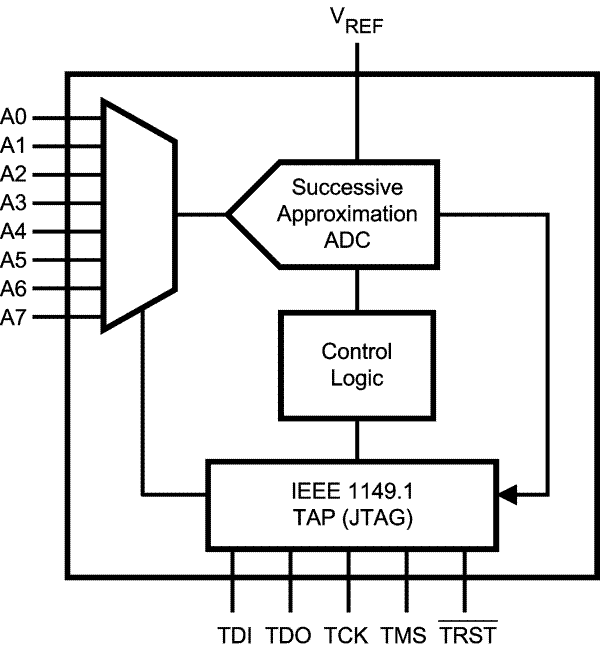
SCANSTA4768-input IEEE 1149.1 analog voltage monitor | Integrated Circuits (ICs) | 2 | Active | The SCANSTA476 is a low power, Analog Voltage Monitor used for sampling or monitoring up to 8 analog/mixed-signal input channels. Analog Voltage Monitors are valuable during product development, environmental test, production, and field service for verifying and monitoring power supply and reference voltages. In a supervisory role, the 'STA476 is useful for card or system-level health monitoring and prognostics applications.
Instead of requiring an external microcontroller with a GPIO interface, the 'STA476 features a common IEEE 1149.1 (JTAG) interface to select the analog input, initiate a measurement, and access the results - further extending the capabilities of an existing JTAG infrastructure.
The SCANSTA476 uses the VREFinput as a reference. This enables the SCANSTA476 to operate with a full-scale input range of 0 to VDD, which can range from +2.7V to +5.5V.
The SCANSTA476 is packaged in a 16-lead non-pullback WSON package that provides an extremely small footprint for applications where space is a critical consideration. This product operates over the industrial temperature range of −40°C to +85°C.
The SCANSTA476 is a low power, Analog Voltage Monitor used for sampling or monitoring up to 8 analog/mixed-signal input channels. Analog Voltage Monitors are valuable during product development, environmental test, production, and field service for verifying and monitoring power supply and reference voltages. In a supervisory role, the 'STA476 is useful for card or system-level health monitoring and prognostics applications.
Instead of requiring an external microcontroller with a GPIO interface, the 'STA476 features a common IEEE 1149.1 (JTAG) interface to select the analog input, initiate a measurement, and access the results - further extending the capabilities of an existing JTAG infrastructure.
The SCANSTA476 uses the VREFinput as a reference. This enables the SCANSTA476 to operate with a full-scale input range of 0 to VDD, which can range from +2.7V to +5.5V.
The SCANSTA476 is packaged in a 16-lead non-pullback WSON package that provides an extremely small footprint for applications where space is a critical consideration. This product operates over the industrial temperature range of −40°C to +85°C. |
| Development Boards, Kits, Programmers | 2 | Obsolete | |
| Development Boards, Kits, Programmers | 1 | Obsolete | |
| Evaluation and Demonstration Boards and Kits | 1 | Obsolete | |
| Development Boards, Kits, Programmers | 1 | Obsolete | |