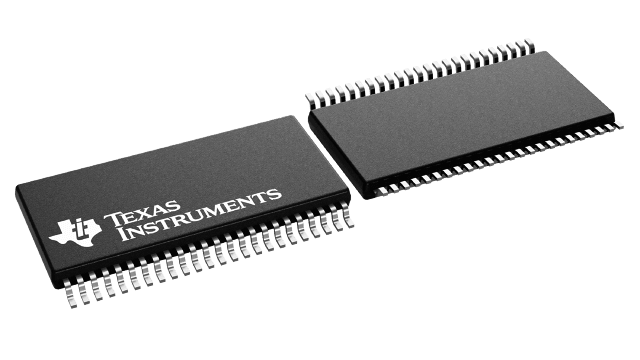
74ABT125Automotive 4-ch, 4.5-V to 5.5-V buffers with TTL-compatible CMOS inputs and 3-state outputs | Buffers, Drivers, Receivers, Transceivers | 17 | Active | The ’ABT125 quadruple bus buffer gates feature independent line drivers with 3-state outputs. Each output is disabled when the associated output-enable (OE)\ input is high.
These devices are fully specified for hot-insertion applications using Ioffand power-up 3-state. The Ioffcircuitry disables the outputs, preventing damaging current backflow through the devices when they are powered down. The power-up 3-state circuitry places the outputs in the high-impedance state during power up and power down, which prevents driver conflict.
To ensure the high-impedance state during power up or power down, OE\ should be tied to VCCthrough a pullup resistor; the minimum value of the resistor is determined by the current-sinking capability of the driver.
The ’ABT125 quadruple bus buffer gates feature independent line drivers with 3-state outputs. Each output is disabled when the associated output-enable (OE)\ input is high.
These devices are fully specified for hot-insertion applications using Ioffand power-up 3-state. The Ioffcircuitry disables the outputs, preventing damaging current backflow through the devices when they are powered down. The power-up 3-state circuitry places the outputs in the high-impedance state during power up and power down, which prevents driver conflict.
To ensure the high-impedance state during power up or power down, OE\ should be tied to VCCthrough a pullup resistor; the minimum value of the resistor is determined by the current-sinking capability of the driver. |
| Logic | 1 | Active | |
74ABT16224416-ch, 4.5-V to 5.5-V buffers with TTL-compatible CMOS inputs and 3-state outputs | Integrated Circuits (ICs) | 6 | Active | The ’ABT162244 devices are 16-bit buffers and line drivers designed specifically to improve both the performance and density of 3-state memory address drivers, clock drivers, and bus-oriented receivers and transmitters. These devices can be used as four 4-bit buffers, two 8-bit buffers, or one 16-bit buffer. These devices provide noninverting outputs and symmetrical active-low output-enable (OE)\ inputs.
The outputs, which are designed to source or sink up to 12 mA, include equivalent 25-series resistors to reduce overshoot and undershoot.
To ensure the high-impedance state during power up or power down, OE\ should be tied to VCCthrough a pullup resistor; the minimum value of the resistor is determined by the current-sinking capability of the driver.
These devices are fully specified for hot-insertion applications using Ioffand power-up 3-state. The Ioffcircuitry disables the outputs, preventing damaging current backflow through the devices when they are powered down. The power-up 3-state circuitry places the outputs in the high-impedance state during power up and power down, which prevents driver conflict.
The ’ABT162244 devices are 16-bit buffers and line drivers designed specifically to improve both the performance and density of 3-state memory address drivers, clock drivers, and bus-oriented receivers and transmitters. These devices can be used as four 4-bit buffers, two 8-bit buffers, or one 16-bit buffer. These devices provide noninverting outputs and symmetrical active-low output-enable (OE)\ inputs.
The outputs, which are designed to source or sink up to 12 mA, include equivalent 25-series resistors to reduce overshoot and undershoot.
To ensure the high-impedance state during power up or power down, OE\ should be tied to VCCthrough a pullup resistor; the minimum value of the resistor is determined by the current-sinking capability of the driver.
These devices are fully specified for hot-insertion applications using Ioffand power-up 3-state. The Ioffcircuitry disables the outputs, preventing damaging current backflow through the devices when they are powered down. The power-up 3-state circuitry places the outputs in the high-impedance state during power up and power down, which prevents driver conflict. |
74ABT16224516-Bit Bus Transceivers With 3-State Outputs | Integrated Circuits (ICs) | 6 | Active | The ’ABT162245 devices are 16-bit noninverting 3-state transceivers designed for synchronous two-way communication between data buses. The control-function implementation minimizes external timing requirements.
These devices can be used as two 8-bit transceivers or one 16-bit transceiver. They allow data transmission from the A bus to the B bus or from the B bus to the A bus, depending on the logic level at the direction-control (DIR) input. The output-enable (OE)\ input can be used to disable the device so that the buses effectively are isolated.
The A-port outputs, which are designed to source or sink up to 12 mA, include equivalent 25-series resistors to reduce overshoot and undershoot.
These devices are fully specified for partial-power-down applications using Ioff. The Ioffcircuitry disables the outputs, preventing damaging current backflow through the devices when they are powered down.
To ensure the high-impedance state during power up or power down, OE\ should be tied to VCCthrough a pullup resistor; the minimum value of the resistor is determined by the current-sinking capability of the driver.
The ’ABT162245 devices are 16-bit noninverting 3-state transceivers designed for synchronous two-way communication between data buses. The control-function implementation minimizes external timing requirements.
These devices can be used as two 8-bit transceivers or one 16-bit transceiver. They allow data transmission from the A bus to the B bus or from the B bus to the A bus, depending on the logic level at the direction-control (DIR) input. The output-enable (OE)\ input can be used to disable the device so that the buses effectively are isolated.
The A-port outputs, which are designed to source or sink up to 12 mA, include equivalent 25-series resistors to reduce overshoot and undershoot.
These devices are fully specified for partial-power-down applications using Ioff. The Ioffcircuitry disables the outputs, preventing damaging current backflow through the devices when they are powered down.
To ensure the high-impedance state during power up or power down, OE\ should be tied to VCCthrough a pullup resistor; the minimum value of the resistor is determined by the current-sinking capability of the driver. |
| Logic | 2 | Active | |
74ABT1624016-ch, 4.5-V to 5.5-V inverters with TTL-compatible CMOS inputs and 3-state outputs | Logic | 7 | Active | The 'ABT16240A devices are 16-bit buffers and line drivers designed specifically to improve both the performance and density of 3-state memory address drivers, clock drivers, and bus-oriented receivers and transmitters.
These devices can be used as four 4-bit buffers, two 8-bit buffers, or one 16-bit buffer. These devices provide inverting outputs and symmetrical active-low output-enable (OE\) inputs.
To ensure the high-impedance state during power up or power down, OE\ should be tied to VCCthrough a pullup resistor; the minimum value of the resistor is determined by the current-sinking capability of the driver.
The SN54ABT16240A is characterized for operation over the full military temperature range of -55°C to 125°C. The SN74ABT16240A is characterized for operation from -40°C to 85°C.
The 'ABT16240A devices are 16-bit buffers and line drivers designed specifically to improve both the performance and density of 3-state memory address drivers, clock drivers, and bus-oriented receivers and transmitters.
These devices can be used as four 4-bit buffers, two 8-bit buffers, or one 16-bit buffer. These devices provide inverting outputs and symmetrical active-low output-enable (OE\) inputs.
To ensure the high-impedance state during power up or power down, OE\ should be tied to VCCthrough a pullup resistor; the minimum value of the resistor is determined by the current-sinking capability of the driver.
The SN54ABT16240A is characterized for operation over the full military temperature range of -55°C to 125°C. The SN74ABT16240A is characterized for operation from -40°C to 85°C. |
| Buffers, Drivers, Receivers, Transceivers | 5 | Active | |
| Logic | 6 | Active | |
| Buffers, Drivers, Receivers, Transceivers | 5 | Active | |
| Signal Switches, Multiplexers, Decoders | 1 | Active | |