| Evaluation Boards | 1 | Active | |
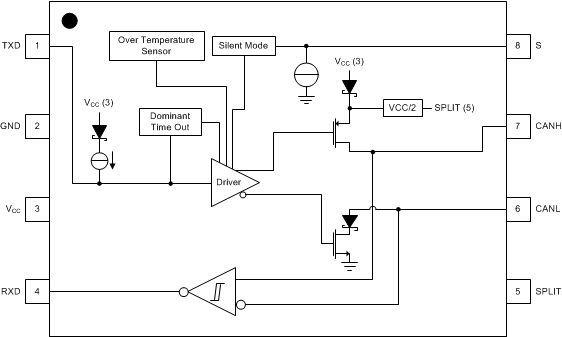
65HVDA1040Automotive EMC-optimized CAN transceiver | Integrated Circuits (ICs) | 2 | Active | The SN65HVDA1040A-Q1 device meets or exceeds the specifications of the ISO 11898 standard for use in applications employing a Controller Area Network (CAN). The device is qualified for use in automotive applications. As a CAN transceiver, this device provides differential transmit capability to the bus and differential receive capability to a CAN controller at signaling rates up to 1 megabit per second (Mbps). The signaling rate of a line is the number of voltage transitions that are made per second, expressed in the units bps (bits per second).
The device is designed for operation in especially harsh environments and includes many device protection features such as undervoltage lock out (UVLO), overtemperature thermal shutdown, wide common-mode range, and loss of ground protection. The bus pins are also protected against external cross-wiring, shorts to –27 V to 40 V, and voltage transients according to ISO 7637.
The SN65HVDA1040A-Q1 device meets or exceeds the specifications of the ISO 11898 standard for use in applications employing a Controller Area Network (CAN). The device is qualified for use in automotive applications. As a CAN transceiver, this device provides differential transmit capability to the bus and differential receive capability to a CAN controller at signaling rates up to 1 megabit per second (Mbps). The signaling rate of a line is the number of voltage transitions that are made per second, expressed in the units bps (bits per second).
The device is designed for operation in especially harsh environments and includes many device protection features such as undervoltage lock out (UVLO), overtemperature thermal shutdown, wide common-mode range, and loss of ground protection. The bus pins are also protected against external cross-wiring, shorts to –27 V to 40 V, and voltage transients according to ISO 7637. |
65HVDA1050Automotive Catalog EMC-Optimized High-Speed CAN Transceiver | Interface | 1 | Active | The SN65HVDA1050A-Q1 meets or exceeds the specifications of the ISO 11898 standard for use in applications employing a controller area network (CAN). The device is qualified for use in automotive applications. As a CAN bus transceiver, this device provides differential transmit capability to the bus and differential receive capability to a CAN controller at signaling rates up to 1 megabit per second (Mbps). The signaling rate of a line is the number of voltage transitions that are made per second expressed in bits per second (bps).
The SN65HVDA1050A-Q1 device is designed for operation in especially harsh environments and includes many device protection features such as undervoltage lockout, overtemperature thermal shutdown, wide common-mode range, and loss of ground protection. The bus pins are also protected against external cross-wiring, shorts to sources from –27 V to 40 V, and voltage transients according to ISO 7637.
The SN65HVDA1050A-Q1 meets or exceeds the specifications of the ISO 11898 standard for use in applications employing a controller area network (CAN). The device is qualified for use in automotive applications. As a CAN bus transceiver, this device provides differential transmit capability to the bus and differential receive capability to a CAN controller at signaling rates up to 1 megabit per second (Mbps). The signaling rate of a line is the number of voltage transitions that are made per second expressed in bits per second (bps).
The SN65HVDA1050A-Q1 device is designed for operation in especially harsh environments and includes many device protection features such as undervoltage lockout, overtemperature thermal shutdown, wide common-mode range, and loss of ground protection. The bus pins are also protected against external cross-wiring, shorts to sources from –27 V to 40 V, and voltage transients according to ISO 7637. |
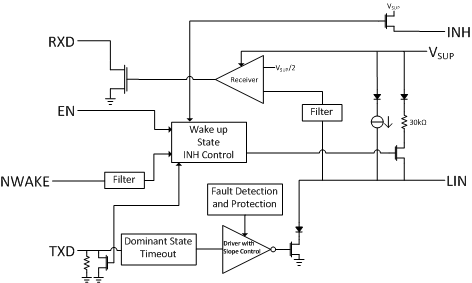
65HVDA195Automotive Catalog LIN, MOST ECL, and K-Line Physical Interface | Integrated Circuits (ICs) | 1 | Active | The SN65HVDA195 device is the Local Interconnect Network (LIN) physical interface and MOST ECL interface, which integrates the serial transceiver with wake-up and protection features. The bus is a single-wire bidirectional bus typically used for low-speed in-vehicle networks using data rates to 20 kbps. The device can transmit with an effective data rate of 0 kbps because it does not have dominant state time-out. The protocol output data stream on TXD is converted by the SN65HVDA195 into the bus signal through a current-limited wave-shaping driver as outlined by the LIN physical layer specification revision 2.0. The receiver converts the data stream from the bus and outputs the data stream through RXD. The bus has two states: dominant state (voltage near ground) and the recessive state (voltage near battery). In the recessive state, the bus is pulled high by the SN65HVDA195 internal pullup resistor and series diode, so no external pullup components are required for responder applications. Commander applications require an external pullup resistor (1 kΩ) plus a series diode per the LIN specification.
The SN65HVDA195 device is the Local Interconnect Network (LIN) physical interface and MOST ECL interface, which integrates the serial transceiver with wake-up and protection features. The bus is a single-wire bidirectional bus typically used for low-speed in-vehicle networks using data rates to 20 kbps. The device can transmit with an effective data rate of 0 kbps because it does not have dominant state time-out. The protocol output data stream on TXD is converted by the SN65HVDA195 into the bus signal through a current-limited wave-shaping driver as outlined by the LIN physical layer specification revision 2.0. The receiver converts the data stream from the bus and outputs the data stream through RXD. The bus has two states: dominant state (voltage near ground) and the recessive state (voltage near battery). In the recessive state, the bus is pulled high by the SN65HVDA195 internal pullup resistor and series diode, so no external pullup components are required for responder applications. Commander applications require an external pullup resistor (1 kΩ) plus a series diode per the LIN specification. |
| Serializers, Deserializers | 2 | Active | |
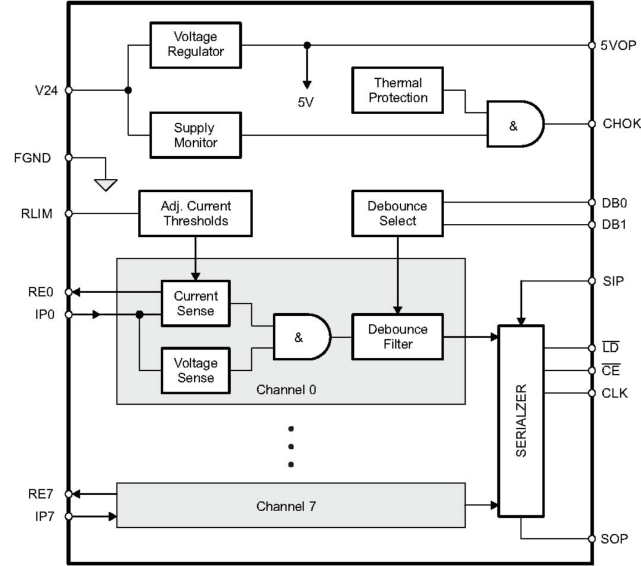
65HVS88134-V, 8-channel digital-input serializer with diagnostics | Serializers, Deserializers | 2 | Active | The SN65HVS881 is an eight channel, digital-input serializer for high-channel density digital input modules in industrial automation. In combination with galvanic isolators the device completes the interface between the high voltage signals on the field-side and the low-voltage signals on the controller side. Input signals are current-limited and then validated by internal debounce filters.
With the addition of a few external components, the input switching characteristics can be configured in accordance with IEC61131-2 for Type 1, 2 and 3 sensor switches.
Upon the application of load and clock signals, input data is latched in parallel into the shift register and afterwards clocked out serially.
Cascading of multiple devices is possible by connecting the serial output of the leading device with the serial input of the following device, enabling the design of high-channel count input modules. Multiple devices can be cascaded through a single serial port, reducing both the isolation channels and controller inputs required.
Input status can be visually indicated via constant current LED outputs. The current limit on the inputs is set by a single external precision resistor. An integrated voltage regulator provides a 5V output to supply low-power isolators. An on-chip temperature sensor provides diagnostic information for graceful shutdown and system safety. An internal parity check for odd parity ensures trustworthy transmission of serial data to the system controller.
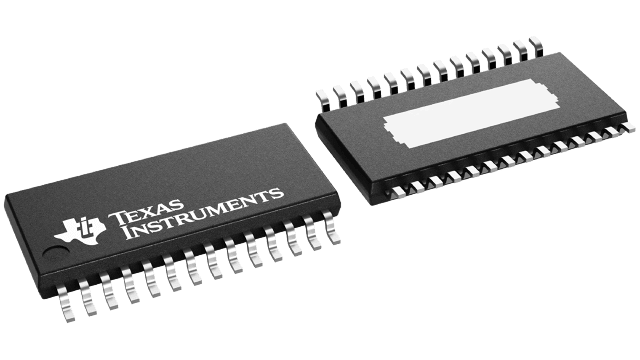
The SN65HVS881 is available in a 28-pin PWP PowerPAD™ package, allowing for efficient heat dissipation. The device is characterized for operation at temperatures from –40°C to 125°C
The SN65HVS881 is an eight channel, digital-input serializer for high-channel density digital input modules in industrial automation. In combination with galvanic isolators the device completes the interface between the high voltage signals on the field-side and the low-voltage signals on the controller side. Input signals are current-limited and then validated by internal debounce filters.
With the addition of a few external components, the input switching characteristics can be configured in accordance with IEC61131-2 for Type 1, 2 and 3 sensor switches.
Upon the application of load and clock signals, input data is latched in parallel into the shift register and afterwards clocked out serially.
Cascading of multiple devices is possible by connecting the serial output of the leading device with the serial input of the following device, enabling the design of high-channel count input modules. Multiple devices can be cascaded through a single serial port, reducing both the isolation channels and controller inputs required.
Input status can be visually indicated via constant current LED outputs. The current limit on the inputs is set by a single external precision resistor. An integrated voltage regulator provides a 5V output to supply low-power isolators. An on-chip temperature sensor provides diagnostic information for graceful shutdown and system safety. An internal parity check for odd parity ensures trustworthy transmission of serial data to the system controller.
The SN65HVS881 is available in a 28-pin PWP PowerPAD™ package, allowing for efficient heat dissipation. The device is characterized for operation at temperatures from –40°C to 125°C |
65HVS88234-V, 8-channel digital-input serializer for industrial automation & process control | Evaluation and Demonstration Boards and Kits | 3 | Obsolete | The SN65HVS882 is an eight channel, digital-input serializer for high-channel density digital input modules in industrial automation. In combination with galvanic isolators the device completes the interface between the high voltage signals on the field-side and the low-voltage signals on the controller side. Input signals are current-limited and then validated by internal debounce filters.
With the addition of a few external components, the input switching characteristics can be configured in accordance with IEC61131-2 for Type 1, 2, and 3 sensor switches.
Upon the application of load and clock signals, input data is latched in parallel into the shift register and afterwards clocked out serially.
Cascading of multiple devices is possible by connecting the serial output of the leading device with the serial input of the following device, enabling the design of high-channel count input modules. Multiple devices can be cascaded through a single serial port, reducing both the isolation channels and controller inputs required.
Input status can be visually indicated via constant current LED outputs. The current limit on the inputs is set by a single external precision resistor. An integrated voltage regulator provides a 5-V output to supply low-power isolators. An on-chip temperature sensor provides diagnostic information for graceful shutdown and system safety.
The SN65HVS882 is available in a 28-pin PWP PowerPAD™ package, allowing for efficient heat dissipation. The device is characterized for operation at temperatures from -40°C to 125°C.
The SN65HVS882 is an eight channel, digital-input serializer for high-channel density digital input modules in industrial automation. In combination with galvanic isolators the device completes the interface between the high voltage signals on the field-side and the low-voltage signals on the controller side. Input signals are current-limited and then validated by internal debounce filters.
With the addition of a few external components, the input switching characteristics can be configured in accordance with IEC61131-2 for Type 1, 2, and 3 sensor switches.
Upon the application of load and clock signals, input data is latched in parallel into the shift register and afterwards clocked out serially.
Cascading of multiple devices is possible by connecting the serial output of the leading device with the serial input of the following device, enabling the design of high-channel count input modules. Multiple devices can be cascaded through a single serial port, reducing both the isolation channels and controller inputs required.
Input status can be visually indicated via constant current LED outputs. The current limit on the inputs is set by a single external precision resistor. An integrated voltage regulator provides a 5-V output to supply low-power isolators. An on-chip temperature sensor provides diagnostic information for graceful shutdown and system safety.
The SN65HVS882 is available in a 28-pin PWP PowerPAD™ package, allowing for efficient heat dissipation. The device is characterized for operation at temperatures from -40°C to 125°C. |
| Evaluation and Demonstration Boards and Kits | 3 | Active | |
65LBC031High-Speed Controller Area Network (CAN) Transceiver | Interface | 3 | Active | The SN75LBC031 is a CAN transceiver used as an interface between a CAN controller and the physical bus for high speed applications of up to 500 kBaud. The device provides transmit capability to the differential bus and differential receive capability to the controller. The transmitter outputs (CANH and CANL), feature internal transition regulation to provide controlled symmetry resulting in low EMI emissions. Both transmitter outputs are fully protected against battery short circuits and electrical transients that can occur on the bus lines. In the event of excessive device power dissipation the output drivers are disabled by the thermal shutdown circuitry at a junction temperature of approximately 160°C. The inclusion of an internal pullup resistor on the transmitter input ensures a defined output during power up and protocol controller reset. For normal operation at 500 kBaud the ASC terminal is open or tied to GND. For slower speed operation at 125 kBaud the bus output transition times can be increased to reduce EMI by connecting the ASC terminal to VCC. The receiver includes an integrated filter that suppresses the signal into pulses less than 30 ns wide.
The SN75LBC031 is characterized for operation from -40°C to 85°C. The SN65LBC031 is characterized for operation from -40°C to 125°C. The SN65LBC031Q is characterized for operation over the automotive temperature range of -40°C to 125°C.
The SN75LBC031 is a CAN transceiver used as an interface between a CAN controller and the physical bus for high speed applications of up to 500 kBaud. The device provides transmit capability to the differential bus and differential receive capability to the controller. The transmitter outputs (CANH and CANL), feature internal transition regulation to provide controlled symmetry resulting in low EMI emissions. Both transmitter outputs are fully protected against battery short circuits and electrical transients that can occur on the bus lines. In the event of excessive device power dissipation the output drivers are disabled by the thermal shutdown circuitry at a junction temperature of approximately 160°C. The inclusion of an internal pullup resistor on the transmitter input ensures a defined output during power up and protocol controller reset. For normal operation at 500 kBaud the ASC terminal is open or tied to GND. For slower speed operation at 125 kBaud the bus output transition times can be increased to reduce EMI by connecting the ASC terminal to VCC. The receiver includes an integrated filter that suppresses the signal into pulses less than 30 ns wide.
The SN75LBC031 is characterized for operation from -40°C to 85°C. The SN65LBC031 is characterized for operation from -40°C to 125°C. The SN65LBC031Q is characterized for operation over the automotive temperature range of -40°C to 125°C. |
| Interface | 2 | Active | |