65HVD54High Output Full-duplex RS-485 Driver and Receiver with enables | Drivers, Receivers, Transceivers | 3 | Active | The SN65HVD5X devices are 3-state differential line drivers and differential-input line receivers that operate with a 5-V power supply. Each driver and receiver has separate input and output pins for full-duplex bus communication designs. They are designed for balanced transmission lines and interoperation with ANSI TIA/EIA-485A, TIA/EIA-422-B, ITU-T v.11 and ISO 8482:1993 standard-compliant devices.
The SN65HVD50, SN65HVD51, and SN65HVD52 are fully enabled with no external enabling pins.
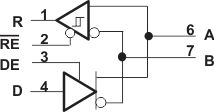
The SN65HVD53, SN65HVD54, and SN65HVD55 have active-high driver enables and active-low receiver enables. A low, less than 1 µA, standby current is achieved by disabling both the driver and receiver.
All devices are characterized for operation from –40°C to 85°C.
The high output feature of the SN65HVD5x provides more noise margin than the typical RS-485 drivers. The extra noise margin makes applications in long cable and harsh noise environments possible.
The SN65HVD5X devices are 3-state differential line drivers and differential-input line receivers that operate with a 5-V power supply. Each driver and receiver has separate input and output pins for full-duplex bus communication designs. They are designed for balanced transmission lines and interoperation with ANSI TIA/EIA-485A, TIA/EIA-422-B, ITU-T v.11 and ISO 8482:1993 standard-compliant devices.
The SN65HVD50, SN65HVD51, and SN65HVD52 are fully enabled with no external enabling pins.
The SN65HVD53, SN65HVD54, and SN65HVD55 have active-high driver enables and active-low receiver enables. A low, less than 1 µA, standby current is achieved by disabling both the driver and receiver.
All devices are characterized for operation from –40°C to 85°C.
The high output feature of the SN65HVD5x provides more noise margin than the typical RS-485 drivers. The extra noise margin makes applications in long cable and harsh noise environments possible. |
65HVD55High Output Full-duplex RS-485 Driver and Receiver with enables | Integrated Circuits (ICs) | 4 | Active | The SN65HVD5X devices are 3-state differential line drivers and differential-input line receivers that operate with a 5-V power supply. Each driver and receiver has separate input and output pins for full-duplex bus communication designs. They are designed for balanced transmission lines and interoperation with ANSI TIA/EIA-485A, TIA/EIA-422-B, ITU-T v.11 and ISO 8482:1993 standard-compliant devices.
The SN65HVD50, SN65HVD51, and SN65HVD52 are fully enabled with no external enabling pins.
The SN65HVD53, SN65HVD54, and SN65HVD55 have active-high driver enables and active-low receiver enables. A low, less than 1 µA, standby current is achieved by disabling both the driver and receiver.
All devices are characterized for operation from –40°C to 85°C.
The high output feature of the SN65HVD5x provides more noise margin than the typical RS-485 drivers. The extra noise margin makes applications in long cable and harsh noise environments possible.
The SN65HVD5X devices are 3-state differential line drivers and differential-input line receivers that operate with a 5-V power supply. Each driver and receiver has separate input and output pins for full-duplex bus communication designs. They are designed for balanced transmission lines and interoperation with ANSI TIA/EIA-485A, TIA/EIA-422-B, ITU-T v.11 and ISO 8482:1993 standard-compliant devices.
The SN65HVD50, SN65HVD51, and SN65HVD52 are fully enabled with no external enabling pins.
The SN65HVD53, SN65HVD54, and SN65HVD55 have active-high driver enables and active-low receiver enables. A low, less than 1 µA, standby current is achieved by disabling both the driver and receiver.
All devices are characterized for operation from –40°C to 85°C.
The high output feature of the SN65HVD5x provides more noise margin than the typical RS-485 drivers. The extra noise margin makes applications in long cable and harsh noise environments possible. |
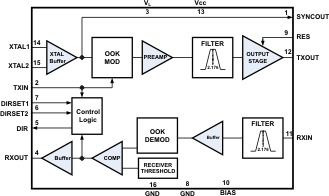
65HVD62AISG® 2.0 on and off keying coax modem transceiver | Interface | 3 | Active | These transceivers modulate and demodulate signals between the logic (baseband) and a frequency suitable for long coaxial media.
The HVD62 is an integrated AISG transceiver designed to be compliant with Antenna Interface Standards Group v2.0 specification.
The HVD62 receiver integrates an active bandpass filter to enable demodulation of signals even in the presence of spurious frequency components. The filter has a 2.176 MHz center frequency.
The transmitter supports adjustable output power levels varying from +0dBm to +6dBm delivered to the 50 Ω coax cable. The HVD62 transmitter is compliant with the spectrum emission requirement provided by the AISG standard.
A direction control output is provided which facilitates bus arbitration for an RS-485 interface. These devices integrate an oscillator input for a crystal, and also accept standard clock inputs to the oscillator.
These transceivers modulate and demodulate signals between the logic (baseband) and a frequency suitable for long coaxial media.
The HVD62 is an integrated AISG transceiver designed to be compliant with Antenna Interface Standards Group v2.0 specification.
The HVD62 receiver integrates an active bandpass filter to enable demodulation of signals even in the presence of spurious frequency components. The filter has a 2.176 MHz center frequency.
The transmitter supports adjustable output power levels varying from +0dBm to +6dBm delivered to the 50 Ω coax cable. The HVD62 transmitter is compliant with the spectrum emission requirement provided by the AISG standard.
A direction control output is provided which facilitates bus arbitration for an RS-485 interface. These devices integrate an oscillator input for a crystal, and also accept standard clock inputs to the oscillator. |
| Interface | 1 | Active | |
65HVD703.3V, Full-Duplex RS-485, 12kV IEC ESD, 400kbps data rate, w/Enables | Drivers, Receivers, Transceivers | 3 | Active | These devices extend the RS-485 portfolio with a family of full-duplex transceivers with robust 3.3-V drivers and receivers and high levels of ESD protection. The ESD protection includes > ±30-kV HBM and > ±12-kV IEC61000-4-2 contact discharge. The large receiver hysteresis of the SN65HVD7x devices provides immunity to conducted differential noise and the wide operating temperature enables reliability in harsh operating environments. The SN65HVD7x devices are offered in a standard SOIC package as well as in a small-footprint MSOP package.
These devices each combine a differential driver and a differential receiver, which operate from a single 3.3-V power supply. Each driver and receiver has separate input and output pins for full-duplex bus communication designs. These devices all feature a wide common-mode voltage range which makes the devices suitable for multi-point applications over long cable runs.
The SN65HVD71, SN65HVD74, and SN65HVD77 devices are fully enabled with no external enabling pins.
The SN65HVD70, SN65HVD73, and SN65HVD76 devices have active-high driver enables and active-low receiver enables. A low, less than 5-µA standby current can be achieved by disabling both the driver and receiver.
These devices are characterized from –40°C to 125°C.
These devices extend the RS-485 portfolio with a family of full-duplex transceivers with robust 3.3-V drivers and receivers and high levels of ESD protection. The ESD protection includes > ±30-kV HBM and > ±12-kV IEC61000-4-2 contact discharge. The large receiver hysteresis of the SN65HVD7x devices provides immunity to conducted differential noise and the wide operating temperature enables reliability in harsh operating environments. The SN65HVD7x devices are offered in a standard SOIC package as well as in a small-footprint MSOP package.
These devices each combine a differential driver and a differential receiver, which operate from a single 3.3-V power supply. Each driver and receiver has separate input and output pins for full-duplex bus communication designs. These devices all feature a wide common-mode voltage range which makes the devices suitable for multi-point applications over long cable runs.
The SN65HVD71, SN65HVD74, and SN65HVD77 devices are fully enabled with no external enabling pins.
The SN65HVD70, SN65HVD73, and SN65HVD76 devices have active-high driver enables and active-low receiver enables. A low, less than 5-µA standby current can be achieved by disabling both the driver and receiver.
These devices are characterized from –40°C to 125°C. |
| Evaluation Boards | 4 | Active | |
65HVD743.3V, Full-Duplex RS-485, 12kV IEC ESD, 20Mbps data rate, No Enables | Drivers, Receivers, Transceivers | 1 | Active | These devices extend the RS-485 portfolio with a family of full-duplex transceivers with robust 3.3-V drivers and receivers and high levels of ESD protection. The ESD protection includes > ±30-kV HBM and > ±12-kV IEC61000-4-2 contact discharge. The large receiver hysteresis of the SN65HVD7x devices provides immunity to conducted differential noise and the wide operating temperature enables reliability in harsh operating environments. The SN65HVD7x devices are offered in a standard SOIC package as well as in a small-footprint MSOP package.
These devices each combine a differential driver and a differential receiver, which operate from a single 3.3-V power supply. Each driver and receiver has separate input and output pins for full-duplex bus communication designs. These devices all feature a wide common-mode voltage range which makes the devices suitable for multi-point applications over long cable runs.
The SN65HVD71, SN65HVD74, and SN65HVD77 devices are fully enabled with no external enabling pins.
The SN65HVD70, SN65HVD73, and SN65HVD76 devices have active-high driver enables and active-low receiver enables. A low, less than 5-µA standby current can be achieved by disabling both the driver and receiver.
These devices are characterized from –40°C to 125°C.
These devices extend the RS-485 portfolio with a family of full-duplex transceivers with robust 3.3-V drivers and receivers and high levels of ESD protection. The ESD protection includes > ±30-kV HBM and > ±12-kV IEC61000-4-2 contact discharge. The large receiver hysteresis of the SN65HVD7x devices provides immunity to conducted differential noise and the wide operating temperature enables reliability in harsh operating environments. The SN65HVD7x devices are offered in a standard SOIC package as well as in a small-footprint MSOP package.
These devices each combine a differential driver and a differential receiver, which operate from a single 3.3-V power supply. Each driver and receiver has separate input and output pins for full-duplex bus communication designs. These devices all feature a wide common-mode voltage range which makes the devices suitable for multi-point applications over long cable runs.
The SN65HVD71, SN65HVD74, and SN65HVD77 devices are fully enabled with no external enabling pins.
The SN65HVD70, SN65HVD73, and SN65HVD76 devices have active-high driver enables and active-low receiver enables. A low, less than 5-µA standby current can be achieved by disabling both the driver and receiver.
These devices are characterized from –40°C to 125°C. |
| Drivers, Receivers, Transceivers | 2 | Active | |
65HVD825V-Supply RS-485 with IEC ESD Protection | Drivers, Receivers, Transceivers | 1 | Active | This device has robust drivers and receivers for demanding industrial applications. The bus pins are robust to ESD events, with high levels of protection to Human-Body Model, Air-Gap Discharge, and Contact Discharge specifications.
The device combines a differential driver and a differential receiver, which operate from a single 5-V power supply. The driver differential outputs and the receiver differential inputs are connected internally to form a bus port suitable for half-duplex (two-wire bus) communication. The device features a wide common-mode voltage range making the device suitable for multi-point applications over long cable runs. The device is characterized from –40°C to 85°C.
This device has robust drivers and receivers for demanding industrial applications. The bus pins are robust to ESD events, with high levels of protection to Human-Body Model, Air-Gap Discharge, and Contact Discharge specifications.
The device combines a differential driver and a differential receiver, which operate from a single 5-V power supply. The driver differential outputs and the receiver differential inputs are connected internally to form a bus port suitable for half-duplex (two-wire bus) communication. The device features a wide common-mode voltage range making the device suitable for multi-point applications over long cable runs. The device is characterized from –40°C to 85°C. |
65HVD888Bus-Polarity Correcting RS-485 Transceiver with IEC-ESD Protection | Integrated Circuits (ICs) | 1 | Active | The SN65HVD888 is a low-power RS-485 transceiver with automatic bus-polarity correction and transient protection. Upon hot plug-in, the device detects and corrects the bus polarity within the first 76 ms of bus idling. On-chip transient protection protects the device against IEC61000 ESD and EFT transients. This device has robust drivers and receivers for demanding industrial applications. The bus pins are robust to electrostatic discharge (ESD) events, with high levels of protection to Human-Body Model (HBM), Air-Gap Discharge, and Contact Discharge specifications.
The device combines a differential driver and a differential receiver, which operate together from a single 5-V power supply. The driver differential outputs and the receiver differential inputs are connected internally to form a bus port suitable for half-duplex (two-wire bus) communication. The device features a wide common-mode voltage range making the device suitable for multi-point applications over long cable runs. The SN65HVD888 is available in an SOIC-8 package, and is characterized from –40°C to 125°C.
The SN65HVD888 is a low-power RS-485 transceiver with automatic bus-polarity correction and transient protection. Upon hot plug-in, the device detects and corrects the bus polarity within the first 76 ms of bus idling. On-chip transient protection protects the device against IEC61000 ESD and EFT transients. This device has robust drivers and receivers for demanding industrial applications. The bus pins are robust to electrostatic discharge (ESD) events, with high levels of protection to Human-Body Model (HBM), Air-Gap Discharge, and Contact Discharge specifications.
The device combines a differential driver and a differential receiver, which operate together from a single 5-V power supply. The driver differential outputs and the receiver differential inputs are connected internally to form a bus port suitable for half-duplex (two-wire bus) communication. The device features a wide common-mode voltage range making the device suitable for multi-point applications over long cable runs. The SN65HVD888 is available in an SOIC-8 package, and is characterized from –40°C to 125°C. |