ISO7341-Q1Low-power, quad-channel, 3/1, 25-Mbps, default output low digital isolator | Development Boards, Kits, Programmers | 9 | Active | The ISO734x-Q1 family of devices provides galvanic isolation up to 3000 VRMSfor 1 minute per UL 1577 and 4242 VPKper VDE V 0884-10. These devices have four isolated channels comprised of logic input and output buffers separated by a silicon dioxide (SiO2) insulation barrier.
The ISO7340-Q1 device has four channels in forward direction, the ISO7341-Q1 device has three forward and one reverse-direction channels, and the ISO7342-Q1 device has two forward and two reverse-direction channels. In case of input power or signal loss, the default output islowfor orderable part numbers with suffixFandhighfor orderable part numbers without suffixF. See theDevice Functional Modessection for further details.
Used in conjunction with isolated power supplies, these devices help prevent noise currents on a data bus or other circuits from entering the local ground and interfering with or damaging sensitive circuitry. The ISO734x-Q1 device has integrated noise filter for harsh industrial environment where short noise pulses may be present at the device input pins. The ISO734x-Q1 device has TTL input thresholds and operates from 3-V to 5.5-V supply levels. Through innovative chip design and layout techniques, electromagnetic compatibility of the ISO734x-Q1 family of devices has been significantly enhanced to enable system-level ESD, EFT, surge, and emissions compliance.
The ISO734x-Q1 family of devices provides galvanic isolation up to 3000 VRMSfor 1 minute per UL 1577 and 4242 VPKper VDE V 0884-10. These devices have four isolated channels comprised of logic input and output buffers separated by a silicon dioxide (SiO2) insulation barrier.
The ISO7340-Q1 device has four channels in forward direction, the ISO7341-Q1 device has three forward and one reverse-direction channels, and the ISO7342-Q1 device has two forward and two reverse-direction channels. In case of input power or signal loss, the default output islowfor orderable part numbers with suffixFandhighfor orderable part numbers without suffixF. See theDevice Functional Modessection for further details.
Used in conjunction with isolated power supplies, these devices help prevent noise currents on a data bus or other circuits from entering the local ground and interfering with or damaging sensitive circuitry. The ISO734x-Q1 device has integrated noise filter for harsh industrial environment where short noise pulses may be present at the device input pins. The ISO734x-Q1 device has TTL input thresholds and operates from 3-V to 5.5-V supply levels. Through innovative chip design and layout techniques, electromagnetic compatibility of the ISO734x-Q1 family of devices has been significantly enhanced to enable system-level ESD, EFT, surge, and emissions compliance. |
ISO7342-Q1Low-power, quad-channel, 2/2, 25-Mbps, default output low digital isolator | Development Boards, Kits, Programmers | 9 | Active | The ISO734x-Q1 family of devices provides galvanic isolation up to 3000 VRMSfor 1 minute per UL 1577 and 4242 VPKper VDE V 0884-10. These devices have four isolated channels comprised of logic input and output buffers separated by a silicon dioxide (SiO2) insulation barrier.
The ISO7340-Q1 device has four channels in forward direction, the ISO7341-Q1 device has three forward and one reverse-direction channels, and the ISO7342-Q1 device has two forward and two reverse-direction channels. In case of input power or signal loss, the default output islowfor orderable part numbers with suffixFandhighfor orderable part numbers without suffixF. See theDevice Functional Modessection for further details.
Used in conjunction with isolated power supplies, these devices help prevent noise currents on a data bus or other circuits from entering the local ground and interfering with or damaging sensitive circuitry. The ISO734x-Q1 device has integrated noise filter for harsh industrial environment where short noise pulses may be present at the device input pins. The ISO734x-Q1 device has TTL input thresholds and operates from 3-V to 5.5-V supply levels. Through innovative chip design and layout techniques, electromagnetic compatibility of the ISO734x-Q1 family of devices has been significantly enhanced to enable system-level ESD, EFT, surge, and emissions compliance.
The ISO734x-Q1 family of devices provides galvanic isolation up to 3000 VRMSfor 1 minute per UL 1577 and 4242 VPKper VDE V 0884-10. These devices have four isolated channels comprised of logic input and output buffers separated by a silicon dioxide (SiO2) insulation barrier.
The ISO7340-Q1 device has four channels in forward direction, the ISO7341-Q1 device has three forward and one reverse-direction channels, and the ISO7342-Q1 device has two forward and two reverse-direction channels. In case of input power or signal loss, the default output islowfor orderable part numbers with suffixFandhighfor orderable part numbers without suffixF. See theDevice Functional Modessection for further details.
Used in conjunction with isolated power supplies, these devices help prevent noise currents on a data bus or other circuits from entering the local ground and interfering with or damaging sensitive circuitry. The ISO734x-Q1 device has integrated noise filter for harsh industrial environment where short noise pulses may be present at the device input pins. The ISO734x-Q1 device has TTL input thresholds and operates from 3-V to 5.5-V supply levels. Through innovative chip design and layout techniques, electromagnetic compatibility of the ISO734x-Q1 family of devices has been significantly enhanced to enable system-level ESD, EFT, surge, and emissions compliance. |
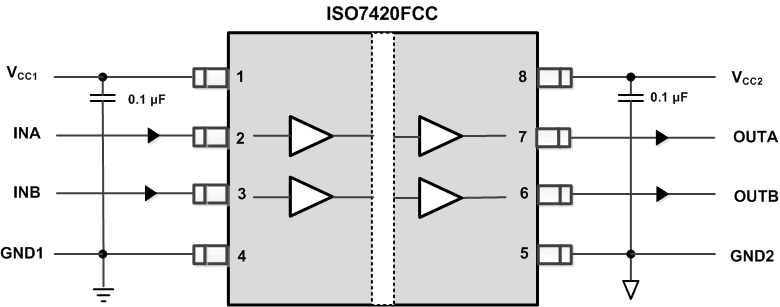
ISO7420FCCDual-channel, 2/0, 1-Mbps digital isolator with wide temperature range | Digital Isolators | 7 | Active | The ISO7420, ISO7420M and ISO7421 provide galvanic isolation up to 2500 VRMSfor 1 minute per UL. These digital isolators have two isolated channels. Each isolation channel has a logic input and output buffer separated by a silicon dioxide (SiO2) insulation barrier. Used in conjunction with isolated power supplies, these devices prevent noise currents on a data bus or other circuit from entering the local ground and interfering with or damaging sensitive circuitry. The suffix M indicates wide temperature range (–40°C to 125°C).
These devices have TTL input thresholds and require two supply voltages, 3.3 or 5 V, or any combination. All inputs are 5-V tolerant when supplied from a 3.3-V supply.
Note: The ISO7420 and ISO7421 are specified for signaling rates up to 1 Mbps. Due to their fast response time, under most cases, these devices will also transmit data with much shorter pulse widths. Designers should add external filtering to remove spurious signals with input pulse duration <20 ns if desired.
The ISO7420, ISO7420M and ISO7421 provide galvanic isolation up to 2500 VRMSfor 1 minute per UL. These digital isolators have two isolated channels. Each isolation channel has a logic input and output buffer separated by a silicon dioxide (SiO2) insulation barrier. Used in conjunction with isolated power supplies, these devices prevent noise currents on a data bus or other circuit from entering the local ground and interfering with or damaging sensitive circuitry. The suffix M indicates wide temperature range (–40°C to 125°C).
These devices have TTL input thresholds and require two supply voltages, 3.3 or 5 V, or any combination. All inputs are 5-V tolerant when supplied from a 3.3-V supply.
Note: The ISO7420 and ISO7421 are specified for signaling rates up to 1 Mbps. Due to their fast response time, under most cases, these devices will also transmit data with much shorter pulse widths. Designers should add external filtering to remove spurious signals with input pulse duration <20 ns if desired. |
ISO7421E-Q1Dual-channel, 1/1, 50-Mbps, default output low digital isolator | Isolators | 8 | Active | The ISO7420, ISO7420M and ISO7421 provide galvanic isolation up to 2500 VRMSfor 1 minute per UL. These digital isolators have two isolated channels. Each isolation channel has a logic input and output buffer separated by a silicon dioxide (SiO2) insulation barrier. Used in conjunction with isolated power supplies, these devices prevent noise currents on a data bus or other circuit from entering the local ground and interfering with or damaging sensitive circuitry. The suffix M indicates wide temperature range (–40°C to 125°C).
These devices have TTL input thresholds and require two supply voltages, 3.3 or 5 V, or any combination. All inputs are 5-V tolerant when supplied from a 3.3-V supply.
Note: The ISO7420 and ISO7421 are specified for signaling rates up to 1 Mbps. Due to their fast response time, under most cases, these devices will also transmit data with much shorter pulse widths. Designers should add external filtering to remove spurious signals with input pulse duration <20 ns if desired.
The ISO7420, ISO7420M and ISO7421 provide galvanic isolation up to 2500 VRMSfor 1 minute per UL. These digital isolators have two isolated channels. Each isolation channel has a logic input and output buffer separated by a silicon dioxide (SiO2) insulation barrier. Used in conjunction with isolated power supplies, these devices prevent noise currents on a data bus or other circuit from entering the local ground and interfering with or damaging sensitive circuitry. The suffix M indicates wide temperature range (–40°C to 125°C).
These devices have TTL input thresholds and require two supply voltages, 3.3 or 5 V, or any combination. All inputs are 5-V tolerant when supplied from a 3.3-V supply.
Note: The ISO7420 and ISO7421 are specified for signaling rates up to 1 Mbps. Due to their fast response time, under most cases, these devices will also transmit data with much shorter pulse widths. Designers should add external filtering to remove spurious signals with input pulse duration <20 ns if desired. |
ISO7520CDual-channel, 2/0, digital isolator | Digital Isolators | 2 | Active | The ISO7520C and ISO7521C provide galvanic isolation of up to 4243 VRMSfor 1 minute per UL and 6000 VPKper VDE. These devices are also certified to 5000 VRMSreinforced insulation per end equipment standards IEC 60950-1, IEC 61010-1, and IEC 60601-1. These digital isolators have two isolated channels with unidirectional (ISO7520C) and bidirectional (ISO7521C) channel configurations. Each isolation channel has a logic input and output buffer separated by a silicon oxide (SiO2) insulation barrier. Used in conjunction with isolated power supplies, these devices prevent noise currents on a data bus or other circuits from entering the local ground and interfering with or damaging sensitive circuitry. The devices have TTL input thresholds and can operate from 3.3- and 5-V supplies. All inputs are 5-V tolerant when supplied from 3.3-V supplies.
NOTE:The ISO7520C and ISO7521C are specified for signaling rates up to 1 Mbps. Due to their fast response time, these devices will also transmit faster data with much shorter pulse widths. Designers must add external filtering to remove spurious signals with input pulse duration < 20 ns, if desired.
The ISO7520C and ISO7521C provide galvanic isolation of up to 4243 VRMSfor 1 minute per UL and 6000 VPKper VDE. These devices are also certified to 5000 VRMSreinforced insulation per end equipment standards IEC 60950-1, IEC 61010-1, and IEC 60601-1. These digital isolators have two isolated channels with unidirectional (ISO7520C) and bidirectional (ISO7521C) channel configurations. Each isolation channel has a logic input and output buffer separated by a silicon oxide (SiO2) insulation barrier. Used in conjunction with isolated power supplies, these devices prevent noise currents on a data bus or other circuits from entering the local ground and interfering with or damaging sensitive circuitry. The devices have TTL input thresholds and can operate from 3.3- and 5-V supplies. All inputs are 5-V tolerant when supplied from 3.3-V supplies.
NOTE:The ISO7520C and ISO7521C are specified for signaling rates up to 1 Mbps. Due to their fast response time, these devices will also transmit faster data with much shorter pulse widths. Designers must add external filtering to remove spurious signals with input pulse duration < 20 ns, if desired. |
ISO7521CDual-channel, 1/1, digital isolator | Isolators | 1 | Active | The ISO7520C and ISO7521C provide galvanic isolation of up to 4243 VRMSfor 1 minute per UL and 6000 VPKper VDE. These devices are also certified to 5000 VRMSreinforced insulation per end equipment standards IEC 60950-1, IEC 61010-1, and IEC 60601-1. These digital isolators have two isolated channels with unidirectional (ISO7520C) and bidirectional (ISO7521C) channel configurations. Each isolation channel has a logic input and output buffer separated by a silicon oxide (SiO2) insulation barrier. Used in conjunction with isolated power supplies, these devices prevent noise currents on a data bus or other circuits from entering the local ground and interfering with or damaging sensitive circuitry. The devices have TTL input thresholds and can operate from 3.3- and 5-V supplies. All inputs are 5-V tolerant when supplied from 3.3-V supplies.
NOTE:The ISO7520C and ISO7521C are specified for signaling rates up to 1 Mbps. Due to their fast response time, these devices will also transmit faster data with much shorter pulse widths. Designers must add external filtering to remove spurious signals with input pulse duration < 20 ns, if desired.
The ISO7520C and ISO7521C provide galvanic isolation of up to 4243 VRMSfor 1 minute per UL and 6000 VPKper VDE. These devices are also certified to 5000 VRMSreinforced insulation per end equipment standards IEC 60950-1, IEC 61010-1, and IEC 60601-1. These digital isolators have two isolated channels with unidirectional (ISO7520C) and bidirectional (ISO7521C) channel configurations. Each isolation channel has a logic input and output buffer separated by a silicon oxide (SiO2) insulation barrier. Used in conjunction with isolated power supplies, these devices prevent noise currents on a data bus or other circuits from entering the local ground and interfering with or damaging sensitive circuitry. The devices have TTL input thresholds and can operate from 3.3- and 5-V supplies. All inputs are 5-V tolerant when supplied from 3.3-V supplies.
NOTE:The ISO7520C and ISO7521C are specified for signaling rates up to 1 Mbps. Due to their fast response time, these devices will also transmit faster data with much shorter pulse widths. Designers must add external filtering to remove spurious signals with input pulse duration < 20 ns, if desired. |
ISO7631FCTriple-channel, 2/1, 150-Mbps, default output low digital isolator | Digital Isolators | 3 | Active | The ISO7631F and ISO7641F devices provide galvanic isolation up to 4242 VPKper VDE. The ISO7631F device has three channels, two of which operate in the forward direction and one which operates in the reverse direction. The ISO7641F device has 4 channels, three of which operate in the forward direction and one of which operates in the reverse direction. Suffix F indicates that output defaults to low-state in fail-safe conditions (see ). M-Grade devices are high-speed isolators capable of up to150-Mbps data rates with fast propagation delays, whereas C-Grade devices are capable of up to 25-Mbps data rates with low power consumption and integrated filters for noise-prone applications. C-Grade devices are recommended for lower-speed applications where input noise pulses of less than 6 ns duration must be suppressed, or when low-power consumption is critical.
Each isolation channel has a logic input and output buffer separated by a silicon dioxide (SiO2) insulation barrier. Used in conjunction with isolated power supplies, these devices prevent noise currents on a data bus or other circuits from entering the local ground and interfering with or damaging sensitive circuitry. The devices have TTL input thresholds and can operate from 2.7-V (M-Grade), 3.3-V and 5-V supplies. All inputs are 5-V tolerant when supplied from 3.3-V or 2.7-V supplies.
The ISO7631F and ISO7641F devices provide galvanic isolation up to 4242 VPKper VDE. The ISO7631F device has three channels, two of which operate in the forward direction and one which operates in the reverse direction. The ISO7641F device has 4 channels, three of which operate in the forward direction and one of which operates in the reverse direction. Suffix F indicates that output defaults to low-state in fail-safe conditions (see ). M-Grade devices are high-speed isolators capable of up to150-Mbps data rates with fast propagation delays, whereas C-Grade devices are capable of up to 25-Mbps data rates with low power consumption and integrated filters for noise-prone applications. C-Grade devices are recommended for lower-speed applications where input noise pulses of less than 6 ns duration must be suppressed, or when low-power consumption is critical.
Each isolation channel has a logic input and output buffer separated by a silicon dioxide (SiO2) insulation barrier. Used in conjunction with isolated power supplies, these devices prevent noise currents on a data bus or other circuits from entering the local ground and interfering with or damaging sensitive circuitry. The devices have TTL input thresholds and can operate from 2.7-V (M-Grade), 3.3-V and 5-V supplies. All inputs are 5-V tolerant when supplied from 3.3-V or 2.7-V supplies. |
ISO7640FMQuad-channel, 4/0, 150-Mbps, default output low digital isolator | Digital Isolators | 2 | Active | ISO7640FM and ISO7641FM provide galvanic isolation up to 6 KVPKfor 1 minute per UL and VDE. These devices are also certified up to 5-KVRMSReinforced isolation at a working voltage of 400 VRMSper end equipment standards EN/UL/CSA 60950-1 and 61010-1. ISO7640F and ISO7641F are quad-channel isolators; ISO7640F has four forward and ISO7641F has three forward and one reverse-direction channels. Suffix F indicates that output defaults to Low-state in fail-safe conditions. M-Grade devices are high-speed isolators capable of 150-Mbps data rate with fast propagation delays.
Each isolation channel has a logic input and output buffer separated by a silicon dioxide (SiO2) insulation barrier. Used in conjunction with isolated power supplies, these devices prevent noise currents on a data bus or other circuits from entering the local ground and interfering with or damaging sensitive circuitry. The devices have TTL input thresholds and can operate from 2.7-V, 3.3-V, and 5-V supplies. All inputs are 5-V tolerant when supplied from 3.3-V or 2.7-V supplies.
ISO7640FM and ISO7641FM provide galvanic isolation up to 6 KVPKfor 1 minute per UL and VDE. These devices are also certified up to 5-KVRMSReinforced isolation at a working voltage of 400 VRMSper end equipment standards EN/UL/CSA 60950-1 and 61010-1. ISO7640F and ISO7641F are quad-channel isolators; ISO7640F has four forward and ISO7641F has three forward and one reverse-direction channels. Suffix F indicates that output defaults to Low-state in fail-safe conditions. M-Grade devices are high-speed isolators capable of 150-Mbps data rate with fast propagation delays.
Each isolation channel has a logic input and output buffer separated by a silicon dioxide (SiO2) insulation barrier. Used in conjunction with isolated power supplies, these devices prevent noise currents on a data bus or other circuits from entering the local ground and interfering with or damaging sensitive circuitry. The devices have TTL input thresholds and can operate from 2.7-V, 3.3-V, and 5-V supplies. All inputs are 5-V tolerant when supplied from 3.3-V or 2.7-V supplies. |
ISO7641FMQuad-channel, 3/1, 150-Mbps, default output low digital isolator | Digital Isolators | 2 | Active | The ISO7631F and ISO7641F devices provide galvanic isolation up to 4242 VPKper VDE. The ISO7631F device has three channels, two of which operate in the forward direction and one which operates in the reverse direction. The ISO7641F device has 4 channels, three of which operate in the forward direction and one of which operates in the reverse direction. Suffix F indicates that output defaults to low-state in fail-safe conditions (see ). M-Grade devices are high-speed isolators capable of up to150-Mbps data rates with fast propagation delays, whereas C-Grade devices are capable of up to 25-Mbps data rates with low power consumption and integrated filters for noise-prone applications. C-Grade devices are recommended for lower-speed applications where input noise pulses of less than 6 ns duration must be suppressed, or when low-power consumption is critical.
Each isolation channel has a logic input and output buffer separated by a silicon dioxide (SiO2) insulation barrier. Used in conjunction with isolated power supplies, these devices prevent noise currents on a data bus or other circuits from entering the local ground and interfering with or damaging sensitive circuitry. The devices have TTL input thresholds and can operate from 2.7-V (M-Grade), 3.3-V and 5-V supplies. All inputs are 5-V tolerant when supplied from 3.3-V or 2.7-V supplies.
The ISO7631F and ISO7641F devices provide galvanic isolation up to 4242 VPKper VDE. The ISO7631F device has three channels, two of which operate in the forward direction and one which operates in the reverse direction. The ISO7641F device has 4 channels, three of which operate in the forward direction and one of which operates in the reverse direction. Suffix F indicates that output defaults to low-state in fail-safe conditions (see ). M-Grade devices are high-speed isolators capable of up to150-Mbps data rates with fast propagation delays, whereas C-Grade devices are capable of up to 25-Mbps data rates with low power consumption and integrated filters for noise-prone applications. C-Grade devices are recommended for lower-speed applications where input noise pulses of less than 6 ns duration must be suppressed, or when low-power consumption is critical.
Each isolation channel has a logic input and output buffer separated by a silicon dioxide (SiO2) insulation barrier. Used in conjunction with isolated power supplies, these devices prevent noise currents on a data bus or other circuits from entering the local ground and interfering with or damaging sensitive circuitry. The devices have TTL input thresholds and can operate from 2.7-V (M-Grade), 3.3-V and 5-V supplies. All inputs are 5-V tolerant when supplied from 3.3-V or 2.7-V supplies. |
ISO7710-Q1Automotive, robust EMC, single-channel, reinforced digital isolator | Isolators | 13 | Active | The ISO7710 device is a high-performance, single-channel digital isolator with 5000VRMS (DW package) and 3000VRMS (D package) isolation ratings per UL 1577. This device is also certified by VDE, TUV, CSA, and CQC.
The ISO7710 device provides high electromagnetic immunity and low emissions at low power consumption, while isolating CMOS or LVCMOS digital I/Os. The isolation channel has a logic input and output buffer separated by a double capacitive silicon dioxide (SiO2) insulation barrier. In the event of input power or signal loss, default output is high for a device without suffix F and low for a device with suffix F. See the Device Functional Modes section for further details.
Used in conjunction with isolated power supplies, the device helps prevent noise currents on data buses, such as RS-485, RS-232, and CAN , or other circuits from entering the local ground and interfering with or damaging sensitive circuitry. Through innovative chip design and layout techniques, the electromagnetic compatibility of the ISO7710 device has been significantly enhanced to ease system-level ESD, EFT, surge, and emissions compliance. The ISO7710 device is available in 16-pin SOIC wide-body (DW) and 8-pin SOIC narrow-body (D) packages.
The ISO7710 device is a high-performance, single-channel digital isolator with 5000VRMS (DW package) and 3000VRMS (D package) isolation ratings per UL 1577. This device is also certified by VDE, TUV, CSA, and CQC.
The ISO7710 device provides high electromagnetic immunity and low emissions at low power consumption, while isolating CMOS or LVCMOS digital I/Os. The isolation channel has a logic input and output buffer separated by a double capacitive silicon dioxide (SiO2) insulation barrier. In the event of input power or signal loss, default output is high for a device without suffix F and low for a device with suffix F. See the Device Functional Modes section for further details.
Used in conjunction with isolated power supplies, the device helps prevent noise currents on data buses, such as RS-485, RS-232, and CAN , or other circuits from entering the local ground and interfering with or damaging sensitive circuitry. Through innovative chip design and layout techniques, the electromagnetic compatibility of the ISO7710 device has been significantly enhanced to ease system-level ESD, EFT, surge, and emissions compliance. The ISO7710 device is available in 16-pin SOIC wide-body (DW) and 8-pin SOIC narrow-body (D) packages. |