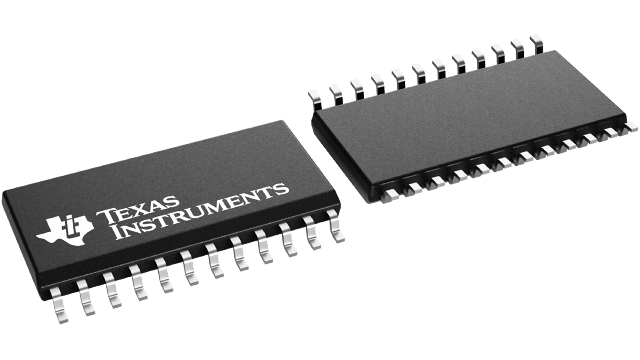
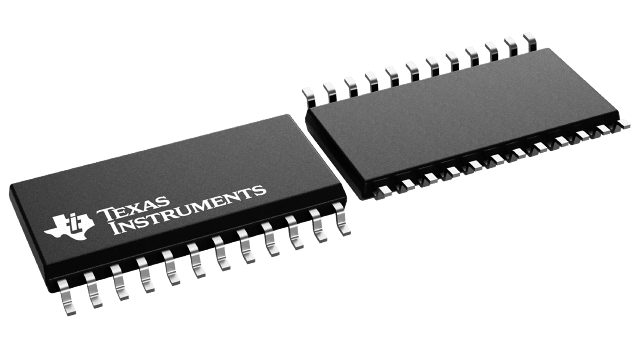
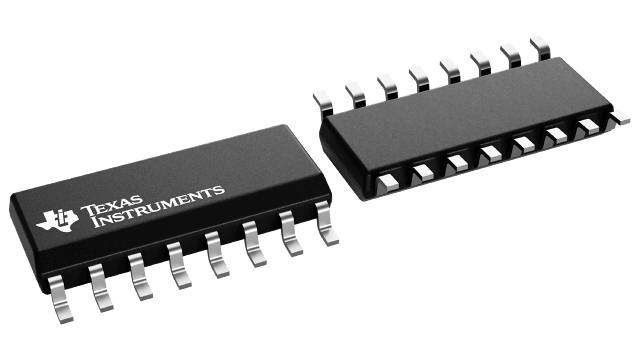
CY74FCT646TOctal Registered Bus Transceivers with 3-State Outputs | Buffers, Drivers, Receivers, Transceivers | 11 | Active | The \x92FCT646T devices consist of a bus transceiver circuit with 3-state, D-type flip-flops, and control circuitry arranged for multiplexed transmission of data directly from the input bus or from the internal registers. Data on the A or B bus is clocked into the registers as the appropriate clock pin goes to a high logic level. Output-enable (G\) and direction (DIR) inputs control the transceiver function. In the transceiver mode,data present at the high-impedance port can be stored in either the A or B register, or in both. Select controls (SAB, SBA) can multiplex stored and real-time (transparent mode) data. DIR determines which bus receives data when G\ is low. In the isolation mode (G\ is high), A data can be stored in the B register and/or B data can be stored in the A register.
These devices are fully specified for partial-power-down applications using Ioff. The Ioffcircuitry disables the outputs, preventing damaging current backflow through the device when it is powered down.
The \x92FCT646T devices consist of a bus transceiver circuit with 3-state, D-type flip-flops, and control circuitry arranged for multiplexed transmission of data directly from the input bus or from the internal registers. Data on the A or B bus is clocked into the registers as the appropriate clock pin goes to a high logic level. Output-enable (G\) and direction (DIR) inputs control the transceiver function. In the transceiver mode,data present at the high-impedance port can be stored in either the A or B register, or in both. Select controls (SAB, SBA) can multiplex stored and real-time (transparent mode) data. DIR determines which bus receives data when G\ is low. In the isolation mode (G\ is high), A data can be stored in the B register and/or B data can be stored in the A register.
These devices are fully specified for partial-power-down applications using Ioff. The Ioffcircuitry disables the outputs, preventing damaging current backflow through the device when it is powered down. |
CY74FCT652TOctal Bus Transceivers and Registers with 3-State Outputs | Logic | 9 | Active | The CY74FCT652T consists of bus transceiver circuits, D-type flip-flops, and control circuitry arranged for multiplexed transmission of data directly from the input bus or from the internal storage registers. GAB and GBA\ inputs control the transceiver functions. Select-control (SAB and SBA) inputs select either real-time or stored-data transfer. The circuitry used for select control eliminates the typical decoding glitch that occurs in a multiplexer during the transition between stored and real-time data. A low input level selects real-time data, and a high input level selects stored data.
Data on the A or B data bus, or both, can be stored in the internal D-type flip-flops by low-to-high transitions of the appropriate clock (CPAB or CPBA) inputs, regardless of the select or enable levels of the control pins. When SAB and SBA are in the real-time transfer mode, it also is possible to store data without using the internal D-type flip-flops by simultaneously enabling GAB and GBA\. In this configuration, each output reinforces its input. Thus, when all other data sources to the two sets of bus lines are at high impedance, each set of bus lines remains at its last state.
This device is fully specified for partial-power-down applications using Ioff. The Ioffcircuitry disables the outputs, preventing damaging current backflow through the device when it is powered down.
The CY74FCT652T consists of bus transceiver circuits, D-type flip-flops, and control circuitry arranged for multiplexed transmission of data directly from the input bus or from the internal storage registers. GAB and GBA\ inputs control the transceiver functions. Select-control (SAB and SBA) inputs select either real-time or stored-data transfer. The circuitry used for select control eliminates the typical decoding glitch that occurs in a multiplexer during the transition between stored and real-time data. A low input level selects real-time data, and a high input level selects stored data.
Data on the A or B data bus, or both, can be stored in the internal D-type flip-flops by low-to-high transitions of the appropriate clock (CPAB or CPBA) inputs, regardless of the select or enable levels of the control pins. When SAB and SBA are in the real-time transfer mode, it also is possible to store data without using the internal D-type flip-flops by simultaneously enabling GAB and GBA\. In this configuration, each output reinforces its input. Thus, when all other data sources to the two sets of bus lines are at high impedance, each set of bus lines remains at its last state.
This device is fully specified for partial-power-down applications using Ioff. The Ioffcircuitry disables the outputs, preventing damaging current backflow through the device when it is powered down. |
CY74FCT821T10-Bit Bus Interface Flip-Flops with 3-State Outputs | Flip Flops | 9 | Active | This bus-interface register is designed to eliminate the extra packages required to buffer existing registers and provide extra data width for wider address/data paths or buses carrying parity. The CY74FCT821T is a 10-bit-wide buffered version of the popular CY74FCT374 function. This device is ideal for use as an output port requiring high IOL/IOH.
This device is designed for high-capacitance load drive capability, while providing low-capacitance bus loading at both inputs and outputs. Outputs are designed for low-capacitance bus loading in the high-impedance state.
This device is fully specified for partial-power-down applications using Ioff. The Ioffcircuitry disables the outputs, preventing damaging current backflow through the device when it is powered down.
This bus-interface register is designed to eliminate the extra packages required to buffer existing registers and provide extra data width for wider address/data paths or buses carrying parity. The CY74FCT821T is a 10-bit-wide buffered version of the popular CY74FCT374 function. This device is ideal for use as an output port requiring high IOL/IOH.
This device is designed for high-capacitance load drive capability, while providing low-capacitance bus loading at both inputs and outputs. Outputs are designed for low-capacitance bus loading in the high-impedance state.
This device is fully specified for partial-power-down applications using Ioff. The Ioffcircuitry disables the outputs, preventing damaging current backflow through the device when it is powered down. |
CY74FCT823T9-Bit Bus Interface Flip-Flops with 3-State Outputs | Flip Flops | 6 | Active | This bus-interface register is designed to eliminate the extra packages required to buffer existing registers and provide extra data width for wider address/data paths or buses carrying parity. The CY74FCT823T is a 9-bit-wide buffered register with clock-enable (EN\) and clear (CLR\) inputs that are ideal for parity bus interfacing in high-performance microprogrammed systems. It is ideal for use as an output port requiring high IOL/IOH.
This device is designed for high-capacitance load drive capability, while providing low-capacitance bus loading at both inputs and outputs. Outputs are designed for low-capacitance bus loading in the high-impedance state.
This device is fully specified for partial-power-down applications using Ioff. The Ioffcircuitry disables the outputs, preventing damaging current backflow through the device when it is powered down.
This bus-interface register is designed to eliminate the extra packages required to buffer existing registers and provide extra data width for wider address/data paths or buses carrying parity. The CY74FCT823T is a 9-bit-wide buffered register with clock-enable (EN\) and clear (CLR\) inputs that are ideal for parity bus interfacing in high-performance microprogrammed systems. It is ideal for use as an output port requiring high IOL/IOH.
This device is designed for high-capacitance load drive capability, while providing low-capacitance bus loading at both inputs and outputs. Outputs are designed for low-capacitance bus loading in the high-impedance state.
This device is fully specified for partial-power-down applications using Ioff. The Ioffcircuitry disables the outputs, preventing damaging current backflow through the device when it is powered down. |
CY74FCT825T8-Bit Bus Interface Flip-Flops with 3-State Outputs | Logic | 2 | Active | This bus-interface register is designed to eliminate the extra packages required to buffer existing registers and provide extra data width for wider address/data paths or buses carrying parity. The CY74FCT825T is an 8-bit buffered register with all the CY74FCT823T controls, plus multiple enables (OE\1, OE\2, OE\3) to allow multiuser control of the interface, e.g., CS\, DMA, and RD/WR\. This device is ideal for use as an output port requiring high IOL/IOH.
This device is designed for high-capacitance load drive capability, while providing low-capacitance bus loading at both inputs and outputs. Outputs are designed for low-capacitance bus loading in the high-impedance state.
This device is fully specified for partial-power-down applications using Ioff. The Ioffcircuitry disables the outputs, preventing damaging current backflow through the device when it is powered down.
This bus-interface register is designed to eliminate the extra packages required to buffer existing registers and provide extra data width for wider address/data paths or buses carrying parity. The CY74FCT825T is an 8-bit buffered register with all the CY74FCT823T controls, plus multiple enables (OE\1, OE\2, OE\3) to allow multiuser control of the interface, e.g., CS\, DMA, and RD/WR\. This device is ideal for use as an output port requiring high IOL/IOH.
This device is designed for high-capacitance load drive capability, while providing low-capacitance bus loading at both inputs and outputs. Outputs are designed for low-capacitance bus loading in the high-impedance state.
This device is fully specified for partial-power-down applications using Ioff. The Ioffcircuitry disables the outputs, preventing damaging current backflow through the device when it is powered down. |
CY74FCT827T10-ch, 4.75-V to 5.25-V buffers with TTL-compatible CMOS inputs and 3-state outputs | Logic | 6 | Active | The \x92FCT827T devices are 10-bit bus drivers that provide high-performance bus-interface buffering for wide data/address paths or buses carrying parity. The 10-bit buffers have NANDed output enables for maximum control flexibility. The \x92FCT827T devices are designed for high-capacitance-load drive capability, while providing low-capacitance bus loading at both inputs and outputs. All outputs are designed for low-capacitance bus loading in the high-impedance state.
This device is fully specified for partial-power-down applications using Ioff. The Ioffcircuitry disables the outputs, preventing damaging current backflow through the device when it is powered down.
The \x92FCT827T devices are 10-bit bus drivers that provide high-performance bus-interface buffering for wide data/address paths or buses carrying parity. The 10-bit buffers have NANDed output enables for maximum control flexibility. The \x92FCT827T devices are designed for high-capacitance-load drive capability, while providing low-capacitance bus loading at both inputs and outputs. All outputs are designed for low-capacitance bus loading in the high-impedance state.
This device is fully specified for partial-power-down applications using Ioff. The Ioffcircuitry disables the outputs, preventing damaging current backflow through the device when it is powered down. |
CY74FCT841T10-Bit Bus-Interface D-Type Latches with 3-State Outputs | Integrated Circuits (ICs) | 7 | Active | The \x92FCT841T bus-interface latches are designed to eliminate additional packages required to buffer existing latches and provide additional data width for wider address/data paths or buses carrying parity. The \x92FCT841T devices are buffered 10-bit-wide versions of the FCT373 function.
The \x92FCT841T devices\x92 high-performance interface is designed for high-capacitance-load drive capability, while providing low-capacitance bus loading at both inputs and outputs. Outputs are designed for low-capacitance bus loading in the high-impedance state.
These devices are fully specified for partial-power-down applications using Ioff. The Ioffcircuitry disables the outputs, preventing damaging current backflow through the device when it is powered down.
The \x92FCT841T bus-interface latches are designed to eliminate additional packages required to buffer existing latches and provide additional data width for wider address/data paths or buses carrying parity. The \x92FCT841T devices are buffered 10-bit-wide versions of the FCT373 function.
The \x92FCT841T devices\x92 high-performance interface is designed for high-capacitance-load drive capability, while providing low-capacitance bus loading at both inputs and outputs. Outputs are designed for low-capacitance bus loading in the high-impedance state.
These devices are fully specified for partial-power-down applications using Ioff. The Ioffcircuitry disables the outputs, preventing damaging current backflow through the device when it is powered down. |
| Logic | 2 | Active | |
| Gates and Inverters | 1 | Active | |
D24051QM96Automotive 5V, 8:1, 1-channel analog multiplexer with TTL inputs | Integrated Circuits (ICs) | 1 | Obsolete | The CD74HCT4051-Q1 device is a digitally controlled analog switch that uses silicon gate CMOS technology to achieve operating speeds similar to LSTTL with the low-power consumption of standard CMOS integrated circuits.
This analog multiplexer and demultiplexer controls analog voltages that may vary across the voltage supply range (for example, VCC to VEE). It is a bidirectional switch that allows any analog input to be used as an output and vice versa. The switch has low ON resistance and low OFF leakages. In addition, this device has an enable control that, when high, disables all switches to their OFF state.
The CD74HCT4051-Q1 device is a digitally controlled analog switch that uses silicon gate CMOS technology to achieve operating speeds similar to LSTTL with the low-power consumption of standard CMOS integrated circuits.
This analog multiplexer and demultiplexer controls analog voltages that may vary across the voltage supply range (for example, VCC to VEE). It is a bidirectional switch that allows any analog input to be used as an output and vice versa. The switch has low ON resistance and low OFF leakages. In addition, this device has an enable control that, when high, disables all switches to their OFF state. |