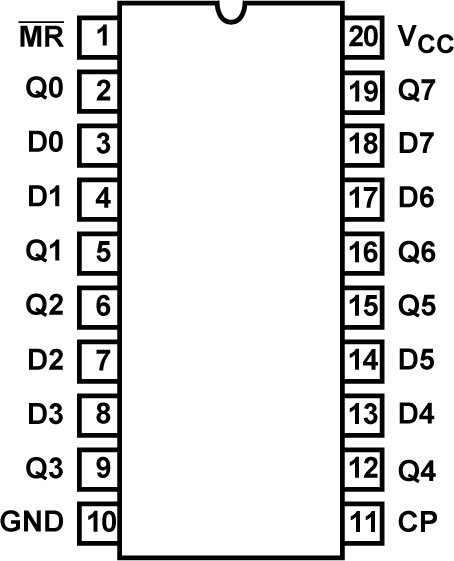
| Integrated Circuits (ICs) | 3 | Active | The ’AC273 and ’ACT273 devices are octal D-type flip-flops with reset that utilize advanced CMOS logic technology. Information at the D input is transferred to the Q output on the positive-going edge of the clock pulse. All eight flip-flops are controlled by a common clock (CP) and a common reset (MR). Resetting is accomplished by a low voltage level independent of the clock.
The ’AC273 and ’ACT273 devices are octal D-type flip-flops with reset that utilize advanced CMOS logic technology. Information at the D input is transferred to the Q output on the positive-going edge of the clock pulse. All eight flip-flops are controlled by a common clock (CP) and a common reset (MR). Resetting is accomplished by a low voltage level independent of the clock. |
CD74AC2809-Bit Odd/Even Parity Generator/Checker | Integrated Circuits (ICs) | 4 | Active | The ’AC280 and ’ACT280 are 9-bit odd/even parity generator/checkers that utilize Advanced CMOS Logic technology. Both even and odd parity outputs are available for checking or generating parity for words up to nine bits long. Even parity is indicated (E output to any input of an additional ’AC280, ’ACT280 parity checker.
The ’AC280 and ’ACT280 are 9-bit odd/even parity generator/checkers that utilize Advanced CMOS Logic technology. Both even and odd parity outputs are available for checking or generating parity for words up to nine bits long. Even parity is indicated (E output to any input of an additional ’AC280, ’ACT280 parity checker. |
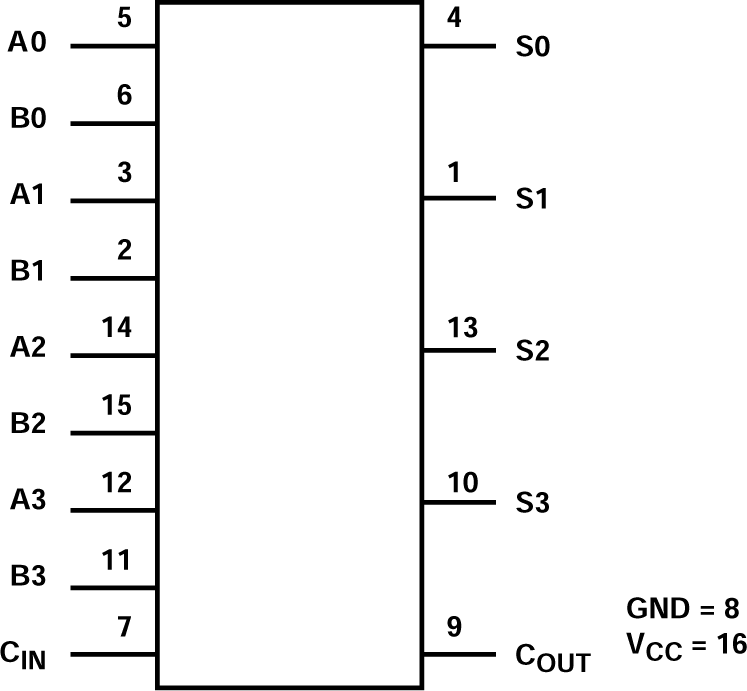
CD74AC2834-Bit Binary Full Adder with Fast Carry | Integrated Circuits (ICs) | 4 | Active | The ’AC283 and ’ACT283 4-bit binary adders with fast carry that utilize Advanced CMOS Logic technology. These devices add two 4-bit binary numbers and generate a carryout bit if the sum exceeds 15.
Because of the symmetry of the add function, this device can be used with either all active-HIGH operands (positive logic) or with all active-LOW operands (negative logic). When using positive logic, the carry-in input must be tied LOW if there is no carry-in.
The ’AC283 and ’ACT283 4-bit binary adders with fast carry that utilize Advanced CMOS Logic technology. These devices add two 4-bit binary numbers and generate a carryout bit if the sum exceeds 15.
Because of the symmetry of the add function, this device can be used with either all active-HIGH operands (positive logic) or with all active-LOW operands (negative logic). When using positive logic, the carry-in input must be tied LOW if there is no carry-in. |
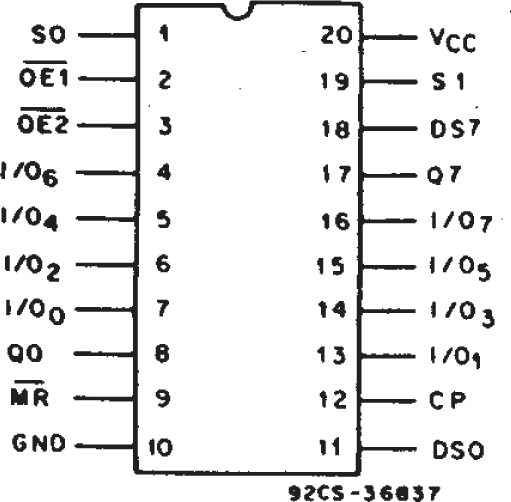
CD74AC2998-Input Universal Shift/Storage Register with Common Parallel I/O Pins and Asynchronous Reset | Integrated Circuits (ICs) | 1 | Active | The RCA CDx4AC299 and CD74AC323 and the CDx4ACT299 are 3-state, 8-input universal shift/storage registers with common parallel I/O pins.
The RCA CDx4AC299 and CD74AC323 and the CDx4ACT299 are 3-state, 8-input universal shift/storage registers with common parallel I/O pins. |
CD74AC3238-Input Universal Shift/Storage Register with Common Parallel I/O Pins and Synchronous Reset | Integrated Circuits (ICs) | 1 | Active | The RCA CDx4AC299 and CD74AC323 and the CDx4ACT299 are 3-state, 8-input universal shift/storage registers with common parallel I/O pins.
The RCA CDx4AC299 and CD74AC323 and the CDx4ACT299 are 3-state, 8-input universal shift/storage registers with common parallel I/O pins. |
CD74AC374Octal D-Type Flip-Flops with 3-State Outputs | Logic | 11 | Active | The eight flip-flops of the ’AC374 devices are D-type edge-triggered flip-flops. On the positive transition of the clock (CLK) input, the Q outputs are set to the logic levels set up at the data (D) inputs.
The eight flip-flops of the ’AC374 devices are D-type edge-triggered flip-flops. On the positive transition of the clock (CLK) input, the Q outputs are set to the logic levels set up at the data (D) inputs. |
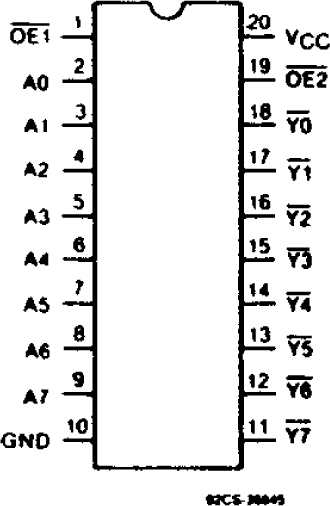
CD74AC5408-ch, 1.5-V to 5.5-V inverters with 3-state outputs | Logic | 3 | Active | The CD54/74AC540, -541, and CD54/74ACT540, -541 octal buffer/line drivers use the RCA ADVANCED CMOS technology. The CD54/74AC/ACT540 are inverting 3-state buffers having two active-LOW output enables. The CD54/74AC/ACT541 are non-inverting 3-state buffers having two active-LOW output enables.
The CD54/74AC540, -541, and CD54/74ACT540, -541 octal buffer/line drivers use the RCA ADVANCED CMOS technology. The CD54/74AC/ACT540 are inverting 3-state buffers having two active-LOW output enables. The CD54/74AC/ACT541 are non-inverting 3-state buffers having two active-LOW output enables. |
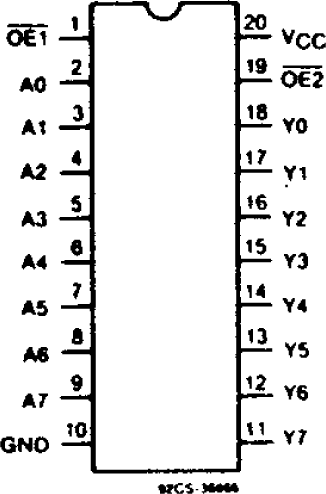
CD74AC5418-ch, 1.5-V to 5.5-V buffers with 3-state outputs | Logic | 8 | Active | The CD54/74AC540, -541, and CD54/74ACT540, -541 octal buffer/line drivers use the RCA ADVANCED CMOS technology. The CD54/74AC/ACT540 are inverting 3-state buffers having two active-LOW output enables. The CD54/74AC/ACT541 are non-inverting 3-state buffers having two active-LOW output enables.
The CD54/74AC540, -541, and CD54/74ACT540, -541 octal buffer/line drivers use the RCA ADVANCED CMOS technology. The CD54/74AC/ACT540 are inverting 3-state buffers having two active-LOW output enables. The CD54/74AC/ACT541 are non-inverting 3-state buffers having two active-LOW output enables. |
CD74AC574Octal D-Type Edge-Triggered Flip-Flops with 3-State Outputs | Flip Flops | 12 | Active | These 8-bit flip-flops feature 3-state outputs designed specifically for driving highly capacitive or relatively low-impedance loads. The devices are particularly suitable for implementing buffer registers, I/O ports, bidirectional bus drivers, and working registers.
These 8-bit flip-flops feature 3-state outputs designed specifically for driving highly capacitive or relatively low-impedance loads. The devices are particularly suitable for implementing buffer registers, I/O ports, bidirectional bus drivers, and working registers. |
CD74AC623Octal Non-Inverting Bus Transceivers with 3-State Outputs | Logic | 3 | Active | The RCA CD54/74AC623 and CD54/74ACT623 octal-bus transceivers use the RCA ADVANCED CMOS technology. They are non-inverting, 3-state, bidirectional transceiver-buffers that allow for two-way transmission from "A" bus to "B" bus or "B" bus to "A" bus, depending on the logic levels of the Output Enable (OEAB,(OE)\BA) inputs.
The dual Output Enable provision gives these devices the capability to store data by simultaneously enabling OEABand (OE)\BA. Each output reinforces its input under these conditions, and when all other data sources to the bus lines are at high-impedance, both sets of bus lines will remian in their last states.
The CD74AC623 is supplied in 20-lead dual-in-line plastic packages E suffix) and in 20-lead small-outline packages (M, M96, and NSR suffixes). The CD74ACT623 is supplied in 20-lead small-outline packages (M96 suffix). Both package types are operable over the following temperature ranges: Commercial (0 to 70°C); Industrial (–40 to +85°C); and Extended Industrial/Military (–55 to +125°C).
The CD54AC623 and CD54ACT623, available in chip form (H suffix), are operable over the -55 to +125°C temperature range.
The RCA CD54/74AC623 and CD54/74ACT623 octal-bus transceivers use the RCA ADVANCED CMOS technology. They are non-inverting, 3-state, bidirectional transceiver-buffers that allow for two-way transmission from "A" bus to "B" bus or "B" bus to "A" bus, depending on the logic levels of the Output Enable (OEAB,(OE)\BA) inputs.
The dual Output Enable provision gives these devices the capability to store data by simultaneously enabling OEABand (OE)\BA. Each output reinforces its input under these conditions, and when all other data sources to the bus lines are at high-impedance, both sets of bus lines will remian in their last states.
The CD74AC623 is supplied in 20-lead dual-in-line plastic packages E suffix) and in 20-lead small-outline packages (M, M96, and NSR suffixes). The CD74ACT623 is supplied in 20-lead small-outline packages (M96 suffix). Both package types are operable over the following temperature ranges: Commercial (0 to 70°C); Industrial (–40 to +85°C); and Extended Industrial/Military (–55 to +125°C).
The CD54AC623 and CD54ACT623, available in chip form (H suffix), are operable over the -55 to +125°C temperature range. |