| RF Transmitters | 1 | Active | |
TX736464-channel, three-level transmitter with 1A pulser and integrated transmit beamformer | RF Misc ICs and Modules | 1 | Active | TX7364 is a highly integrated, high-performance transmitter device for ultrasound imaging system. The device has total 64 pulser circuits, 64 transmit/ receive switches (referred as T/R or TR switches) and supports on-chip beamformer (TxBF). The device also integrates on-chip floating power supplies that reduce the number of required high voltage power supplies.
TX7364 has a pulser circuit that generates three-level high voltage pulses (up to ±100 V) that is used to excite multiple channels of an ultrasound transducer. The device supports total 64 outputs. The maximum output current is 1A.
Device can be used as a transmitter solution for many applications like ultrasound imaging, non-destructive testing, SONAR, LIDAR, marine navigation system, brain imaging systems and so on.
TX7364 is a highly integrated, high-performance transmitter device for ultrasound imaging system. The device has total 64 pulser circuits, 64 transmit/ receive switches (referred as T/R or TR switches) and supports on-chip beamformer (TxBF). The device also integrates on-chip floating power supplies that reduce the number of required high voltage power supplies.
TX7364 has a pulser circuit that generates three-level high voltage pulses (up to ±100 V) that is used to excite multiple channels of an ultrasound transducer. The device supports total 64 outputs. The maximum output current is 1A.
Device can be used as a transmitter solution for many applications like ultrasound imaging, non-destructive testing, SONAR, LIDAR, marine navigation system, brain imaging systems and so on. |
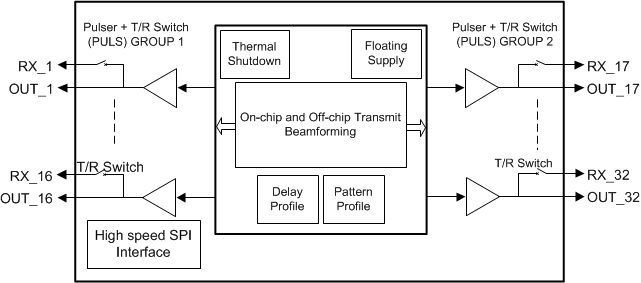
TX73H3232-channel, three -level transmitter with 2A pulser and integrated transmit beamformer | RF Transmitters | 1 | Active | TX73H32 is a highly integrated, high-performance transmitter device for ultrasound imaging system. The device has a total of 32 pulser circuits, 32 transmit/ receive switches (referred to as T/R or TR switches) and supports on-chip beamformer (TxBF). The device also integrates on-chip floating power supplies that reduce the number of required high-voltage power supplies.
TX73H32 has a pulser circuit that generates three-level high voltage pulses (up to ±100V) that is used to excite multiple channels of an ultrasound transducer. The device supports total 32 outputs. The maximum output current is 2A.
Device can be used as a transmitter for many applications like ultrasound imaging, non-destructive testing, SONAR, LIDAR, marine navigation system, brain imaging systems and so on.
TX73H32 is a highly integrated, high-performance transmitter device for ultrasound imaging system. The device has a total of 32 pulser circuits, 32 transmit/ receive switches (referred to as T/R or TR switches) and supports on-chip beamformer (TxBF). The device also integrates on-chip floating power supplies that reduce the number of required high-voltage power supplies.
TX73H32 has a pulser circuit that generates three-level high voltage pulses (up to ±100V) that is used to excite multiple channels of an ultrasound transducer. The device supports total 32 outputs. The maximum output current is 2A.
Device can be used as a transmitter for many applications like ultrasound imaging, non-destructive testing, SONAR, LIDAR, marine navigation system, brain imaging systems and so on. |
TX751616-channel five-level transmitter | Specialized ICs | 1 | Active | TX7516 is a highly integrated, high-performance transmitter solution for ultrasound imaging system. The device has total 16 pulser circuits, 16 transmit/receive switches (referred as T/R or TR switches), and supports on-chip beamformer (TxBF). The device also integrates on-chip floating power supplies that reduce the number of required high voltage power supplies.
TX7516 has a pulser circuit that generates five-level high voltage pulses (up to ±100 V) that is used to excite multiple channels of an ultrasound transducer. The device supports total 16 outputs. The maximum output current is 2 A.
Device can be used as a transmitter solution for many applications like ultrasound imaging, non-destructive testing, SONAR, LIDAR, marine navigation system, brain imaging systems and so on.
TX7516 is a highly integrated, high-performance transmitter solution for ultrasound imaging system. The device has total 16 pulser circuits, 16 transmit/receive switches (referred as T/R or TR switches), and supports on-chip beamformer (TxBF). The device also integrates on-chip floating power supplies that reduce the number of required high voltage power supplies.
TX7516 has a pulser circuit that generates five-level high voltage pulses (up to ±100 V) that is used to excite multiple channels of an ultrasound transducer. The device supports total 16 outputs. The maximum output current is 2 A.
Device can be used as a transmitter solution for many applications like ultrasound imaging, non-destructive testing, SONAR, LIDAR, marine navigation system, brain imaging systems and so on. |
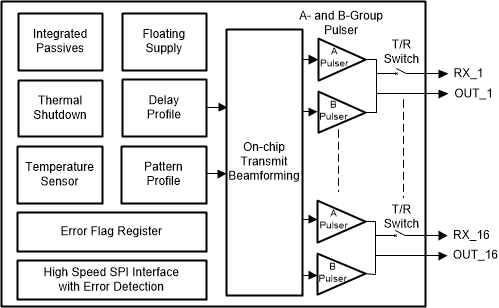
TX75E1616-channel five-level transmitter with enhanced damping feature | Integrated Circuits (ICs) | 1 | Active | The TX75E16 is a highly integrated, high-performance transmitter for ultrasound imaging system. The device has total 16 pulser circuits, 16 transmit/receive switches (referred as T/R or TR switches), and supports on-chip beamformer (TxBF). The device also integrates on-chip floating power supplies that reduce the number of required high voltage power supplies.
The TX75E16 has a pulser circuit that generates five-level high voltage pulses (up to ±100 V) that is used to excite multiple channels of an ultrasound transducer. The device supports total 16 outputs. The maximum output current is 2 A.
The device can be used as a transmitter for many applications like ultrasound imaging, non-destructive testing, SONAR, LIDAR, marine navigation system, brain imaging systems and so on.
The TX75E16 (referred as device in this data sheet) is highly integrated transmitter targeted for exciting ultrasound transducers. Device integrates 16 pulsers and 16 T/R switches, on-chip beamformer, and pattern generator.
The device integrates all the decoupling capacitors required for the floating supplies and internal bias voltages. This integration significantly reduces the required number of external capacitors. The TX75E16 is available in a 10-mm × 10-mm 144-pin FC-BGA package (ALH package) and is specified for operation from 0°C to 70°C.
Pulser circuit generates five-level high voltage pulses (up to ±100 V) with maximum output current of 2 A. When pulser transmits the high voltage pulses, T/R switch turns OFF and protects the low voltage receiver circuit from damage. When the transducer is receiving echo signals, the T/R switch turns ON and connects the transducer to the receiver. The ON/OFF operation of the T/R switch is controlled by on-chip beamforming engine in the device. The T/R switch offers 8-Ω impedance in the ON state.
Ultrasound transmission relies on excitation of multiple transducer elements, with different delay values defining the direction of the transmission. Such an operation is referred to as transmit beamforming. The TX75E16 supports staggered pulsing of the different channels, allowing for transmit beamforming.
In the on-chip beamformer mode, delay profile for pulsing of different channels is stored within the device. The device supports a transmit beamformer delay resolution of one beamformer clock period and a maximum delay of 2 14 beamformer clock periods. An internal pattern generator generates the output pulse patterns based on pattern profiles stored in a profile RAM. Each channel has a RAM, which is 960 words long. The patterns have global and local repeats feature. This capability can be used to generate long patterns and can be used in Shear-Wave imaging.
These pattern profiles and delay profiles are written using a high-speed (400 MHz) serial peripheral interface. The high-speed writes can be prone to errors, therefore the device has a checksum feature to detect errors in SPI writes.
To protect the device from getting damaged because of improper configuration, an internal error flag register can detect faulty condition and configure the device in shutdown mode automatically.
The TX75E16 is a highly integrated, high-performance transmitter for ultrasound imaging system. The device has total 16 pulser circuits, 16 transmit/receive switches (referred as T/R or TR switches), and supports on-chip beamformer (TxBF). The device also integrates on-chip floating power supplies that reduce the number of required high voltage power supplies.
The TX75E16 has a pulser circuit that generates five-level high voltage pulses (up to ±100 V) that is used to excite multiple channels of an ultrasound transducer. The device supports total 16 outputs. The maximum output current is 2 A.
The device can be used as a transmitter for many applications like ultrasound imaging, non-destructive testing, SONAR, LIDAR, marine navigation system, brain imaging systems and so on.
The TX75E16 (referred as device in this data sheet) is highly integrated transmitter targeted for exciting ultrasound transducers. Device integrates 16 pulsers and 16 T/R switches, on-chip beamformer, and pattern generator.
The device integrates all the decoupling capacitors required for the floating supplies and internal bias voltages. This integration significantly reduces the required number of external capacitors. The TX75E16 is available in a 10-mm × 10-mm 144-pin FC-BGA package (ALH package) and is specified for operation from 0°C to 70°C.
Pulser circuit generates five-level high voltage pulses (up to ±100 V) with maximum output current of 2 A. When pulser transmits the high voltage pulses, T/R switch turns OFF and protects the low voltage receiver circuit from damage. When the transducer is receiving echo signals, the T/R switch turns ON and connects the transducer to the receiver. The ON/OFF operation of the T/R switch is controlled by on-chip beamforming engine in the device. The T/R switch offers 8-Ω impedance in the ON state.
Ultrasound transmission relies on excitation of multiple transducer elements, with different delay values defining the direction of the transmission. Such an operation is referred to as transmit beamforming. The TX75E16 supports staggered pulsing of the different channels, allowing for transmit beamforming.
In the on-chip beamformer mode, delay profile for pulsing of different channels is stored within the device. The device supports a transmit beamformer delay resolution of one beamformer clock period and a maximum delay of 2 14 beamformer clock periods. An internal pattern generator generates the output pulse patterns based on pattern profiles stored in a profile RAM. Each channel has a RAM, which is 960 words long. The patterns have global and local repeats feature. This capability can be used to generate long patterns and can be used in Shear-Wave imaging.
These pattern profiles and delay profiles are written using a high-speed (400 MHz) serial peripheral interface. The high-speed writes can be prone to errors, therefore the device has a checksum feature to detect errors in SPI writes.
To protect the device from getting damaged because of improper configuration, an internal error flag register can detect faulty condition and configure the device in shutdown mode automatically. |
| Integrated Circuits (ICs) | 2 | Active | |
| Development Boards, Kits, Programmers | 1 | Active | |
| Translators, Level Shifters | 10 | Active | |
| Integrated Circuits (ICs) | 5 | Active | |
TXB0104Automotive 4-bit bidirectional voltage-level translator with auto direction sensing and +/-15kV ESD | Translators, Level Shifters | 17 | Active | Voltage-level translators address the challenges posed by simultaneous use of different supply-voltage levels on the same circuit board. This 4-bit non-inverting translator uses two separate configurable power-supply rails. The A port is designed to track V CCA. VCCA accepts any supply voltage from 1.2 V to 3.6 V. The B port is designed to track V CCB. VCCB accepts any supply voltage from 1.65 V to 5.5 V. This allows for universal low-voltage bidirectional translation between any of the 1.2-V, 1.5-V, 1.8-V, 2.5-V, 3.3-V, and 5-V voltage nodes. V CCA should not exceed V CCB.
When the output-enable (OE) input is low, all outputs are placed in the high-impedance state. To ensure the high-impedance state during power up or power down, OE should be tied to GND through a pulldown resistor; the minimum value of the resistor is determined by the current-sourcing capability of the driver.
The TXB0104 is designed so that the OE input circuit is supplied by V CCA.
This device is fully specified for partial-power-down applications using I off. The I off circuitry disables the outputs, preventing damaging current backflow through the device when it is powered down.
Voltage-level translators address the challenges posed by simultaneous use of different supply-voltage levels on the same circuit board. This 4-bit non-inverting translator uses two separate configurable power-supply rails. The A port is designed to track V CCA. VCCA accepts any supply voltage from 1.2 V to 3.6 V. The B port is designed to track V CCB. VCCB accepts any supply voltage from 1.65 V to 5.5 V. This allows for universal low-voltage bidirectional translation between any of the 1.2-V, 1.5-V, 1.8-V, 2.5-V, 3.3-V, and 5-V voltage nodes. V CCA should not exceed V CCB.
When the output-enable (OE) input is low, all outputs are placed in the high-impedance state. To ensure the high-impedance state during power up or power down, OE should be tied to GND through a pulldown resistor; the minimum value of the resistor is determined by the current-sourcing capability of the driver.
The TXB0104 is designed so that the OE input circuit is supplied by V CCA.
This device is fully specified for partial-power-down applications using I off. The I off circuitry disables the outputs, preventing damaging current backflow through the device when it is powered down. |