T
Texas Instruments
| Series | Category | # Parts | Status | Description |
|---|---|---|---|---|
| Part | Spec A | Spec B | Spec C | Spec D | Description |
|---|---|---|---|---|---|



| Series | Category | # Parts | Status | Description |
|---|---|---|---|---|
| Part | Spec A | Spec B | Spec C | Spec D | Description |
|---|---|---|---|---|---|
| Part | Category | Description |
|---|---|---|
 Texas Instruments BQ2002CSNTRG4Unknown | Integrated Circuits (ICs) | LINEAR BATTERY CHARGER NICD/NIMH 2000MA 0V TO 6V 8-PIN SOIC T/R |
 Texas Instruments LM3676SDX-3.3Obsolete | Integrated Circuits (ICs) | IC REG BUCK 3.3V 600MA 8WSON |
 Texas Instruments | Integrated Circuits (ICs) | TMX320DRE311 179PIN UBGA 200MHZ |
 Texas Instruments UCC3580N-1G4Obsolete | Integrated Circuits (ICs) | IC REG CTRLR FWRD CONV 16DIP |
 Texas Instruments LM2831YMF EVALObsolete | Development Boards Kits Programmers | EVAL BOARD FOR LM2831 |
 Texas Instruments | Integrated Circuits (ICs) | BUFFER/LINE DRIVER 8-CH NON-INVERTING 3-ST CMOS 20-PIN SSOP T/R |
 Texas Instruments | Integrated Circuits (ICs) | ANALOG OTHER PERIPHERALS |
Texas Instruments | Integrated Circuits (ICs) | RADIATION-HARDENED, QMLP 60V HAL |
 Texas Instruments SN75LVDS051DRObsolete | Integrated Circuits (ICs) | IC TRANSCEIVER FULL 2/2 16SOIC |
 Texas Instruments | Integrated Circuits (ICs) | AUTOMOTIVE OCTAL D-TYPE FLIP-FLO |
| Series | Category | # Parts | Status | Description |
|---|---|---|---|---|
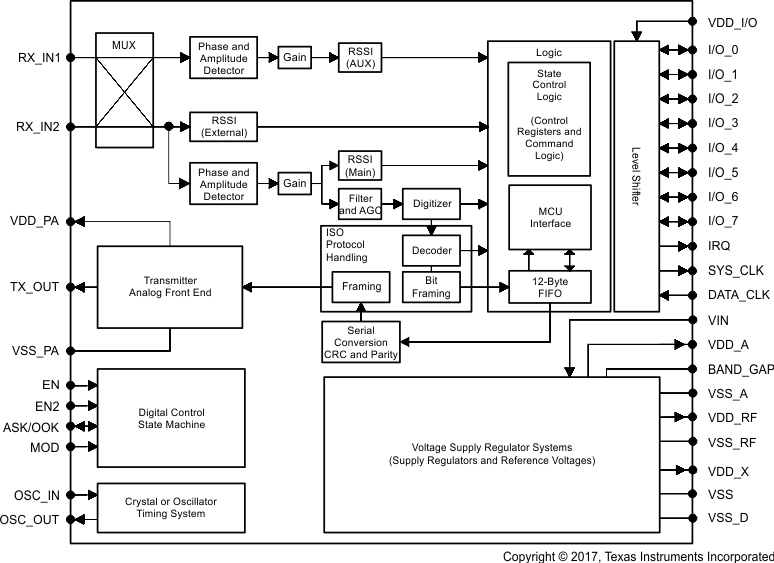
TRF7960TRF7960A Multi-Protocol Fully Integrated 13.56-MHz RFID Reader/Writer IC | RFID, RF Access, Monitoring ICs | 7 | Active | The TRF7960A device is an integrated analog front-end (AFE) and multiprotocol data-framing device for a 13.56-MHzRFIDreader/writer system that supports ISO/IEC 14443 A and B, Sony FeliCa, and ISO/IEC 15693. Built-in programming options make it suitable for a wide range of applications for proximity and vicinity identification systems.
The reader is configured by selecting the desired protocol in the control registers. Direct access to all control registers allows fine tuning of various reader parameters as needed.
The TRF7960A device supports data rates up to 848 kbps with all framing and synchronization tasks for the ISO protocols onboard. The device also supports reader/writer mode for NFC Forum tag types 1, 2, 3, 4, and 5. NFC Forum tag types 2, 3, 4, and 5 are supported with the built-in protocol decoders used in Direct Mode 2. NFC Forum tag type 1 requires the use of Direct Mode 0. Other standards and custom protocols can also be implemented by using Direct Mode 0. Direct Mode 0 lets the user fully control the AFE and also gain access to the raw subcarrier data or the unframed, but already ISO-formatted, data and the associated (extracted) clock signal.
The receiver system has a dual-input receiver architecture to maximize communication robustness. The receivers also include various automatic and manual gain control options. The received signal strength from transponders, ambient sources, or internal levels is available in the RSSI register.
A SPI or parallel interface can be used for the communication between the MCU and the TRF7960A reader. When the built-in hardware encoders and decoders are used, transmit and receive functions use a 12-byte FIFO register. For direct transmit or receive functions, the encoders or decoders can be bypassed so the MCU can process the data in real time.
The TRF7960A device supports a wide supply voltage range of 2.7 V to 5.5 V and data communication levels from 1.8 V to 5.5 V for the MCU I/O interface.
The transmitter has selectable output power levels of 100 mW (+20 dBm) or 200 mW (+23 dBm) equivalent into a 50-Ω load when using a 5-V supply and supports OOK and ASK modulation with selectable modulation depth.
The built-in programmable auxiliary voltage regulator delivers up to 20 mA to supply an MCU and additional external circuits within the reader system.
To evaluate the latest products in the TRF79xx product family – TRF7970A and TRF7964A – see theNFC Transceiver Booster Pack.
Documentation,Tools, Reference Designs, and Software,Samples
The TRF7960A device is an integrated analog front-end (AFE) and multiprotocol data-framing device for a 13.56-MHzRFIDreader/writer system that supports ISO/IEC 14443 A and B, Sony FeliCa, and ISO/IEC 15693. Built-in programming options make it suitable for a wide range of applications for proximity and vicinity identification systems.
The reader is configured by selecting the desired protocol in the control registers. Direct access to all control registers allows fine tuning of various reader parameters as needed.
The TRF7960A device supports data rates up to 848 kbps with all framing and synchronization tasks for the ISO protocols onboard. The device also supports reader/writer mode for NFC Forum tag types 1, 2, 3, 4, and 5. NFC Forum tag types 2, 3, 4, and 5 are supported with the built-in protocol decoders used in Direct Mode 2. NFC Forum tag type 1 requires the use of Direct Mode 0. Other standards and custom protocols can also be implemented by using Direct Mode 0. Direct Mode 0 lets the user fully control the AFE and also gain access to the raw subcarrier data or the unframed, but already ISO-formatted, data and the associated (extracted) clock signal.
The receiver system has a dual-input receiver architecture to maximize communication robustness. The receivers also include various automatic and manual gain control options. The received signal strength from transponders, ambient sources, or internal levels is available in the RSSI register.
A SPI or parallel interface can be used for the communication between the MCU and the TRF7960A reader. When the built-in hardware encoders and decoders are used, transmit and receive functions use a 12-byte FIFO register. For direct transmit or receive functions, the encoders or decoders can be bypassed so the MCU can process the data in real time.
The TRF7960A device supports a wide supply voltage range of 2.7 V to 5.5 V and data communication levels from 1.8 V to 5.5 V for the MCU I/O interface.
The transmitter has selectable output power levels of 100 mW (+20 dBm) or 200 mW (+23 dBm) equivalent into a 50-Ω load when using a 5-V supply and supports OOK and ASK modulation with selectable modulation depth.
The built-in programmable auxiliary voltage regulator delivers up to 20 mA to supply an MCU and additional external circuits within the reader system.
To evaluate the latest products in the TRF79xx product family – TRF7970A and TRF7964A – see theNFC Transceiver Booster Pack.
Documentation,Tools, Reference Designs, and Software,Samples |
| RFID, RF Access, Monitoring ICs | 4 | Active | ||
TRF7962TRF7962A Fully Integrated 13.56-MHz RFID Reader/Writer IC for ISO15693 | RF and Wireless | 4 | Active | The TRF7962A device is an integrated analog front-end (AFE) and data-framing device for a 13.56-MHzRFIDreader/writer system that supports ISO/IEC 15693. Built-in programming options make it suitable for a wide range of applications for proximity and vicinity identification systems.
The reader is configured by selecting the desired protocol in the control registers. Direct access to all control registers allows fine tuning of various reader parameters as needed.
The TRF7962A device supports data rates 6 kbps and 26 kbps with all framing and synchronization tasks for the ISO protocols onboard. The device also supports reader/writer mode for NFC Forum tag type 5. NFC Forum tag type 5 is supported with the built-in protocol decoders used in Direct Mode 2. NFC Forum tag type 1 requires the use of Direct Mode 0. Other standards and custom protocols can also be implemented by using Direct Mode 0. Direct Mode 0 lets the user fully control the AFE and also gain access to the raw subcarrier data or the unframed, but already ISO-formatted, data and the associated (extracted) clock signal.
The receiver system has a dual-input receiver architecture to maximize communication robustness. The receivers also include various automatic and manual gain control options. The received signal strength from transponders, ambient sources, or internal levels is available in the RSSI register.
A SPI or parallel interface can be used for the communication between the MCU and the TRF7962A reader. When the built-in hardware encoders and decoders are used, transmit and receive functions use a 12-byte FIFO register. For direct transmit or receive functions, the encoders or decoders can be bypassed so the MCU can process the data in real time.
The TRF7962A device supports a wide supply voltage range of 2.7 V to 5.5 V and data communication levels from 1.8 V to 5.5 V for the MCU I/O interface.
The transmitter has selectable output power levels of 100 mW (+20 dBm) or 200 mW (+23 dBm) equivalent into a 50-Ω load when using a 5-V supply and supports OOK and ASK modulation with selectable modulation depth.
The built-in programmable auxiliary voltage regulator delivers up to 20 mA to supply an MCU and additional external circuits within the reader system.
To evaluate the latest products in the TRF79xx product family – TRF7970A and TRF7964A – see theNFC Transceiver Booster Pack.
Documentation,Tools, Reference Designs, and Software,Samples
The TRF7962A device is an integrated analog front-end (AFE) and data-framing device for a 13.56-MHzRFIDreader/writer system that supports ISO/IEC 15693. Built-in programming options make it suitable for a wide range of applications for proximity and vicinity identification systems.
The reader is configured by selecting the desired protocol in the control registers. Direct access to all control registers allows fine tuning of various reader parameters as needed.
The TRF7962A device supports data rates 6 kbps and 26 kbps with all framing and synchronization tasks for the ISO protocols onboard. The device also supports reader/writer mode for NFC Forum tag type 5. NFC Forum tag type 5 is supported with the built-in protocol decoders used in Direct Mode 2. NFC Forum tag type 1 requires the use of Direct Mode 0. Other standards and custom protocols can also be implemented by using Direct Mode 0. Direct Mode 0 lets the user fully control the AFE and also gain access to the raw subcarrier data or the unframed, but already ISO-formatted, data and the associated (extracted) clock signal.
The receiver system has a dual-input receiver architecture to maximize communication robustness. The receivers also include various automatic and manual gain control options. The received signal strength from transponders, ambient sources, or internal levels is available in the RSSI register.
A SPI or parallel interface can be used for the communication between the MCU and the TRF7962A reader. When the built-in hardware encoders and decoders are used, transmit and receive functions use a 12-byte FIFO register. For direct transmit or receive functions, the encoders or decoders can be bypassed so the MCU can process the data in real time.
The TRF7962A device supports a wide supply voltage range of 2.7 V to 5.5 V and data communication levels from 1.8 V to 5.5 V for the MCU I/O interface.
The transmitter has selectable output power levels of 100 mW (+20 dBm) or 200 mW (+23 dBm) equivalent into a 50-Ω load when using a 5-V supply and supports OOK and ASK modulation with selectable modulation depth.
The built-in programmable auxiliary voltage regulator delivers up to 20 mA to supply an MCU and additional external circuits within the reader system.
To evaluate the latest products in the TRF79xx product family – TRF7970A and TRF7964A – see theNFC Transceiver Booster Pack.
Documentation,Tools, Reference Designs, and Software,Samples |
| RF and Wireless | 4 | Active | ||
| RF and Wireless | 2 | Active | ||
TRF7970Multi-Protocol Fully Integrated 13.56-MHz NFC / RFID Transceiver IC | Evaluation Boards | 3 | Active | The TRF7970A device is an integrated analog front end (AFE) and multiprotocol data-framing device for a 13.56-MHzNFC/RFIDsystem supporting all three NFC operation modes – reader/writer, peer-to-peer, and card emulation according to ISO/IEC 14443 A and B, Sony FeliCa, ISO/IEC 15693, NFCIP-1 (ISO/IEC 18092), and NFCIP-2 (ISO/IEC 21481). Built-in programming options make the device suitable for a wide range of applications for NFC, proximity, and vicinity identification systems.
The device is configured by selecting the desired protocol in the control registers. Direct access to all control registers allows fine tuning of various reader parameters as needed.
The TRF7970A device supports data rates up to 848 kbps with all framing and synchronization tasks for the ISO protocols onboard. The TRF7970A device also supports reader and writer mode for NFC Forum tag types 1, 2, 3, 4, and 5. Other standards and even custom protocols can be implemented by using one of the direct modes the device offers. These direct modes let the user fully control the AFE and also gain access to the raw subcarrier data or the unframed, but already ISO-formatted, data and the associated (extracted) clock signal.
The receiver system has a dual-input receiver architecture to maximize communication robustness. The receivers also include various automatic and manual gain control options. The received signal strength from transponders, ambient sources, or internal levels is available in the RSSI register.
A SPI or parallel interface can be used for the communication between the MCU and the TRF7970A device. When the built-in hardware encoders and decoders are used, transmit and receive functions use a 127-byte FIFO register. For direct transmit or receive functions, the encoders or decoders can be bypassed so the MCU can process the data in real time.
The TRF7970A device supports a wide supply voltage range of 2.7 V to 5.5 V and data communication levels from 1.8 V to 5.5 V for the MCU I/O interface.
The transmitter has selectable output power levels of 100 mW (+20 dBm) or 200 mW (+23 dBm) equivalent into a 50-Ω load when using a 5-V supply and supports OOK and ASK modulation with selectable modulation depth.
The built-in programmable auxiliary voltage regulator delivers up to 20 mA to supply an MCU and additional external circuits within the reader system.
Integrated RF field detector with programmable wake-up levels, eight selectable power modes, and ultra-low power operation enable easy development of robust and cost-efficient designs for long battery life.
Start evaluating the TRF7970A multiprotocol transceiver IC with theDLP-7970ABP.
The TRF7970A device is an integrated analog front end (AFE) and multiprotocol data-framing device for a 13.56-MHzNFC/RFIDsystem supporting all three NFC operation modes – reader/writer, peer-to-peer, and card emulation according to ISO/IEC 14443 A and B, Sony FeliCa, ISO/IEC 15693, NFCIP-1 (ISO/IEC 18092), and NFCIP-2 (ISO/IEC 21481). Built-in programming options make the device suitable for a wide range of applications for NFC, proximity, and vicinity identification systems.
The device is configured by selecting the desired protocol in the control registers. Direct access to all control registers allows fine tuning of various reader parameters as needed.
The TRF7970A device supports data rates up to 848 kbps with all framing and synchronization tasks for the ISO protocols onboard. The TRF7970A device also supports reader and writer mode for NFC Forum tag types 1, 2, 3, 4, and 5. Other standards and even custom protocols can be implemented by using one of the direct modes the device offers. These direct modes let the user fully control the AFE and also gain access to the raw subcarrier data or the unframed, but already ISO-formatted, data and the associated (extracted) clock signal.
The receiver system has a dual-input receiver architecture to maximize communication robustness. The receivers also include various automatic and manual gain control options. The received signal strength from transponders, ambient sources, or internal levels is available in the RSSI register.
A SPI or parallel interface can be used for the communication between the MCU and the TRF7970A device. When the built-in hardware encoders and decoders are used, transmit and receive functions use a 127-byte FIFO register. For direct transmit or receive functions, the encoders or decoders can be bypassed so the MCU can process the data in real time.
The TRF7970A device supports a wide supply voltage range of 2.7 V to 5.5 V and data communication levels from 1.8 V to 5.5 V for the MCU I/O interface.
The transmitter has selectable output power levels of 100 mW (+20 dBm) or 200 mW (+23 dBm) equivalent into a 50-Ω load when using a 5-V supply and supports OOK and ASK modulation with selectable modulation depth.
The built-in programmable auxiliary voltage regulator delivers up to 20 mA to supply an MCU and additional external circuits within the reader system.
Integrated RF field detector with programmable wake-up levels, eight selectable power modes, and ultra-low power operation enable easy development of robust and cost-efficient designs for long battery life.
Start evaluating the TRF7970A multiprotocol transceiver IC with theDLP-7970ABP. |
TRF7970AMulti-Protocol Fully Integrated 13.56-MHz NFC / RFID Transceiver IC | RF and Wireless | 1 | Active | The TRF7970A device is an integrated analog front end (AFE) and multiprotocol data-framing device for a 13.56-MHzNFC/RFIDsystem supporting all three NFC operation modes – reader/writer, peer-to-peer, and card emulation according to ISO/IEC 14443 A and B, Sony FeliCa, ISO/IEC 15693, NFCIP-1 (ISO/IEC 18092), and NFCIP-2 (ISO/IEC 21481). Built-in programming options make the device suitable for a wide range of applications for NFC, proximity, and vicinity identification systems.
The device is configured by selecting the desired protocol in the control registers. Direct access to all control registers allows fine tuning of various reader parameters as needed.
The TRF7970A device supports data rates up to 848 kbps with all framing and synchronization tasks for the ISO protocols onboard. The TRF7970A device also supports reader and writer mode for NFC Forum tag types 1, 2, 3, 4, and 5. Other standards and even custom protocols can be implemented by using one of the direct modes the device offers. These direct modes let the user fully control the AFE and also gain access to the raw subcarrier data or the unframed, but already ISO-formatted, data and the associated (extracted) clock signal.
The receiver system has a dual-input receiver architecture to maximize communication robustness. The receivers also include various automatic and manual gain control options. The received signal strength from transponders, ambient sources, or internal levels is available in the RSSI register.
A SPI or parallel interface can be used for the communication between the MCU and the TRF7970A device. When the built-in hardware encoders and decoders are used, transmit and receive functions use a 127-byte FIFO register. For direct transmit or receive functions, the encoders or decoders can be bypassed so the MCU can process the data in real time.
The TRF7970A device supports a wide supply voltage range of 2.7 V to 5.5 V and data communication levels from 1.8 V to 5.5 V for the MCU I/O interface.
The transmitter has selectable output power levels of 100 mW (+20 dBm) or 200 mW (+23 dBm) equivalent into a 50-Ω load when using a 5-V supply and supports OOK and ASK modulation with selectable modulation depth.
The built-in programmable auxiliary voltage regulator delivers up to 20 mA to supply an MCU and additional external circuits within the reader system.
Integrated RF field detector with programmable wake-up levels, eight selectable power modes, and ultra-low power operation enable easy development of robust and cost-efficient designs for long battery life.
Start evaluating the TRF7970A multiprotocol transceiver IC with theDLP-7970ABP.
The TRF7970A device is an integrated analog front end (AFE) and multiprotocol data-framing device for a 13.56-MHzNFC/RFIDsystem supporting all three NFC operation modes – reader/writer, peer-to-peer, and card emulation according to ISO/IEC 14443 A and B, Sony FeliCa, ISO/IEC 15693, NFCIP-1 (ISO/IEC 18092), and NFCIP-2 (ISO/IEC 21481). Built-in programming options make the device suitable for a wide range of applications for NFC, proximity, and vicinity identification systems.
The device is configured by selecting the desired protocol in the control registers. Direct access to all control registers allows fine tuning of various reader parameters as needed.
The TRF7970A device supports data rates up to 848 kbps with all framing and synchronization tasks for the ISO protocols onboard. The TRF7970A device also supports reader and writer mode for NFC Forum tag types 1, 2, 3, 4, and 5. Other standards and even custom protocols can be implemented by using one of the direct modes the device offers. These direct modes let the user fully control the AFE and also gain access to the raw subcarrier data or the unframed, but already ISO-formatted, data and the associated (extracted) clock signal.
The receiver system has a dual-input receiver architecture to maximize communication robustness. The receivers also include various automatic and manual gain control options. The received signal strength from transponders, ambient sources, or internal levels is available in the RSSI register.
A SPI or parallel interface can be used for the communication between the MCU and the TRF7970A device. When the built-in hardware encoders and decoders are used, transmit and receive functions use a 127-byte FIFO register. For direct transmit or receive functions, the encoders or decoders can be bypassed so the MCU can process the data in real time.
The TRF7970A device supports a wide supply voltage range of 2.7 V to 5.5 V and data communication levels from 1.8 V to 5.5 V for the MCU I/O interface.
The transmitter has selectable output power levels of 100 mW (+20 dBm) or 200 mW (+23 dBm) equivalent into a 50-Ω load when using a 5-V supply and supports OOK and ASK modulation with selectable modulation depth.
The built-in programmable auxiliary voltage regulator delivers up to 20 mA to supply an MCU and additional external circuits within the reader system.
Integrated RF field detector with programmable wake-up levels, eight selectable power modes, and ultra-low power operation enable easy development of robust and cost-efficient designs for long battery life.
Start evaluating the TRF7970A multiprotocol transceiver IC with theDLP-7970ABP. |
| RF and Wireless | 2 | Obsolete | ||
| RF and Wireless | 5 | Active | ||
TRPGR30TRPGR30ATGC 12-mm Low-Frequency Glass-Encapsulated Transponder, Read Only | RF and Wireless | 5 | Active | Texas Instruments' 12-mm low-frequency (LF) glass transponders provide superior performance and operate at a resonance frequency of 134.2 kHz. The products are compliant to ISO/IEC 11784 and ISO/IEC 11785 global open standards. Texas Instruments LF glass transponders are manufactured with TI's patented tuning process to provide consistent read performance. Before delivery, the transponders undergo complete functional and parametric testing to provide the high quality customers have come to expect from TI.
Texas Instruments' 12-mm low-frequency (LF) glass transponders provide superior performance and operate at a resonance frequency of 134.2 kHz. The products are compliant to ISO/IEC 11784 and ISO/IEC 11785 global open standards. Texas Instruments LF glass transponders are manufactured with TI's patented tuning process to provide consistent read performance. Before delivery, the transponders undergo complete functional and parametric testing to provide the high quality customers have come to expect from TI. |