T
Texas Instruments
| Series | Category | # Parts | Status | Description |
|---|---|---|---|---|
| Part | Spec A | Spec B | Spec C | Spec D | Description |
|---|---|---|---|---|---|



| Series | Category | # Parts | Status | Description |
|---|---|---|---|---|
| Part | Spec A | Spec B | Spec C | Spec D | Description |
|---|---|---|---|---|---|
| Part | Category | Description |
|---|---|---|
 Texas Instruments BQ2002CSNTRG4Unknown | Integrated Circuits (ICs) | LINEAR BATTERY CHARGER NICD/NIMH 2000MA 0V TO 6V 8-PIN SOIC T/R |
 Texas Instruments LM3676SDX-3.3Obsolete | Integrated Circuits (ICs) | IC REG BUCK 3.3V 600MA 8WSON |
 Texas Instruments | Integrated Circuits (ICs) | TMX320DRE311 179PIN UBGA 200MHZ |
 Texas Instruments UCC3580N-1G4Obsolete | Integrated Circuits (ICs) | IC REG CTRLR FWRD CONV 16DIP |
 Texas Instruments LM2831YMF EVALObsolete | Development Boards Kits Programmers | EVAL BOARD FOR LM2831 |
 Texas Instruments | Integrated Circuits (ICs) | BUFFER/LINE DRIVER 8-CH NON-INVERTING 3-ST CMOS 20-PIN SSOP T/R |
 Texas Instruments | Integrated Circuits (ICs) | ANALOG OTHER PERIPHERALS |
Texas Instruments | Integrated Circuits (ICs) | RADIATION-HARDENED, QMLP 60V HAL |
 Texas Instruments SN75LVDS051DRObsolete | Integrated Circuits (ICs) | IC TRANSCEIVER FULL 2/2 16SOIC |
 Texas Instruments | Integrated Circuits (ICs) | AUTOMOTIVE OCTAL D-TYPE FLIP-FLO |
| Series | Category | # Parts | Status | Description |
|---|---|---|---|---|
| Development Boards, Kits, Programmers | 1 | Active | ||
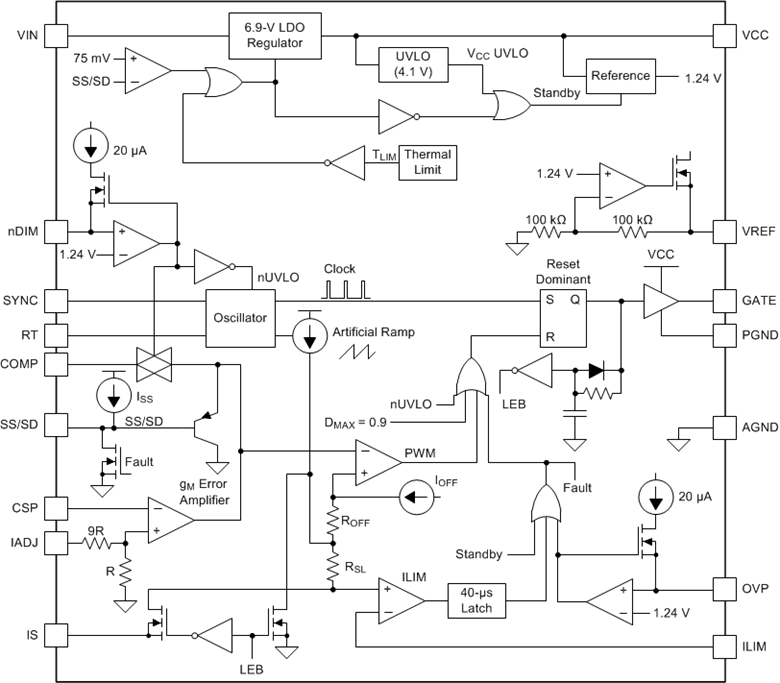
TPS92690Automotive N-channel controller for dimmable LED Drives with Low-side current sense | Evaluation Boards | 5 | Active | The TPS92690-Q1 device is a high-voltage, low-side NFET controller with an adjustable output current sense resistor voltage. Ideal for LED drivers, it contains all of the features needed to implement current regulators based on boost, SEPIC, flyback, and Cuk topologies.
Output current regulation is based on peak current-mode control supervised by a control loop. This methodology eases the design of loop compensation while providing inherent input voltage feed-forward compensation. The TPS92690-Q1 device includes a high-voltage start-up regulator that operates over a wide input range between 4.5 and 75 V. The PWM controller is designed for high-speed capability including an oscillator frequency range up to 2 MHz. The TPS92690-Q1 device includes an error amplifier, precision reference, cycle-by-cycle current limit, and thermal shutdown.
The TPS92690-Q1 device is AEC-Q100 Grade 1 qualified.
The TPS92690-Q1 device is a high-voltage, low-side NFET controller with an adjustable output current sense resistor voltage. Ideal for LED drivers, it contains all of the features needed to implement current regulators based on boost, SEPIC, flyback, and Cuk topologies.
Output current regulation is based on peak current-mode control supervised by a control loop. This methodology eases the design of loop compensation while providing inherent input voltage feed-forward compensation. The TPS92690-Q1 device includes a high-voltage start-up regulator that operates over a wide input range between 4.5 and 75 V. The PWM controller is designed for high-speed capability including an oscillator frequency range up to 2 MHz. The TPS92690-Q1 device includes an error amplifier, precision reference, cycle-by-cycle current limit, and thermal shutdown.
The TPS92690-Q1 device is AEC-Q100 Grade 1 qualified. |
TPS92691Automotive multi-topology LED driver with rail-to-rail current sense amplifier | Development Boards, Kits, Programmers | 7 | Active | The TPS92691/-Q1 is a versatile LED controller that can support a range of step-up or step-down driver topologies. The device implements a fixed-frequency peak current mode control technique with programmable switching frequency, slope compensation, and soft-start timing. It incorporates a high voltage (65-V) rail-to-rail current sense amplifier that can directly measure LED current using either a high-side or a low-side series sense resistor. The amplifier is designed to achieve low input offset voltage and attain better than ±3% LED current accuracy over junction temperature range of 25°C to 140°C and output common-mode voltage range of 0 to 60 V.
LED current can be independently modulated using either analog or PWM dimming techniques. Linear analog dimming response with 15:1 range is obtained by varying the voltage from 140 mV to 2.25 V across the high impedance analog adjust (IADJ) input. PWM dimming of LED current is achieved by modulating the PWM input pin with the desired duty cycle and frequency. Optional DDRV gate driver output can be used to enable series FET dimming functionality to get over 1000:1 contrast ratio.
The TPS92691/-Q1 supports continuous LED status check through the current monitor (IMON) output. This allows for LED short circuit or open circuit detection and protection. Additional fault protection features include VCC UVLO, output OVP, switch cycle-by-cycle current limit, and thermal protection.
The TPS92691/-Q1 is a versatile LED controller that can support a range of step-up or step-down driver topologies. The device implements a fixed-frequency peak current mode control technique with programmable switching frequency, slope compensation, and soft-start timing. It incorporates a high voltage (65-V) rail-to-rail current sense amplifier that can directly measure LED current using either a high-side or a low-side series sense resistor. The amplifier is designed to achieve low input offset voltage and attain better than ±3% LED current accuracy over junction temperature range of 25°C to 140°C and output common-mode voltage range of 0 to 60 V.
LED current can be independently modulated using either analog or PWM dimming techniques. Linear analog dimming response with 15:1 range is obtained by varying the voltage from 140 mV to 2.25 V across the high impedance analog adjust (IADJ) input. PWM dimming of LED current is achieved by modulating the PWM input pin with the desired duty cycle and frequency. Optional DDRV gate driver output can be used to enable series FET dimming functionality to get over 1000:1 contrast ratio.
The TPS92691/-Q1 supports continuous LED status check through the current monitor (IMON) output. This allows for LED short circuit or open circuit detection and protection. Additional fault protection features include VCC UVLO, output OVP, switch cycle-by-cycle current limit, and thermal protection. |
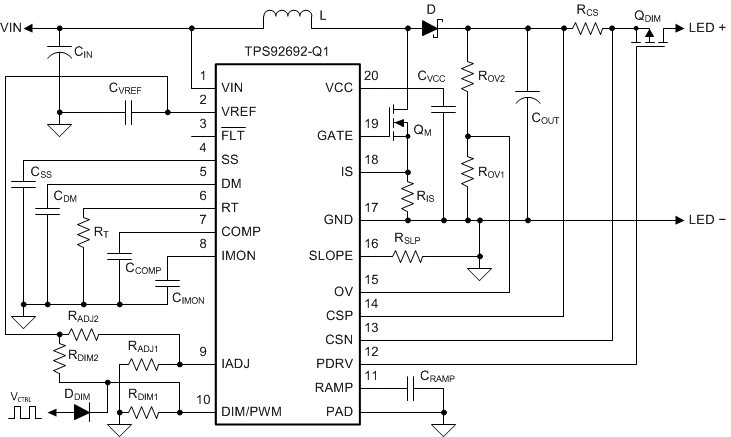
TPS92692high-accuracy LED controller with spread spectrum frequency modulation and internal PWM Generator | Evaluation Boards | 5 | Active | The TPS92692 and TPS92692-Q1 are high accuracy peak current mode based controllers designed to support step-up/down LED driver topologies. The device incorporates a rail-to-rail current amplifier to measure LED current and spread spectrum frequency modulation technique for improved EMI performance.
This high performance LED controller can independently modulate LED current using either analog or PWM dimming techniques. Linear analog dimming response with over 15:1 range is obtained by varying the voltage across the high impedance analog adjust (IADJ) input. PWM dimming of LED current is achieved by directly modulating the DIM/PWM input pin with the desired duty cycle or by enabling the internal PWM generator circuit. The PWM generator translates the DC voltage at DIM/PWM pin to corresponding duty cycle by comparing it to the internal triangle wave generator. The optional PDRV gate driver output can be used to drive an external P-Channel series MOSFET.
The TPS92692 and TPS92692-Q1 devices support continuous LED status check through the current monitor (IMON) output. The devices also include an open drain fault indicator output to indicate LED overcurrent, output overvoltage and output undervoltage conditions.
The TPS92692 and TPS92692-Q1 are high accuracy peak current mode based controllers designed to support step-up/down LED driver topologies. The device incorporates a rail-to-rail current amplifier to measure LED current and spread spectrum frequency modulation technique for improved EMI performance.
This high performance LED controller can independently modulate LED current using either analog or PWM dimming techniques. Linear analog dimming response with over 15:1 range is obtained by varying the voltage across the high impedance analog adjust (IADJ) input. PWM dimming of LED current is achieved by directly modulating the DIM/PWM input pin with the desired duty cycle or by enabling the internal PWM generator circuit. The PWM generator translates the DC voltage at DIM/PWM pin to corresponding duty cycle by comparing it to the internal triangle wave generator. The optional PDRV gate driver output can be used to drive an external P-Channel series MOSFET.
The TPS92692 and TPS92692-Q1 devices support continuous LED status check through the current monitor (IMON) output. The devices also include an open drain fault indicator output to indicate LED overcurrent, output overvoltage and output undervoltage conditions. |
| LED Driver Evaluation Boards | 1 | Active | ||
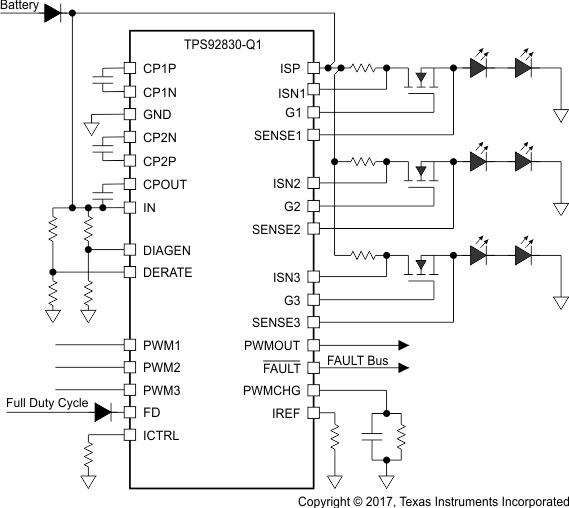
TPS92830-Q1Automotive 3-channel high-side high-power constant-current Linear LED controller | LED Drivers | 1 | Active | With the trend of better lighting homogeneity, high-current LEDs are often used in automotive front and rear lamps with lighting diffusers and light-guides. Meanwhile, in order to meet strict EMC and reliability requirements, linear LED drivers are popular in automotive applications. However, it is a challenge to deliver high current for linear LED drivers with integrated power transistors. The TPS92830-Q1 device is an advanced automotive-grade high-side constant-current linear LED controller for delivering high current using external N-channel MOSFETs. The device has a full set of features for automotive applications and is compatible with a wide selection of N-channel MOSFETs.
Each channel of the TPS92830-Q1 device sets the channel current independently by the sense-resistor value. An internal precision constant-current regulation loop senses the channel current by the voltage across the sense resistor and controls the gate voltage of the N-channel MOSFET accordingly. The device also integrates a two-stage charge pump for low-dropout operation. The charge-pump voltage is high enough to support a wide selection of N-channel MOSFETs. PWM dimming allows multiple
sources for flexibility—internal PWM generator, external PWM inputs, or power supply dimming. Various diagnostics and protection features specially designed for automotive applications help improve system robustness and ease of use. A one-fails–all-fail fault bus supports TPS92830-Q1 operation together with the TPS92630-Q1, TPS92638-Q1, and TPS9261x-Q1 family to fulfill various fault-handling requirements.
With the trend of better lighting homogeneity, high-current LEDs are often used in automotive front and rear lamps with lighting diffusers and light-guides. Meanwhile, in order to meet strict EMC and reliability requirements, linear LED drivers are popular in automotive applications. However, it is a challenge to deliver high current for linear LED drivers with integrated power transistors. The TPS92830-Q1 device is an advanced automotive-grade high-side constant-current linear LED controller for delivering high current using external N-channel MOSFETs. The device has a full set of features for automotive applications and is compatible with a wide selection of N-channel MOSFETs.
Each channel of the TPS92830-Q1 device sets the channel current independently by the sense-resistor value. An internal precision constant-current regulation loop senses the channel current by the voltage across the sense resistor and controls the gate voltage of the N-channel MOSFET accordingly. The device also integrates a two-stage charge pump for low-dropout operation. The charge-pump voltage is high enough to support a wide selection of N-channel MOSFETs. PWM dimming allows multiple
sources for flexibility—internal PWM generator, external PWM inputs, or power supply dimming. Various diagnostics and protection features specially designed for automotive applications help improve system robustness and ease of use. A one-fails–all-fail fault bus supports TPS92830-Q1 operation together with the TPS92630-Q1, TPS92638-Q1, and TPS9261x-Q1 family to fulfill various fault-handling requirements. |
| LED Drivers | 3 | Active | ||
TPS929121-Q112-channel automotive 40-V high-side LED driver with FlexWire interface | LED Drivers | 2 | Active | With increasing demand for animation in automotive lighting, LEDs must be controlled independently. Therefore, LED drivers with digital interfaces are essential to effectively drive pixel-controlled lighting applications. In exterior lighting, multiple lamp functions are typically located on different PCB boards with off-board wires connected to each other. It is difficult for a traditional single-ended interface to meet the strict EMC requirements. By using an industrial-standard CAN physical layer, the UART-based FlexWire interface of the TPS929121-Q1 easily accomplishes long distance off-board communication without impacting EMC.
The TPS929121-Q1 is a 12-channel, 40-V high-side LED driver that controls the 8-bit output current and 12-bit PWM duty cycles. The device meets multiple regulation requirements with LED open-circuit, short-to-ground, and single LED short-circuit diagnostics. A configurable watchdog also automatically sets fail-safe states when the MCU connection is lost, and, with programmable EEPROM, TPS929121-Q1 can flexibly be set for different application scenarios.
With increasing demand for animation in automotive lighting, LEDs must be controlled independently. Therefore, LED drivers with digital interfaces are essential to effectively drive pixel-controlled lighting applications. In exterior lighting, multiple lamp functions are typically located on different PCB boards with off-board wires connected to each other. It is difficult for a traditional single-ended interface to meet the strict EMC requirements. By using an industrial-standard CAN physical layer, the UART-based FlexWire interface of the TPS929121-Q1 easily accomplishes long distance off-board communication without impacting EMC.
The TPS929121-Q1 is a 12-channel, 40-V high-side LED driver that controls the 8-bit output current and 12-bit PWM duty cycles. The device meets multiple regulation requirements with LED open-circuit, short-to-ground, and single LED short-circuit diagnostics. A configurable watchdog also automatically sets fail-safe states when the MCU connection is lost, and, with programmable EEPROM, TPS929121-Q1 can flexibly be set for different application scenarios. |
TPS929160-Q1Automotive 16-channel 40-V high-side LED and OLED driver | LED Drivers | 1 | Active | With the increasing demand for animation in automotive lighting, LEDs must be controlled independently. Therefore, LED drivers with digital interfaces are essential to effectively drive pixel-controlled lighting applications. In exterior lighting, multiple lamp functions are typically located on different PCB boards with off-board wires connected to each other. It is difficult for a traditional single-ended interface to meet the strict EMC requirements. By using an industrial-standard CAN physical layer, the UART-based FlexWire interface of the TPS929160-Q1 easily accomplishes long distance off-board communication without impacting EMC.
The TPS929160-Q1 is a 16-channel, 40V high-side LED driver that controls the 8-bit output current and 12-bit PWM duty cycles. The device meets multiple regulation requirements with LED open-circuit, short-to-ground, and single LED short-circuit diagnostics. A configurable watchdog also automatically sets FAIL-SAFE states when the MCU connection is lost, and, with programmable EEPROM, TPS929160-Q1 can flexibly be set for different application scenarios.
With the increasing demand for animation in automotive lighting, LEDs must be controlled independently. Therefore, LED drivers with digital interfaces are essential to effectively drive pixel-controlled lighting applications. In exterior lighting, multiple lamp functions are typically located on different PCB boards with off-board wires connected to each other. It is difficult for a traditional single-ended interface to meet the strict EMC requirements. By using an industrial-standard CAN physical layer, the UART-based FlexWire interface of the TPS929160-Q1 easily accomplishes long distance off-board communication without impacting EMC.
The TPS929160-Q1 is a 16-channel, 40V high-side LED driver that controls the 8-bit output current and 12-bit PWM duty cycles. The device meets multiple regulation requirements with LED open-circuit, short-to-ground, and single LED short-circuit diagnostics. A configurable watchdog also automatically sets FAIL-SAFE states when the MCU connection is lost, and, with programmable EEPROM, TPS929160-Q1 can flexibly be set for different application scenarios. |
TPS929240-Q1Automotive 24-channel 40-V high-side LED and OLED driver | LED Drivers | 2 | Active | With the increasing demand for animation in automotive lighting, LEDs must be controlled independently. Therefore, LED drivers with digital interfaces are essential to effectively drive pixel-controlled lighting applications. In exterior lighting, multiple lamp functions are typically located on different PCB boards with off-board wires connected to each other. It is difficult for a traditional single-ended interface to meet the strict EMC requirements. By using an industrial-standard CAN physical layer, the UART-based FlexWire interface of the TPS929240-Q1 easily accomplishes long distance off-board communication without impacting EMC.
The TPS929240-Q1 is a 24-channel, 40V high-side LED driver that controls the 8-bit output current and 12-bit PWM duty cycles. The device meets multiple regulation requirements with LED open-circuit, short-to-ground, and single LED short-circuit diagnostics. A configurable watchdog also automatically sets FAIL-SAFE states when the MCU connection is lost, and, with programmable EEPROM, TPS929240-Q1 can flexibly be set for different application scenarios.
With the increasing demand for animation in automotive lighting, LEDs must be controlled independently. Therefore, LED drivers with digital interfaces are essential to effectively drive pixel-controlled lighting applications. In exterior lighting, multiple lamp functions are typically located on different PCB boards with off-board wires connected to each other. It is difficult for a traditional single-ended interface to meet the strict EMC requirements. By using an industrial-standard CAN physical layer, the UART-based FlexWire interface of the TPS929240-Q1 easily accomplishes long distance off-board communication without impacting EMC.
The TPS929240-Q1 is a 24-channel, 40V high-side LED driver that controls the 8-bit output current and 12-bit PWM duty cycles. The device meets multiple regulation requirements with LED open-circuit, short-to-ground, and single LED short-circuit diagnostics. A configurable watchdog also automatically sets FAIL-SAFE states when the MCU connection is lost, and, with programmable EEPROM, TPS929240-Q1 can flexibly be set for different application scenarios. |