TPS550651.5-V to 40-V, 500-mA buck-boost converter with 5-V fixed output voltage, AEC-Q100 qualified | Power Management (PMIC) | 2 | Active | The TPS55065 is a switched-mode regulator with integrated switches for voltage-mode control. With the aid of external components (LC combination), the device regulates the output to 5 V ±3% for a wide input-voltage range.
The TPS55065 device offers a reset function to detect and indicate when the 5-V output rail is outside of the specified tolerance. This reset delay is programmable using an external timing capacitor on the REST terminal. Additionally, an alarm (AOUT) feature is activated when the input supply rail Vdriveris below a prescaled specified value (set by the AINterminal).
The TPS55065 device has a frequency-modulation scheme to minimize EMI. The clock modulator permits a modulation of the switching frequency to reduce interference energy in the frequency band.
The 5-Vg output is a switched 5-V regulated output with internal current limiting to prevent assertion of RESET when powering a capacitive load on the supply line. This function is controlled by the 5Vg_ENABLE terminal. If there is a short to ground on this output (5Vg output), the output self-protects by operating in a chopping mode. This does, however, increase the output ripple voltage on VOUTduring this fault condition.
The TPS55065 is a switched-mode regulator with integrated switches for voltage-mode control. With the aid of external components (LC combination), the device regulates the output to 5 V ±3% for a wide input-voltage range.
The TPS55065 device offers a reset function to detect and indicate when the 5-V output rail is outside of the specified tolerance. This reset delay is programmable using an external timing capacitor on the REST terminal. Additionally, an alarm (AOUT) feature is activated when the input supply rail Vdriveris below a prescaled specified value (set by the AINterminal).
The TPS55065 device has a frequency-modulation scheme to minimize EMI. The clock modulator permits a modulation of the switching frequency to reduce interference energy in the frequency band.
The 5-Vg output is a switched 5-V regulated output with internal current limiting to prevent assertion of RESET when powering a capacitive load on the supply line. This function is controlled by the 5Vg_ENABLE terminal. If there is a short to ground on this output (5Vg output), the output self-protects by operating in a chopping mode. This does, however, increase the output ripple voltage on VOUTduring this fault condition. |
| Integrated Circuits (ICs) | 1 | Obsolete | |
| Integrated Circuits (ICs) | 3 | Active | |
| Power Management (PMIC) | 1 | Active | |
| Power Management (PMIC) | 1 | Active | |
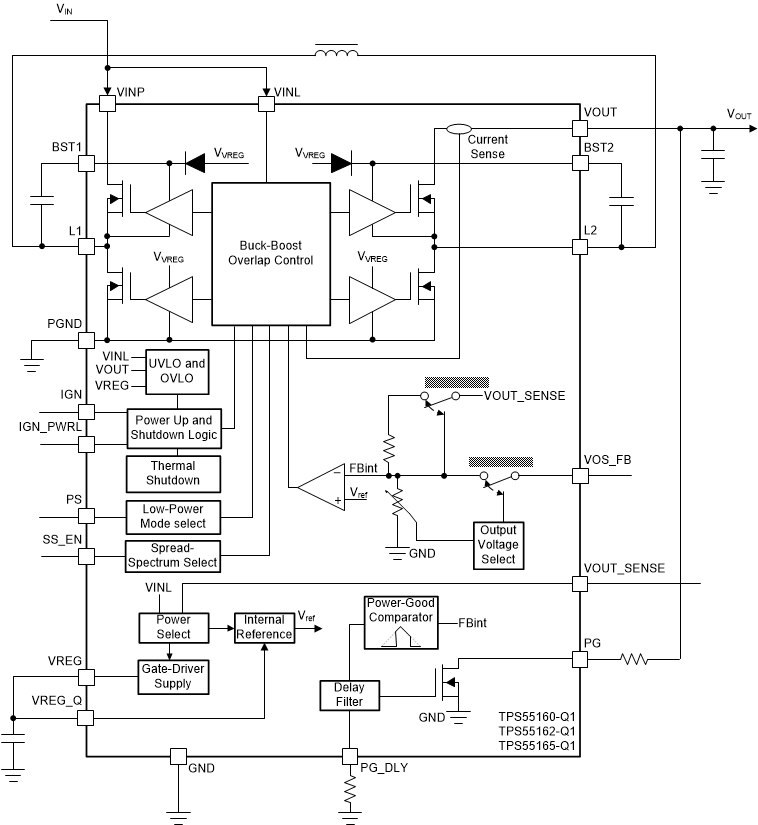
TPS551652-V to 36-V, 1-A output, 2-MHz, 5-V or 12-V fixed output voltage, step-up and step-down converter | Evaluation Boards | 3 | Active | The TPS5516x-Q1 family of devices is a high-voltage synchronous buck-boost DC-DC converter. The device provides a stable power-supply output from a wide varying input-power supply such as an automotive car battery. The buck-boost overlap control ensures automatic transition between step-down and step-up mode with optimal efficiency. The TPS55165-Q1 output voltage can be set to a fixed level of 5 V or 12 V. The TPS55160-Q1 and TPS55162-Q1 devices have a configurable output voltage ranging from 5.7 V to 9 V that is set by an external resistive divider.
Output currents can be as high as 1 A for a normal car battery voltage, and can be maintained at 0.4 A for lower input voltages, such as those for common battery-cranking profiles. The buck-boost converter is based on a fixed-frequency, pulse-width-modulation (PWM) control circuit using synchronous rectification to obtain maximum efficiency. The switching frequency is set to 2 MHz (typical) which allows for the usage of a small inductor that uses less board space.
The TPS5516x-Q1 family of devices is a high-voltage synchronous buck-boost DC-DC converter. The device provides a stable power-supply output from a wide varying input-power supply such as an automotive car battery. The buck-boost overlap control ensures automatic transition between step-down and step-up mode with optimal efficiency. The TPS55165-Q1 output voltage can be set to a fixed level of 5 V or 12 V. The TPS55160-Q1 and TPS55162-Q1 devices have a configurable output voltage ranging from 5.7 V to 9 V that is set by an external resistive divider.
Output currents can be as high as 1 A for a normal car battery voltage, and can be maintained at 0.4 A for lower input voltages, such as those for common battery-cranking profiles. The buck-boost converter is based on a fixed-frequency, pulse-width-modulation (PWM) control circuit using synchronous rectification to obtain maximum efficiency. The switching frequency is set to 2 MHz (typical) which allows for the usage of a small inductor that uses less board space. |
TPS55189-Q1Automotive, 27V 8A buck-boost converter with I²C interface | Power Management (PMIC) | 1 | Active | The TPS55189-Q1 is a synchronous buck-boost converter that is optimized for converting battery voltage or adapter voltage into power supply rails. The TPS55189-Q1 integrates four MOSFET switches providing a compact solution for USB Power Delivery (USB PD) application.
The TPS55189-Q1 has up to 27V input voltage capability. Through the I2C interface, the output voltage of the TPS55189-Q1 can be programmed from 0.8V to 22V with 10mV step. When working in boost mode, it can deliver 60W from a 12V input voltage. It is capable of delivering 45W from 9V input voltage.
The TPS55189-Q1 employs an average current-mode control scheme. The switching frequency is programmable from 200kHz to 2.2MHz by an external resistor and can be synchronized to an external clock. The TPS55189-Q1 also provides optional spread spectrum to minimize peak EMI.
The TPS55189-Q1 offers output over-voltage protection, average inductor current limit, cycle-by-cycle peak current limit and output short circuit protection. The TPS55189-Q1 also ensures safe operating with optional output current limit and hiccup-mode protection in sustained overload conditions.
The TPS55189-Q1 can use a small inductor and small capacitors with high switching frequency. It is available in a 3.0mm × 5.0mm QFN package.
The TPS55189-Q1 is a synchronous buck-boost converter that is optimized for converting battery voltage or adapter voltage into power supply rails. The TPS55189-Q1 integrates four MOSFET switches providing a compact solution for USB Power Delivery (USB PD) application.
The TPS55189-Q1 has up to 27V input voltage capability. Through the I2C interface, the output voltage of the TPS55189-Q1 can be programmed from 0.8V to 22V with 10mV step. When working in boost mode, it can deliver 60W from a 12V input voltage. It is capable of delivering 45W from 9V input voltage.
The TPS55189-Q1 employs an average current-mode control scheme. The switching frequency is programmable from 200kHz to 2.2MHz by an external resistor and can be synchronized to an external clock. The TPS55189-Q1 also provides optional spread spectrum to minimize peak EMI.
The TPS55189-Q1 offers output over-voltage protection, average inductor current limit, cycle-by-cycle peak current limit and output short circuit protection. The TPS55189-Q1 also ensures safe operating with optional output current limit and hiccup-mode protection in sustained overload conditions.
The TPS55189-Q1 can use a small inductor and small capacitors with high switching frequency. It is available in a 3.0mm × 5.0mm QFN package. |
TPS551892-Q1Automotive, 27V 8A fully integrated buck-boost converter | Integrated Circuits (ICs) | 1 | Active | The TPS551892-Q1 is a synchronous buck-boost converter that is optimized for converting battery voltage or adapter voltage into power supply rails. The TPS551892-Q1 integrates four MOSFET switches providing a compact solution for a variety of applications. The TPS551892-Q1 has up to 27V input voltage capability. When working in boost mode, the TPS551892-Q1 can deliver 60W from a 12V input. It is capable of delivering 45W from 9V input voltage.
The TPS551892-Q1 employs an average current-mode control scheme. The switching frequency is programmable from 200kHz to 2.2MHz by an external resistor and can be synchronized to an external clock. The TPS551892-Q1 also provides optional spread spectrum to minimize peak EMI.
The TPS551892-Q1 offers output over-voltage protection, average inductor current limit, cycle-by-cycle peak current limit, output short circuit protection. The TPS551892-Q1 also ensures safe operating with optional output current limit and hiccup-mode protection in sustained overload conditions.
The TPS551892-Q1 can use a small inductor and small capacitors with high switching frequency. It is available in a 3.0mm × 5.0mm QFN package.
The TPS551892-Q1 is a synchronous buck-boost converter that is optimized for converting battery voltage or adapter voltage into power supply rails. The TPS551892-Q1 integrates four MOSFET switches providing a compact solution for a variety of applications. The TPS551892-Q1 has up to 27V input voltage capability. When working in boost mode, the TPS551892-Q1 can deliver 60W from a 12V input. It is capable of delivering 45W from 9V input voltage.
The TPS551892-Q1 employs an average current-mode control scheme. The switching frequency is programmable from 200kHz to 2.2MHz by an external resistor and can be synchronized to an external clock. The TPS551892-Q1 also provides optional spread spectrum to minimize peak EMI.
The TPS551892-Q1 offers output over-voltage protection, average inductor current limit, cycle-by-cycle peak current limit, output short circuit protection. The TPS551892-Q1 also ensures safe operating with optional output current limit and hiccup-mode protection in sustained overload conditions.
The TPS551892-Q1 can use a small inductor and small capacitors with high switching frequency. It is available in a 3.0mm × 5.0mm QFN package. |
TPS5528736V 4A buck-boost converter with I²C interface | Power Management (PMIC) | 1 | Active | The TPS55287 is a synchronous buck-boost converter that is optimized for converting battery voltage or adapter voltage into power supply rails. The TPS55287 integrates four MOSFET switches, providing a compact solution for USB power delivery (USB PD) application.
The TPS55287 has up to 36V input voltage capability. Through the I2C interface, the output voltage of the TPS55287 can be programmed from 0.8V to 22V with 10mV step. When working in boost mode, the device can deliver 35W from a 12V input. It is capable of delivering 25W from 9V input voltage.
The TPS55287 employs an average current-mode control scheme. The switching frequency is programmable from 200kHz to 2.2MHz by an external resistor and can be synchronized to an external clock. The TPS55287 also provides optional spread spectrum to minimize peak EMI.
The TPS55287 offers output overvoltage protection, average inductor current limit, cycle-by-cycle peak current limit, and output short circuit protection. The TPS55287 also makes sure it safely operates with optional output current limit and hiccup-mode protection in sustained overload conditions.
The TPS55287 can use a small inductor and small capacitors with high switching frequency. It is available in a 3.0mm × 5.0mm QFN package.
The TPS55287 is a synchronous buck-boost converter that is optimized for converting battery voltage or adapter voltage into power supply rails. The TPS55287 integrates four MOSFET switches, providing a compact solution for USB power delivery (USB PD) application.
The TPS55287 has up to 36V input voltage capability. Through the I2C interface, the output voltage of the TPS55287 can be programmed from 0.8V to 22V with 10mV step. When working in boost mode, the device can deliver 35W from a 12V input. It is capable of delivering 25W from 9V input voltage.
The TPS55287 employs an average current-mode control scheme. The switching frequency is programmable from 200kHz to 2.2MHz by an external resistor and can be synchronized to an external clock. The TPS55287 also provides optional spread spectrum to minimize peak EMI.
The TPS55287 offers output overvoltage protection, average inductor current limit, cycle-by-cycle peak current limit, and output short circuit protection. The TPS55287 also makes sure it safely operates with optional output current limit and hiccup-mode protection in sustained overload conditions.
The TPS55287 can use a small inductor and small capacitors with high switching frequency. It is available in a 3.0mm × 5.0mm QFN package. |
TPS55287-Q1Automotive 36V 4A buck-boost converter with I²C interface | Voltage Regulators - DC DC Switching Regulators | 1 | Active | The TPS55287-Q1 is a synchronous buck-boost converter that is optimized for converting battery voltage or adapter voltage into power supply rails. The TPS55287-Q1 integrates four MOSFET switches providing a compact solution for USB Power Delivery (USB PD) application.
The TPS55287-Q1 has up to 36V input voltage capability. Through the I2C interface, the output voltage of the TPS55287-Q1 can be programmed from 0.8V to 22V with 10mV step. When working in boost mode, it can deliver 35W from a 12V input voltage. It is capable of delivering 25W from 9V input voltage.
The TPS55287-Q1 employs an average current-mode control scheme. The switching frequency is programmable from 200kHz to 2.2MHz by an external resistor and can be synchronized to an external clock. The TPS55287-Q1 also provides optional spread spectrum to minimize peak EMI.
The TPS55287-Q1 offers output over-voltage protection, average inductor current limit, cycle-by-cycle peak current limit and output short circuit protection. The TPS55287-Q1 also ensures safe operating with optional output current limit and hiccup-mode protection in sustained overload conditions.
The TPS55287-Q1 can use a small inductor and small capacitors with high switching frequency. It is available in a 3.0mm × 5.0mm QFN package.
The TPS55287-Q1 is a synchronous buck-boost converter that is optimized for converting battery voltage or adapter voltage into power supply rails. The TPS55287-Q1 integrates four MOSFET switches providing a compact solution for USB Power Delivery (USB PD) application.
The TPS55287-Q1 has up to 36V input voltage capability. Through the I2C interface, the output voltage of the TPS55287-Q1 can be programmed from 0.8V to 22V with 10mV step. When working in boost mode, it can deliver 35W from a 12V input voltage. It is capable of delivering 25W from 9V input voltage.
The TPS55287-Q1 employs an average current-mode control scheme. The switching frequency is programmable from 200kHz to 2.2MHz by an external resistor and can be synchronized to an external clock. The TPS55287-Q1 also provides optional spread spectrum to minimize peak EMI.
The TPS55287-Q1 offers output over-voltage protection, average inductor current limit, cycle-by-cycle peak current limit and output short circuit protection. The TPS55287-Q1 also ensures safe operating with optional output current limit and hiccup-mode protection in sustained overload conditions.
The TPS55287-Q1 can use a small inductor and small capacitors with high switching frequency. It is available in a 3.0mm × 5.0mm QFN package. |