T
Texas Instruments
| Series | Category | # Parts | Status | Description |
|---|---|---|---|---|
| Part | Spec A | Spec B | Spec C | Spec D | Description |
|---|---|---|---|---|---|



| Series | Category | # Parts | Status | Description |
|---|---|---|---|---|
| Part | Spec A | Spec B | Spec C | Spec D | Description |
|---|---|---|---|---|---|
| Part | Category | Description |
|---|---|---|
 Texas Instruments | Integrated Circuits (ICs) | BUS DRIVER, BCT/FBT SERIES |
 Texas Instruments | Integrated Circuits (ICs) | 12BIT 3.3V~3.6V 210MHZ PARALLEL VQFN-48-EP(7X7) ANALOG TO DIGITAL CONVERTERS (ADC) ROHS |
Texas Instruments | Integrated Circuits (ICs) | TMX320DRE311 179PIN UBGA 200MHZ |
 Texas Instruments TPS61040DRVTG4Unknown | Integrated Circuits (ICs) | IC LED DRV RGLTR PWM 350MA 6WSON |
 Texas Instruments LP3876ET-2.5Obsolete | Integrated Circuits (ICs) | IC REG LINEAR 2.5V 3A TO220-5 |
 Texas Instruments LMS1585ACSX-ADJObsolete | Integrated Circuits (ICs) | IC REG LIN POS ADJ 5A DDPAK |
 Texas Instruments INA111APG4Obsolete | Integrated Circuits (ICs) | IC INST AMP 1 CIRCUIT 8DIP |
 Texas Instruments | Integrated Circuits (ICs) | AUTOMOTIVE, QUAD 36V 1.2MHZ OPERATIONAL AMPLIFIER |
 Texas Instruments OPA340NA/3KG4Unknown | Integrated Circuits (ICs) | IC OPAMP GP 1 CIRCUIT SOT23-5 |
 Texas Instruments PT5112AObsolete | Power Supplies - Board Mount | DC DC CONVERTER 8V 8W |
| Series | Category | # Parts | Status | Description |
|---|---|---|---|---|
SN74F657Octal Transceiver With Parity Generator/Checker and 3-State Outputs | Logic | 4 | Active | The SN74F657 contains eight noninverting buffers with 3-state outputs and an 8-bit parity generator/checker. It is intended for bus-oriented applications. The buffers have a specified current sinking capability of 24 mA at the A port and 64 mA at the B port.
The transmit/receive (T/R\) input determines the direction of the data flow through the bidirectional transceivers. When T/R\ is high, data is transmitted from the A port to the B port. When T/R\ is low, data is received at the A port from the B port.
When the output enable () input is high, both the A and B ports are placed in a high-impedance state (disabled). The ODD/EVEN\ input allows the user to select between odd or even parity systems. When transmitting from A port to B port (T/R\ high), PARITY is an output from the generator/checker. When receiving from B port to A port (T/R\ low), PARITY is an input.
When transmitting (T/R\ high), the parity select (ODD/EVEN\) input is made high or low as appropriate. The A port is then polled to determine the number of high bits.The PARITY output goes to the logic state determined by ODD/EVEN\ and the number of high bits on A port. When ODD/EVEN\ is low (for even parity) and the number of high bits on A port is odd, the PARITY will be high, transmitting even parity. If the number of high bits on A port is even, the PARITY will be low, keeping even parity.
When in the receive mode (T/R\ low), the B port is polled to determine the number of high bits. If ODD/EVEN\ is low (for even parity) and the number of highs on B port is:
The SN74F657 is characterized for operation from 0°C to 70°C.
The SN74F657 contains eight noninverting buffers with 3-state outputs and an 8-bit parity generator/checker. It is intended for bus-oriented applications. The buffers have a specified current sinking capability of 24 mA at the A port and 64 mA at the B port.
The transmit/receive (T/R\) input determines the direction of the data flow through the bidirectional transceivers. When T/R\ is high, data is transmitted from the A port to the B port. When T/R\ is low, data is received at the A port from the B port.
When the output enable () input is high, both the A and B ports are placed in a high-impedance state (disabled). The ODD/EVEN\ input allows the user to select between odd or even parity systems. When transmitting from A port to B port (T/R\ high), PARITY is an output from the generator/checker. When receiving from B port to A port (T/R\ low), PARITY is an input.
When transmitting (T/R\ high), the parity select (ODD/EVEN\) input is made high or low as appropriate. The A port is then polled to determine the number of high bits.The PARITY output goes to the logic state determined by ODD/EVEN\ and the number of high bits on A port. When ODD/EVEN\ is low (for even parity) and the number of high bits on A port is odd, the PARITY will be high, transmitting even parity. If the number of high bits on A port is even, the PARITY will be low, keeping even parity.
When in the receive mode (T/R\ low), the B port is polled to determine the number of high bits. If ODD/EVEN\ is low (for even parity) and the number of highs on B port is:
The SN74F657 is characterized for operation from 0°C to 70°C. |
SN74F74Dual Positive-Edge-Triggered D-Type Flip-Flops With Clear And Preset | Flip Flops | 5 | Active | These devices contain two independent positive-edge-triggered D-type flip-flops. A low level at the preset () or clear () inputs sets or resets the outputs regardless of the levels of the other inputs. Whenandare inactive (high), data at the data (D) input meeting the setup time requirements is transferred to the outputs on the positive-going edge of the clock pulse. Clock triggering occurs at a voltage level and is not directly related to the rise time of the clock pulse. Following the hold-time interval, data at the D input may be changed without affecting the levels at the outputs.
The SN54F74 is characterized for operation over the full military temperature range of -55°C to 125°C. The SN74F74 is characterized for operation from 0°C to 70°C.
The output levels are not guaranteed to meet the minimum levels for VOH. Furthermore, this configuration is nonstable; that is, it will not persist whenorreturns to its inactive (high) level.
These devices contain two independent positive-edge-triggered D-type flip-flops. A low level at the preset () or clear () inputs sets or resets the outputs regardless of the levels of the other inputs. Whenandare inactive (high), data at the data (D) input meeting the setup time requirements is transferred to the outputs on the positive-going edge of the clock pulse. Clock triggering occurs at a voltage level and is not directly related to the rise time of the clock pulse. Following the hold-time interval, data at the D input may be changed without affecting the levels at the outputs.
The SN54F74 is characterized for operation over the full military temperature range of -55°C to 125°C. The SN74F74 is characterized for operation from 0°C to 70°C.
The output levels are not guaranteed to meet the minimum levels for VOH. Furthermore, this configuration is nonstable; that is, it will not persist whenorreturns to its inactive (high) level. |
SN74F864-ch, 2-input, 4.5-V to 5.5-V bipolar XOR (exclusive OR) gates | Integrated Circuits (ICs) | 5 | Active | These devices contain four independent 2-input exclusive-OR gates. They perform the Boolean function Y = AB or Y = A\B + AB\ in positive logic.
A common application is as a true/complement element. If one of the inputs is low, the other input is reproduced in true form at the output. If one of the inputs is high, the signal on the other input is reproduced inverted at the output.
The SN54F86 is characterized for operation over the full military temperature range of -55°C to 125°C. The SN74F86 is characterized for operation from 0°C to 70°C.
These devices contain four independent 2-input exclusive-OR gates. They perform the Boolean function Y = AB or Y = A\B + AB\ in positive logic.
A common application is as a true/complement element. If one of the inputs is low, the other input is reproduced in true form at the output. If one of the inputs is high, the signal on the other input is reproduced inverted at the output.
The SN54F86 is characterized for operation over the full military temperature range of -55°C to 125°C. The SN74F86 is characterized for operation from 0°C to 70°C. |
SN74FB165018-bit TTL/BTL universal storage transceiver | Specialty Logic | 1 | Active | The SN74FB1650 contains two 9-bit transceivers designed to translate signals between TTL and backplane transceiver-logic (BTL) environments. The device is designed specifically to be compatible with IEEE Std 1194.1-1991.
The B\ port operates at BTL-signal levels. The open-collector B\ ports are specified to sink 100 mA. Two output enables (OEB and OEB\) are provided for the B\ outputs. When OEB is low, OEB\ is high, or VCCis less than 2.1 V, the B\ port is turned off.
The A port operates at TTL-signal levels. The A outputs reflect the inverse of the data at the B\ port when the A-port output enable (OEA) is high. When OEA is low or when VCCis less than 2.1 V, the A outputs are in the high-impedance state.
BIAS VCCestablishes a voltage between 1.62 V and 2.1 V on the BTL outputs when VCCis not connected.
BG VCCand BG GND are the supply inputs for the bias generator.
The SN74FB1650 contains two 9-bit transceivers designed to translate signals between TTL and backplane transceiver-logic (BTL) environments. The device is designed specifically to be compatible with IEEE Std 1194.1-1991.
The B\ port operates at BTL-signal levels. The open-collector B\ ports are specified to sink 100 mA. Two output enables (OEB and OEB\) are provided for the B\ outputs. When OEB is low, OEB\ is high, or VCCis less than 2.1 V, the B\ port is turned off.
The A port operates at TTL-signal levels. The A outputs reflect the inverse of the data at the B\ port when the A-port output enable (OEA) is high. When OEA is low or when VCCis less than 2.1 V, the A outputs are in the high-impedance state.
BIAS VCCestablishes a voltage between 1.62 V and 2.1 V on the BTL outputs when VCCis not connected.
BG VCCand BG GND are the supply inputs for the bias generator. |
| Universal Bus Functions | 1 | Obsolete | ||
SN74GTL1661218-Bit LVTTL-to-GTL/GTL+ Universal Bus Transceivers | Universal Bus Functions | 3 | Active | The 'GTL16612 devices are 18-bit UBT™ transceivers that provide LVTTL-to-GTL/GTL+ and GTL/GTL+-to-LVTTL signal-level translation. They combine D-type flip-flops and D-type latches to allow for transparent, latched, clocked, and clock-enabled modes of data transfer identical to the '16601 function. The devices provide an interface between cards operating at LVTTL logic levels and a backplane operating at GTL/GTL+ signal levels. Higher-speed operation is a direct result of the reduced output swing (<1 V), reduced input threshold levels, and OEC™ circuitry.
The user has the flexibility of using these devices at either GTL (VTT= 1.2 V and VREF= 0.8 V) or the preferred higher noise margin GTL+ (VTT= 1.5 V and VREF= 1 V) signal levels. GTL+ is the Texas Instruments derivative of the Gunning Transceiver Logic (GTL) JEDEC standard JESD 8-3. The B port normally operates at GTL or GTL+ signal levels, while the A-port and control inputs are compatible with LVTTL logic levels and are 5-V tolerant. VREFis the reference input voltage for the B port.
VCC(5 V) supplies the internal and GTL circuitry while VCC(3.3 V) supplies the LVTTL output buffers.
Data flow in each direction is controlled by output-enable (OEAB\ and OEBA\), latch-enable(LEAB and LEBA), and clock (CLKAB and CLKBA) inputs. The clock can be controlled by the clock-enable (CEAB\ and CEBA\) inputs. For A-to-B data flow, the devices operate in the transparent mode when LEAB is high. When LEAB is low, the A data is latched if CEAB\ is low and CLKAB is held at a high or low logic level. If LEAB is low, the A data is stored in the latch/flip-flop on the low-to-high transition of CLKAB if CEAB\ also is low. When OEAB\ is low, the outputs are active. When OEAB\ is high, the outputs are in the high-impedance state. Data flow for B to A is similar to that for A to B, but uses OEBA\, LEBA, CLKBA, and CEBA\.
These devices are fully specified for partial-power-down applications using Ioff. The Ioffcircuitry disables the outputs, preventing damaging current backflow through the device when it is powered down.
Active bus-hold circuitry holds unused or undriven LVTTL inputs at a valid logic state. Use of pullup or pulldown resistors with the bus-hold circuitry is not recommended.
The 'GTL16612 devices are 18-bit UBT™ transceivers that provide LVTTL-to-GTL/GTL+ and GTL/GTL+-to-LVTTL signal-level translation. They combine D-type flip-flops and D-type latches to allow for transparent, latched, clocked, and clock-enabled modes of data transfer identical to the '16601 function. The devices provide an interface between cards operating at LVTTL logic levels and a backplane operating at GTL/GTL+ signal levels. Higher-speed operation is a direct result of the reduced output swing (<1 V), reduced input threshold levels, and OEC™ circuitry.
The user has the flexibility of using these devices at either GTL (VTT= 1.2 V and VREF= 0.8 V) or the preferred higher noise margin GTL+ (VTT= 1.5 V and VREF= 1 V) signal levels. GTL+ is the Texas Instruments derivative of the Gunning Transceiver Logic (GTL) JEDEC standard JESD 8-3. The B port normally operates at GTL or GTL+ signal levels, while the A-port and control inputs are compatible with LVTTL logic levels and are 5-V tolerant. VREFis the reference input voltage for the B port.
VCC(5 V) supplies the internal and GTL circuitry while VCC(3.3 V) supplies the LVTTL output buffers.
Data flow in each direction is controlled by output-enable (OEAB\ and OEBA\), latch-enable(LEAB and LEBA), and clock (CLKAB and CLKBA) inputs. The clock can be controlled by the clock-enable (CEAB\ and CEBA\) inputs. For A-to-B data flow, the devices operate in the transparent mode when LEAB is high. When LEAB is low, the A data is latched if CEAB\ is low and CLKAB is held at a high or low logic level. If LEAB is low, the A data is stored in the latch/flip-flop on the low-to-high transition of CLKAB if CEAB\ also is low. When OEAB\ is low, the outputs are active. When OEAB\ is high, the outputs are in the high-impedance state. Data flow for B to A is similar to that for A to B, but uses OEBA\, LEBA, CLKBA, and CEBA\.
These devices are fully specified for partial-power-down applications using Ioff. The Ioffcircuitry disables the outputs, preventing damaging current backflow through the device when it is powered down.
Active bus-hold circuitry holds unused or undriven LVTTL inputs at a valid logic state. Use of pullup or pulldown resistors with the bus-hold circuitry is not recommended. |
SN74GTL16622A18-Bit LVTTL To GTL/GTL+ Bus Transceiver | Integrated Circuits (ICs) | 1 | Active | The SN74GTL16622A is an 18-bit registered bus transceiver that provides LVTTL-to-GTL/GTL+ and GTL/GTL+-to-LVTTL signal-level translation. This device is partitioned as two separate 9-bit transceivers with individual clock-enable controls and contains D-type flip-flops for temporary storage of data flowing in either direction. This device provides an interface between cards operating at LVTTL logic levels and a backplane operating at GTL/GTL+ signal levels. Higher speed operation is a direct result of the reduced output swing (<1 V), reduced input threshold levels, and OEC™ circuitry.
The user has the flexibility of using this device at either GTL (VTT= 1.2 V and VREF= 0.8 V) or the preferred higher noise margin GTL+ (VTT= 1.5 V and VREF= 1 V) signal levels. GTL+ is the Texas Instruments derivative of the Gunning Transceiver Logic (GTL) JEDEC standard JESD 8-3. The B port normally operates at GTL or GTL+ signal levels, while the A-port and control inputs are compatible with LVTTL logic levels and are 5-V tolerant. VREFis the reference input voltage for the B port.
Data flow in each direction is controlled by the output-enable (OEAB\ and OEBA\) and clock (CLKAB and CLKBA) inputs. The clock-enable (CEAB\ and CEBA\) inputs control each 9-bit transceiver independently, which makes the device more versatile. For A-to-B data flow, the device operates on the low-to-high transition of CLKAB if CEAB\ is low. When OEAB\ is low, the outputs are active. When OEAB\ is high, the outputs are in the high-impedance state. Data flow for B to A is similar to that of A to B, but uses OEBA\, CLKBA, and CEBA\.
This device is fully specified for partial-power-down applications using Ioff. The Ioffcircuitry disables the outputs, preventing damaging current backflow through the device when it is powered down.
Active bus-hold circuitry holds unused or undriven LVTTL inputs at a valid logic state. Use of pullup or pulldown resistors with the bus-hold circuitry is not recommended.
To ensure the high-impedance state during power up or power down, OE\ should be tied to VCCthrough a pullup resistor; the minimum value of the resistor is determined by the current-sinking capability of the driver.
The SN74GTL16622A is an 18-bit registered bus transceiver that provides LVTTL-to-GTL/GTL+ and GTL/GTL+-to-LVTTL signal-level translation. This device is partitioned as two separate 9-bit transceivers with individual clock-enable controls and contains D-type flip-flops for temporary storage of data flowing in either direction. This device provides an interface between cards operating at LVTTL logic levels and a backplane operating at GTL/GTL+ signal levels. Higher speed operation is a direct result of the reduced output swing (<1 V), reduced input threshold levels, and OEC™ circuitry.
The user has the flexibility of using this device at either GTL (VTT= 1.2 V and VREF= 0.8 V) or the preferred higher noise margin GTL+ (VTT= 1.5 V and VREF= 1 V) signal levels. GTL+ is the Texas Instruments derivative of the Gunning Transceiver Logic (GTL) JEDEC standard JESD 8-3. The B port normally operates at GTL or GTL+ signal levels, while the A-port and control inputs are compatible with LVTTL logic levels and are 5-V tolerant. VREFis the reference input voltage for the B port.
Data flow in each direction is controlled by the output-enable (OEAB\ and OEBA\) and clock (CLKAB and CLKBA) inputs. The clock-enable (CEAB\ and CEBA\) inputs control each 9-bit transceiver independently, which makes the device more versatile. For A-to-B data flow, the device operates on the low-to-high transition of CLKAB if CEAB\ is low. When OEAB\ is low, the outputs are active. When OEAB\ is high, the outputs are in the high-impedance state. Data flow for B to A is similar to that of A to B, but uses OEBA\, CLKBA, and CEBA\.
This device is fully specified for partial-power-down applications using Ioff. The Ioffcircuitry disables the outputs, preventing damaging current backflow through the device when it is powered down.
Active bus-hold circuitry holds unused or undriven LVTTL inputs at a valid logic state. Use of pullup or pulldown resistors with the bus-hold circuitry is not recommended.
To ensure the high-impedance state during power up or power down, OE\ should be tied to VCCthrough a pullup resistor; the minimum value of the resistor is determined by the current-sinking capability of the driver. |
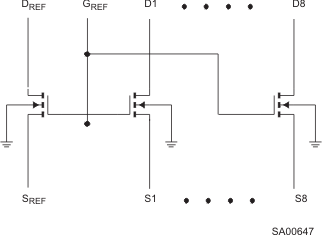
SN74GTL20038-Bit Bidirectional Low-voltage Translator | Translators, Level Shifters | 3 | Active | 8-Bit Bidirectional Low-voltage Translator |
SN74GTL200613-Bit GTL-/GTL/GTL+ To LVTTL Translator | Integrated Circuits (ICs) | 3 | Active | The SN74GTL2006 is a 13-bit translator to interface between the 3.3-V LVTTL chipset I/O and the Xeon™ processor GTL-/GTL/GTL+ I/O. The device is designed for platform health management in dual-processor applications.
The SN74GTL2006 is a 13-bit translator to interface between the 3.3-V LVTTL chipset I/O and the Xeon™ processor GTL-/GTL/GTL+ I/O. The device is designed for platform health management in dual-processor applications. |
SN74GTL200712-Bit GTL-/GTL/GTL+ to LVTTL Translator | Logic | 2 | Active | The SN74GTL2007 is a 12-bit translator to interface between the 3.3-V LVTTL chip set I/O and the Xeon. processor GTL-/GTL/GTL+ I/O. The device is designed for platform health management in dual-processor applications.
The SN74GTL2007 is a 12-bit translator to interface between the 3.3-V LVTTL chip set I/O and the Xeon. processor GTL-/GTL/GTL+ I/O. The device is designed for platform health management in dual-processor applications. |