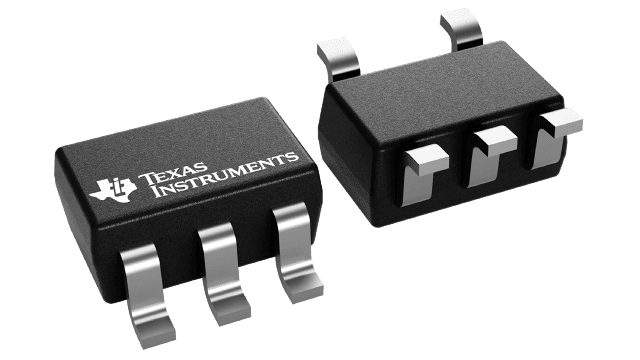
SN74AUP1G80Low-Power Single Postitive-Edge-Triggered D-Type Flip-Flop | Flip Flops | 9 | Active | The AUP family is TI’s premier solution to the industry’s low-power needs in battery-powered portable applications. This family assures a low static- and dynamic-power consumption across the entire VCCrange of 0.8 V to 3.6 V, resulting in increased battery life (seeAUP – The Lowest-Power Family). This product also maintains excellent signal integrity (seeExcellent Signal Integrity).
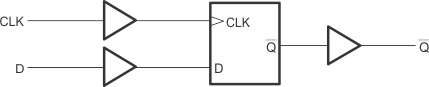
This is a single positive-edge-triggered D-type flip-flop. When data at the data (D) input meets the setup time requirement, the data is transferred to theQoutput on the positive-going edge of the clock pulse. Clock triggering occurs at a voltage level and is not directly related to the rise time of the clock pulse. Following the hold-time interval, data at the D input can be changed without affecting the levels at the outputs.
NanoStar™ package technology is a major breakthrough in IC packaging concepts, using the die as the package.
This device is fully specified for partial-power-down applications using Ioff. The Ioffcircuitry disables the outputs when the device is powered down. This inhibits current backflow into the device which prevents damage to the device.
The AUP family is TI’s premier solution to the industry’s low-power needs in battery-powered portable applications. This family assures a low static- and dynamic-power consumption across the entire VCCrange of 0.8 V to 3.6 V, resulting in increased battery life (seeAUP – The Lowest-Power Family). This product also maintains excellent signal integrity (seeExcellent Signal Integrity).
This is a single positive-edge-triggered D-type flip-flop. When data at the data (D) input meets the setup time requirement, the data is transferred to theQoutput on the positive-going edge of the clock pulse. Clock triggering occurs at a voltage level and is not directly related to the rise time of the clock pulse. Following the hold-time interval, data at the D input can be changed without affecting the levels at the outputs.
NanoStar™ package technology is a major breakthrough in IC packaging concepts, using the die as the package.
This device is fully specified for partial-power-down applications using Ioff. The Ioffcircuitry disables the outputs when the device is powered down. This inhibits current backflow into the device which prevents damage to the device. |
SN74AUP1G97Low-Power Configurable Multiple-Function Gate | Logic | 10 | Active | The AUP family is TI’s premier solution to the industry’s low-power needs in battery-powered portable applications. This family ensures a very low static- and dynamic-power consumption across the entire VCCrange of 0.8 V to 3.6 V, resulting in increased battery life (see Figure 1). This product also maintains excellent signal integrity (see the very low undershoot and overshoot characteristics shown in Figure 2).
The SN74AUP1G97 features configurable multiple functions. The output state is determined by eight patterns of 3-bit input. The user can choose the logic functions MUX, AND, OR, NAND, NOR, inverter, and noninverter. All inputs can be connected to VCCor GND.
The device functions as an independent gate with Schmitt-trigger inputs, which allows for slow input transition and better switching-noise immunity at the input.
NanoStar™ package technology is a major breakthrough in IC packaging concepts, using the die as the package.
This device is fully specified for partial-power-down applications using Ioff. The Ioffcircuitry disables the outputs, preventing damaging current backflow through the device when it is powered down.
The AUP family is TI’s premier solution to the industry’s low-power needs in battery-powered portable applications. This family ensures a very low static- and dynamic-power consumption across the entire VCCrange of 0.8 V to 3.6 V, resulting in increased battery life (see Figure 1). This product also maintains excellent signal integrity (see the very low undershoot and overshoot characteristics shown in Figure 2).
The SN74AUP1G97 features configurable multiple functions. The output state is determined by eight patterns of 3-bit input. The user can choose the logic functions MUX, AND, OR, NAND, NOR, inverter, and noninverter. All inputs can be connected to VCCor GND.
The device functions as an independent gate with Schmitt-trigger inputs, which allows for slow input transition and better switching-noise immunity at the input.
NanoStar™ package technology is a major breakthrough in IC packaging concepts, using the die as the package.
This device is fully specified for partial-power-down applications using Ioff. The Ioffcircuitry disables the outputs, preventing damaging current backflow through the device when it is powered down. |
SN74AUP1G98Low-Power Configurable Multiple-Function Gate | Logic | 3 | Active | The AUP family is TI’s premier solution to the industry’s low-power needs in battery-powered portable applications. This family ensures a very low static- and dynamic-power consumption across the entire VCCrange of 0.8 V to 3.6 V, resulting in increased battery life (see Figure 1). This product also maintains excellent signal integrity (see the very low undershoot and overshoot characteristics shown in Figure 2).
The SN74AUP1G98 features configurable multiple functions. The output state is determined by eight patterns of 3-bit input. The user can choose the logic functions MUX, AND, OR, NAND, NOR, inverter, and noninverter. All inputs can be connected to VCCor GND.
The device functions as an independent gate with Schmitt-trigger inputs, which allow for slow input transition and better switching-noise immunity at the input.
NanoStar™ package technology is a major breakthrough in IC packaging concepts, using the die as the package.
This device is fully specified for partial-power-down applications using Ioff. The Ioffcircuitry disables the outputs, preventing damaging current backflow through the device when it is powered down.
The AUP family is TI’s premier solution to the industry’s low-power needs in battery-powered portable applications. This family ensures a very low static- and dynamic-power consumption across the entire VCCrange of 0.8 V to 3.6 V, resulting in increased battery life (see Figure 1). This product also maintains excellent signal integrity (see the very low undershoot and overshoot characteristics shown in Figure 2).
The SN74AUP1G98 features configurable multiple functions. The output state is determined by eight patterns of 3-bit input. The user can choose the logic functions MUX, AND, OR, NAND, NOR, inverter, and noninverter. All inputs can be connected to VCCor GND.
The device functions as an independent gate with Schmitt-trigger inputs, which allow for slow input transition and better switching-noise immunity at the input.
NanoStar™ package technology is a major breakthrough in IC packaging concepts, using the die as the package.
This device is fully specified for partial-power-down applications using Ioff. The Ioffcircuitry disables the outputs, preventing damaging current backflow through the device when it is powered down. |
SN74AUP1G99Low-Power Ultra-Configurable Multiple-Function Gate with 3-State Outputs | Integrated Circuits (ICs) | 6 | Active | The AUP family is TI’s premier solution to the industry’s low-power needs in battery-powered portable applications. This family ensures a very low static- and dynamic-power consumption across the entire VCCrange of 0.8 V to 3.6 V, resulting in an increased battery life. This product also maintains excellent signal integrity (see Figures 1 and 2).
The SN74AUP1G99 features configurable multiple functions with a 3-state output. This device has the input-disable feature, which allows floating input signals. The inputs and output are disabled when the output-enable (OE) input is high. WhenOEis low, the output state is determined by 16 patterns of 4-bit input. The user can choose the logic functions, such as MUX, AND, OR, NAND, NOR, XOR, XNOR, inverter, and buffer. All inputs can be connected to VCCor GND.
This device functions as an independent gate with Schmitt-trigger inputs, which allows for slow input transition and better switching noise immunity at the input.
To ensure the high-impedance state during power up or power down,OEshould be tied to VCCthrough a pullup resistor; the minimum value of the resistor is determined by the current-sinking capability of the driver.
NanoStar™ and NanoFree™ package technology is a major breakthrough in IC packaging concepts, using the die as the package.
This device is fully specified for partial-power-down applications using Ioff. The Ioffcircuitry disables the outputs, preventing damaging current backflow through the device when it is powered down.
The AUP family is TI’s premier solution to the industry’s low-power needs in battery-powered portable applications. This family ensures a very low static- and dynamic-power consumption across the entire VCCrange of 0.8 V to 3.6 V, resulting in an increased battery life. This product also maintains excellent signal integrity (see Figures 1 and 2).
The SN74AUP1G99 features configurable multiple functions with a 3-state output. This device has the input-disable feature, which allows floating input signals. The inputs and output are disabled when the output-enable (OE) input is high. WhenOEis low, the output state is determined by 16 patterns of 4-bit input. The user can choose the logic functions, such as MUX, AND, OR, NAND, NOR, XOR, XNOR, inverter, and buffer. All inputs can be connected to VCCor GND.
This device functions as an independent gate with Schmitt-trigger inputs, which allows for slow input transition and better switching noise immunity at the input.
To ensure the high-impedance state during power up or power down,OEshould be tied to VCCthrough a pullup resistor; the minimum value of the resistor is determined by the current-sinking capability of the driver.
NanoStar™ and NanoFree™ package technology is a major breakthrough in IC packaging concepts, using the die as the package.
This device is fully specified for partial-power-down applications using Ioff. The Ioffcircuitry disables the outputs, preventing damaging current backflow through the device when it is powered down. |
SN74AUP1T02Low Power, 1.8/2.5/3.3-V In, 3.3-V CMOS Out, Single 2-Input Positive-NOR Gate | Gates and Inverters | 1 | Active | The SN74AUP1T02 performs the Boolean function Y =A + Bor Y =A•Bwith designation for logic-level translation applications with output referenced to supply VCC.
AUP technology is the industry’s lowest-power logic technology designed for use in extending battery-life in operating. All input levels that accept 1.8-V LVCMOS signals, while operating from either a single 3.3-V or 2.5-V VCCsupply. This product also maintains excellent signal integrity (see Figure 1 and Figure 2).
The wide VCCrange of 2.3 V to 3.6 V allows the possibility of switching output level to connect to external controllers or processors.
Schmitt-trigger inputs (VT= 210 mV between positive and negative input transitions) offer improved noise immunity during switching transitions, which is especially useful on analog mixed-mode designs. Schmitt-trigger inputs reject input noise, ensure integrity of output signals, and allow for slow input signal transition.
Ioffis a feature that allows for powered-down conditions (VCC= 0 V) and is important in portable and mobile applications. When VCC= 0 V, signals in the range from 0 V to 3.6 V can be applied to the inputs and outputs of the device. No damage occurs to the device under these conditions.
The SN74AUP1T02 is designed with optimized current-drive capability of 4 mA to reduce line reflections, overshoot, and undershoot caused by high-drive outputs.
The SN74AUP1T02 performs the Boolean function Y =A + Bor Y =A•Bwith designation for logic-level translation applications with output referenced to supply VCC.
AUP technology is the industry’s lowest-power logic technology designed for use in extending battery-life in operating. All input levels that accept 1.8-V LVCMOS signals, while operating from either a single 3.3-V or 2.5-V VCCsupply. This product also maintains excellent signal integrity (see Figure 1 and Figure 2).
The wide VCCrange of 2.3 V to 3.6 V allows the possibility of switching output level to connect to external controllers or processors.
Schmitt-trigger inputs (VT= 210 mV between positive and negative input transitions) offer improved noise immunity during switching transitions, which is especially useful on analog mixed-mode designs. Schmitt-trigger inputs reject input noise, ensure integrity of output signals, and allow for slow input signal transition.
Ioffis a feature that allows for powered-down conditions (VCC= 0 V) and is important in portable and mobile applications. When VCC= 0 V, signals in the range from 0 V to 3.6 V can be applied to the inputs and outputs of the device. No damage occurs to the device under these conditions.
The SN74AUP1T02 is designed with optimized current-drive capability of 4 mA to reduce line reflections, overshoot, and undershoot caused by high-drive outputs. |
SN74AUP1T04Low Power, 1.8/2.5/3.3-V Input, 3.3-V CMOS Output, Single Inverter Gate | Integrated Circuits (ICs) | 1 | Active | The SN74AUP1T04 performs the Boolean function Y =Awith designation for logic-level translation applications with output referenced to supply VCC.
AUP technology is the industry’s lowest-power logic technology designed for use in extending battery-life in operating. All input levels that accept 1.8-V LVCMOS signals, while operating from either a single 3.3-V or 2.5-V VCCsupply. This product also maintains excellent signal integrity (see Figure 1 and Figure 2).
The wide VCCrange of 2.3 V to 3.6 V allows the possibility of switching output level to connect to external controllers or processors.
Schmitt-trigger inputs (VT= 210 mV between positive and negative input transitions) offer improved noise immunity during switching transitions, which is especially useful on analog mixed-mode designs. Schmitt-trigger inputs reject input noise, ensure integrity of output signals, and allow for slow input signal transition.
Ioffis a feature that allows for powered-down conditions (VCC= 0 V) and is important in portable and mobile applications. When VCC= 0 V, signals in the range from 0 V to 3.6 V can be applied to the inputs and outputs of the device. No damage occurs to the device under these conditions.
The SN74AUP1T04 is designed with optimized current-drive capability of 4 mA to reduce line reflections, overshoot, and undershoot caused by high-drive outputs.
The SN74AUP1T04 performs the Boolean function Y =Awith designation for logic-level translation applications with output referenced to supply VCC.
AUP technology is the industry’s lowest-power logic technology designed for use in extending battery-life in operating. All input levels that accept 1.8-V LVCMOS signals, while operating from either a single 3.3-V or 2.5-V VCCsupply. This product also maintains excellent signal integrity (see Figure 1 and Figure 2).
The wide VCCrange of 2.3 V to 3.6 V allows the possibility of switching output level to connect to external controllers or processors.
Schmitt-trigger inputs (VT= 210 mV between positive and negative input transitions) offer improved noise immunity during switching transitions, which is especially useful on analog mixed-mode designs. Schmitt-trigger inputs reject input noise, ensure integrity of output signals, and allow for slow input signal transition.
Ioffis a feature that allows for powered-down conditions (VCC= 0 V) and is important in portable and mobile applications. When VCC= 0 V, signals in the range from 0 V to 3.6 V can be applied to the inputs and outputs of the device. No damage occurs to the device under these conditions.
The SN74AUP1T04 is designed with optimized current-drive capability of 4 mA to reduce line reflections, overshoot, and undershoot caused by high-drive outputs. |
SN74AUP1T08Low Power, 1.8/2.5/3.3-V Input, 3.3-V CMOS Output, 2-Input Positive-AND Gate | Integrated Circuits (ICs) | 1 | Active | The SN74AUP1T08 performs the Boolean function Y = A • B or Y =/A + /Bwith designation for logic-level translation applications with output referenced to supply VCC.
AUP technology is the industrys lowest-power logic technology designed for use in extending battery-life in operating. All input levels that accept 1.8-V LVCMOS signals, while operating from either a single 3.3-V or 2.5-V VCCsupply. This product also maintains excellent signal integrity (see Figure 5-1 and Figure 5-2).
The wide VCCrange of 2.3 V to 3.6 V allows the possibility of switching output level to connect to external controllers or processors.
Schmitt-trigger inputs (ΔVT= 210 mV between positive and negative input transitions) offer improved noise immunity during switching transitions, which is especially useful on analog mixed-mode designs. Schmitt-trigger inputs reject input noise, ensure integrity of output signals, and allow for slow input signal transition.
Ioffis a feature that allows for powered-down conditions (VCC= 0 V) and is important in portable and mobile applications. When VCC= 0 V, signals in the range from 0 V to 3.6 V can be applied to the inputs and outputs of the device. No damage occurs to the device under these conditions.
The SN74AUP1T08 is designed with optimized current-drive capability of 4 mA to reduce line reflections, overshoot, and undershoot caused by high-drive outputs.
The SN74AUP1T08 performs the Boolean function Y = A • B or Y =/A + /Bwith designation for logic-level translation applications with output referenced to supply VCC.
AUP technology is the industrys lowest-power logic technology designed for use in extending battery-life in operating. All input levels that accept 1.8-V LVCMOS signals, while operating from either a single 3.3-V or 2.5-V VCCsupply. This product also maintains excellent signal integrity (see Figure 5-1 and Figure 5-2).
The wide VCCrange of 2.3 V to 3.6 V allows the possibility of switching output level to connect to external controllers or processors.
Schmitt-trigger inputs (ΔVT= 210 mV between positive and negative input transitions) offer improved noise immunity during switching transitions, which is especially useful on analog mixed-mode designs. Schmitt-trigger inputs reject input noise, ensure integrity of output signals, and allow for slow input signal transition.
Ioffis a feature that allows for powered-down conditions (VCC= 0 V) and is important in portable and mobile applications. When VCC= 0 V, signals in the range from 0 V to 3.6 V can be applied to the inputs and outputs of the device. No damage occurs to the device under these conditions.
The SN74AUP1T08 is designed with optimized current-drive capability of 4 mA to reduce line reflections, overshoot, and undershoot caused by high-drive outputs. |
SN74AUP1T14Low Power, 1.8/2.5/3.3-V In, 3.3-V CMOS Out Single Schmitt-Trigger Inverter Gate | Integrated Circuits (ICs) | 1 | Active | The SN74AUP1T14 performs the Boolean function Y =Awith designation for logic-level translation applications with output referenced to supply VCC.
AUP technology is the industry’s lowest-power logic technology designed for use in extending battery-life in operating. All input levels that accept 1.8-V LVCMOS signals, while operating from either a single 3.3-V or 2.5-V VCCsupply. This product also maintains excellent signal integrity (see Figure 1 and Figure 2).
The wide VCCrange of 2.3 V to 3.6 V allows the possibility of switching output level to connect to external controllers or processors.
Schmitt-trigger inputs (VT= 210 mV between positive and negative input transitions) offer improved noise immunity during switching transitions, which is especially useful on analog mixed-mode designs. Schmitt-trigger inputs reject input noise, ensure integrity of output signals, and allow for slow input signal transition.
Ioffis a feature that allows for powered-down conditions (VCC= 0 V) and is important in portable and mobile applications. When VCC= 0 V, signals in the range from 0 V to 3.6 V can be applied to the inputs and outputs of the device. No damage occurs to the device under these conditions.
The SN74AUP1T14 is designed with optimized current-drive capability of 4 mA to reduce line reflections, overshoot, and undershoot caused by high-drive outputs.
The SN74AUP1T14 performs the Boolean function Y =Awith designation for logic-level translation applications with output referenced to supply VCC.
AUP technology is the industry’s lowest-power logic technology designed for use in extending battery-life in operating. All input levels that accept 1.8-V LVCMOS signals, while operating from either a single 3.3-V or 2.5-V VCCsupply. This product also maintains excellent signal integrity (see Figure 1 and Figure 2).
The wide VCCrange of 2.3 V to 3.6 V allows the possibility of switching output level to connect to external controllers or processors.
Schmitt-trigger inputs (VT= 210 mV between positive and negative input transitions) offer improved noise immunity during switching transitions, which is especially useful on analog mixed-mode designs. Schmitt-trigger inputs reject input noise, ensure integrity of output signals, and allow for slow input signal transition.
Ioffis a feature that allows for powered-down conditions (VCC= 0 V) and is important in portable and mobile applications. When VCC= 0 V, signals in the range from 0 V to 3.6 V can be applied to the inputs and outputs of the device. No damage occurs to the device under these conditions.
The SN74AUP1T14 is designed with optimized current-drive capability of 4 mA to reduce line reflections, overshoot, and undershoot caused by high-drive outputs. |
SN74AUP1T157Low Power, 1.8/2.5/3.3-V In, 3.3-V CMOS Out, Buffer Multiplexer (Noninverted) | Logic | 1 | Active | The SN74AUP1T157 is a single 2-input multiplexer that selects data from two data inputs (A and B) under control of a common data select input (C). The state of the common data select input determines the particular register from which the data comes. The output (Y) presents the selected data in the true (non-inverted) form.
AUP technology is the industry’s lowest-power logic technology designed for use in extending battery-life in operating. All input levels that accept 1.8-V LVCMOS signals, while operating from either a single 3.3-V or 2.5-V VCCsupply. This product also maintains excellent signal integrity (see Figure 2 and Figure 3).
The wide VCCrange of 2.3 V to 3.6 V allows the possibility of switching output level to connect to external controllers or processors.
Schmitt-trigger inputs (VT= 210 mV between positive and negative input transitions) offer improved noise immunity during switching transitions, which is especially useful on analog mixed-mode designs. Schmitt-trigger inputs reject input noise, ensure integrity of output signals, and allow for slow input signal transition.
Ioffis a feature that allows for powered-down conditions (VCC= 0 V) and is important in portable and mobile applications. When VCC= 0 V, signals in the range from 0 V to 3.6 V can be applied to the inputs and outputs of the device. No damage occurs to the device under these conditions.
The SN74AUP1T157 is designed with optimized current-drive capability of 4 mA to reduce line reflections, overshoot, and undershoot caused by high-drive outputs.
The SN74AUP1T157 is a single 2-input multiplexer that selects data from two data inputs (A and B) under control of a common data select input (C). The state of the common data select input determines the particular register from which the data comes. The output (Y) presents the selected data in the true (non-inverted) form.
AUP technology is the industry’s lowest-power logic technology designed for use in extending battery-life in operating. All input levels that accept 1.8-V LVCMOS signals, while operating from either a single 3.3-V or 2.5-V VCCsupply. This product also maintains excellent signal integrity (see Figure 2 and Figure 3).
The wide VCCrange of 2.3 V to 3.6 V allows the possibility of switching output level to connect to external controllers or processors.
Schmitt-trigger inputs (VT= 210 mV between positive and negative input transitions) offer improved noise immunity during switching transitions, which is especially useful on analog mixed-mode designs. Schmitt-trigger inputs reject input noise, ensure integrity of output signals, and allow for slow input signal transition.
Ioffis a feature that allows for powered-down conditions (VCC= 0 V) and is important in portable and mobile applications. When VCC= 0 V, signals in the range from 0 V to 3.6 V can be applied to the inputs and outputs of the device. No damage occurs to the device under these conditions.
The SN74AUP1T157 is designed with optimized current-drive capability of 4 mA to reduce line reflections, overshoot, and undershoot caused by high-drive outputs. |
| Signal Switches, Multiplexers, Decoders | 1 | Active | The SN74AUP1T158 is a single 2-input multiplexer that selects data from two data inputs (A and B) under control of a common data select input (C). The state of the common data select input determines the particular register from which the data comes. The output (Y) presents the selected data in the inverted form.
AUP technology is the industry’s lowest-power logic technology designed for use in extending battery-life in operating. All input levels that accept 1.8-V LVCMOS signals, while operating from either a single 3.3-V or 2.5-V VCCsupply. This product also maintains excellent signal integrity (see Figure 2 and Figure 3).
The wide VCCrange of 2.3 V to 3.6 V allows the possibility of switching output level to connect to external controllers or processors.
Schmitt-trigger inputs (VT= 210 mV between positive and negative input transitions) offer improved noise immunity during switching transitions, which is especially useful on analog mixed-mode designs. Schmitt-trigger inputs reject input noise, ensure integrity of output signals, and allow for slow input signal transition.
Ioffis a feature that allows for powered-down conditions (VCC= 0 V) and is important in portable and mobile applications. When VCC= 0 V, signals in the range from 0 V to 3.6 V can be applied to the inputs and outputs of the device. No damage occurs to the device under these conditions.
The SN74AUP1T158 is designed with optimized current-drive capability of 4 mA to reduce line reflections, overshoot, and undershoot caused by high-drive outputs.
The SN74AUP1T158 is a single 2-input multiplexer that selects data from two data inputs (A and B) under control of a common data select input (C). The state of the common data select input determines the particular register from which the data comes. The output (Y) presents the selected data in the inverted form.
AUP technology is the industry’s lowest-power logic technology designed for use in extending battery-life in operating. All input levels that accept 1.8-V LVCMOS signals, while operating from either a single 3.3-V or 2.5-V VCCsupply. This product also maintains excellent signal integrity (see Figure 2 and Figure 3).
The wide VCCrange of 2.3 V to 3.6 V allows the possibility of switching output level to connect to external controllers or processors.
Schmitt-trigger inputs (VT= 210 mV between positive and negative input transitions) offer improved noise immunity during switching transitions, which is especially useful on analog mixed-mode designs. Schmitt-trigger inputs reject input noise, ensure integrity of output signals, and allow for slow input signal transition.
Ioffis a feature that allows for powered-down conditions (VCC= 0 V) and is important in portable and mobile applications. When VCC= 0 V, signals in the range from 0 V to 3.6 V can be applied to the inputs and outputs of the device. No damage occurs to the device under these conditions.
The SN74AUP1T158 is designed with optimized current-drive capability of 4 mA to reduce line reflections, overshoot, and undershoot caused by high-drive outputs. |