| Data Acquisition | 5 | Active | |
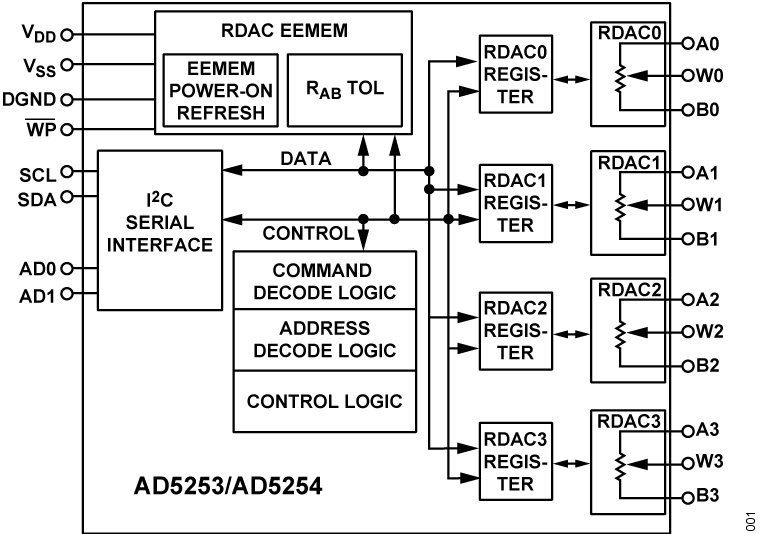
AD5253Quad 64-Position I2C Nonvolatile Memory Digital Potentiometer | Integrated Circuits (ICs) | 6 | Active | The AD5253 /AD5254are quad-channel, I2C, nonvolatile memory, digitally controlled potentiometers with 64/256 positions, respectively. These devices perform the same electronic adjustment functions as mechanical potentiometers, trimmers, and variable resistors.The parts’ versatile programmability allows multiple modes of operation, including read/write access in the RDAC and EEMEM registers, increment/decrement of resistance, resistance changes in ±6 dB scales, wiper setting readback, and extra EEMEM for storing user-defined information, such as memory data for other components, look-up table, or system identification information.The AD5253 / AD5254 allow the host I2C controllers to write any of the 64-/256-step wiper settings in the RDAC registers and store them in the EEMEM. Once the settings are stored, they are restored automatically to the RDAC registers at system power-on; the settings can also be restored dynamically.The AD5253 / AD5254 provide additional increment, decrement, +6 dB step change, and –6 dB step change in synchronous or asynchronous channel update mode. The increment and decrement functions allow stepwise linear adjustments, with a ± 6 dB step change equivalent to doubling or halving the RDAC wiper setting. These functions are useful for steep-slope, nonlinear adjustments, such as white LED brightness and audio volume control.The AD5253 / AD5254 have a patented resistance-tolerance storing function that allows the user to access the EEMEM and obtain the absolute end-to-end resistance values of the RDACs for precision applications.The AD5253 / AD5254 are available in TSSOP-20 packages in 1 kΩ, 10 kΩ, 50 kΩ, and 100 kΩ options. All parts are guaranteed to operate over the –40°C to +105°C extended industrial temperature range. In this data sheet, the nonvolatile memory and EEMEM terms are used interchangeably, as are the digital potentiometer and RDAC terms.APPLICATIONSMechanical potentiometer replacementLow resolution DAC replacementRGB LED backlight controlWhite LED brightness adjustmentRF base station power amp bias controlProgrammable gain and offset controlProgrammable attenuatorsProgrammable voltage-to-current conversionProgrammable power supplyProgrammable filtersSensor calibrations |
| Data Acquisition | 8 | Active | |
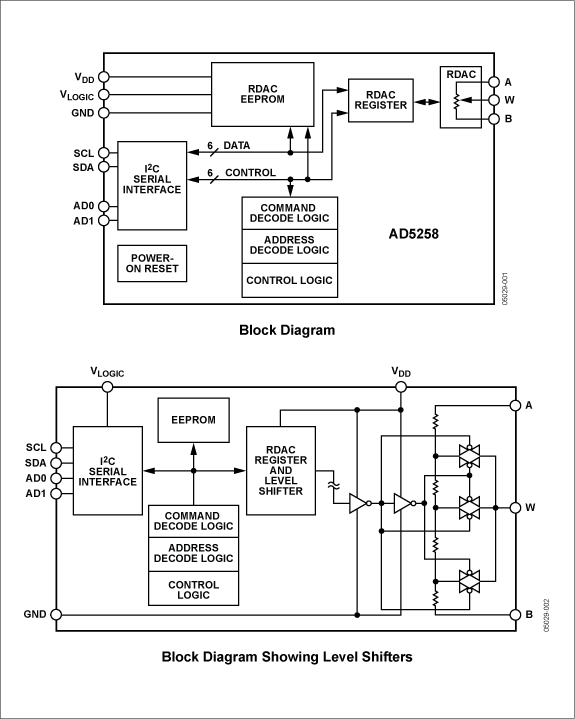
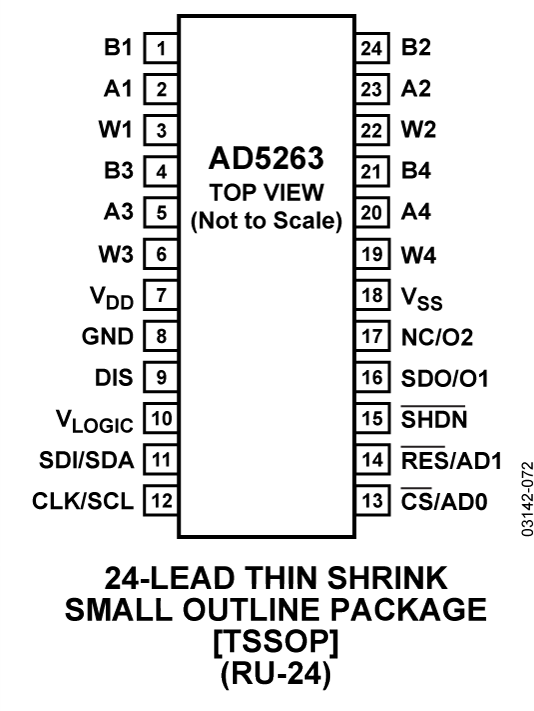
AD5258Nonvolatile, I2C®-Compatible 64-Position, Digital Potentiometer | Development Boards, Kits, Programmers | 4 | Active | The AD5258 provides a compact, nonvolatile 3 mm × 4.9 mm packaged solution for 64-position adjustment applications. These devices perform the same electronic adjustment function as mechanical potentiometers or variable resistors, but with enhanced resolution and solid-state reliability.The wiper settings are controllable through an I2C-compatible digital interface that is also used to read back the wiper register and EEPROM content in addition, resistor tolerance is stored within EEPROM, providing an end-to-end tolerance accuracy of 0.1%. There is also a software write protection function that ensures data cannot be written to the EEPROM register.A separate VLOGICpin delivers increased interface flexibility. For users who need multiple parts on one bus, Address Bit AD0 and Address Bit AD1 allow up to four devices on the same bus.APPLICATIONSLCD panel VCOM adjustmentLCD panel brightness and contrast controlMechanical potentiometer replacement in new designsProgrammable power suppliesRF amplifier biasingAutomotive electronics adjustmentGain control and offset adjustmentFiber to the home systemsElectronics level settings |
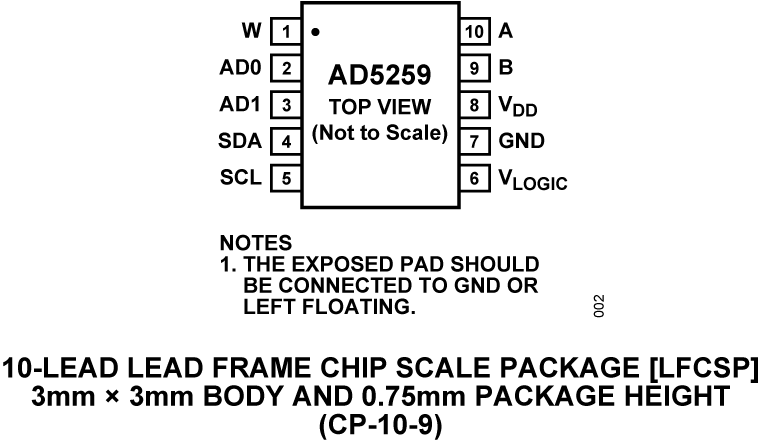
AD5259Nonvolatile, I2C Compatible 256-Position, Digital Potentiometer | Data Acquisition | 5 | Active | The AD5259 provides a compact, nonvolatile LFCSP-10 (3 mm x 3 mm) or MSOP-10 (3 mm x 4.9 mm) packaged solution for 256-position adjustment applications. These devices perform the same electronic adjustment function as mechanical potentiometers or variable resistors, but with enhanced resolution and solid-state reliability. The terms digital potentiometer, VR (variable resistor), and RDAC are used interchangeably.The wiper settings are controllable through an I2C-compatible digital interface that is also used to read back the wiper register and EEPROM content. Resistor tolerance is also stored within EEPROM, providing an end-to-end tolerance accuracy of 0.1%.A separate VLOGICpin delivers increased interface flexibility. For users who need multiple parts on one bus, Address Bit AD0 and Address Bit AD1 allow up to four devices on the same busAPPLICATIONSLCD panel VCOMadjustmentLCD panel brightness and contrast controlMechanical potentiometer replacement in new designsProgrammable power suppliesRF amplifier biasingAutomotive electronics adjustmentGain control and offset adjustmentFiber to the home systemsElectronics level settings |
AD526Software Programmable Gain Amplifier | Instrumentation, Op Amps, Buffer Amps | 5 | Active | The AD526 is a single-ended, monolithic software programmable gain amplifier (SPGA) that provides gains of 1, 2, 4, 8 and 16. It is complete, including amplifier, resistor network and TTL-compatible latched inputs, and requires no external components.Low gain error and low nonlinearity make the AD526 ideal for precision instrumentation applications requiring programmable gain. The small signal bandwidth is 350 kHz at a gain of 16. In addition, the AD526 provides excellent dc precision. The FET-input stage results in a low bias current of 50 pA. A guaranteed maximum input offset voltage of 0.5 mV max (C grade) and low gain error (0.01%, G = 1, 2, 4, C grade) are accomplished using Analog Devices' laser trimming technology.To provide flexibility to the system designer, the AD526 can be operated in either latched or transparent mode. The force/sense configuration preserves accuracy when the output is connected to remote or low impedance loads.The AD526 is offered in one commercial (0°C to +70°C) grade, J, and three industrial grades, A, B and C, which are specified from -40°C to +85°C. The S grade is specified from -55°C to +125°C. The military version is available processed to MIL-STD 883B, Rev C. The J grade is supplied in a 16-pin plastic DIP, and the other grades are offered in a 16-pin hermetic side-brazed ceramic DIP. |
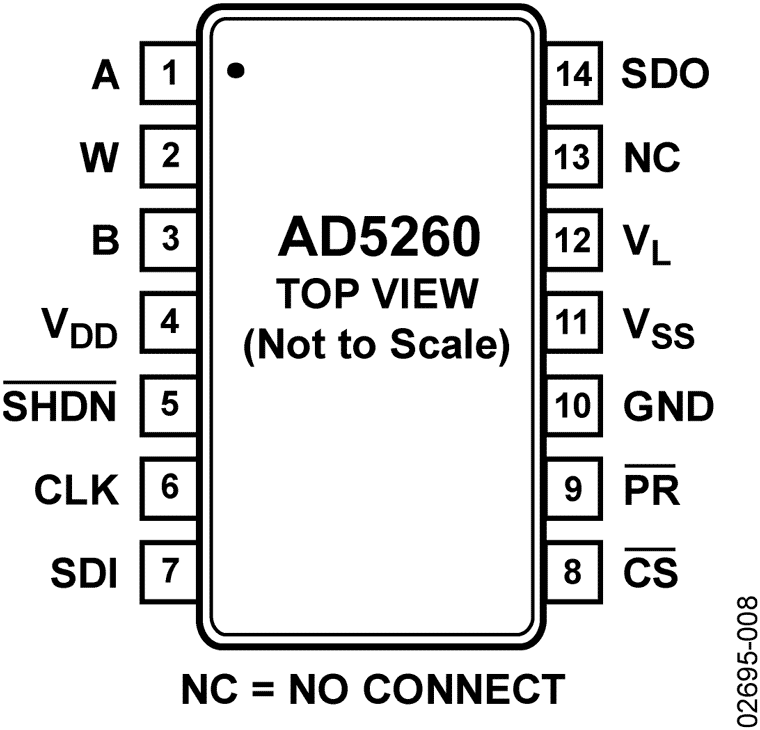
AD5260+15 V or ±5 V, Single-Channel, SPI Compatible, 256 Position Digital Potentiometer | Data Acquisition | 4 | Active | The AD5260 andAD5262are 1- and 2-channel, 256 position, SPI interface digitally controlled, variable resistor (VR) devices. These parts operate from either a single +5 V to +15 V supply or a dual ±5 V supply, extending terminal voltage adjustment to these supply voltages. (Most industry digital potentiometers are limited to a 5 V operating range). These devices perform the same electronic adjustment function as a potentiometer or variable resistor while offering solid-state reliability and electronic packaging compactness. These devices are offered in the thin 1.1 mm height TSSOP 14- and 16-lead surface mount packages. |
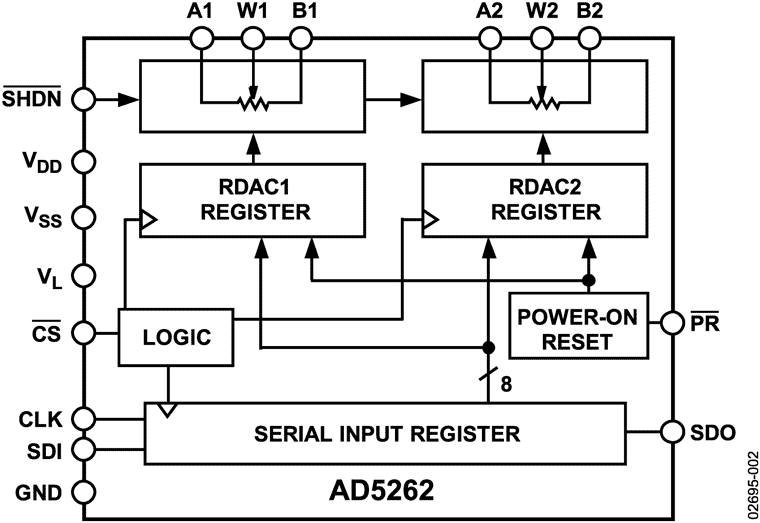
AD5262+15 V or ±5 V, Dual-Channel, SPI Compatible, 256 Position Digital Potentiometer | Data Acquisition | 2 | Active | The AD5260 / AD5262 provide a single- or dual-channel, 256- position, digitally controlled variable resistor (VR) device.1These devices perform the same electronic adjustment function as a potentiometer or variable resistor. Each channel of the AD5260/AD5262 contains a fixed resistor with a wiper contact that taps the fixed resistor value at a point determined by a digital code loaded into the SPI-compatible serial-input register. The resistance between the wiper and either end point of the fixed resistor varies linearly with respect to the digital code transferred into the VR latch. The variable resistor offers a completely programmable value of resistance, between the A terminal and the wiper or the B terminal and the wiper. The fixed A-to-B terminal resistance of 20 Ω, 50 Ω, or 200 Ω has a nominal temperature coefficient of 35 ppm/°C. Unlike the majority of the digital potentiometers in the market, these devices can operate up to 15 V or ±5 V provided proper supply voltages are furnished.Each VR has its own VR latch that holds its programmed resistance value. These VR latches are updated from an internal serial-to-parallel shift register, which is loaded from a standard 3-wire serial-input digital interface. The AD5260 contains an 8-bit serial register whereas the AD5262 contains a 9-bit serial register. Each bit is clocked into the register on the positive edge of the CLK pin. The AD5262 address bit determines the corresponding VR latch to be loaded with the last eight bits of the data word during the positive edging ofCSstrobe. A serial data output pin at the opposite end of the serial register enables simple daisy-chaining in multiple VR applications without additional external decoding logic. An optional reset pin (PR) forces the wiper to the midscale position by loading 0x80 into the VR latch.The AD5260 / AD5262 are available in thin surface-mount 14-lead TSSOP and 16-lead TSSOP packages. All parts are guaranteed to operate over the extended industrial temperature range of −40°C to +85°C.APPLICATIONSMechanical potentiometer replacementInstrumentation: gain, offset adjustmentStereo channel audio level controlProgrammable voltage-to-current conversionProgrammable filters, delays, time constantsLine impedance matchingLow resolution DAC replacement |
| Integrated Circuits (ICs) | 8 | Active | |
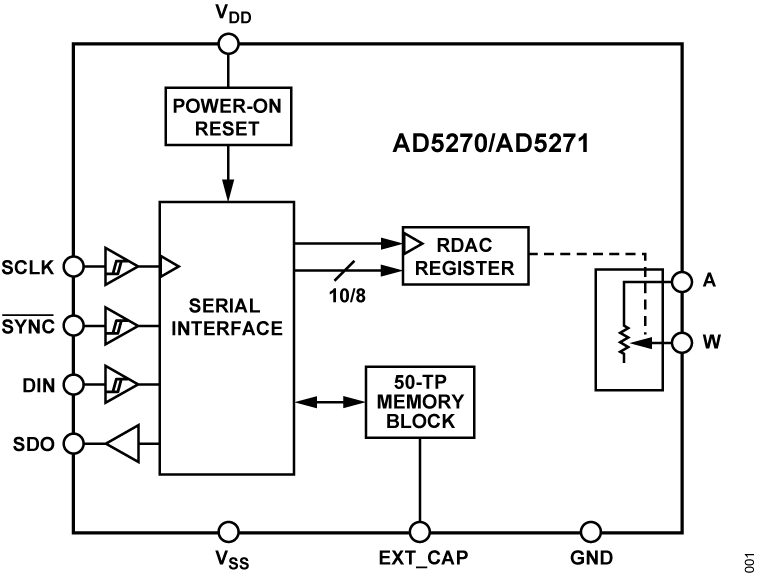
AD52701024-Position, 1% Resistor Tolerance Error, SPI Interface and 50-TP Memory Digital Rheostat | Integrated Circuits (ICs) | 4 | Active | The AD5270/AD5271are single-channel, 1024-/256-position digital rheostats that combine industry leading variable resistor performance with nonvolatile memory (NVM) in a compact package.The AD5270/AD5271 ensure less than 1% end-to-end resistor tolerance error and offer 50-times programmable (50-TP) memory.The guaranteed industry leading low resistor tolerance error feature simplifies open-loop applications as well as precision calibration and tolerance matching applications.The AD5270/AD5271 device wiper settings are controllable through the SPI digital interface. Unlimited adjustments are allowed before programming the resistance value into the 50-TP memory. The AD5270/AD5271 do not require any external voltage supply to facilitate fuse blow and there are 50 opportunities for permanent programming. During 50-TP activation, a permanent blow fuse command freezes the resistance position (analogous to placing epoxy on a mechanical trimmer).The AD5270/AD5271 are available in a 3 mm x 3 mm, 10-lead LFCSP package and in a 10-lead MSOP package. The parts are guaranteed to operate over the extended industrial temperature range of −40°C to +125°C.ApplicationsMechanical potentiometer replacementsOp-amp: variable gain controlInstrumentation: gain, offset adjustmentProgrammable voltage-to-current conversionsProgrammable filters, delays, time constantsProgrammable power supplySensor calibration |