


A
Analog Devices Inc./Maxim Integrated
| Series | Category | # Parts | Status | Description |
|---|---|---|---|---|
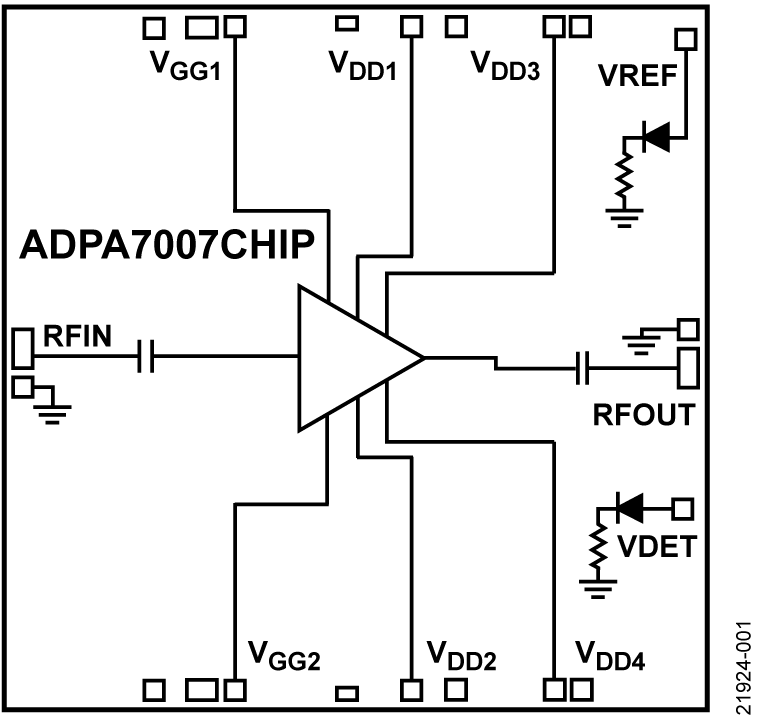
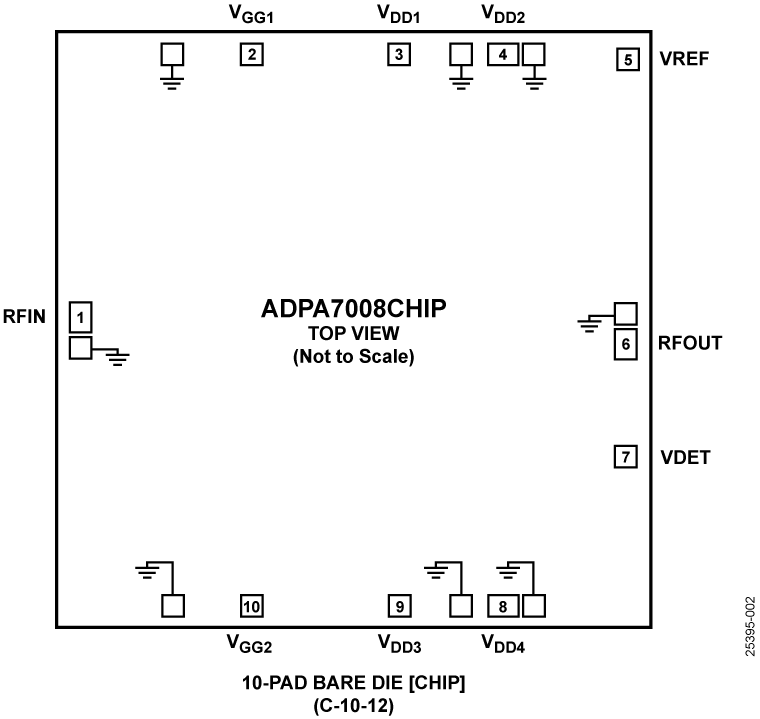
ADPA7007GaAs, pHEMT, MMIC,1 W Power Amplifier, 18 GHz to 44 GHz | RF and Wireless | 4 | Active | The ADPA7007CHIP is a gallium arsenide (GaAs), pseudomorphic high electron mobility transistor (pHEMT), monolithic microwave integrated circuit (MMIC), distributed power amplifier that operates from 18 GHz to 44 GHz. The amplifier provides a gain of 21.5 dB, an output power for 1 dB compression (P1dB) of 31 dBm, and a typical output thirdorder intercept (IP3) of 41 dBm. The ADPA7007CHIP requires 1400 mA from a 5 V supply on the supply voltage (VDD) and features inputs and outputs that are internally matched to 50 Ω, facilitating integration into multichip modules (MCMs). All data was taken with the chip connected via two 0.025 mm wire bonds that are at least 0.31 mm long.ApplicationsMilitary and spaceTest instrumentation |
| RF Amplifiers | 3 | Active | ||
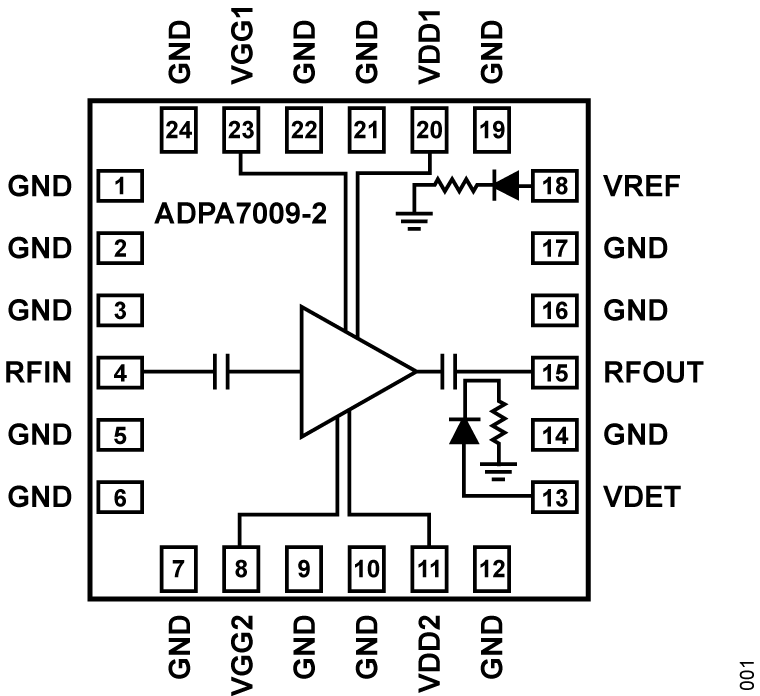
ADPA700920 GHz to 54 GHz, GaAs, pHEMT, MMIC, 29 dBm (0.5 W) Power Amplifier | Evaluation Boards | 4 | Active | The ADPA7009-2 is a gallium arsenide (GaAs), pseudomorphic high-electron-mobility transistor (pHEMT), monolithic microwave integrated circuit (MMIC), 0.5 W power amplifier with an integrated temperature-compensated, on-chip power detector that operates between 20 GHz and 54 GHz. The amplifier provides a gain of 17.5 dB, an output power for 1 dB compression (OP1dB) of 28 dBm, and a typical output third-order intercept (OIP3) of 34.5 dBm at 20 GHz to 35 GHz. The ADPA7009-2 requires 850 mA from a 5 V supply voltage (VDDx). The RF input and outputs are internally matched and DC-blocked for ease of integration into higher level assemblies. Most of the typically required external passive components for operation (AC coupling capacitors and power supply decoupling capacitors) are integrated, which facilitates a small, compact printed circuit board (PCB) footprint. The ADPA7009-2 is available in a 5.00 mm × 5.00 mm, 24-terminal chip array, small outline, no lead cavity [LGA_CAV] package.APPLICATIONSMilitary and spaceTest instrumentation |
ADPA7009-220 GHz to 54 GHz, GaAs, pHEMT, MMIC, 29 dBm (0.5 W) Power Amplifier | RF Amplifiers | 1 | Active | The ADPA7009-2 is a gallium arsenide (GaAs), pseudomorphic high-electron-mobility transistor (pHEMT), monolithic microwave integrated circuit (MMIC), 0.5 W power amplifier with an integrated temperature-compensated, on-chip power detector that operates between 20 GHz and 54 GHz. The amplifier provides a gain of 17.5 dB, an output power for 1 dB compression (OP1dB) of 28 dBm, and a typical output third-order intercept (OIP3) of 34.5 dBm at 20 GHz to 35 GHz. The ADPA7009-2 requires 850 mA from a 5 V supply voltage (VDDx). The RF input and outputs are internally matched and DC-blocked for ease of integration into higher level assemblies. Most of the typically required external passive components for operation (AC coupling capacitors and power supply decoupling capacitors) are integrated, which facilitates a small, compact printed circuit board (PCB) footprint. The ADPA7009-2 is available in a 5.00 mm × 5.00 mm, 24-terminal chip array, small outline, no lead cavity [LGA_CAV] package.APPLICATIONSMilitary and spaceTest instrumentation |
| RF, RFID, Wireless Evaluation Boards | 3 | Active | ||
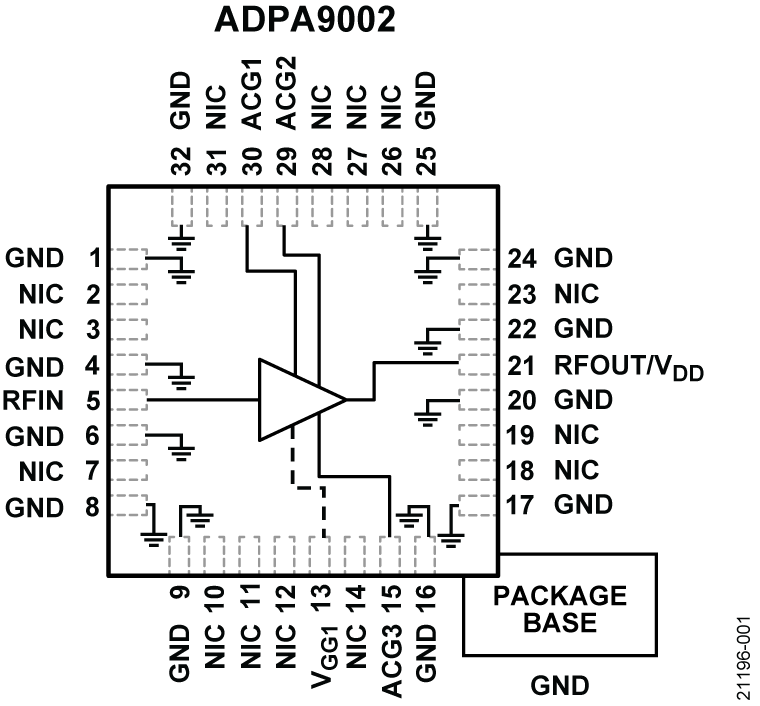
ADPA9007DC to 28 GHz, GaAs, pHEMT, 2 W Power Amplifier | RF and Wireless | 2 | Active | The ADPA9007 is a 2 W, RF power amplifier that operates from DC to 28 GHz. The RF input and output are internally-matched and DC-coupled. The ADPA9007 includes an integrated temperature-compensated RF power detector and an integrated temperature sensor.The ADPA9007 amplifier provides a gain of 12.5 dB, an output power for 1 dB compression (OP1dB) of 33 dBm, and an output third-order intercept (OIP3) of 45 dBm from 2 GHz to 16 GHz. The amplifier operates from a typical supply voltage of 15 V and has a 500 mA typical quiescent bias current, which is adjustable.The ADPA9007 is fabricated on a gallium arsenide (GaAs), pseudomorphic high electron mobility transistor (pHEMT) process. The amplifier is housed in an RoHS-compliant, 32-Lead, 5 mm × 5 mm, lead frame chip scale package, premolded cavity [LFCSP_CAV] and is specified for operation from −40°C to +85°C.ApplicationsElectronic warfareRadarTest and measurement equipment |
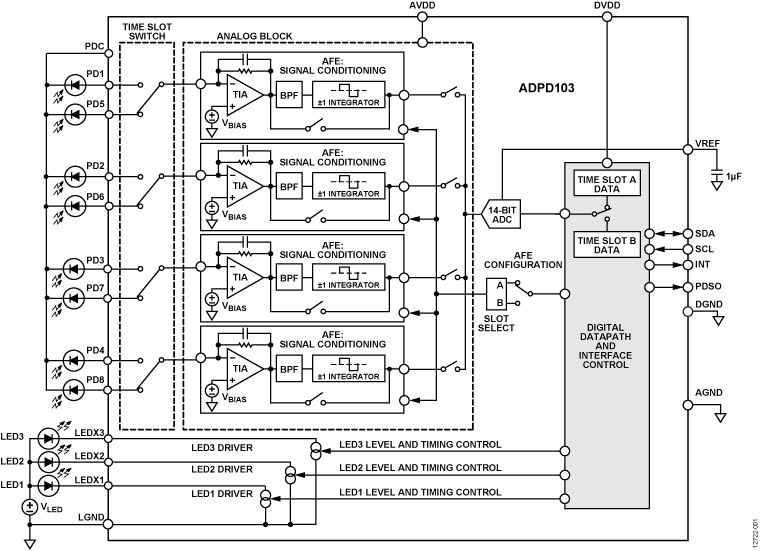
ADPD103Photometric Front End | Evaluation Boards | 4 | Active | The ADPD103 is a highly efficient photometric front end with an integrated 14-bit analog-to-digital converter (ADC) and a 20-bit burst accumulator that works in concert with flexible light emitting diode (LED) drivers. It is designed to stimulate an LED and measure the corresponding optical return signal. The data output and functional configuration occur over a 1.8 V I2C interface. The control circuitry includes flexible LED signaling and synchronous detection.The analog front end (AFE) features best-in-class rejection of signal offset and corruption due to modulated interference commonly caused by ambient light.Couple the ADPD103 with a low capacitance photodiode of <100 pF for optimal performance. The ADPD103 can be used with any LED.AplicationsBody worn health and fitness monitors, for example, heart rate monitoringClinical measurements, for example, SpO2Industrial monitoringBackground light measurements |
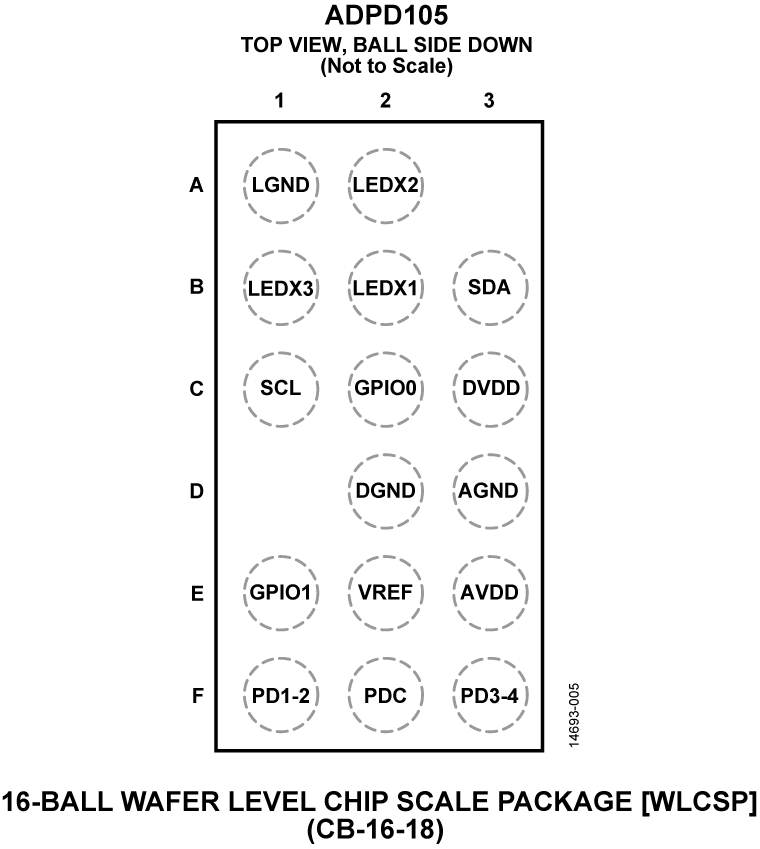
ADPD105Photometric Front End with I2C | Data Acquisition | 3 | Active | The ADPD105/ADPD106/ADPD107are highly efficient, photometric front ends, each with an integrated 14-bit analog-to-digital converter (ADC) and a 20-bit burst accumulator that works with flexible light emitting diode (LED) drivers. The accumulator is designed to stimulate an LED and measure the corresponding optical return signal. The data output and functional configuration occur over a 1.8 V I2C interface on the ADPD105 or SPI on the ADPD106 and ADPD107. The control circuitry includes flexible LED signaling and synchronous detection.The analog front end (AFE) features best-in-class rejection of signal offset and corruption due to modulated interference commonly caused by ambient light.Couple the ADPD105/ADPD106/ADPD107 with a low capacitance photodiode of <100 pF for optimal performance. The ADPD105/ADPD106/ADPD107 can be used with any LED. The ADPD105 is available in a 2.46 mm × 1.4 mm WLCSP and a 4 mm × 4 mm LFCSP. The SPI only versions, ADPD106 and ADPD107, are available in a 2.46 mm × 1.4 mm WLCSP.ApplicationsWearable health and fitness monitorsClinical measurements, for example, SpO2Industrial monitoringBackground light measurements |
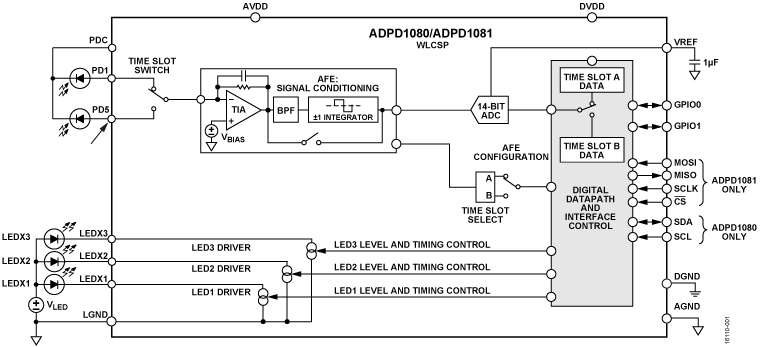
ADPD1080Photometric Front Ends | Sensor and Detector Interfaces | 4 | Active | The ADPD1080/ADPD1081are highly efficient, photometric front ends, each with an integrated 14-bit analog-to-digital converter (ADC) and a 20-bit burst accumulator that works with flexible light emitting diode (LED) drivers. The ADPD1080/ADPD1081 stimulate an LED and measures the corresponding optical return signal. The data output and functional configuration occur over a 1.8 V I2C interface on the ADPD1080 or a serial port interface (SPI) on the ADPD1081. The control circuitry includes flexible LED signaling and synchronous detection.The analog front end (AFE) features rejection of signal offset and corruption due to modulated interference commonly caused by ambient light without the need for optical filters or dc cancellation circuitry that requires external control.Couple the ADPD1080/ADPD1081 with a low capacitance photodiode of <100 pF for optimal performance. The ADPD1080/ADPD1081 can be used with any LED. The ADPD1080 is available in a 16-ball, 2.46 mm × 1.4 mm WLCSP and a 28-lead, 4 mm × 4 mm LFCSP. The SPI only version, ADPD1081, is available in a 17-ball, 2.46 mm × 1.4 mm WLCSP.ApplicationsWearable health and fitness monitorsClinical measurements, for example, SpO2Industrial monitoringBackground light measurements |
ADPD1081Photometric Front Ends | Sensor and Detector Interfaces | 2 | Active | TheADPD1080/ADPD1081 are highly efficient, photometric front ends, each with an integrated 14-bit analog-to-digital converter (ADC) and a 20-bit burst accumulator that works with flexible light emitting diode (LED) drivers. The ADPD1080/ADPD1081 stimulate an LED and measures the corresponding optical return signal. The data output and functional configuration occur over a 1.8 V I2C interface on the ADPD1080 or a serial port interface (SPI) on the ADPD1081. The control circuitry includes flexible LED signaling and synchronous detection.The analog front end (AFE) features rejection of signal offset and corruption due to modulated interference commonly caused by ambient light without the need for optical filters or dc cancellation circuitry that requires external control.Couple the ADPD1080/ADPD1081 with a low capacitance photodiode of <100 pF for optimal performance. The ADPD1080/ADPD1081 can be used with any LED. The ADPD1080 is available in a 16-ball, 2.46 mm × 1.4 mm WLCSP and a 28-lead, 4 mm × 4 mm LFCSP. The SPI only version, ADPD1081, is available in a 17-ball, 2.46 mm × 1.4 mm WLCSP.ApplicationsWearable health and fitness monitorsClinical measurements, for example, SpO2Industrial monitoringBackground light measurements |

Standalone parts(23843)
...
| Part | Category | Description |
|---|---|---|
 Analog Devices Inc./Maxim Integrated | Development Boards Kits Programmers | EVAL BOARD HMC264LM3 |
 Analog Devices Inc./Maxim Integrated | Development Boards Kits Programmers | EVAL BOARD HMC362S8GE |
 Analog Devices Inc./Maxim Integrated | Development Boards Kits Programmers | BOARD EVAL DIVIDER HMC365 |
 Analog Devices Inc./Maxim Integrated | Development Boards Kits Programmers | EVAL BOARD HMC413QS16G |
 Analog Devices Inc./Maxim Integrated | Development Boards Kits Programmers | EVAL BOARD HMC414MS8G |
 Analog Devices Inc./Maxim Integrated | Development Boards Kits Programmers | EVAL BRD, 3.5GHZ, SPDT NON-REFLECTIVE SW ROHS COMPLIANT: YES |
 Analog Devices Inc./Maxim Integrated | Development Boards Kits Programmers | BOARD EVALUATION HMC435AMS8G |
 Analog Devices Inc./Maxim Integrated | Development Boards Kits Programmers | EVALUATION BOARD, HMC536MS8G, RF SWITCH, RF / IF |
 Analog Devices Inc./Maxim Integrated | Development Boards Kits Programmers | EVAL BOARD HMC415LP3 |
 Analog Devices Inc./Maxim Integrated | Development Boards Kits Programmers | EVAL BRD, HBT MMIC, DIVIDE-BY-2, 8GHZ ROHS COMPLIANT: YES |