


A
Analog Devices Inc./Maxim Integrated
| Series | Category | # Parts | Status | Description |
|---|---|---|---|---|
| Interface | 2 | Active | ||
| Data Acquisition | 2 | Active | ||
| Optical Sensors | 5 | Active | ||
| Software, Services | 6 | Active | ||
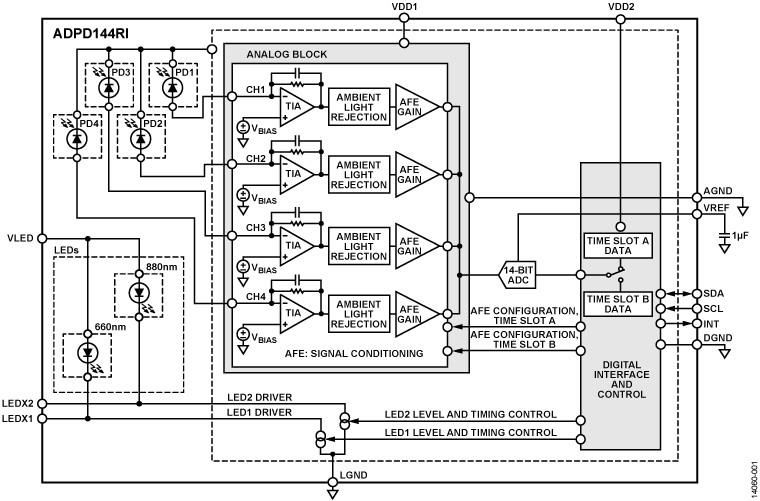
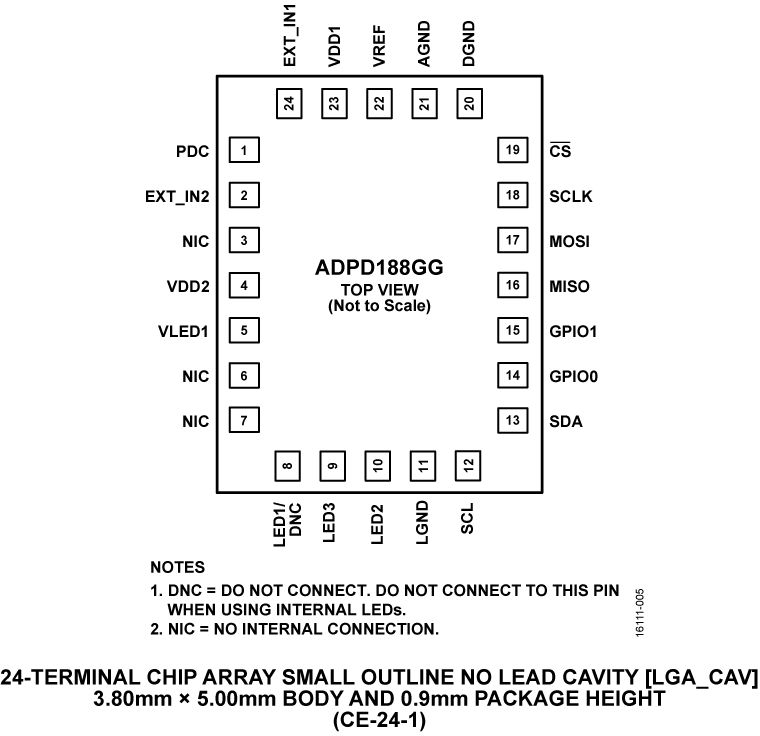
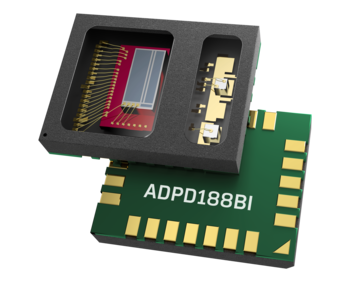
ADPD188GGIntegrated Optical Module with Ambient Light Rejection and Two LEDs | Sensors, Transducers | 1 | Active | The ADPD188GG is a complete photometric system designed to measure optical signals from ambient light and from synchronous reflected light emitting diode (LED) pulses. Synchronous measurement offers best-in-class rejection of ambient light interference, both dc and ac. The module integrates a highly efficient photometric front end, two LEDs, and two photodiode (PD). All of these items are housed in a custom package that prevents light from going directly from the LED to the photodiode without first entering the subject.The front end of the application specific integrated circuit (ASIC) consists of a control block, a 14-bit analog-to-digital converter (ADC) with a 20-bit burst accumulator, and three flexible, independently configurable LED drivers. The control circuitry includes flexible LED signaling and synchronous detection. The analog front end (AFE) features best-in-class rejection of signal offset and corruption due to modulated interference commonly caused by ambient light. The data output and functional configuration occur over a 1.8 V I2C interface or a serial peripheral interface (SPI) port.ApplicationsOptical heart rate monitoringReflective PPG measurementCNIBP measurement |
| Sensors, Transducers | 4 | Active | ||
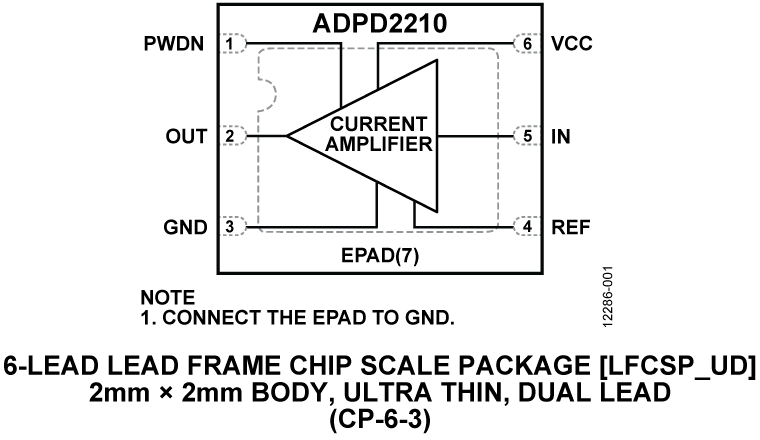
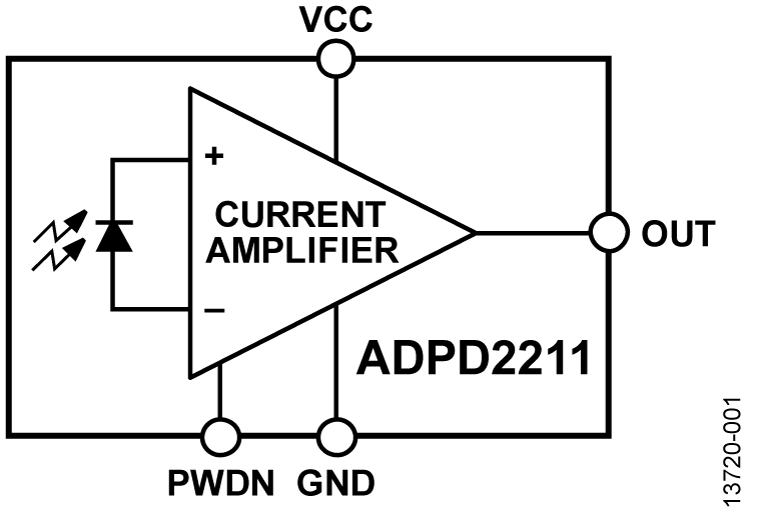
ADPD2210Ultralow Noise, Low Power Current Amplifier | Integrated Circuits (ICs) | 1 | Active | The ADPD2210 is a low noise current amplifier designed to allow the use of smaller photodiodes by amplifying sensor signal currents by a factor of 24 while adding minimal noise. This amplification provides the system sensitivity of a large photodiode with the benefits of a smaller photodiode. A minimum linearity of 60 dB allows accurate extraction of very small time variant signals on top of large dc or low frequency offsets.The ADPD2210 is optimized for pulse mode applications such as wrist worn heart rate monitoring (HRM) or finger worn pulse oximeter oxygen saturation (SpO2), where low power consumption and rejection of ambient light is critical. In photodiode applications, the ADPD2210 holds the sensor input to within ±5 mV (typical) of the reference terminal, providing near zero-bias voltage and allowing minimal dark current and shot noise limited performance.The ADPD2210 is designed for applications where power conservation is critical. The ADPD2210 uses very little power, typically 140 μA with no input to 954 μA at full scale. A power-down pin places the ADPD2210 in standby when sensing is inactive. This mode adds critical time for battery-powered monitoring and can reduce battery costs in disposable applications.Using the ADPD2210 to provide sensor site amplification reduces the effect of electromagnetic interference (EMI) in low level wired interfaces, providing improved signal-to-noise ratio (SNR) and rejection of interferer signals from nearby equipment. The combination of low power, high SNR, and EMI immunity enables low power system solutions not possible with traditional small current sensors, such as photodiodes plus transimpedance amplifiers (TIAs).Applications:PhotoplethysmographyPhotodiode measurementsSmall current pulsed amperometryAny application requiring the ultralow noise amplification of small currents |
| Sensor Evaluation Boards | 3 | Active | ||
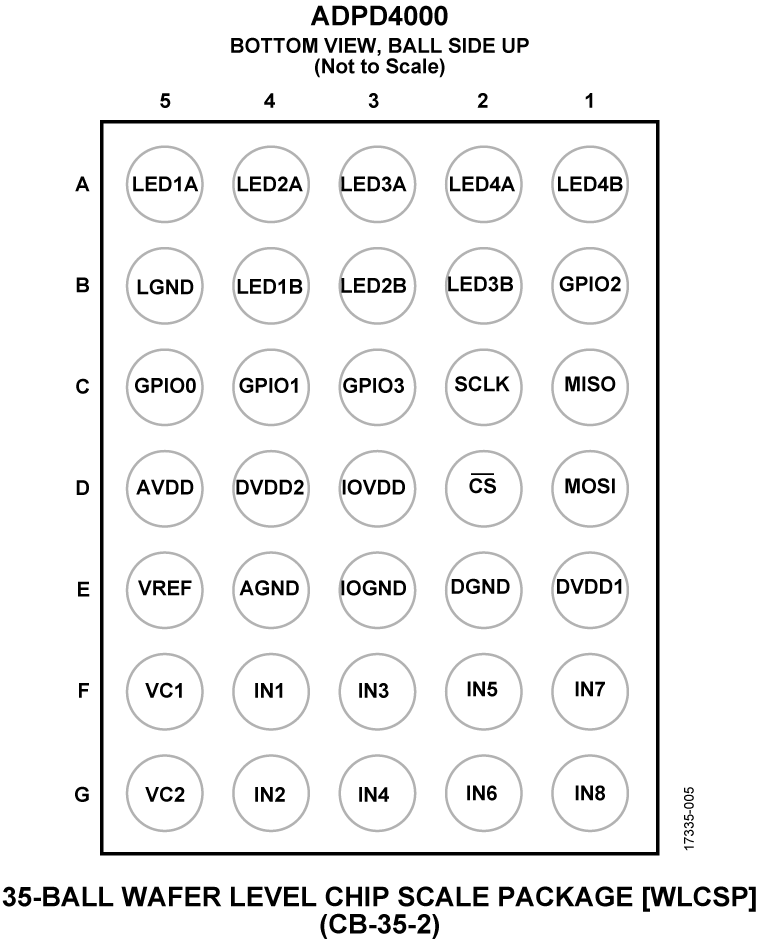
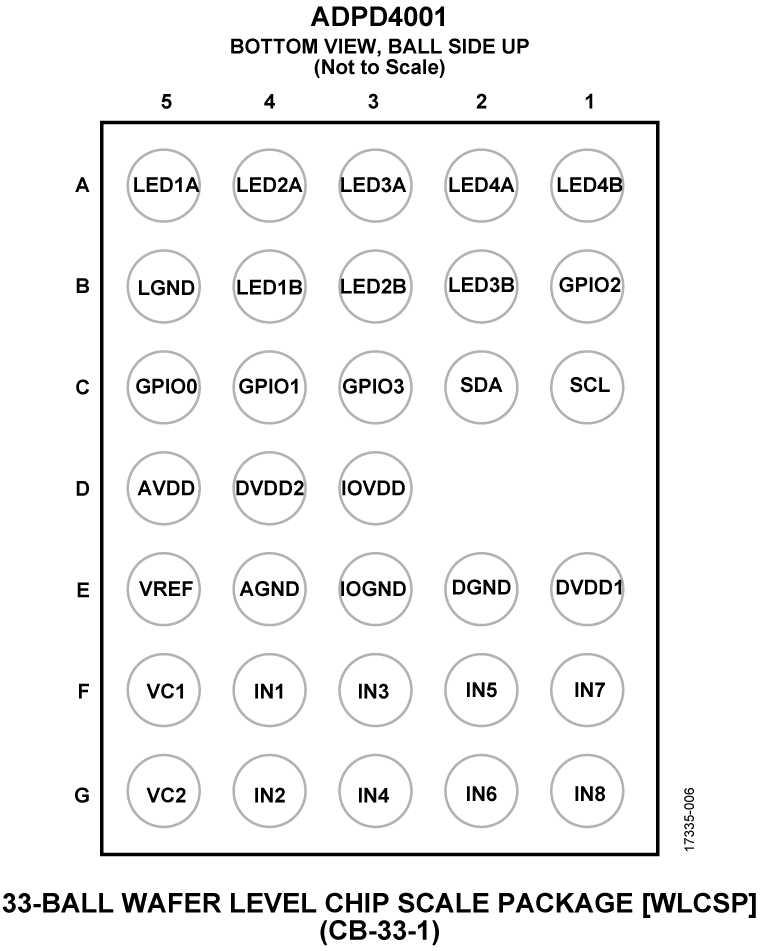
ADPD4000Multimodal Sensor Front End | Evaluation and Demonstration Boards and Kits | 2 | Active | The ADPD4000/ADPD4001operate as a complete multimodal sensor front end, stimulating up to eight LEDs and measuring the return signal on up to eight separate current inputs. Twelve time slots are available, enabling 12 separate measurements per sampling period.The data output and functional configuration utilize an I2C interface on the ADPD4001 or a serial port interface (SPI) on the ADPD4000. The control circuitry includes flexible LED signaling and synchronous detection. The devices use a 1.8 V analog core and 1.8 V/3.3 V compatible digital input/output (I/O).The analog front end (AFE) rejects signal offsets and corruption from asynchronous modulated interference, typically from ambient light, eliminating the need for optical filters or externally controlled dc cancellation circuitry. Multiple operating modes are provided, enabling the ADPD4000/ADPD4001 to be a sensor hub for synchronous measurements of photodiodes, biopotential electrodes, resistance, capacitance, and temperature sensors.The ADPD4000/ADPD4001 are available in a 3.11 mm × 2.14 mm, 0.4 mm pitch, 33-ball WLCSP and 35-ball WLCSP.For more information about the ADPD4000/ADPD4001, contact Analog Devices, Inc., atoptical_sensors@analog.com.ApplicationsWearable health and fitness monitors: heart rate monitors (HRMs), heart rate variability (HRV), stress, blood pressure estimation, SpO2, hydration, body compositionIndustrial monitoring: CO, CO2, smoke, and aerosol detectionHome patient monitoring |
ADPD4001Multimodal Sensor Front End | Integrated Circuits (ICs) | 1 | Active | TheADPD4000/ADPD4001 operate as a complete multimodal sensor front end, stimulating up to eight LEDs and measuring the return signal on up to eight separate current inputs. Twelve time slots are available, enabling 12 separate measurements per sampling period.The data output and functional configuration utilize an I2C interface on the ADPD4001 or a serial port interface (SPI) on the ADPD4000. The control circuitry includes flexible LED signaling and synchronous detection. The devices use a 1.8 V analog core and 1.8 V/3.3 V compatible digital input/output (I/O).The analog front end (AFE) rejects signal offsets and corruption from asynchronous modulated interference, typically from ambient light, eliminating the need for optical filters or externally controlled dc cancellation circuitry. Multiple operating modes are provided, enabling the ADPD4000/ADPD4001 to be a sensor hub for synchronous measurements of photodiodes, biopotential electrodes, resistance, capacitance, and temperature sensors.The ADPD4000/ADPD4001 are available in a 3.11 mm × 2.14 mm, 0.4 mm pitch, 33-ball WLCSP and 35-ball WLCSP.For more information about the ADPD4000/ADPD4001, contact Analog Devices, Inc., atoptical_sensors@analog.com.ApplicationsWearable health and fitness monitors: heart rate monitors (HRMs), heart rate variability (HRV), stress, blood pressure estimation, SpO2, hydration, body compositionIndustrial monitoring: CO, CO2, smoke, and aerosol detectionHome patient monitoring |
Standalone parts(23843)
...
| Part | Category | Description |
|---|---|---|
 Analog Devices Inc./Maxim Integrated | Development Boards Kits Programmers | EVAL BOARD HMC264LM3 |
 Analog Devices Inc./Maxim Integrated | Development Boards Kits Programmers | EVAL BOARD HMC362S8GE |
 Analog Devices Inc./Maxim Integrated | Development Boards Kits Programmers | BOARD EVAL DIVIDER HMC365 |
 Analog Devices Inc./Maxim Integrated | Development Boards Kits Programmers | EVAL BOARD HMC413QS16G |
 Analog Devices Inc./Maxim Integrated | Development Boards Kits Programmers | EVAL BOARD HMC414MS8G |
 Analog Devices Inc./Maxim Integrated | Development Boards Kits Programmers | EVAL BRD, 3.5GHZ, SPDT NON-REFLECTIVE SW ROHS COMPLIANT: YES |
 Analog Devices Inc./Maxim Integrated | Development Boards Kits Programmers | BOARD EVALUATION HMC435AMS8G |
 Analog Devices Inc./Maxim Integrated | Development Boards Kits Programmers | EVALUATION BOARD, HMC536MS8G, RF SWITCH, RF / IF |
 Analog Devices Inc./Maxim Integrated | Development Boards Kits Programmers | EVAL BOARD HMC415LP3 |
 Analog Devices Inc./Maxim Integrated | Development Boards Kits Programmers | EVAL BRD, HBT MMIC, DIVIDE-BY-2, 8GHZ ROHS COMPLIANT: YES |