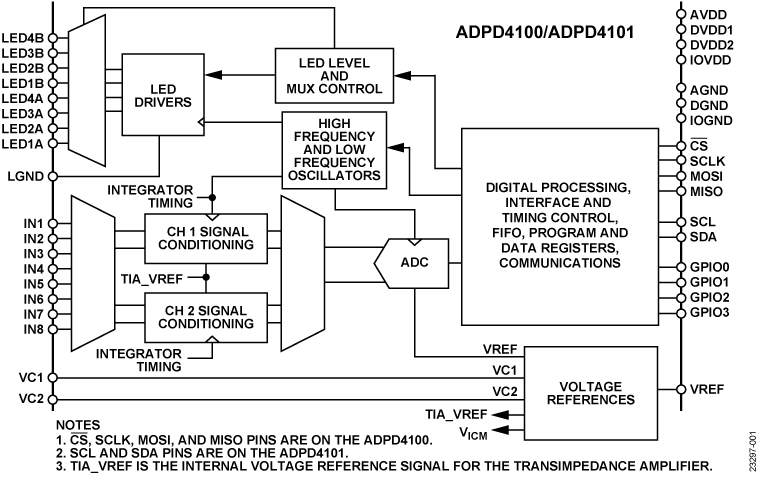
| Integrated Circuits (ICs) | 1 | Active | The ADPD4100/ADPD4101 operate as a complete multimodal sensor front end, stimulating up to eight light emitting diodes (LEDs) and measuring the return signal on up to eight separate current inputs. Twelve time slots are available, enabling 12 separate measurements per sampling period.The data output and functional configuration utilize an I2C interface on the ADPD4101 or a serial port interface (SPI) on the ADPD4100. The control circuitry includes flexible LED signaling and synchronous detection. The devices use a 1.8 V analog core and 1.8 V/3.3 V compatible digital input/output (I/O).The analog front end (AFE) rejects signal offsets and corruption from asynchronous modulated interference, typically from ambient light, eliminating the need for optical filters or externally controlled dc cancellation circuitry. Multiple operating modes are provided, enabling the ADPD4100/ADPD4101 to be a sensor hub for synchronous measurements of photodiodes, biopotential electrodes, resistance, capacitance, and temperature sensors. The multiple operation modes accommodate various sensor measurements, including, but not limited to, photoplethysmography (PPG), electrocardiography (ECG), electrodermal activity (EDA), impedance, capacitance, temperature, gas detection, smoke detection, and aerosol detection for various healthcare, industrial, and consumer applications.The ADPD4100/ADPD4101 are available in a 3.11 mm × 2.14 mm, 0.4 mm pitch, 33-ball WLCSP and 35-ball WLCSPApplicationsWearable health and fitness monitors: heart rate monitors (HRMs), heart rate variability (HRV), stress, blood pressure estimation, SpO2, hydration, body compositionIndustrial monitoring: CO, CO2, smoke, and aerosol detectionHome patient monitoring |
| Integrated Circuits (ICs) | 1 | Active | The ADPD4100/ADPD4101 operate as a complete multimodal sensor front end, stimulating up to eight light emitting diodes (LEDs) and measuring the return signal on up to eight separate current inputs. Twelve time slots are available, enabling 12 separate measurements per sampling period.The data output and functional configuration utilize an I2C interface on the ADPD4101 or a serial port interface (SPI) on the ADPD4100. The control circuitry includes flexible LED signaling and synchronous detection. The devices use a 1.8 V analog core and 1.8 V/3.3 V compatible digital input/output (I/O).The analog front end (AFE) rejects signal offsets and corruption from asynchronous modulated interference, typically from ambient light, eliminating the need for optical filters or externally controlled dc cancellation circuitry. Multiple operating modes are provided, enabling the ADPD4100/ADPD4101 to be a sensor hub for synchronous measurements of photodiodes, biopotential electrodes, resistance, capacitance, and temperature sensors. The multiple operation modes accommodate various sensor measurements, including, but not limited to, photoplethysmography (PPG), electrocardiography (ECG), electrodermal activity (EDA), impedance, capacitance, temperature, gas detection, smoke detection, and aerosol detection for various healthcare, industrial, and consumer applications.The ADPD4100/ADPD4101 are available in a 3.11 mm × 2.14 mm, 0.4 mm pitch, 33-ball WLCSP and 35-ball WLCSPApplicationsWearable health and fitness monitors: heart rate monitors (HRMs), heart rate variability (HRV), stress, blood pressure estimation, SpO2, hydration, body compositionIndustrial monitoring: CO, CO2, smoke, and aerosol detectionHome patient monitoring |
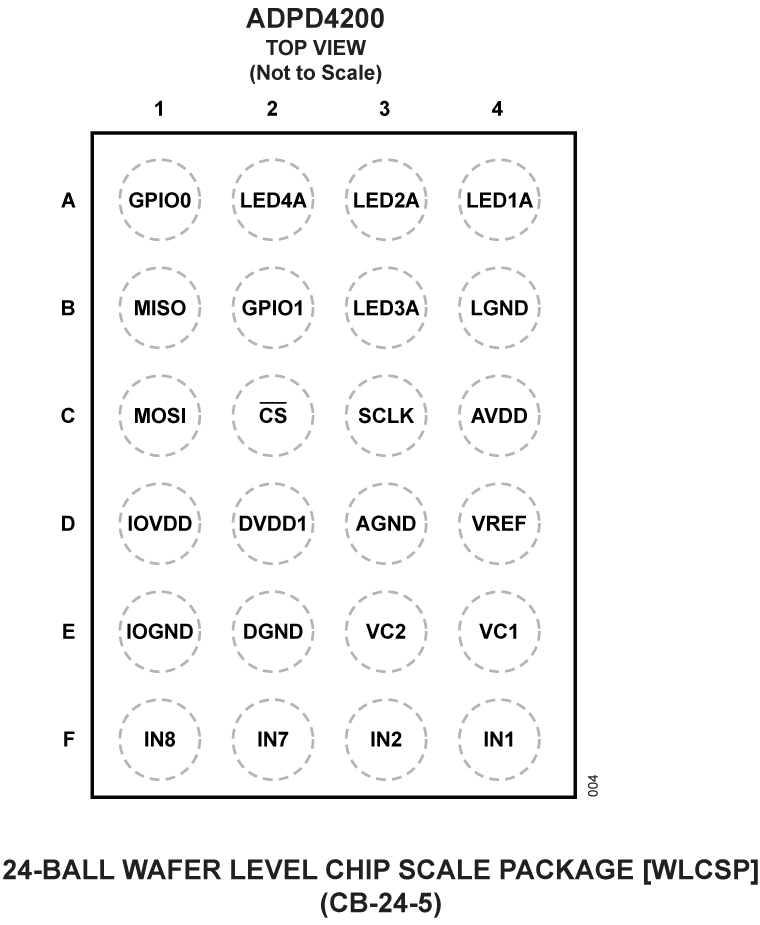
| Sensor and Detector Interfaces | 1 | Active | The ADPD4200 operates as a complete multimodal sensor front end, stimulating up to four light emitting diodes (LEDs) and measuring the return signal on up to four separate current inputs. Twelve time slots are available, enabling 12 separate measurements per sampling period.The data output and functional configuration utilize a serial port interface (SPI) on the ADPD4200. The control circuitry includes flexible LED signaling and synchronous detection. The device uses a 1.8 V analog core and 1.8 V or 3.3 V compatible digital input/output (I/O).The analog front end (AFE) rejects signal offsets and corruption from asynchronous modulated interference, typically from ambient light, eliminating the need for optical filters or externally controlled dc cancellation circuitry. Multiple operating modes are provided, enabling the ADPD4200 to be a sensor hub for synchronous measurements of photodiodes, biopotential electrodes, resistance, capacitance, and temperature sensors.The ADPD4200 is available in a 2.619 mm × 1.804 mm, 0.40 mm pitch, 24-ball WLCSP.Analog Devices is in the process of updating documentation to provide terminology and language that is culturally appropriate. This is a process with a wide scope and will be phased in as quickly as possible. Thank you for your patience.APPLICATIONSWearable health and fitness monitors: heart rate monitors (HRMs), heart rate variability (HRV), stress, blood pressure estimation, SpO2, hydration, and body compositionIndustrial monitoring: CO, CO2, smoke, and aerosol detectionHome patient monitoring |
| Analog Front End (AFE) | 1 | Active | The ADPD6000 is a highly integrated analog front end (AFE) designed for measuring various vital signals.The optical channel is designed as an optical transceiver, stimulating up to four light emitting diodes (LEDs) and measuring the return signal on up to four separate current inputs. The signal chain rejects signal offsets and corruption from asynchronous modulated interference, typically from ambient light, eliminating the need for optical filters or externally controlled dc cancellation circuitry.The electrocardiography (ECG) signal acquisition is designed to support low noise, diagnostic level measurement in the presence of a variety of interferers. The ECG signal chain has a number of complementary features supporting ECG measurement, such as driven reference for common-mode rejection and lead off detection to identify a fallen electrode.The body impedance analysis (BIA) signal chain is designed for body impedance measurement with a configurable excitation path and measurement path. A 12-bit digital-to-analog (DAC) is used in the excitation path to generate the sinusoid wave and high precision measurement, with configurable filters used to measure the body response of the stimulus.The data output and functional configuration use a serial port interface (SPI) on the ADPD6000. The control circuitry includes flexible LED signaling and synchronous detection, digital filters, digital wave generators, and configurable filters.The ADPD6000 is available in a 2.6 mm × 2.6 mm, 0.4 mm pitch, 36-ball wafer level chip scale package (WLCSP).APPLICATIONSWearable health and fitness monitors: heart rate, heart rate variability, SpO2, body impedance analysis, hydration, cuffless noninvasive blood pressureHome patient monitoringIndustrial monitoring: particle and aerosol, gas, and conductivity detection |
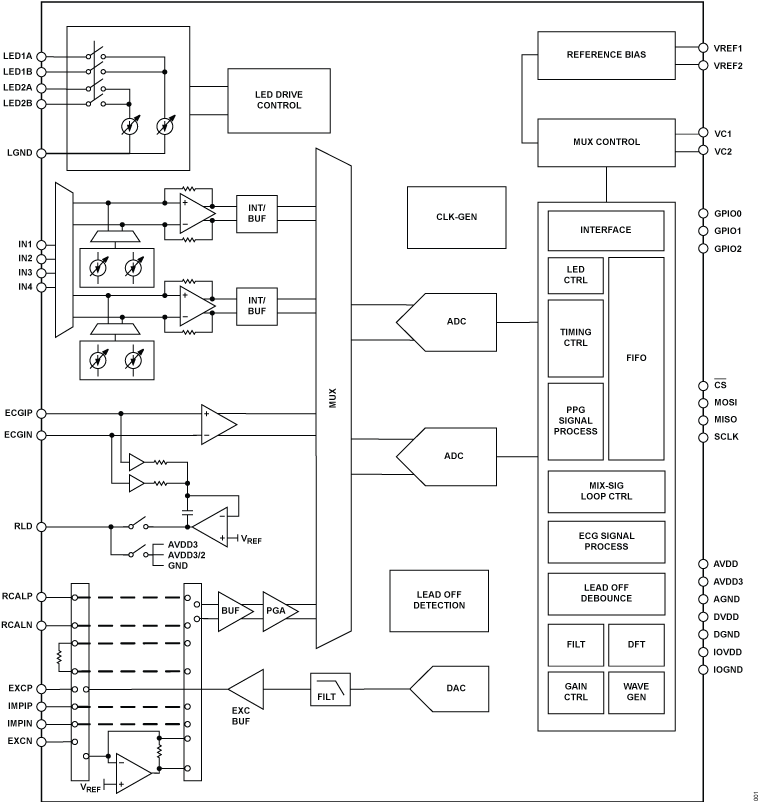
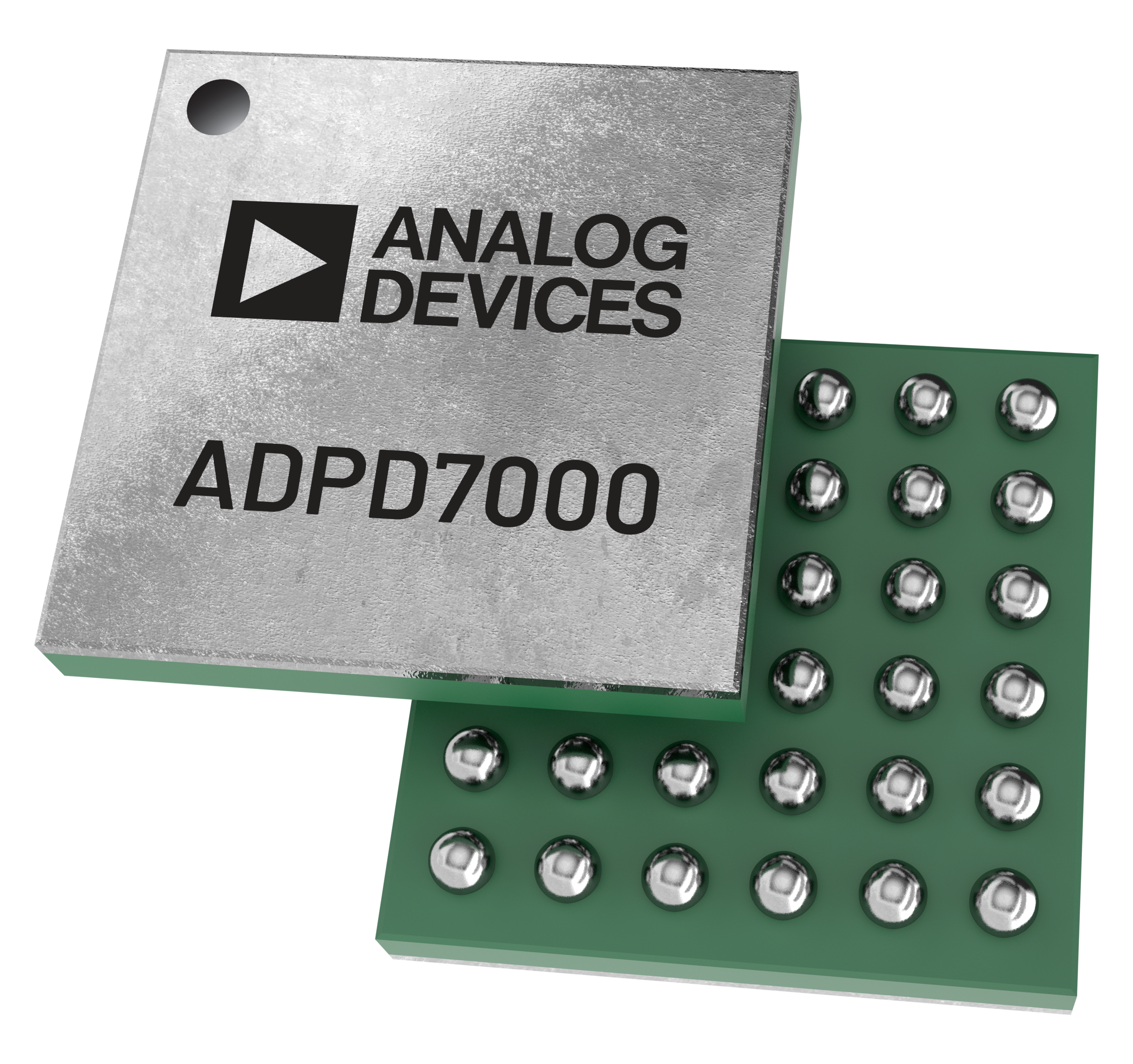
| Integrated Circuits (ICs) | 1 | Active | The ADPD7000 is a highly integrated analog front end (AFE) designed for measuring various vital signals.The optical channel is designed as an optical transceiver, stimulating up to eight light emitting diodes (LEDs) and measuring the return signal on up to four separate current inputs. The signal chain rejects signal offsets and corruption from asynchronous modulated interference, typically from ambient light, eliminating the need for optical filters or externally controlled DC cancellation circuitry.The electrocardiography (ECG) signal acquisition is designed to support low noise, diagnostic level measurement in the presence of a variety of interferers. The ECG signal chain has a number of complementary features supporting ECG measurement, such as driven reference for common-mode rejection and lead off detection to identify a fallen electrode.The body impedance analysis (BIA) signal chain is designed for body impedance measurement with a configurable excitation path and measurement path. A 12-bit digital-to-analog converter (DAC) is used in the excitation path to generate the sinusoid wave and high precision measurement, with configurable filters used to measure the body response of the stimulus.The electrodermal activity (EDA) signal chain is designed for electrodermal activity. By multiplexing BIA and ECG peripheral circuits, the ADPD7000 supports high precision AC and DC measurement with 1 nS resolution.The data output and functional configuration use a serial port interface (SPI) on the ADPD7000. The control circuitry includes flexible LED signaling and synchronous detection, digital filters, digital wave generators, and configurable filters.The ADPD7000 is available in a 2.795 mm × 2.560 mm, 0.40 mm pitch, 36-ball WLCSP.APPLICATIONSWearable health and fitness monitors: heart rate, heart rate variability, saturation level of pulse oxygen, body impedance analysis, hydration analysis, and cuff-less noninvasive blood pressureClinical patient monitors: small bed-side patient, home portable patient, and small remote patientIndustrial monitoring: particle, aerosol, and gas detectionConductivity detection |
| Evaluation and Demonstration Boards and Kits | 1 | Active | |
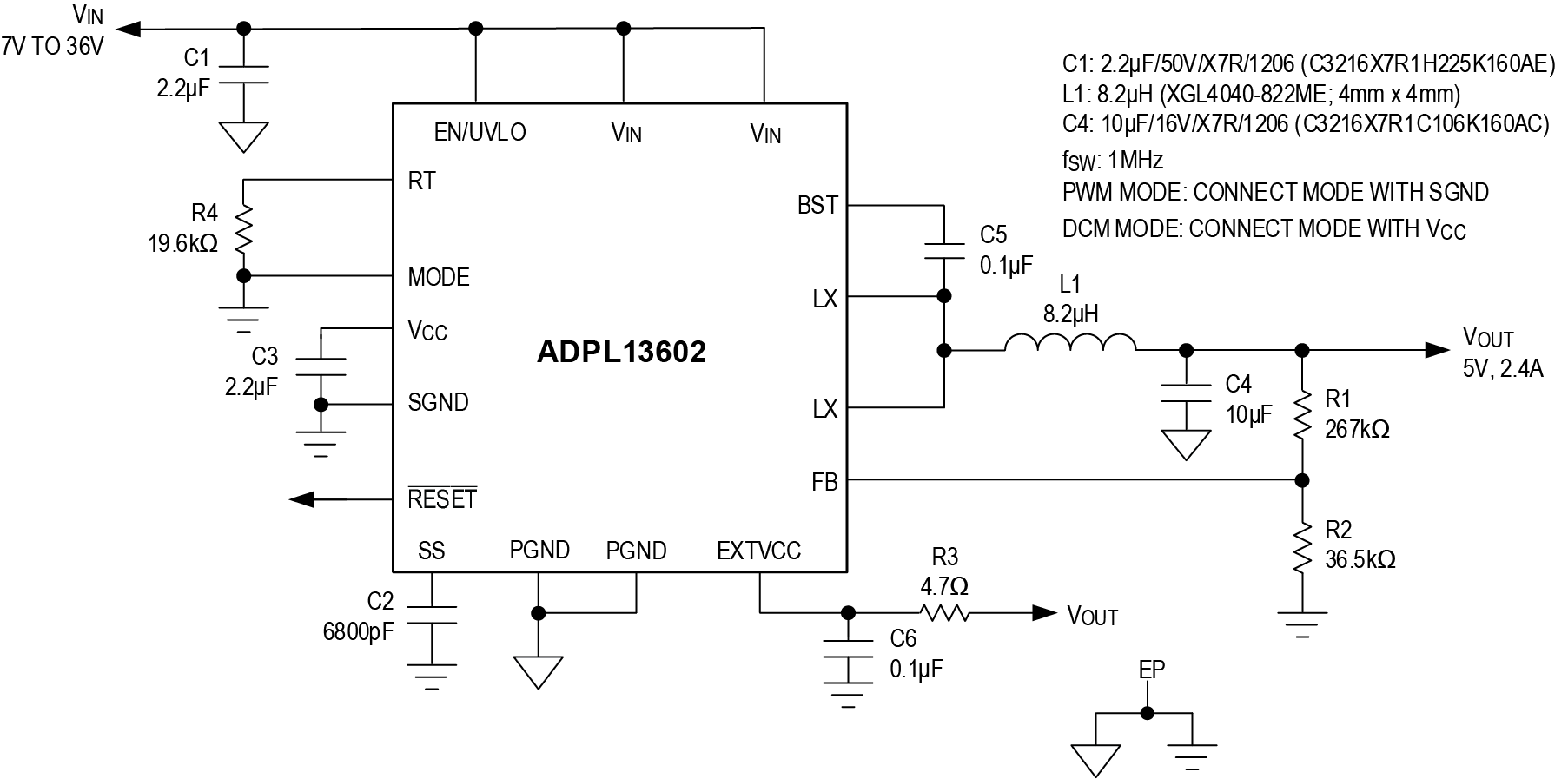
ADPL136023.5V to 36V, 2.4A, High-Efficiency, Synchronous Step-Down DC-DC Converter | Power Management (PMIC) | 2 | Active | The ADPL13602 is a high-efficiency, synchronous stepdown DC-DC converter with integrated MOSFETs operating over an input-voltage range of 3.5V to 36V. It can deliver up to 2.4A current. Output voltage is programmable from 1V up to 90% of VIN. Built-in compensation across the output-voltage range eliminates the need for external compensation components.The ADPL13602 features a peak-current-mode control architecture. The ADPL13602 can be operated in forced pulse-width modulation (PWM) or discontinuousconduction mode (DCM) to enable high efficiency under full-load and light-load conditions. The ADPL13602 offers a low minimum on-time that allows high switching frequencies and a smaller solution size.The feedback-voltage regulation accuracy over -40°C to +125°C is ±1.5%. The device is available in a 16-pin (3mm x 3mm) TQFN-EP package. Simulation models are available.APPLICATIONSIndustrial Control Power Supplies Distributed Supply Regulation Wall Transformer Regulation High-Voltage, Single-Board Systems |
| DC/DC & AC/DC (Off-Line) SMPS Evaluation Boards | 5 | Active | |
| Voltage Regulators - DC DC Switching Regulators | 3 | Active | |
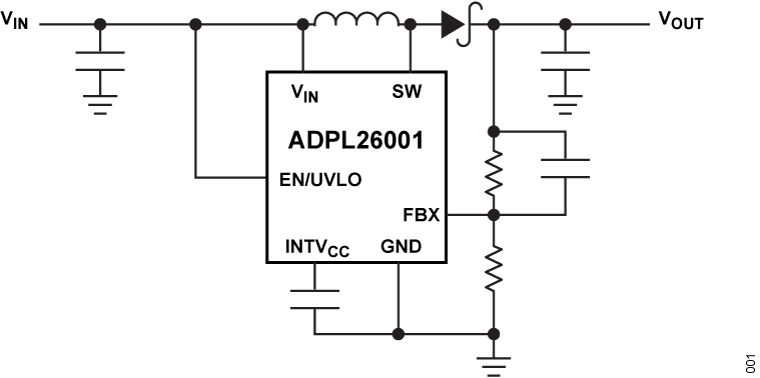
ADPL26001Low-IQBoost/SEPIC/ Inverting Converter with 1A, 60V Switch | Voltage Regulators - DC DC Switching Regulators | 2 | Active | The ADPL26001 is a current-mode DC/DC converter capable of generating either positive or negative output voltages using a single feedback pin. It can be configured as a boost, single-ended primary inductance converter (SEPIC), or inverting converter consuming as low as 6μA of quiescent current. Low ripple Burst Mode operation maintains high efficiency down to very low output currents while keeping the output ripple below 15mV in a typical application. The internally compensated current-mode architecture results in stable operation over a wide range of input and output voltages. Integrated soft-start and frequency foldback functions are included to control inductor current during start-up. The ADPL26001 comes in small package options that combined with a high switching frequency of 2MHz, helps to maintain a small footprint for an overall efficient, space-saving and cost-effective solution.APPLICATIONSIndustrialTelecomMedical Diagnostic EquipmentPortable Electronics |