A
Analog Devices Inc./Maxim Integrated
| Series | Category | # Parts | Status | Description |
|---|---|---|---|---|
| Part | Spec A | Spec B | Spec C | Spec D | Description |
|---|---|---|---|---|---|



| Series | Category | # Parts | Status | Description |
|---|---|---|---|---|
| Part | Spec A | Spec B | Spec C | Spec D | Description |
|---|---|---|---|---|---|
| Part | Category | Description |
|---|---|---|
 Analog Devices Inc./Maxim Integrated LTC1879EGN#TRUnknown | Integrated Circuits (ICs) | IC REG BUCK ADJ 1.2A 16SSOP |
 Analog Devices Inc./Maxim Integrated LTC2208CUP#TRUnknown | Integrated Circuits (ICs) | IC ADC 16BIT 130MSPS 64-QFN |
 Analog Devices Inc./Maxim Integrated ADP2108ACBZ-1.1-R7Obsolete | Integrated Circuits (ICs) | IC REG BUCK 1.1V 600MA 5WLCSP |
 Analog Devices Inc./Maxim Integrated EV1HMC832ALP6GObsolete | Development Boards Kits Programmers | EVAL BOARD FOR HMC832ALP6GE |
 Analog Devices Inc./Maxim Integrated LTC488ISWUnknown | Integrated Circuits (ICs) | IC LINE RCVR RS485 QUAD 16-SOIC |
 Analog Devices Inc./Maxim Integrated LTC6946IUFD-2Obsolete | Integrated Circuits (ICs) | IC CLK/FREQ SYNTH 28QFN |
 Analog Devices Inc./Maxim Integrated MAX5556ESA+TObsolete | Integrated Circuits (ICs) | IC DAC/AUDIO 16BIT 50K 8SOIC |
 Analog Devices Inc./Maxim Integrated EVAL-FLTR-LD-1RZUnknown | Unclassified | EVAL BRD FOR AD800 SERIES |
 Analog Devices Inc./Maxim Integrated | Development Boards Kits Programmers | BOARD EVAL FOR AD9963 |
 Analog Devices Inc./Maxim Integrated LTC1296CCSW#TRUnknown | Integrated Circuits (ICs) | IC DATA ACQ SYS 12BIT 5V 20SOIC |
| Series | Category | # Parts | Status | Description |
|---|---|---|---|---|
| Evaluation Boards | 1 | Active | ||
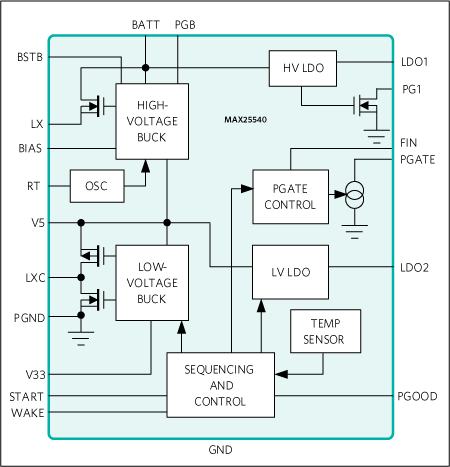
MAX25540Automotive 4-Output Display Power Solution | Integrated Circuits (ICs) | 2 | Active | The MAX25540 is a 4-channel power-management IC designed to accommodate the main rails used in modern automotive TFT displays. The IC supports the power requirement of GMSL parts. The MAX25540 and the MAX25530 TFT power supply and LED backlight driver combine to provide a two-chip solution to automotive display power supply requirements.The MAX25540 integrates a high-voltage buck converter that transforms battery voltages into a 3.3V intermediate rail. In addition, a high-voltage, always-on, low-quiescent-current linear regulator supplies power at 3.3V.The low-voltage section consists of a fully-integrated DC/DC converter and an LDO running off the intermediate rail. The low-voltage DC/DC converter provides 1V, while the LDO produces 1.8V.A single START control pin initiates the start-up sequence, thereby simplifying device control. The MAX25540's external pMOSFET control block allows battery voltage to be switched to a downstream device, such as a backlight boost converter.The MAX25540 is available in a TQFN package and operates in the -40°C to 105°C temperature range.ApplicationsCentral Information DisplaysInfotainment DisplaysInstrument Clusters |
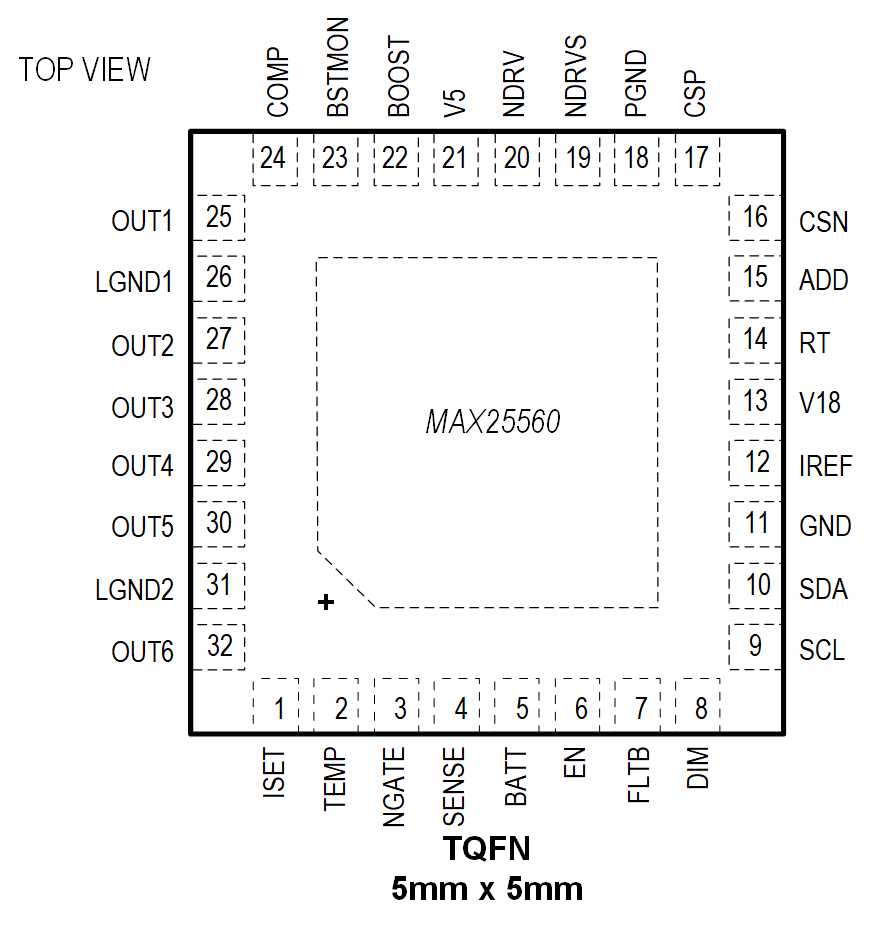
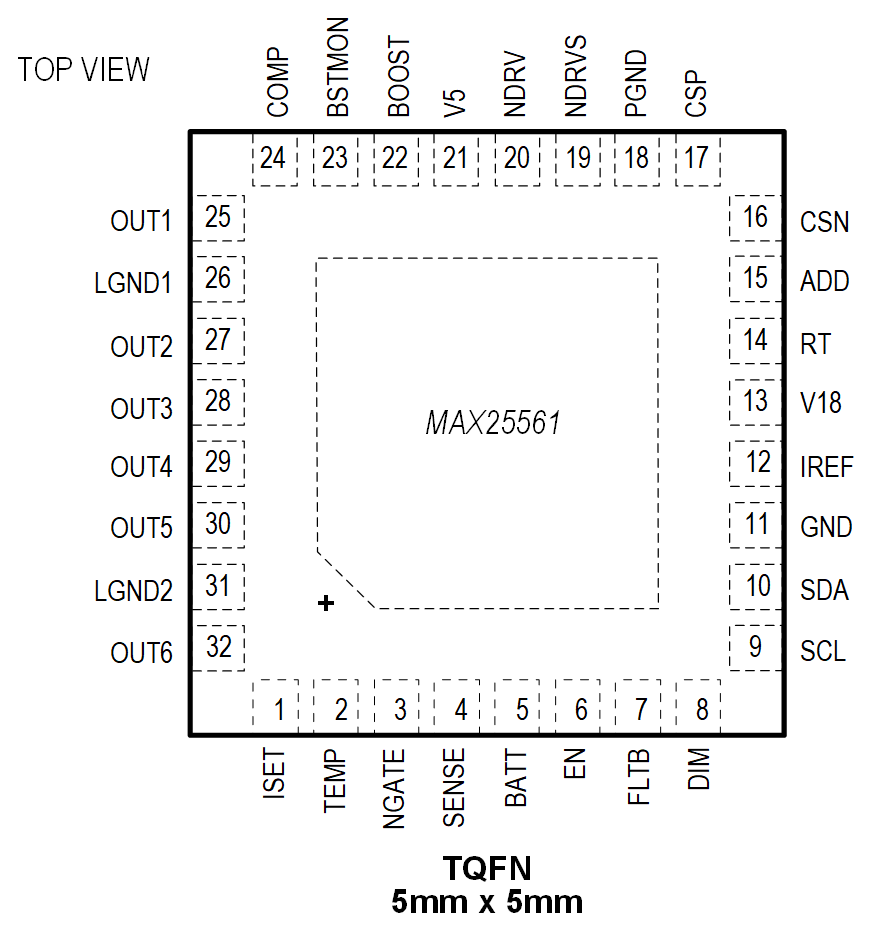
MAX255606 x 220mA LED Backlight Driver with Boost Controller | Power Management (PMIC) | 2 | Active | The MAX25560 is a six-channel LED backlight driver with an integrated current-mode boost controller that operates over a switching frequency range of 400kHz to 2.2MHz and incorporates spread spectrum. Selectable phase-shifting of the output channels is included to reduce EMI. The MAX25560 provides up to 220mA per channel. The device is capable of operating down to very low battery voltages by virtue of a unique input voltage switching scheme.Extensive diagnostics and an I2C interface are included in the device.The MAX25560 is available in a compact TQFN package and operates over the -40°C to +125°C temperature range.ApplicationsAutomotive Instrument ClustersAutomotive Central Information DisplaysAutomotive Head-Up Displays |
| LED Drivers | 5 | Active | ||
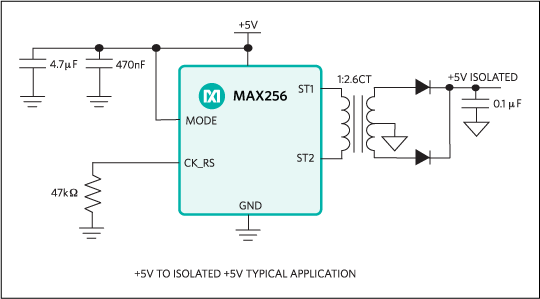
MAX2563W Primary-Side Transformer H-Bridge Driver for Isolated Supplies | DC/DC & AC/DC (Off-Line) SMPS Evaluation Boards | 5 | Active | The MAX256 is an integrated primary-side controller and H-bridge driver for isolated power-supply circuits. The device contains an on-board oscillator, protection circuitry and internal FET drivers to provide up to 3W of power to the primary winding of a transformer. The MAX256 can be operated using the internal programmable oscillator or can be driven by an external clock for improved EMI performance. Regardless of the clock source being used, an internal flip-flop stage guarantees a fixed 50% duty cycle to prevent DC current flow in the transformer.The MAX256 operates from a single-supply voltage of +5V or +3.3V, and includes undervoltage lockout for controlled startup. The device prevents cross-conduction of the H-bridge MOSFETs by implementing break-before-make switching. Thermal shutdown circuitry provides additional protection against damage due to overtemperature conditions.The MAX256 is available in the 8-pin thermally-enhanced SO package. The device is specified for the automotive(-40°Cto +125°C) temperature range.ApplicationsIndustrial Process ControlIsolated Communications LinksIsolated Power SuppliesMedical EquipmentTelecommunications |
| LED Drivers | 5 | Active | ||
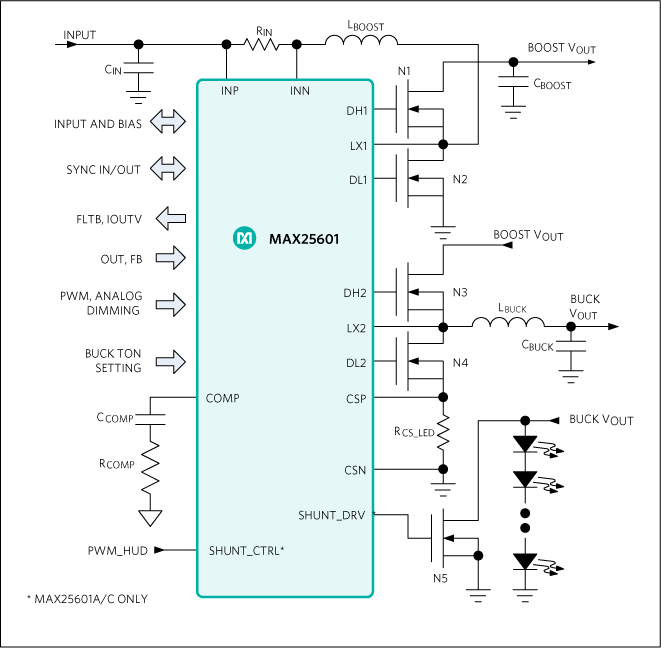
MAX25601Synchronous Boost and Synchronous Buck LED Controllers | Integrated Circuits (ICs) | 14 | Active | The MAX25601A/B/C/D is a synchronous boost controller followed by a synchronous buck LED controller. The 4.5V to 40V input voltage range of the boost controller is ideal for automotive applications, and acts as a pre-boost power supply for the second-stage buck LED controller.The synchronous boost is a current-mode controller that can be be paralleled with another device to provide higher output power. A SYNCOUT pin provides the clock to drive the RT/SYNCIN pin of the other device, enabling two-phase 180-degree out-of-phase operation. The boost converter can be programmed with a switching frequency of 200kHz to 2.2MHz. Spread spectrum is included to reduce EMI. An internal digital soft-start feature is provided to enable a smooth power up of the boost output. Protection features like hiccup mode, overvoltage protection, and thermal shutdown are provided.The synchronous buck LED controller uses Maxim's F3 Architecture, a proprietary average-current-mode control scheme to regulate the inductor current at a constant switching frequency without any control-loop compensation. Inductor current is sensed in the bottom synchronous n-channel MOSFET. The device operates over a wide 4.5V to 65V input range at switching frequencies as high as 1MHz. Both analog and PWM dimming are included. LED current can be monitored on the IOUTV pin.Both controllers have high- and low-side gate drivers with at least 1A peak source and sink-current capability. Adaptive non-overlap control logic prevents shoot-through currents during transition. Both the boost and the buck faults are monitored on the active-low FLT pin.The MAX25601A/C is available in a 32-pin SWTQFN package and the MAX25601B/D is available in a 28-pin TSSOP package. The 32-pin package features an additional switch control that can be used in high-beam/low-beam and heads-up display applications.ApplicationsAutomotive Exterior Lighting: High-Beam/Low-Beam/ Signal/Position Lights, Daytime Running Lights (DRLs), Matrix Light, Pixel Light, and Other Adaptive Front-Light AssembliesCommercial, Industrial, and Architectural Lighting |
MAX25601CSynchronous Boost and Synchronous Buck LED Controllers | LED Drivers | 1 | Active | The MAX25601A/B/C/D is a synchronous boost controller followed by a synchronous buck LED controller. The 4.5V to 40V input voltage range of the boost controller is ideal for automotive applications, and acts as a pre-boost power supply for the second-stage buck LED controller.The synchronous boost is a current-mode controller that can be be paralleled with another device to provide higher output power. A SYNCOUT pin provides the clock to drive the RT/SYNCIN pin of the other device, enabling two-phase 180-degree out-of-phase operation. The boost converter can be programmed with a switching frequency of 200kHz to 2.2MHz. Spread spectrum is included to reduce EMI. An internal digital soft-start feature is provided to enable a smooth power up of the boost output. Protection features like hiccup mode, overvoltage protection, and thermal shutdown are provided.The synchronous buck LED controller uses Maxim's F3 Architecture, a proprietary average-current-mode control scheme to regulate the inductor current at a constant switching frequency without any control-loop compensation. Inductor current is sensed in the bottom synchronous n-channel MOSFET. The device operates over a wide 4.5V to 65V input range at switching frequencies as high as 1MHz. Both analog and PWM dimming are included. LED current can be monitored on the IOUTV pin.Both controllers have high- and low-side gate drivers with at least 1A peak source and sink-current capability. Adaptive non-overlap control logic prevents shoot-through currents during transition. Both the boost and the buck faults are monitored on the active-low FLT pin.The MAX25601A/C is available in a 32-pin SWTQFN package and the MAX25601B/D is available in a 28-pin TSSOP package. The 32-pin package features an additional switch control that can be used in high-beam/low-beam and heads-up display applications.ApplicationsAutomotive Exterior Lighting: High-Beam/Low-Beam/ Signal/Position Lights, Daytime Running Lights (DRLs), Matrix Light, Pixel Light, and Other Adaptive Front-Light AssembliesCommercial, Industrial, and Architectural Lighting |
MAX25601DSynchronous Boost and Synchronous Buck LED Controllers | Integrated Circuits (ICs) | 1 | Active | The MAX25601A/B/C/D is a synchronous boost controller followed by a synchronous buck LED controller. The 4.5V to 40V input voltage range of the boost controller is ideal for automotive applications, and acts as a pre-boost power supply for the second-stage buck LED controller.The synchronous boost is a current-mode controller that can be be paralleled with another device to provide higher output power. A SYNCOUT pin provides the clock to drive the RT/SYNCIN pin of the other device, enabling two-phase 180-degree out-of-phase operation. The boost converter can be programmed with a switching frequency of 200kHz to 2.2MHz. Spread spectrum is included to reduce EMI. An internal digital soft-start feature is provided to enable a smooth power up of the boost output. Protection features like hiccup mode, overvoltage protection, and thermal shutdown are provided.The synchronous buck LED controller uses Maxim's F3 Architecture, a proprietary average-current-mode control scheme to regulate the inductor current at a constant switching frequency without any control-loop compensation. Inductor current is sensed in the bottom synchronous n-channel MOSFET. The device operates over a wide 4.5V to 65V input range at switching frequencies as high as 1MHz. Both analog and PWM dimming are included. LED current can be monitored on the IOUTV pin.Both controllers have high- and low-side gate drivers with at least 1A peak source and sink-current capability. Adaptive non-overlap control logic prevents shoot-through currents during transition. Both the boost and the buck faults are monitored on the active-low FLT pin.The MAX25601A/C is available in a 32-pin SWTQFN package and the MAX25601B/D is available in a 28-pin TSSOP package. The 32-pin package features an additional switch control that can be used in high-beam/low-beam and heads-up display applications.ApplicationsAutomotive Exterior Lighting: High-Beam/Low-Beam/ Signal/Position Lights, Daytime Running Lights (DRLs), Matrix Light, Pixel Light, and Other Adaptive Front-Light AssembliesCommercial, Industrial, and Architectural Lighting |
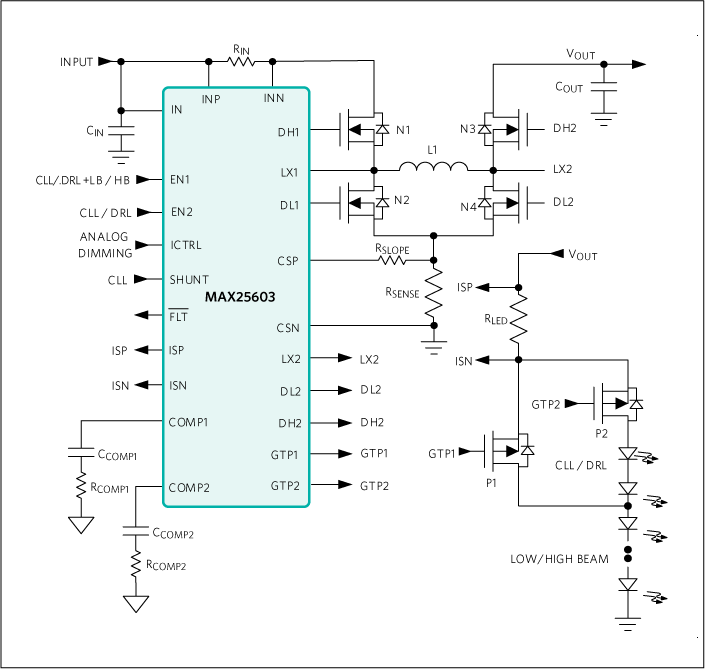
MAX25603Automotive Four-Switch Buck-Boost LED Controller for Combination Head Lights | Integrated Circuits (ICs) | 2 | Active | The MAX25603 is a synchronous four-switch, buckboost LED driver controller suitable for multifunction automotive combination head lamps. The controller regulates the LED current for LED string voltages from 0V to 60V. The MAX25603 can be used as a seamless buck-boost LED driver for applications that require an efficient buck-boost LED driver with synchronous rectification. The MAX25603 is ideal for high-power applications that require a current source with PWM dimming capability.The device provides seamless transition between buck, boost, and buck-boost modes depending on the ratio of input to output voltage. The MAX25603 is ideal for LED driver applications in automotive, industrial, and other LED lighting applications. A fault flag indicates open LED or thermal shutdown conditions. The device uses Analog Devices’ proprietary average-current-mode control scheme and allows adjustable 200kHz to 440kHz fixedfrequency operation. In addition, ±6% triangular spreadspectrum is added internally to the oscillator to improve EMI performance. The MAX25603 provides both analog and digital PWM dimming in dual string applications with time sharing. A single device can be used to power a daytime running light (DRL), position light, high beam, and low beam in an automotive front headlamp. The MAX25603 integrates two high-side pMOS drivers for PWM dimming applications that require fast rising and falling edges of the LED current. It also features robust output open and short protection, is AEC qualified, and is suitable for automotive applications.The MAX25603 uses Analog Devices’ proprietary architecture to limit LED current overshoots and overshoot durations during switchover in dual-string applications in time-sharing mode. In multistring applications in time-sharing mode, LED current overshoots during switchover between strings is minimized by an Analog Devices’ proprietary control scheme.ApplicationsCombination Automotive Head Lamps |