| RF and Wireless | 1 | Active | |
| RFID Reader Modules | 8 | Active | |
| RF and Wireless | 3 | Obsolete | |
| RFID Transponders, Tags | 1 | Active | TI 32-mm glass transponders provide superior performance and operate at a resonance frequency of 134.2 kHz. Specific products are compliant to ISO 11784 and ISO 11785 global open standards. TI LF transponders are manufactured with TI’s patented tuning process to provide consistent read and write performance. Before delivery, the transponders undergo complete functional and parametric testing to provide the high quality that customers have come to expect from TI. The transponder is well suited for use in a broad range of applications including, but not limited to, access control, vehicle identification, container tracking, asset management, and waste management applications.
TI 32-mm glass transponders provide superior performance and operate at a resonance frequency of 134.2 kHz. Specific products are compliant to ISO 11784 and ISO 11785 global open standards. TI LF transponders are manufactured with TI’s patented tuning process to provide consistent read and write performance. Before delivery, the transponders undergo complete functional and parametric testing to provide the high quality that customers have come to expect from TI. The transponder is well suited for use in a broad range of applications including, but not limited to, access control, vehicle identification, container tracking, asset management, and waste management applications. |
| Uncategorized | 33 | Obsolete | Texas Instruments’ 30 mm disk transponder provides superior performance and operates at a resonance frequency of 134.2 kHz. Specific products are compliant to ISO/IEC 11784/11785 global open standards. Texas Instruments LF transponders are manufactured with TI’'s patented tuning process to provide consistent read and write performance. Prior to delivery, the transponders undergo complete functional and parametric testing, in order to provide the high quality customers have come to expect from TI. The transponder is well suited for usage in a broad range of applications including, but not limited to, access control, vehicle identification, container tracking, asset management and waste management applications.
Texas Instruments’ 30 mm disk transponder provides superior performance and operates at a resonance frequency of 134.2 kHz. Specific products are compliant to ISO/IEC 11784/11785 global open standards. Texas Instruments LF transponders are manufactured with TI’'s patented tuning process to provide consistent read and write performance. Prior to delivery, the transponders undergo complete functional and parametric testing, in order to provide the high quality customers have come to expect from TI. The transponder is well suited for usage in a broad range of applications including, but not limited to, access control, vehicle identification, container tracking, asset management and waste management applications. |
| RFID, RF Access, Monitoring ICs | 4 | Obsolete | |
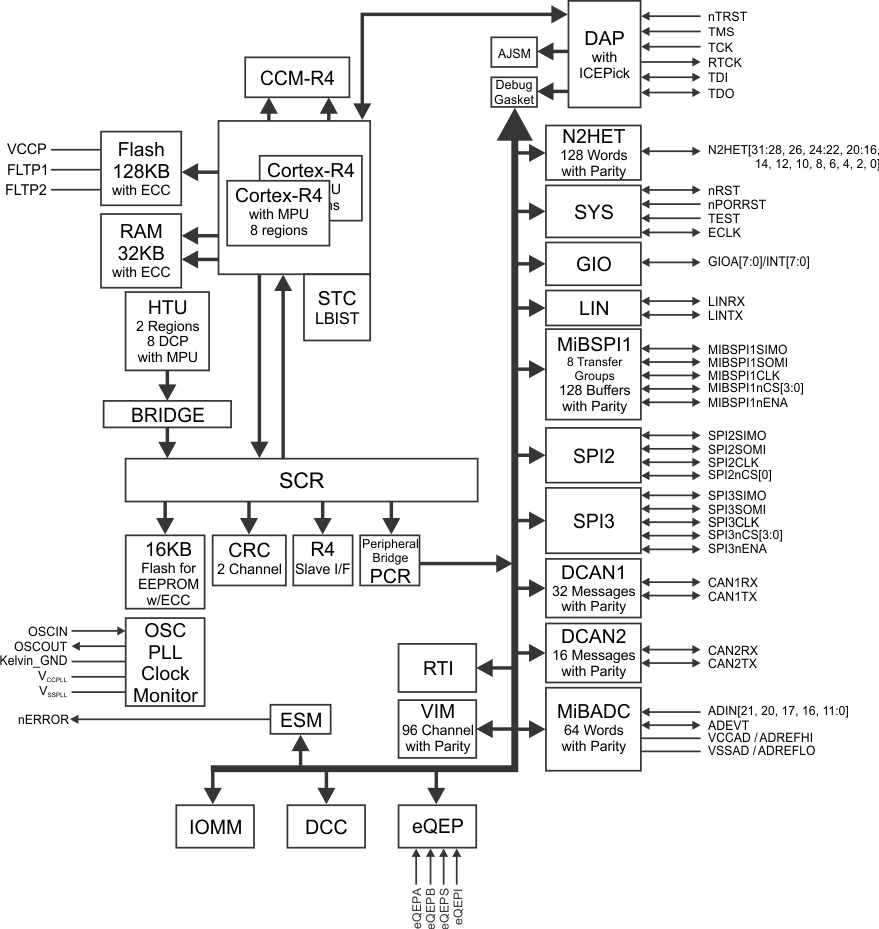
RM41L23216/32 Bit RISC Flash MCU, Arm Cortex-R4F | Integrated Circuits (ICs) | 1 | Active | The RM41L232 device is a high-performance microcontroller for safety systems. The safety architecture includes dual CPUs in lockstep, CPU and Memory BIST logic, ECC on both the flash and the data SRAM, parity on peripheral memories, and loopback capability on peripheral I/Os.
The RM41L232 device integrates the ARM Cortex-R4 CPU. The CPU offers an efficient 1.66 DMIPS/MHz, and has configurations that can run up to 80 MHz, providing up to 132 DMIPS. The device operates in little-endian (LE) mode.
The RM41L232 device has 128KB of integrated flash and 32KB of data RAM. Both the flash and RAM have single-bit error correction and double-bit error detection. The flash memory on this device is a nonvolatile, electrically erasable, and programmable memory implemented with a 64-bit-wide data bus interface. The flash operates on a 3.3-V supply input (the same level as I/O supply) for all read, program, and erase operations. When in pipeline mode, the flash operates with a system clock frequency of 80 MHz. The SRAM supports single-cycle read and write accesses in byte, halfword, word, and double-word modes throughout the supported frequency range.
The RM41L232 device features peripherals for real-time control-based applications, including a Next Generation High-End Timer (N2HET) timing coprocessor with up to 19 I/O terminals and a 12-bit Analog-to-Digital Converter (ADC) supporting 16 inputs in the 100-pin package.
The N2HET is an advanced intelligent timer that provides sophisticated timing functions for real-time applications. The timer is software-controlled, using a small instruction set, with a specialized timer micromachine and an attached I/O port. The N2HET can be used for pulse-width-modulated outputs, capture or compare inputs, or GPIO. The N2HET is especially well suited for applications requiring multiple sensor information and drive actuators with complex and accurate time pulses. A High-End Timer Transfer Unit (HTU) can perform DMA-type transactions to transfer N2HET data to or from main memory. A Memory Protection Unit (MPU) is built into the HTU.
The Enhanced Quadrature Encoder Pulse (eQEP) module is used for direct interface with a linear or rotary incremental encoder to get position, direction, and speed information from a rotating machine as used in high-performance motion and position-control systems.
The device has a 12-bit-resolution MibADC with 16 channels and 64 words of parity-protected buffer RAM. The MibADC channels can be converted individually or can be grouped by software for sequential conversion sequences. There are three separate groupings. Each sequence can be converted once when triggered or configured for continuous conversion mode. The MibADC has a 10-bit mode for use when compatibility with older devices or faster conversion time is desired.
The device has multiple communication interfaces: one MibSPI, two SPIs, one UART/LIN, and two DCANs. The SPI provides a convenient method of serial high-speed communications between similar shift-register type devices. The UART/LIN supports the Local Interconnect standard 2.1 and can be used as a UART in full-duplex mode using the standard Non-Return-to-Zero (NRZ) format. The DCAN supports the CAN 2.0 (A and B) protocol standard and uses a serial, multimaster communication protocol that efficiently supports distributed real-time control with robust communication rates of up to 1 Mbps. The DCAN is ideal for applications operating in noisy and harsh environments (for example, automotive and industrial applications) that require reliable serial communication or multiplexed wiring.
The Frequency-Modulated Phase-Locked Loop (FMPLL) clock module is used to multiply the external frequency reference to a higher frequency for internal use. The FMPLL provides one of the five possible clock source inputs to the Global Clock Module (GCM). The GCM manages the mapping between the available clock sources and the device clock domains.
The device also has an External Clock Prescaler (ECP) module that when enabled, outputs a continuous external clock on the ECLK pin. The ECLK frequency is a user-programmable ratio of the peripheral interface clock (VCLK) frequency. This low-frequency output can be monitored externally as an indicator of the device operating frequency.
The Error Signaling Module (ESM) monitors all device errors and determines whether an interrupt is generated or the external nERROR pin is toggled when a fault is detected. The nERROR pin can be monitored externally as an indicator of a fault condition in the microcontroller.
The I/O Multiplexing and Control Module (IOMM) allows the configuration of the input/output pins to support alternate functions. See for a list of the pins that support multiple functions on this device.
With integrated safety features and a wide choice of communication and control peripherals, the RM41L232 device is an ideal solution for real-time control applications with safety-critical
The RM41L232 device is a high-performance microcontroller for safety systems. The safety architecture includes dual CPUs in lockstep, CPU and Memory BIST logic, ECC on both the flash and the data SRAM, parity on peripheral memories, and loopback capability on peripheral I/Os.
The RM41L232 device integrates the ARM Cortex-R4 CPU. The CPU offers an efficient 1.66 DMIPS/MHz, and has configurations that can run up to 80 MHz, providing up to 132 DMIPS. The device operates in little-endian (LE) mode.
The RM41L232 device has 128KB of integrated flash and 32KB of data RAM. Both the flash and RAM have single-bit error correction and double-bit error detection. The flash memory on this device is a nonvolatile, electrically erasable, and programmable memory implemented with a 64-bit-wide data bus interface. The flash operates on a 3.3-V supply input (the same level as I/O supply) for all read, program, and erase operations. When in pipeline mode, the flash operates with a system clock frequency of 80 MHz. The SRAM supports single-cycle read and write accesses in byte, halfword, word, and double-word modes throughout the supported frequency range.
The RM41L232 device features peripherals for real-time control-based applications, including a Next Generation High-End Timer (N2HET) timing coprocessor with up to 19 I/O terminals and a 12-bit Analog-to-Digital Converter (ADC) supporting 16 inputs in the 100-pin package.
The N2HET is an advanced intelligent timer that provides sophisticated timing functions for real-time applications. The timer is software-controlled, using a small instruction set, with a specialized timer micromachine and an attached I/O port. The N2HET can be used for pulse-width-modulated outputs, capture or compare inputs, or GPIO. The N2HET is especially well suited for applications requiring multiple sensor information and drive actuators with complex and accurate time pulses. A High-End Timer Transfer Unit (HTU) can perform DMA-type transactions to transfer N2HET data to or from main memory. A Memory Protection Unit (MPU) is built into the HTU.
The Enhanced Quadrature Encoder Pulse (eQEP) module is used for direct interface with a linear or rotary incremental encoder to get position, direction, and speed information from a rotating machine as used in high-performance motion and position-control systems.
The device has a 12-bit-resolution MibADC with 16 channels and 64 words of parity-protected buffer RAM. The MibADC channels can be converted individually or can be grouped by software for sequential conversion sequences. There are three separate groupings. Each sequence can be converted once when triggered or configured for continuous conversion mode. The MibADC has a 10-bit mode for use when compatibility with older devices or faster conversion time is desired.
The device has multiple communication interfaces: one MibSPI, two SPIs, one UART/LIN, and two DCANs. The SPI provides a convenient method of serial high-speed communications between similar shift-register type devices. The UART/LIN supports the Local Interconnect standard 2.1 and can be used as a UART in full-duplex mode using the standard Non-Return-to-Zero (NRZ) format. The DCAN supports the CAN 2.0 (A and B) protocol standard and uses a serial, multimaster communication protocol that efficiently supports distributed real-time control with robust communication rates of up to 1 Mbps. The DCAN is ideal for applications operating in noisy and harsh environments (for example, automotive and industrial applications) that require reliable serial communication or multiplexed wiring.
The Frequency-Modulated Phase-Locked Loop (FMPLL) clock module is used to multiply the external frequency reference to a higher frequency for internal use. The FMPLL provides one of the five possible clock source inputs to the Global Clock Module (GCM). The GCM manages the mapping between the available clock sources and the device clock domains.
The device also has an External Clock Prescaler (ECP) module that when enabled, outputs a continuous external clock on the ECLK pin. The ECLK frequency is a user-programmable ratio of the peripheral interface clock (VCLK) frequency. This low-frequency output can be monitored externally as an indicator of the device operating frequency.
The Error Signaling Module (ESM) monitors all device errors and determines whether an interrupt is generated or the external nERROR pin is toggled when a fault is detected. The nERROR pin can be monitored externally as an indicator of a fault condition in the microcontroller.
The I/O Multiplexing and Control Module (IOMM) allows the configuration of the input/output pins to support alternate functions. See for a list of the pins that support multiple functions on this device.
With integrated safety features and a wide choice of communication and control peripherals, the RM41L232 device is an ideal solution for real-time control applications with safety-critical |
RM42L43216/32 Bit RISC Flash MCU, Arm Cortex-R4F | Microcontrollers | 2 | Active | The RM42L432 device is a high-performance microcontroller for safety systems. The safety architecture includes dual CPUs in lockstep, CPU and Memory BIST logic, ECC on both the flash and the data SRAM, parity on peripheral memories, and loopback capability on peripheral I/Os.
The RM42L432 device integrates the ARM Cortex-R4 CPU. The CPU offers an efficient 1.66 DMIPS/MHz, and has configurations that can run up to 100 MHz, providing up to 166 DMIPS. The device operates in little-endian (LE) mode.
The RM42L432 device has 384KB of integrated flash and 32KB of data RAM. Both the flash and RAM have single-bit error correction and double-bit error detection. The flash memory on this device is a nonvolatile, electrically erasable, and programmable memory implemented with a 64-bit-wide data bus interface. The flash operates on a 3.3-V supply input (the same level as I/O supply) for all read, program, and erase operations. When in pipeline mode, the flash operates with a system clock frequency of up to 100 MHz. The SRAM supports single-cycle read and write accesses in byte, halfword, word, and double-word modes throughout the supported frequency range.
The RM42L432 device features peripherals for real-time control-based applications, including a Next Generation High-End Timer (N2HET) timing coprocessor with up to 19 I/O terminals and a 12-bit Analog-to-Digital Converter (ADC) supporting 16 inputs in the 100-pin package.
The N2HET is an advanced intelligent timer that provides sophisticated timing functions for real-time applications. The timer is software-controlled, using a small instruction set, with a specialized timer micromachine and an attached I/O port. The N2HET can be used for pulse-width-modulated outputs, capture or compare inputs, or GPIO. The N2HET is especially well suited for applications requiring multiple sensor information and drive actuators with complex and accurate time pulses. A High-End Timer Transfer Unit (HTU) can perform DMA-type transactions to transfer N2HET data to or from main memory. A Memory Protection Unit (MPU) is built into the HTU.
The Enhanced Quadrature Encoder Pulse (eQEP) module is used for direct interface with a linear or rotary incremental encoder to get position, direction, and speed information from a rotating machine as used in high-performance motion and position-control systems.
The device has a 12-bit-resolution MibADC with 16 channels and 64 words of parity-protected buffer RAM. The MibADC channels can be converted individually or can be grouped by software for sequential conversion sequences. There are three separate groupings. Each sequence can be converted once when triggered or configured for continuous conversion mode. The MibADC has a 10-bit mode for use when compatibility with older devices or faster conversion time is desired.
The device has multiple communication interfaces: one MibSPI, two SPIs, one UART/LIN, and two DCANs. The SPI provides a convenient method of serial high-speed communications between similar shift-register type devices. The UART/LIN supports the Local Interconnect standard 2.1 and can be used as a UART in full-duplex mode using the standard Non-Return-to-Zero (NRZ) format. The DCAN supports the CAN 2.0 (A and B) protocol standard and uses a serial, multimaster communication protocol that efficiently supports distributed real-time control with robust communication rates of up to 1 Mbps. The DCAN is ideal for applications operating in noisy and harsh environments (for example, automotive and industrial applications) that require reliable serial communication or multiplexed wiring.
The Frequency-Modulated Phase-Locked Loop (FMPLL) clock module is used to multiply the external frequency reference to a higher frequency for internal use. The FMPLL provides one of the five possible clock source inputs to the Global Clock Module (GCM). The GCM manages the mapping between the available clock sources and the device clock domains.
The device also has an External Clock Prescaler (ECP) module that when enabled, outputs a continuous external clock on the ECLK pin. The ECLK frequency is a user-programmable ratio of the peripheral interface clock (VCLK) frequency. This low-frequency output can be monitored externally as an indicator of the device operating frequency.
The Error Signaling Module (ESM) monitors all device errors and determines whether an interrupt is generated or the external nERROR pin is toggled when a fault is detected. The nERROR pin can be monitored externally as an indicator of a fault condition in the microcontroller.
The I/O Multiplexing and Control Module (IOMM) allows the configuration of the input/output pins to support alternate functions. See for a list of the pins that support multiple functions on this device.
With integrated safety features and a wide choice of communication and control peripherals, the RM42L432 device is an ideal solution for real-time control applications with safety-critical
The RM42L432 device is a high-performance microcontroller for safety systems. The safety architecture includes dual CPUs in lockstep, CPU and Memory BIST logic, ECC on both the flash and the data SRAM, parity on peripheral memories, and loopback capability on peripheral I/Os.
The RM42L432 device integrates the ARM Cortex-R4 CPU. The CPU offers an efficient 1.66 DMIPS/MHz, and has configurations that can run up to 100 MHz, providing up to 166 DMIPS. The device operates in little-endian (LE) mode.
The RM42L432 device has 384KB of integrated flash and 32KB of data RAM. Both the flash and RAM have single-bit error correction and double-bit error detection. The flash memory on this device is a nonvolatile, electrically erasable, and programmable memory implemented with a 64-bit-wide data bus interface. The flash operates on a 3.3-V supply input (the same level as I/O supply) for all read, program, and erase operations. When in pipeline mode, the flash operates with a system clock frequency of up to 100 MHz. The SRAM supports single-cycle read and write accesses in byte, halfword, word, and double-word modes throughout the supported frequency range.
The RM42L432 device features peripherals for real-time control-based applications, including a Next Generation High-End Timer (N2HET) timing coprocessor with up to 19 I/O terminals and a 12-bit Analog-to-Digital Converter (ADC) supporting 16 inputs in the 100-pin package.
The N2HET is an advanced intelligent timer that provides sophisticated timing functions for real-time applications. The timer is software-controlled, using a small instruction set, with a specialized timer micromachine and an attached I/O port. The N2HET can be used for pulse-width-modulated outputs, capture or compare inputs, or GPIO. The N2HET is especially well suited for applications requiring multiple sensor information and drive actuators with complex and accurate time pulses. A High-End Timer Transfer Unit (HTU) can perform DMA-type transactions to transfer N2HET data to or from main memory. A Memory Protection Unit (MPU) is built into the HTU.
The Enhanced Quadrature Encoder Pulse (eQEP) module is used for direct interface with a linear or rotary incremental encoder to get position, direction, and speed information from a rotating machine as used in high-performance motion and position-control systems.
The device has a 12-bit-resolution MibADC with 16 channels and 64 words of parity-protected buffer RAM. The MibADC channels can be converted individually or can be grouped by software for sequential conversion sequences. There are three separate groupings. Each sequence can be converted once when triggered or configured for continuous conversion mode. The MibADC has a 10-bit mode for use when compatibility with older devices or faster conversion time is desired.
The device has multiple communication interfaces: one MibSPI, two SPIs, one UART/LIN, and two DCANs. The SPI provides a convenient method of serial high-speed communications between similar shift-register type devices. The UART/LIN supports the Local Interconnect standard 2.1 and can be used as a UART in full-duplex mode using the standard Non-Return-to-Zero (NRZ) format. The DCAN supports the CAN 2.0 (A and B) protocol standard and uses a serial, multimaster communication protocol that efficiently supports distributed real-time control with robust communication rates of up to 1 Mbps. The DCAN is ideal for applications operating in noisy and harsh environments (for example, automotive and industrial applications) that require reliable serial communication or multiplexed wiring.
The Frequency-Modulated Phase-Locked Loop (FMPLL) clock module is used to multiply the external frequency reference to a higher frequency for internal use. The FMPLL provides one of the five possible clock source inputs to the Global Clock Module (GCM). The GCM manages the mapping between the available clock sources and the device clock domains.
The device also has an External Clock Prescaler (ECP) module that when enabled, outputs a continuous external clock on the ECLK pin. The ECLK frequency is a user-programmable ratio of the peripheral interface clock (VCLK) frequency. This low-frequency output can be monitored externally as an indicator of the device operating frequency.
The Error Signaling Module (ESM) monitors all device errors and determines whether an interrupt is generated or the external nERROR pin is toggled when a fault is detected. The nERROR pin can be monitored externally as an indicator of a fault condition in the microcontroller.
The I/O Multiplexing and Control Module (IOMM) allows the configuration of the input/output pins to support alternate functions. See for a list of the pins that support multiple functions on this device.
With integrated safety features and a wide choice of communication and control peripherals, the RM42L432 device is an ideal solution for real-time control applications with safety-critical |
RM44L52016/32 Bit RISC Flash MCU, Arm Cortex-R4F | Integrated Circuits (ICs) | 2 | Active | The RM44Lx20 device is part of theHerculesRM series of high-performance industrial-grade ARM® Cortex®-R-based MCUs. Comprehensive documentation, tools, and software are available to assist in the development of IEC 61508 functional safety applications. Start evaluating today with the HerculesRM LaunchPad Development Kit. The RM44Lx20 device has on-chip diagnostic features including: dual CPUs in lockstep; CPU and memory Built-In Self-Test (BIST) logic; ECC on both the flash and the SRAM; parity on peripheral memories; and loopback capability on most peripheral I/Os.
The RM44Lx20 device integrates the ARM Cortex-R4F floating-point CPU which offers an efficient 1.66 DMIPS/MHz, and has configurations which can run up to 180 MHz providing up to 298 DMIPS. The RM44Lx20 device supports the little-endian [LE] format.
The RM44Lx20 device has up to 1MB of integrated flash and 128KB of RAM configurations with single-bit error correction and double-bit error detection. The flash memory on this device is nonvolatile, electrically erasable and programmable, and is implemented with a 64-bit-wide data bus interface. The flash operates on a 3.3-V supply input (same level as the I/O supply) for all read, program, and erase operations. The SRAM supports single-cycle read and write accesses in byte, halfword, word, and doubleword modes throughout the supported frequency range.
The RM44Lx20 device features peripherals for real-time control-based applications, including two Next-Generation High-End Timer (N2HET) timing coprocessors with up to 44 total I/O terminals, seven Enhanced PWM (ePWM) modules with up to 14 outputs, six Enhanced Capture (eCAP) modules, two Enhanced Quadrature Encoder Pulse (eQEP) modules, and two 12-bit Analog-to-Digital Converters (ADCs) supporting up to 24 inputs.
The N2HET is an advanced intelligent timer that provides sophisticated timing functions for real-time applications. The timer is software-controlled, using a reduced instruction set, with a specialized timer micromachine and an attached I/O port. The N2HET can be used for pulse-width-modulated outputs, capture or compare inputs, or general-purpose I/O (GIO). The N2HET is especially well suited for applications requiring multiple sensor information and drive actuators with complex and accurate time pulses. A High-End Timer Transfer Unit (HTU) can transfer N2HET data to or from main memory. A Memory Protection Unit (MPU) is built into the HTU.
The ePWM module can generate complex pulse width waveforms with minimal CPU overhead or intervention. The ePWM is easy to use and supports complementary PWMs and deadband generation. With integrated trip zone protection and synchronization with the on-chip MibADC, the ePWM is ideal for digital motor control applications.
The eCAP module is essential in systems where the accurately timed capture of external events is important. The eCAP can also be used to monitor the ePWM outputs or to generate simple PWM when not needed for capture applications.
The eQEP module is used for direct interface with a linear or rotary incremental encoder to get position, direction, and speed information from a rotating machine as used in high-performance motion and position-control systems.
The device has two 12-bit-resolution MibADCs with 24 total inputs and 64 words of parity-protected buffer RAM each. The MibADC channels can be converted individually or can be grouped by software for sequential conversion sequences. Sixteen inputs are shared between the two MibADCs. There are three separate groups. Each group can be converted once when triggered or configured for continuous conversion mode. The MibADC has a 10-bit mode for use when compatibility with older devices or faster conversion time is desired.
The device has multiple communication interfaces: three MibSPIs; two SPIs; two SCIs, one of which can be used as LIN; up to three DCANs; and one I2C module. The SPI provides a convenient method of serial interaction for high-speed communications between similar shift-register type devices. The LIN supports the Local Interconnect standard 2.0 and can be used as a UART in full-duplex mode using the standard Non-Return-to-Zero (NRZ) format. The DCAN supports the CAN 2.0B protocol standard and uses a serial, multimaster communication protocol that efficiently supports distributed real-time control with robust communication rates of up to 1 Mbps. The DCAN is ideal for applications operating in noisy and harsh environments (for example, automotive and industrial fields) that require reliable serial communication or multiplexed wiring.
The I2C module is a multimaster communication module providing an interface between the microcontroller and an I2C-compatible device through the I2C serial bus. The I2C module supports speeds of 100 and 400 kbps.
A Frequency-Modulated Phase-Locked Loop (FMPLL) clock module is used to multiply the external frequency reference to a higher frequency for internal use. The FMPLL provides one of the six possible clock source inputs to the Global Clock Module (GCM). The GCM manages the mapping between the available clock sources and the device clock domains.
The device also has an external clock prescaler (ECP) circuit that when enabled, outputs a continuous external clock on the ECLK terminal. The ECLK frequency is a user-programmable ratio of the peripheral interface clock (VCLK) frequency. This low-frequency output can be monitored externally as an indicator of the device operating frequency.
The Direct Memory Access (DMA) controller has 16 channels, 32 peripheral requests, and parity protection on its memory. An MPU is built into the DMA to protect memory against erroneous transfers.
The Error Signaling Module (ESM) monitors device errors and determines whether an interrupt or external error signal (nERROR) is asserted when a fault is detected. The nERROR terminal can be monitored externally as an indicator of a fault condition in the microcontroller.
With integrated functional safety features and a wide choice of communication and control peripherals, the RM44Lx20 device is an ideal solution for high-performance, real-time control applications with safety-critical
The RM44Lx20 device is part of theHerculesRM series of high-performance industrial-grade ARM® Cortex®-R-based MCUs. Comprehensive documentation, tools, and software are available to assist in the development of IEC 61508 functional safety applications. Start evaluating today with the HerculesRM LaunchPad Development Kit. The RM44Lx20 device has on-chip diagnostic features including: dual CPUs in lockstep; CPU and memory Built-In Self-Test (BIST) logic; ECC on both the flash and the SRAM; parity on peripheral memories; and loopback capability on most peripheral I/Os.
The RM44Lx20 device integrates the ARM Cortex-R4F floating-point CPU which offers an efficient 1.66 DMIPS/MHz, and has configurations which can run up to 180 MHz providing up to 298 DMIPS. The RM44Lx20 device supports the little-endian [LE] format.
The RM44Lx20 device has up to 1MB of integrated flash and 128KB of RAM configurations with single-bit error correction and double-bit error detection. The flash memory on this device is nonvolatile, electrically erasable and programmable, and is implemented with a 64-bit-wide data bus interface. The flash operates on a 3.3-V supply input (same level as the I/O supply) for all read, program, and erase operations. The SRAM supports single-cycle read and write accesses in byte, halfword, word, and doubleword modes throughout the supported frequency range.
The RM44Lx20 device features peripherals for real-time control-based applications, including two Next-Generation High-End Timer (N2HET) timing coprocessors with up to 44 total I/O terminals, seven Enhanced PWM (ePWM) modules with up to 14 outputs, six Enhanced Capture (eCAP) modules, two Enhanced Quadrature Encoder Pulse (eQEP) modules, and two 12-bit Analog-to-Digital Converters (ADCs) supporting up to 24 inputs.
The N2HET is an advanced intelligent timer that provides sophisticated timing functions for real-time applications. The timer is software-controlled, using a reduced instruction set, with a specialized timer micromachine and an attached I/O port. The N2HET can be used for pulse-width-modulated outputs, capture or compare inputs, or general-purpose I/O (GIO). The N2HET is especially well suited for applications requiring multiple sensor information and drive actuators with complex and accurate time pulses. A High-End Timer Transfer Unit (HTU) can transfer N2HET data to or from main memory. A Memory Protection Unit (MPU) is built into the HTU.
The ePWM module can generate complex pulse width waveforms with minimal CPU overhead or intervention. The ePWM is easy to use and supports complementary PWMs and deadband generation. With integrated trip zone protection and synchronization with the on-chip MibADC, the ePWM is ideal for digital motor control applications.
The eCAP module is essential in systems where the accurately timed capture of external events is important. The eCAP can also be used to monitor the ePWM outputs or to generate simple PWM when not needed for capture applications.
The eQEP module is used for direct interface with a linear or rotary incremental encoder to get position, direction, and speed information from a rotating machine as used in high-performance motion and position-control systems.
The device has two 12-bit-resolution MibADCs with 24 total inputs and 64 words of parity-protected buffer RAM each. The MibADC channels can be converted individually or can be grouped by software for sequential conversion sequences. Sixteen inputs are shared between the two MibADCs. There are three separate groups. Each group can be converted once when triggered or configured for continuous conversion mode. The MibADC has a 10-bit mode for use when compatibility with older devices or faster conversion time is desired.
The device has multiple communication interfaces: three MibSPIs; two SPIs; two SCIs, one of which can be used as LIN; up to three DCANs; and one I2C module. The SPI provides a convenient method of serial interaction for high-speed communications between similar shift-register type devices. The LIN supports the Local Interconnect standard 2.0 and can be used as a UART in full-duplex mode using the standard Non-Return-to-Zero (NRZ) format. The DCAN supports the CAN 2.0B protocol standard and uses a serial, multimaster communication protocol that efficiently supports distributed real-time control with robust communication rates of up to 1 Mbps. The DCAN is ideal for applications operating in noisy and harsh environments (for example, automotive and industrial fields) that require reliable serial communication or multiplexed wiring.
The I2C module is a multimaster communication module providing an interface between the microcontroller and an I2C-compatible device through the I2C serial bus. The I2C module supports speeds of 100 and 400 kbps.
A Frequency-Modulated Phase-Locked Loop (FMPLL) clock module is used to multiply the external frequency reference to a higher frequency for internal use. The FMPLL provides one of the six possible clock source inputs to the Global Clock Module (GCM). The GCM manages the mapping between the available clock sources and the device clock domains.
The device also has an external clock prescaler (ECP) circuit that when enabled, outputs a continuous external clock on the ECLK terminal. The ECLK frequency is a user-programmable ratio of the peripheral interface clock (VCLK) frequency. This low-frequency output can be monitored externally as an indicator of the device operating frequency.
The Direct Memory Access (DMA) controller has 16 channels, 32 peripheral requests, and parity protection on its memory. An MPU is built into the DMA to protect memory against erroneous transfers.
The Error Signaling Module (ESM) monitors device errors and determines whether an interrupt or external error signal (nERROR) is asserted when a fault is detected. The nERROR terminal can be monitored externally as an indicator of a fault condition in the microcontroller.
With integrated functional safety features and a wide choice of communication and control peripherals, the RM44Lx20 device is an ideal solution for high-performance, real-time control applications with safety-critical |
RM44L92016/32 Bit Arm Cortex-R4F Flash MCU, RISC | Microcontrollers | 1 | Active | The RM44Lx20 device is part of theHerculesRM series of high-performance industrial-grade ARM® Cortex®-R-based MCUs. Comprehensive documentation, tools, and software are available to assist in the development of IEC 61508 functional safety applications. Start evaluating today with the HerculesRM LaunchPad Development Kit. The RM44Lx20 device has on-chip diagnostic features including: dual CPUs in lockstep; CPU and memory Built-In Self-Test (BIST) logic; ECC on both the flash and the SRAM; parity on peripheral memories; and loopback capability on most peripheral I/Os.
The RM44Lx20 device integrates the ARM Cortex-R4F floating-point CPU which offers an efficient 1.66 DMIPS/MHz, and has configurations which can run up to 180 MHz providing up to 298 DMIPS. The RM44Lx20 device supports the little-endian [LE] format.
The RM44Lx20 device has up to 1MB of integrated flash and 128KB of RAM configurations with single-bit error correction and double-bit error detection. The flash memory on this device is nonvolatile, electrically erasable and programmable, and is implemented with a 64-bit-wide data bus interface. The flash operates on a 3.3-V supply input (same level as the I/O supply) for all read, program, and erase operations. The SRAM supports single-cycle read and write accesses in byte, halfword, word, and doubleword modes throughout the supported frequency range.
The RM44Lx20 device features peripherals for real-time control-based applications, including two Next-Generation High-End Timer (N2HET) timing coprocessors with up to 44 total I/O terminals, seven Enhanced PWM (ePWM) modules with up to 14 outputs, six Enhanced Capture (eCAP) modules, two Enhanced Quadrature Encoder Pulse (eQEP) modules, and two 12-bit Analog-to-Digital Converters (ADCs) supporting up to 24 inputs.
The N2HET is an advanced intelligent timer that provides sophisticated timing functions for real-time applications. The timer is software-controlled, using a reduced instruction set, with a specialized timer micromachine and an attached I/O port. The N2HET can be used for pulse-width-modulated outputs, capture or compare inputs, or general-purpose I/O (GIO). The N2HET is especially well suited for applications requiring multiple sensor information and drive actuators with complex and accurate time pulses. A High-End Timer Transfer Unit (HTU) can transfer N2HET data to or from main memory. A Memory Protection Unit (MPU) is built into the HTU.
The ePWM module can generate complex pulse width waveforms with minimal CPU overhead or intervention. The ePWM is easy to use and supports complementary PWMs and deadband generation. With integrated trip zone protection and synchronization with the on-chip MibADC, the ePWM is ideal for digital motor control applications.
The eCAP module is essential in systems where the accurately timed capture of external events is important. The eCAP can also be used to monitor the ePWM outputs or to generate simple PWM when not needed for capture applications.
The eQEP module is used for direct interface with a linear or rotary incremental encoder to get position, direction, and speed information from a rotating machine as used in high-performance motion and position-control systems.
The device has two 12-bit-resolution MibADCs with 24 total inputs and 64 words of parity-protected buffer RAM each. The MibADC channels can be converted individually or can be grouped by software for sequential conversion sequences. Sixteen inputs are shared between the two MibADCs. There are three separate groups. Each group can be converted once when triggered or configured for continuous conversion mode. The MibADC has a 10-bit mode for use when compatibility with older devices or faster conversion time is desired.
The device has multiple communication interfaces: three MibSPIs; two SPIs; two SCIs, one of which can be used as LIN; up to three DCANs; and one I2C module. The SPI provides a convenient method of serial interaction for high-speed communications between similar shift-register type devices. The LIN supports the Local Interconnect standard 2.0 and can be used as a UART in full-duplex mode using the standard Non-Return-to-Zero (NRZ) format. The DCAN supports the CAN 2.0B protocol standard and uses a serial, multimaster communication protocol that efficiently supports distributed real-time control with robust communication rates of up to 1 Mbps. The DCAN is ideal for applications operating in noisy and harsh environments (for example, automotive and industrial fields) that require reliable serial communication or multiplexed wiring.
The I2C module is a multimaster communication module providing an interface between the microcontroller and an I2C-compatible device through the I2C serial bus. The I2C module supports speeds of 100 and 400 kbps.
A Frequency-Modulated Phase-Locked Loop (FMPLL) clock module is used to multiply the external frequency reference to a higher frequency for internal use. The FMPLL provides one of the six possible clock source inputs to the Global Clock Module (GCM). The GCM manages the mapping between the available clock sources and the device clock domains.
The device also has an external clock prescaler (ECP) circuit that when enabled, outputs a continuous external clock on the ECLK terminal. The ECLK frequency is a user-programmable ratio of the peripheral interface clock (VCLK) frequency. This low-frequency output can be monitored externally as an indicator of the device operating frequency.
The Direct Memory Access (DMA) controller has 16 channels, 32 peripheral requests, and parity protection on its memory. An MPU is built into the DMA to protect memory against erroneous transfers.
The Error Signaling Module (ESM) monitors device errors and determines whether an interrupt or external error signal (nERROR) is asserted when a fault is detected. The nERROR terminal can be monitored externally as an indicator of a fault condition in the microcontroller.
With integrated functional safety features and a wide choice of communication and control peripherals, the RM44Lx20 device is an ideal solution for high-performance, real-time control applications with safety-critical
The RM44Lx20 device is part of theHerculesRM series of high-performance industrial-grade ARM® Cortex®-R-based MCUs. Comprehensive documentation, tools, and software are available to assist in the development of IEC 61508 functional safety applications. Start evaluating today with the HerculesRM LaunchPad Development Kit. The RM44Lx20 device has on-chip diagnostic features including: dual CPUs in lockstep; CPU and memory Built-In Self-Test (BIST) logic; ECC on both the flash and the SRAM; parity on peripheral memories; and loopback capability on most peripheral I/Os.
The RM44Lx20 device integrates the ARM Cortex-R4F floating-point CPU which offers an efficient 1.66 DMIPS/MHz, and has configurations which can run up to 180 MHz providing up to 298 DMIPS. The RM44Lx20 device supports the little-endian [LE] format.
The RM44Lx20 device has up to 1MB of integrated flash and 128KB of RAM configurations with single-bit error correction and double-bit error detection. The flash memory on this device is nonvolatile, electrically erasable and programmable, and is implemented with a 64-bit-wide data bus interface. The flash operates on a 3.3-V supply input (same level as the I/O supply) for all read, program, and erase operations. The SRAM supports single-cycle read and write accesses in byte, halfword, word, and doubleword modes throughout the supported frequency range.
The RM44Lx20 device features peripherals for real-time control-based applications, including two Next-Generation High-End Timer (N2HET) timing coprocessors with up to 44 total I/O terminals, seven Enhanced PWM (ePWM) modules with up to 14 outputs, six Enhanced Capture (eCAP) modules, two Enhanced Quadrature Encoder Pulse (eQEP) modules, and two 12-bit Analog-to-Digital Converters (ADCs) supporting up to 24 inputs.
The N2HET is an advanced intelligent timer that provides sophisticated timing functions for real-time applications. The timer is software-controlled, using a reduced instruction set, with a specialized timer micromachine and an attached I/O port. The N2HET can be used for pulse-width-modulated outputs, capture or compare inputs, or general-purpose I/O (GIO). The N2HET is especially well suited for applications requiring multiple sensor information and drive actuators with complex and accurate time pulses. A High-End Timer Transfer Unit (HTU) can transfer N2HET data to or from main memory. A Memory Protection Unit (MPU) is built into the HTU.
The ePWM module can generate complex pulse width waveforms with minimal CPU overhead or intervention. The ePWM is easy to use and supports complementary PWMs and deadband generation. With integrated trip zone protection and synchronization with the on-chip MibADC, the ePWM is ideal for digital motor control applications.
The eCAP module is essential in systems where the accurately timed capture of external events is important. The eCAP can also be used to monitor the ePWM outputs or to generate simple PWM when not needed for capture applications.
The eQEP module is used for direct interface with a linear or rotary incremental encoder to get position, direction, and speed information from a rotating machine as used in high-performance motion and position-control systems.
The device has two 12-bit-resolution MibADCs with 24 total inputs and 64 words of parity-protected buffer RAM each. The MibADC channels can be converted individually or can be grouped by software for sequential conversion sequences. Sixteen inputs are shared between the two MibADCs. There are three separate groups. Each group can be converted once when triggered or configured for continuous conversion mode. The MibADC has a 10-bit mode for use when compatibility with older devices or faster conversion time is desired.
The device has multiple communication interfaces: three MibSPIs; two SPIs; two SCIs, one of which can be used as LIN; up to three DCANs; and one I2C module. The SPI provides a convenient method of serial interaction for high-speed communications between similar shift-register type devices. The LIN supports the Local Interconnect standard 2.0 and can be used as a UART in full-duplex mode using the standard Non-Return-to-Zero (NRZ) format. The DCAN supports the CAN 2.0B protocol standard and uses a serial, multimaster communication protocol that efficiently supports distributed real-time control with robust communication rates of up to 1 Mbps. The DCAN is ideal for applications operating in noisy and harsh environments (for example, automotive and industrial fields) that require reliable serial communication or multiplexed wiring.
The I2C module is a multimaster communication module providing an interface between the microcontroller and an I2C-compatible device through the I2C serial bus. The I2C module supports speeds of 100 and 400 kbps.
A Frequency-Modulated Phase-Locked Loop (FMPLL) clock module is used to multiply the external frequency reference to a higher frequency for internal use. The FMPLL provides one of the six possible clock source inputs to the Global Clock Module (GCM). The GCM manages the mapping between the available clock sources and the device clock domains.
The device also has an external clock prescaler (ECP) circuit that when enabled, outputs a continuous external clock on the ECLK terminal. The ECLK frequency is a user-programmable ratio of the peripheral interface clock (VCLK) frequency. This low-frequency output can be monitored externally as an indicator of the device operating frequency.
The Direct Memory Access (DMA) controller has 16 channels, 32 peripheral requests, and parity protection on its memory. An MPU is built into the DMA to protect memory against erroneous transfers.
The Error Signaling Module (ESM) monitors device errors and determines whether an interrupt or external error signal (nERROR) is asserted when a fault is detected. The nERROR terminal can be monitored externally as an indicator of a fault condition in the microcontroller.
With integrated functional safety features and a wide choice of communication and control peripherals, the RM44Lx20 device is an ideal solution for high-performance, real-time control applications with safety-critical |