| Evaluation and Demonstration Boards and Kits | 1 | Obsolete | |
UCD3138Highly Integrated Digital Controller for Isolated Power with 3 Feedback Loops and 8 DPWM Outputs | Power Management (PMIC) | 24 | Active | The UCD3138 family is a digital power supply controller from Texas Instruments offering superior levels of integration and performance in a single chip solution. The UCD3138x, in comparison to Texas Instruments UCD3138x digital power controller offers 64 kB of program Flash memory in UCD3138A64 (128 KB in UCD3138128) and additional options for communication such as SPI and a second I2C port. The availability of program Flash memory in multiple 32 kB banks enables designers to implement dual images of firmware (e.g. one main image + one back-up image) in the device and provides the option to execute from either of the banks using appropriate algorithms. It also creates the unique opportunity for the processor to load a new program and subsequently execute that program without interrupting power delivery. This feature allows the end user to add new features to the power supply in the field while eliminating any down-time required to load the new program.
The flexible nature of the UCD3138 family makes it suitable for a wide variety of power conversion applications. In addition, multiple peripherals inside the device have been specifically optimized to enhance the performance of AC/DC and isolated DC/DC applications and reduce the solution component count in the IT and network infrastructure space. The UCD3138 family is a fully programmable solution offering customers complete control of their application, along with ample ability to differentiate their solution. At the same time, TI is committed to simplifying our customer’s development effort through offering best in class development tools, including application firmware, Code Composer StudioTMsoftware development environment, and TI’s Fusion Power Development GUI which enables customers to configure and monitor key system parameters.
At the core of the controller are the Digital Power Peripherals (DPP). Each DPP implements a high speed digital control loop consisting of a dedicated Error Analog to Digital Converter (EADC), a PID based 2 pole - 2 zero digital compensator and DPWM outputs with 250ps pulse width resolution. The device also contains a 12-bit, 267 ksps general purpose ADC with up to 15 channels, timers, interrupt control, PMBus, I2C, SPI and UART communications ports. The device is based on a 32-bit ARM7TDMI-S RISC microcontroller that performs real-time monitoring, configures peripherals and manages communications. The ARM microcontroller executes its program out of programmable flash memory as well as on chip RAM and ROM.
In addition to the DPP, specific power management peripherals have been added to enable high efficiency across the entire operating range, high integration for increased power density, reliability, and lowest overall system cost and high flexibility with support for the widest number of control schemes and topologies. Such peripherals include: light load burst mode, synchronous rectification, LLC and phase shifted full bridge mode switching, input voltage feed forward, copper trace current sense, ideal diode emulation, constant current constant power control, synchronous rectification soft on and off, peak current mode control, flux balancing, secondary side input voltage sensing, high resolution current sharing, hardware configurable soft start with pre bias, as well as several other features. Topology support has been optimized for voltage mode and peak current mode controlled phase shifted full bridge, single and dual phase PFC, bridgeless PFC, hard switched full bridge and half bridge, active clamp forward converter, two switch forward converter and LLC half bridge and full bridge.
The UCD3138 family is a digital power supply controller from Texas Instruments offering superior levels of integration and performance in a single chip solution. The UCD3138x, in comparison to Texas Instruments UCD3138x digital power controller offers 64 kB of program Flash memory in UCD3138A64 (128 KB in UCD3138128) and additional options for communication such as SPI and a second I2C port. The availability of program Flash memory in multiple 32 kB banks enables designers to implement dual images of firmware (e.g. one main image + one back-up image) in the device and provides the option to execute from either of the banks using appropriate algorithms. It also creates the unique opportunity for the processor to load a new program and subsequently execute that program without interrupting power delivery. This feature allows the end user to add new features to the power supply in the field while eliminating any down-time required to load the new program.
The flexible nature of the UCD3138 family makes it suitable for a wide variety of power conversion applications. In addition, multiple peripherals inside the device have been specifically optimized to enhance the performance of AC/DC and isolated DC/DC applications and reduce the solution component count in the IT and network infrastructure space. The UCD3138 family is a fully programmable solution offering customers complete control of their application, along with ample ability to differentiate their solution. At the same time, TI is committed to simplifying our customer’s development effort through offering best in class development tools, including application firmware, Code Composer StudioTMsoftware development environment, and TI’s Fusion Power Development GUI which enables customers to configure and monitor key system parameters.
At the core of the controller are the Digital Power Peripherals (DPP). Each DPP implements a high speed digital control loop consisting of a dedicated Error Analog to Digital Converter (EADC), a PID based 2 pole - 2 zero digital compensator and DPWM outputs with 250ps pulse width resolution. The device also contains a 12-bit, 267 ksps general purpose ADC with up to 15 channels, timers, interrupt control, PMBus, I2C, SPI and UART communications ports. The device is based on a 32-bit ARM7TDMI-S RISC microcontroller that performs real-time monitoring, configures peripherals and manages communications. The ARM microcontroller executes its program out of programmable flash memory as well as on chip RAM and ROM.
In addition to the DPP, specific power management peripherals have been added to enable high efficiency across the entire operating range, high integration for increased power density, reliability, and lowest overall system cost and high flexibility with support for the widest number of control schemes and topologies. Such peripherals include: light load burst mode, synchronous rectification, LLC and phase shifted full bridge mode switching, input voltage feed forward, copper trace current sense, ideal diode emulation, constant current constant power control, synchronous rectification soft on and off, peak current mode control, flux balancing, secondary side input voltage sensing, high resolution current sharing, hardware configurable soft start with pre bias, as well as several other features. Topology support has been optimized for voltage mode and peak current mode controlled phase shifted full bridge, single and dual phase PFC, bridgeless PFC, hard switched full bridge and half bridge, active clamp forward converter, two switch forward converter and LLC half bridge and full bridge. |
UCD3138064Highly-Integrated Digital Controller for Isolated Power with 64kB Memory | Development Boards, Kits, Programmers | 10 | Active | The SN3138064A is a digital power supply controller from Texas Instruments offering superior levels of integration and performance in a single-chip solution. The SN3138064A, in comparison to Texas Instruments UCD3138 digital power controller (), offers 64 kB of program Flash memory (vs 32 kB in UCD3138) and additional options for communication such as SPI and a second I2C port. The availability of 64 kB of program Flash memory in 2-32 kB banks, enables the designers to implement dual images of firmware (e.g. one main image + one back-up image) in the device and the flexibility to execute from either of the banks using appropriate algorithms. It also creates the unique opportunity for the processor to load a new program and subsequently execute that program without interrupting power delivery. This feature allows the end user to add new features to the power supply in the field while eliminating any down-time required to load the new program.
The flexible nature of the SN3138064A makes it suitable for a wide variety of power conversion applications. In addition, multiple peripherals inside the device have been specifically optimized to enhance the performance of AC/DC and isolated DC/DC applications and reduce the solution component count in the IT and network infrastructure space. The SN3138064A is a fully programmable solution offering customers complete control of their application, along with ample ability to differentiate their solution. At the same time, TI is committed to simplifying our customers' development effort through offering best in class development tools, including application firmware, Code Composer StudioTMsoftware development environment, and TI’s Fusion Power Development GUI which let customers configure and monitor key system parameters.
At the core of the SN3138064A controller are the Digital Power Peripherals (DPP). Each DPP implements a high-speed digital control loop consisting of a dedicated Error Analog-to-Digital Converter (EADC), a PID-based 2-pole/general-purpose ADC with up to 14 channels2-zero digital compensator and DPWM outputs with 250-ps pulse width resolution. The device also contains a 12-bit, 267-ksps general-purpose ADC with up to 14 channels, timers, interrupt control, PMBus, I2C, SPI and UART communications ports. The device is based on a 32-bit ARM7TDMI-S RISC microcontroller that performs real-time monitoring, configures peripherals, and manages communications. The ARM microcontroller executes its program out of programmable flash memory as well as on chip RAM and ROM.
In addition to the DPP, specific power management peripherals have been added to enable high efficiency across the entire operating range, high integration for increased power density, reliability, and lowest overall system cost and high flexibility with support for the widest number of control schemes and topologies. Such peripherals include: light load burst mode, synchronous rectification, automatic mode switching, input voltage feed forward, copper trace current sense, ideal diode emulation, constant current constant power control, synchronous rectification soft on and off, peak current mode control, flux balancing, secondary side input voltage sensing, high-resolution current sharing, hardware-configurable soft start with pre bias, as well as several other features. Topology support has been optimized for voltage mode and peak current mode controlled phase shifted full bridge, single and dual phase PFC, bridgeless PFC, hard switched full bridge and half bridge, and LLC half bridge and full bridge.
The SN3138064A is a functional variant of the SN3138064A Digital Power Controller that includes significant improvements over the UCD3138064. For a description of the complete changes made in the SN3138064A, refer to . The major improvements are:
The General Purpose ADC has been improved for better accuracy and performance at extreme cold temperatures (–40°C).
The UART peripheral has been modified to include a hardware based auto-baud rate adjustment feature.
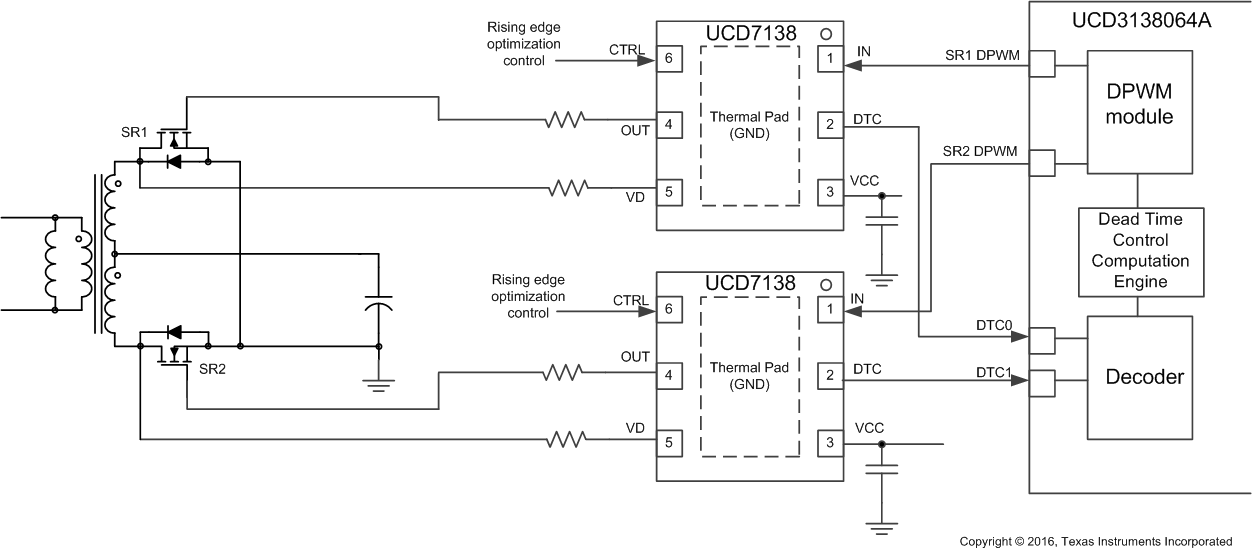
A new Synchronous Rectifier Dead Time Optimization hardware peripheral has been added. Benefits include: Improved efficiency Reduced synchronous rectifier voltage stressesShorter development cycle
A Duty Cycle Read Function has been added to improve use in peak current mode.
The SN3138064A is a digital power supply controller from Texas Instruments offering superior levels of integration and performance in a single-chip solution. The SN3138064A, in comparison to Texas Instruments UCD3138 digital power controller (), offers 64 kB of program Flash memory (vs 32 kB in UCD3138) and additional options for communication such as SPI and a second I2C port. The availability of 64 kB of program Flash memory in 2-32 kB banks, enables the designers to implement dual images of firmware (e.g. one main image + one back-up image) in the device and the flexibility to execute from either of the banks using appropriate algorithms. It also creates the unique opportunity for the processor to load a new program and subsequently execute that program without interrupting power delivery. This feature allows the end user to add new features to the power supply in the field while eliminating any down-time required to load the new program.
The flexible nature of the SN3138064A makes it suitable for a wide variety of power conversion applications. In addition, multiple peripherals inside the device have been specifically optimized to enhance the performance of AC/DC and isolated DC/DC applications and reduce the solution component count in the IT and network infrastructure space. The SN3138064A is a fully programmable solution offering customers complete control of their application, along with ample ability to differentiate their solution. At the same time, TI is committed to simplifying our customers' development effort through offering best in class development tools, including application firmware, Code Composer StudioTMsoftware development environment, and TI’s Fusion Power Development GUI which let customers configure and monitor key system parameters.
At the core of the SN3138064A controller are the Digital Power Peripherals (DPP). Each DPP implements a high-speed digital control loop consisting of a dedicated Error Analog-to-Digital Converter (EADC), a PID-based 2-pole/general-purpose ADC with up to 14 channels2-zero digital compensator and DPWM outputs with 250-ps pulse width resolution. The device also contains a 12-bit, 267-ksps general-purpose ADC with up to 14 channels, timers, interrupt control, PMBus, I2C, SPI and UART communications ports. The device is based on a 32-bit ARM7TDMI-S RISC microcontroller that performs real-time monitoring, configures peripherals, and manages communications. The ARM microcontroller executes its program out of programmable flash memory as well as on chip RAM and ROM.
In addition to the DPP, specific power management peripherals have been added to enable high efficiency across the entire operating range, high integration for increased power density, reliability, and lowest overall system cost and high flexibility with support for the widest number of control schemes and topologies. Such peripherals include: light load burst mode, synchronous rectification, automatic mode switching, input voltage feed forward, copper trace current sense, ideal diode emulation, constant current constant power control, synchronous rectification soft on and off, peak current mode control, flux balancing, secondary side input voltage sensing, high-resolution current sharing, hardware-configurable soft start with pre bias, as well as several other features. Topology support has been optimized for voltage mode and peak current mode controlled phase shifted full bridge, single and dual phase PFC, bridgeless PFC, hard switched full bridge and half bridge, and LLC half bridge and full bridge.
The SN3138064A is a functional variant of the SN3138064A Digital Power Controller that includes significant improvements over the UCD3138064. For a description of the complete changes made in the SN3138064A, refer to . The major improvements are:
The General Purpose ADC has been improved for better accuracy and performance at extreme cold temperatures (–40°C).
The UART peripheral has been modified to include a hardware based auto-baud rate adjustment feature.
A new Synchronous Rectifier Dead Time Optimization hardware peripheral has been added. Benefits include: Improved efficiency Reduced synchronous rectifier voltage stressesShorter development cycle
A Duty Cycle Read Function has been added to improve use in peak current mode. |
UCD3138064AHighly Integrated Digital Controller for Isolated Power | Power Supply Controllers, Monitors | 1 | Active | The SN3138064A is a digital power supply controller from Texas Instruments offering superior levels of integration and performance in a single-chip solution. The SN3138064A, in comparison to Texas Instruments UCD3138 digital power controller (), offers 64 kB of program Flash memory (vs 32 kB in UCD3138) and additional options for communication such as SPI and a second I2C port. The availability of 64 kB of program Flash memory in 2-32 kB banks, enables the designers to implement dual images of firmware (e.g. one main image + one back-up image) in the device and the flexibility to execute from either of the banks using appropriate algorithms. It also creates the unique opportunity for the processor to load a new program and subsequently execute that program without interrupting power delivery. This feature allows the end user to add new features to the power supply in the field while eliminating any down-time required to load the new program.
The flexible nature of the SN3138064A makes it suitable for a wide variety of power conversion applications. In addition, multiple peripherals inside the device have been specifically optimized to enhance the performance of AC/DC and isolated DC/DC applications and reduce the solution component count in the IT and network infrastructure space. The SN3138064A is a fully programmable solution offering customers complete control of their application, along with ample ability to differentiate their solution. At the same time, TI is committed to simplifying our customers' development effort through offering best in class development tools, including application firmware, Code Composer StudioTMsoftware development environment, and TI’s Fusion Power Development GUI which let customers configure and monitor key system parameters.
At the core of the SN3138064A controller are the Digital Power Peripherals (DPP). Each DPP implements a high-speed digital control loop consisting of a dedicated Error Analog-to-Digital Converter (EADC), a PID-based 2-pole/general-purpose ADC with up to 14 channels2-zero digital compensator and DPWM outputs with 250-ps pulse width resolution. The device also contains a 12-bit, 267-ksps general-purpose ADC with up to 14 channels, timers, interrupt control, PMBus, I2C, SPI and UART communications ports. The device is based on a 32-bit ARM7TDMI-S RISC microcontroller that performs real-time monitoring, configures peripherals, and manages communications. The ARM microcontroller executes its program out of programmable flash memory as well as on chip RAM and ROM.
In addition to the DPP, specific power management peripherals have been added to enable high efficiency across the entire operating range, high integration for increased power density, reliability, and lowest overall system cost and high flexibility with support for the widest number of control schemes and topologies. Such peripherals include: light load burst mode, synchronous rectification, automatic mode switching, input voltage feed forward, copper trace current sense, ideal diode emulation, constant current constant power control, synchronous rectification soft on and off, peak current mode control, flux balancing, secondary side input voltage sensing, high-resolution current sharing, hardware-configurable soft start with pre bias, as well as several other features. Topology support has been optimized for voltage mode and peak current mode controlled phase shifted full bridge, single and dual phase PFC, bridgeless PFC, hard switched full bridge and half bridge, and LLC half bridge and full bridge.
The SN3138064A is a functional variant of the SN3138064A Digital Power Controller that includes significant improvements over the UCD3138064. For a description of the complete changes made in the SN3138064A, refer to . The major improvements are:
The General Purpose ADC has been improved for better accuracy and performance at extreme cold temperatures (–40°C).
The UART peripheral has been modified to include a hardware based auto-baud rate adjustment feature.
A new Synchronous Rectifier Dead Time Optimization hardware peripheral has been added. Benefits include: Improved efficiency Reduced synchronous rectifier voltage stressesShorter development cycle
A Duty Cycle Read Function has been added to improve use in peak current mode.
The SN3138064A is a digital power supply controller from Texas Instruments offering superior levels of integration and performance in a single-chip solution. The SN3138064A, in comparison to Texas Instruments UCD3138 digital power controller (), offers 64 kB of program Flash memory (vs 32 kB in UCD3138) and additional options for communication such as SPI and a second I2C port. The availability of 64 kB of program Flash memory in 2-32 kB banks, enables the designers to implement dual images of firmware (e.g. one main image + one back-up image) in the device and the flexibility to execute from either of the banks using appropriate algorithms. It also creates the unique opportunity for the processor to load a new program and subsequently execute that program without interrupting power delivery. This feature allows the end user to add new features to the power supply in the field while eliminating any down-time required to load the new program.
The flexible nature of the SN3138064A makes it suitable for a wide variety of power conversion applications. In addition, multiple peripherals inside the device have been specifically optimized to enhance the performance of AC/DC and isolated DC/DC applications and reduce the solution component count in the IT and network infrastructure space. The SN3138064A is a fully programmable solution offering customers complete control of their application, along with ample ability to differentiate their solution. At the same time, TI is committed to simplifying our customers' development effort through offering best in class development tools, including application firmware, Code Composer StudioTMsoftware development environment, and TI’s Fusion Power Development GUI which let customers configure and monitor key system parameters.
At the core of the SN3138064A controller are the Digital Power Peripherals (DPP). Each DPP implements a high-speed digital control loop consisting of a dedicated Error Analog-to-Digital Converter (EADC), a PID-based 2-pole/general-purpose ADC with up to 14 channels2-zero digital compensator and DPWM outputs with 250-ps pulse width resolution. The device also contains a 12-bit, 267-ksps general-purpose ADC with up to 14 channels, timers, interrupt control, PMBus, I2C, SPI and UART communications ports. The device is based on a 32-bit ARM7TDMI-S RISC microcontroller that performs real-time monitoring, configures peripherals, and manages communications. The ARM microcontroller executes its program out of programmable flash memory as well as on chip RAM and ROM.
In addition to the DPP, specific power management peripherals have been added to enable high efficiency across the entire operating range, high integration for increased power density, reliability, and lowest overall system cost and high flexibility with support for the widest number of control schemes and topologies. Such peripherals include: light load burst mode, synchronous rectification, automatic mode switching, input voltage feed forward, copper trace current sense, ideal diode emulation, constant current constant power control, synchronous rectification soft on and off, peak current mode control, flux balancing, secondary side input voltage sensing, high-resolution current sharing, hardware-configurable soft start with pre bias, as well as several other features. Topology support has been optimized for voltage mode and peak current mode controlled phase shifted full bridge, single and dual phase PFC, bridgeless PFC, hard switched full bridge and half bridge, and LLC half bridge and full bridge.
The SN3138064A is a functional variant of the SN3138064A Digital Power Controller that includes significant improvements over the UCD3138064. For a description of the complete changes made in the SN3138064A, refer to . The major improvements are:
The General Purpose ADC has been improved for better accuracy and performance at extreme cold temperatures (–40°C).
The UART peripheral has been modified to include a hardware based auto-baud rate adjustment feature.
A new Synchronous Rectifier Dead Time Optimization hardware peripheral has been added. Benefits include: Improved efficiency Reduced synchronous rectifier voltage stressesShorter development cycle
A Duty Cycle Read Function has been added to improve use in peak current mode. |
UCD3138128Highly-Integrated Digital Controller for Isolated Power | Integrated Circuits (ICs) | 4 | Active | The UCD3138xA is a digital power supply controller from Texas Instruments offering superior levels of integration and performance in a single chip solution. The UCD3138128A offers 128 kB of program flash memory in comparison to 32 kB in UCD3138A. and it also provides additional options for communication such as SPI and a second I2C/PMBus port. The availability of of program Flash memory in multiple 32 kB banks enables designers to implement dual images of firmware (that is, one main image + one back-up image) in the device and provides the option to execute from either of the banks using appropriate algorithms. It also creates the unique opportunity for the processor to load a new program and subsequently execute that program without interrupting power delivery. This feature allows the end user to add new features to the power supply in the field while eliminating any down-time required to load the new program.
The flexible nature of the UCD3138xA family makes it suitable for a wide variety of power conversion applications. In addition, multiple peripherals inside the device have been specifically optimized to enhance the performance of AC/DC and isolated DC/DC applications and reduce the solution component count in the IT and network infrastructure space. The UCD3138xA family is a fully programmable solution offering customers complete control of their application, along with ample flexibility for many solutions. At the same time, TI is committed to simplifying our customer’s development effort through offering best in class development tools, including application firmware, Code Composer StudioTMsoftware development environment, and TI’s Fusion Power Development GUI which enables customers to configure and monitor key system parameters.
At the core of the controller are the Digital Power Peripherals (DPP). Each DPP implements a high speed digital control loop consisting of a dedicated Error Analog to Digital Converter (EADC), a PID based 2 pole - 2 zero digital compensator and DPWM outputs with 250 ps pulse width resolution. The device also contains a 12-bit, 539 ksps general purpose ADC with up to 15 channels, timers, interrupt control, PMBus, I2C, SPI and UART communications ports. The device is based on a 32-bit ARM7TDMI-S RISC microcontroller that performs real-time monitoring, configures peripherals and manages communications. The ARM microcontroller executes its program out of programmable flash memory as well as on chip RAM and ROM.
In addition to the DPP, specific power management peripherals have been added to enable high efficiency across the entire operating range, high integration for increased power density, reliability, and lowest overall system cost and high flexibility with support for the widest number of control schemes and topologies. Such peripherals include: light load burst mode, synchronous rectification, LLC and phase shifted full bridge mode switching, input voltage feed forward, copper trace current sense, ideal diode emulation, constant current constant power control, synchronous rectification soft on and off, peak current mode control, flux balancing, secondary side input voltage sensing, high resolution current sharing, hardware configurable soft start with pre bias, as well as several other features. Topology support has been optimized for voltage mode and peak current mode controlled phase shifted full bridge, single and dual phase PFC, bridgeless PFC, hard switched full bridge and half bridge, active clamp forward converter, two switch forward converter and LLC half bridge and full bridge.
The UCD3138128A is a functional variant of the UCD3138 Digital Power Controller that includes significant improvements over the UCD3138. For a description of the complete changes made in the UCD3138128A, refer to UCD3138128A Migration Guide. The major improvements are: The General Purpose ADC has been improved for better accuracy and performance at extreme cold temperatures (–40°C). The UART peripheral has been modified to include a hardware based auto-baud rate adjustment feature. A new Synchronous Rectifier Dead Time Optimization hardware peripheral has been added. Benefits include: Improved efficiency Reduced synchronous rectifier voltage stressesShorter development cycleA Duty Cycle Read Function has been added to improve use in peak current mode.
The UCD3138xA is a digital power supply controller from Texas Instruments offering superior levels of integration and performance in a single chip solution. The UCD3138128A offers 128 kB of program flash memory in comparison to 32 kB in UCD3138A. and it also provides additional options for communication such as SPI and a second I2C/PMBus port. The availability of of program Flash memory in multiple 32 kB banks enables designers to implement dual images of firmware (that is, one main image + one back-up image) in the device and provides the option to execute from either of the banks using appropriate algorithms. It also creates the unique opportunity for the processor to load a new program and subsequently execute that program without interrupting power delivery. This feature allows the end user to add new features to the power supply in the field while eliminating any down-time required to load the new program.
The flexible nature of the UCD3138xA family makes it suitable for a wide variety of power conversion applications. In addition, multiple peripherals inside the device have been specifically optimized to enhance the performance of AC/DC and isolated DC/DC applications and reduce the solution component count in the IT and network infrastructure space. The UCD3138xA family is a fully programmable solution offering customers complete control of their application, along with ample flexibility for many solutions. At the same time, TI is committed to simplifying our customer’s development effort through offering best in class development tools, including application firmware, Code Composer StudioTMsoftware development environment, and TI’s Fusion Power Development GUI which enables customers to configure and monitor key system parameters.
At the core of the controller are the Digital Power Peripherals (DPP). Each DPP implements a high speed digital control loop consisting of a dedicated Error Analog to Digital Converter (EADC), a PID based 2 pole - 2 zero digital compensator and DPWM outputs with 250 ps pulse width resolution. The device also contains a 12-bit, 539 ksps general purpose ADC with up to 15 channels, timers, interrupt control, PMBus, I2C, SPI and UART communications ports. The device is based on a 32-bit ARM7TDMI-S RISC microcontroller that performs real-time monitoring, configures peripherals and manages communications. The ARM microcontroller executes its program out of programmable flash memory as well as on chip RAM and ROM.
In addition to the DPP, specific power management peripherals have been added to enable high efficiency across the entire operating range, high integration for increased power density, reliability, and lowest overall system cost and high flexibility with support for the widest number of control schemes and topologies. Such peripherals include: light load burst mode, synchronous rectification, LLC and phase shifted full bridge mode switching, input voltage feed forward, copper trace current sense, ideal diode emulation, constant current constant power control, synchronous rectification soft on and off, peak current mode control, flux balancing, secondary side input voltage sensing, high resolution current sharing, hardware configurable soft start with pre bias, as well as several other features. Topology support has been optimized for voltage mode and peak current mode controlled phase shifted full bridge, single and dual phase PFC, bridgeless PFC, hard switched full bridge and half bridge, active clamp forward converter, two switch forward converter and LLC half bridge and full bridge.
The UCD3138128A is a functional variant of the UCD3138 Digital Power Controller that includes significant improvements over the UCD3138. For a description of the complete changes made in the UCD3138128A, refer to UCD3138128A Migration Guide. The major improvements are: The General Purpose ADC has been improved for better accuracy and performance at extreme cold temperatures (–40°C). The UART peripheral has been modified to include a hardware based auto-baud rate adjustment feature. A new Synchronous Rectifier Dead Time Optimization hardware peripheral has been added. Benefits include: Improved efficiency Reduced synchronous rectifier voltage stressesShorter development cycleA Duty Cycle Read Function has been added to improve use in peak current mode. |
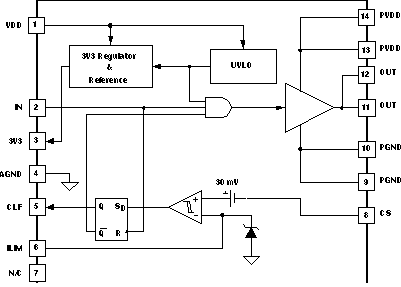
UCD7100Digital Control Compatible Single Low-Side +/- 4Amp MOSFET Driver with Current Sense | Integrated Circuits (ICs) | 5 | Active | The UCD7100 device is part of the UCD7K family of digital control compatible drivers for applications that use digital control technology that requires fast local peak current limit protection.
The UCD7100 is a low-side ±4-A high-current MOSFET gate driver. It allows the digital power controllers such as UCD9110 or UCD9501 to interface to the power stage in single ended topologies. It provides a cycle-by-cycle current limit function with programmable threshold and a digital output current limit flag which can be monitored by the host controller. With a fast 25-ns cycle-by-cycle current limit protection, the driver can turn off the power stage in the unlikely event that the digital system can not respond to a failure situation in time.
The UCD7100 device is part of the UCD7K family of digital control compatible drivers for applications that use digital control technology that requires fast local peak current limit protection.
The UCD7100 is a low-side ±4-A high-current MOSFET gate driver. It allows the digital power controllers such as UCD9110 or UCD9501 to interface to the power stage in single ended topologies. It provides a cycle-by-cycle current limit function with programmable threshold and a digital output current limit flag which can be monitored by the host controller. With a fast 25-ns cycle-by-cycle current limit protection, the driver can turn off the power stage in the unlikely event that the digital system can not respond to a failure situation in time. |
| Power Management (PMIC) | 2 | Active | |
| Integrated Circuits (ICs) | 2 | Active | |
| Integrated Circuits (ICs) | 8 | NRND | |
UCD7231Digital Control Compatible Synchronous Buck Gate Driver with Current Sense and Fault Protection | Integrated Circuits (ICs) | 2 | Active | The UCD7231 high current driver is specifically designed for digitally-controlled, point-of-load, synchronous buck switching power supplies. Two driver circuits provide high charge and discharge current for the high-side NMOS switch and the low-side NMOS synchronous rectifier in a synchronous buck circuit. The MOSFET gates are driven to +6 V by an internally regulated VGGsupply. The internal VGGregulator can be disabled to permit the user to supply their own gate drive voltage. This flexibility allows a wide power conversion input voltage range of 2.2 to 15 V. Internal under voltage lockout (UVLO) logic insures VGGis good before allowing chip operation.
A drive logic block allows operation in one of two modes selected by the SRE Mode pin. In Synchronous Mode, the logic block uses the PWM signal to control both the high-side and low-side gate drive signals. Dead time is automatically adjusted to prevent cross conduction. The Synchronous Rectifier Enable (SRE) pin controls whether or not the low-side FET is turned on when the PWM signal is low. In Independent Mode, the PWM and SRE pins control the high-side and low-side gates directly. No anti-cross-conduction logic is used in this mode.
On-board comparators monitor the voltage across the high side switch and the voltage across an external current sense element to safeguard the power stage from sudden high current loads. Blanking delay is set for the high side comparator by a single resistor in order to avoid false reports coincident with switching edge noise. In the event of a high-side fault or an over-current fault, the high-side FET turned off and the Fault Flag (FLT) is asserted to alert the digital controller. The fault thresholds are independently set by the HS Sense and ILIM pins.
Output current is measured and monitored by a precision, high gain, switched capacitor differential amplifier that processes the voltage present across an external current sense element. The amplified signal is available for use by the digital controller on the IMONpin. The current sense amplifier has output offset of 0.5 V so that both positive (sourcing) and negative (sinking) current can be sensed.
An on-chip temperature sense monitors the die temperature. If it exceeds approximately 165°C, the temperature sensor will initiate a thermal shutdown that halts output switching and sets the FLT flag. The temperature fault automatically clears when the die temperatures falls by approximately 20°.
The UCD7231 high current driver is specifically designed for digitally-controlled, point-of-load, synchronous buck switching power supplies. Two driver circuits provide high charge and discharge current for the high-side NMOS switch and the low-side NMOS synchronous rectifier in a synchronous buck circuit. The MOSFET gates are driven to +6 V by an internally regulated VGGsupply. The internal VGGregulator can be disabled to permit the user to supply their own gate drive voltage. This flexibility allows a wide power conversion input voltage range of 2.2 to 15 V. Internal under voltage lockout (UVLO) logic insures VGGis good before allowing chip operation.
A drive logic block allows operation in one of two modes selected by the SRE Mode pin. In Synchronous Mode, the logic block uses the PWM signal to control both the high-side and low-side gate drive signals. Dead time is automatically adjusted to prevent cross conduction. The Synchronous Rectifier Enable (SRE) pin controls whether or not the low-side FET is turned on when the PWM signal is low. In Independent Mode, the PWM and SRE pins control the high-side and low-side gates directly. No anti-cross-conduction logic is used in this mode.
On-board comparators monitor the voltage across the high side switch and the voltage across an external current sense element to safeguard the power stage from sudden high current loads. Blanking delay is set for the high side comparator by a single resistor in order to avoid false reports coincident with switching edge noise. In the event of a high-side fault or an over-current fault, the high-side FET turned off and the Fault Flag (FLT) is asserted to alert the digital controller. The fault thresholds are independently set by the HS Sense and ILIM pins.
Output current is measured and monitored by a precision, high gain, switched capacitor differential amplifier that processes the voltage present across an external current sense element. The amplified signal is available for use by the digital controller on the IMONpin. The current sense amplifier has output offset of 0.5 V so that both positive (sourcing) and negative (sinking) current can be sensed.
An on-chip temperature sense monitors the die temperature. If it exceeds approximately 165°C, the temperature sensor will initiate a thermal shutdown that halts output switching and sets the FLT flag. The temperature fault automatically clears when the die temperatures falls by approximately 20°. |