T
Texas Instruments
| Series | Category | # Parts | Status | Description |
|---|---|---|---|---|
| Part | Spec A | Spec B | Spec C | Spec D | Description |
|---|---|---|---|---|---|



| Series | Category | # Parts | Status | Description |
|---|---|---|---|---|
| Part | Spec A | Spec B | Spec C | Spec D | Description |
|---|---|---|---|---|---|
| Part | Category | Description |
|---|---|---|
 Texas Instruments BQ2002CSNTRG4Unknown | Integrated Circuits (ICs) | LINEAR BATTERY CHARGER NICD/NIMH 2000MA 0V TO 6V 8-PIN SOIC T/R |
 Texas Instruments LM3676SDX-3.3Obsolete | Integrated Circuits (ICs) | IC REG BUCK 3.3V 600MA 8WSON |
 Texas Instruments | Integrated Circuits (ICs) | TMX320DRE311 179PIN UBGA 200MHZ |
 Texas Instruments UCC3580N-1G4Obsolete | Integrated Circuits (ICs) | IC REG CTRLR FWRD CONV 16DIP |
 Texas Instruments LM2831YMF EVALObsolete | Development Boards Kits Programmers | EVAL BOARD FOR LM2831 |
 Texas Instruments | Integrated Circuits (ICs) | BUFFER/LINE DRIVER 8-CH NON-INVERTING 3-ST CMOS 20-PIN SSOP T/R |
 Texas Instruments | Integrated Circuits (ICs) | ANALOG OTHER PERIPHERALS |
Texas Instruments | Integrated Circuits (ICs) | RADIATION-HARDENED, QMLP 60V HAL |
 Texas Instruments SN75LVDS051DRObsolete | Integrated Circuits (ICs) | IC TRANSCEIVER FULL 2/2 16SOIC |
 Texas Instruments | Integrated Circuits (ICs) | AUTOMOTIVE OCTAL D-TYPE FLIP-FLO |
| Series | Category | # Parts | Status | Description |
|---|---|---|---|---|
| Interface | 2 | Obsolete | ||
| Interface | 1 | Active | ||
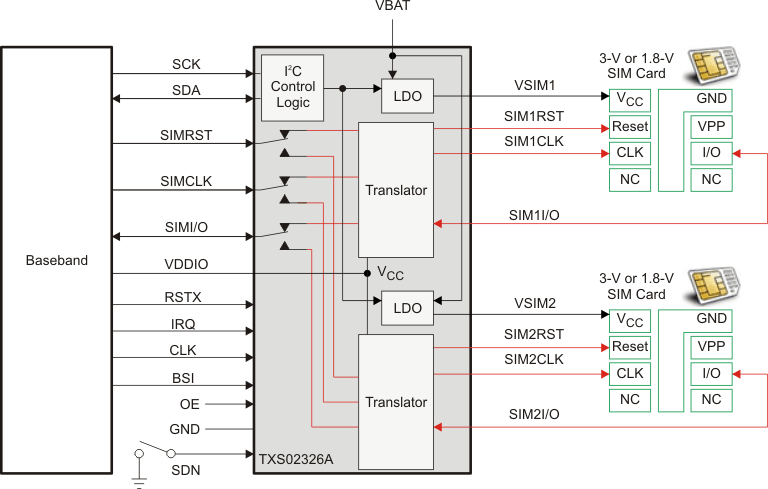
TXS02326Dual-Supply 2:1 SIM Card Multiplexer/Translator with Automatic Detect and slot dedicated dual LDO | Interface | 1 | Active | The TXS02326A is a complete dual-supply standby Smart Identity Module (SIM) card solution for interfacing wireless baseband processors with two individual SIM subscriber cards to store data for mobile handset applications. It is a custom device which is used to extend a single SIM/UICC interface to support two SIMs/UICCs.
The device complies with ISO/IEC Smart-Card Interface requirements as well as GSM and 3G mobile standards. It includes a high-speed level translator capable of supporting Class-B (2.95-V) and Class-C (1.8-V) interfaces; two low-dropout (LDO) voltage regulators with output voltages that are selectable between 2.95-V Class-B and 1.8-V Class-C interfaces; an integrated "fast-mode" 400 kb/s "slave" I2C control register interface, for configuration purposes; and a 32-kHz clock input, for internal timing generation. The TXS02326A also includes a shutdown input and a comparator input that detects battery pack removal to safely power-down the two SIM cards. The shutdown input and comparator input are equipped with two programmable debounce counter (i.e. BSI input and SDN input) circuits realized by an 8 bit counter.
The voltage-level translator has two supply voltage pins. VDDIO sets the reference for the baseband interface and can be operated from 1.7-V to 3.3-V. VSIM1 and VSIM2 are programmed to either 1.8-V or 2.95-V, each supplied by an independent internal LDO regulator. The integrated LDO accepts input battery voltages from 2.3-V to 5.5-V and outputs up to 50 mA to the B-side circuitry and external Class-B or Class-C SIM card.
The TXS02326A is a complete dual-supply standby Smart Identity Module (SIM) card solution for interfacing wireless baseband processors with two individual SIM subscriber cards to store data for mobile handset applications. It is a custom device which is used to extend a single SIM/UICC interface to support two SIMs/UICCs.
The device complies with ISO/IEC Smart-Card Interface requirements as well as GSM and 3G mobile standards. It includes a high-speed level translator capable of supporting Class-B (2.95-V) and Class-C (1.8-V) interfaces; two low-dropout (LDO) voltage regulators with output voltages that are selectable between 2.95-V Class-B and 1.8-V Class-C interfaces; an integrated "fast-mode" 400 kb/s "slave" I2C control register interface, for configuration purposes; and a 32-kHz clock input, for internal timing generation. The TXS02326A also includes a shutdown input and a comparator input that detects battery pack removal to safely power-down the two SIM cards. The shutdown input and comparator input are equipped with two programmable debounce counter (i.e. BSI input and SDN input) circuits realized by an 8 bit counter.
The voltage-level translator has two supply voltage pins. VDDIO sets the reference for the baseband interface and can be operated from 1.7-V to 3.3-V. VSIM1 and VSIM2 are programmed to either 1.8-V or 2.95-V, each supplied by an independent internal LDO regulator. The integrated LDO accepts input battery voltages from 2.3-V to 5.5-V and outputs up to 50 mA to the B-side circuitry and external Class-B or Class-C SIM card. |
| Integrated Circuits (ICs) | 1 | Obsolete | ||
TXS02612SDIO Port Expander With Voltage-Level Translation | Interface | 1 | Active | The TXS02612 is designed to interface the cell phone baseband with external SDIO peripherals. The device includes a 6-channel SPDT switch with voltage-level translation capability. This allows a single SDIO port to be interfaced with two SDIO peripherals. The TXS02612 has three separate supply rails that operate over the full range of 1.1 V to 3.6 V. This allows the baseband and SDIO peripherals to operate at different supply voltages if required.
The select (SEL) input is used to choose between the B0 port and B1 port. When SEL = Low, B0 port is selected; when SEL = High, B1 port is selected. SEL is referenced to VCCA. For the unselected B port, the clock output is held low, whereas the data and command I/Os are pulled high to their respective VCCBthrough a 70-kresistor (±30% tolerance).
The TXS02612 is designed to interface the cell phone baseband with external SDIO peripherals. The device includes a 6-channel SPDT switch with voltage-level translation capability. This allows a single SDIO port to be interfaced with two SDIO peripherals. The TXS02612 has three separate supply rails that operate over the full range of 1.1 V to 3.6 V. This allows the baseband and SDIO peripherals to operate at different supply voltages if required.
The select (SEL) input is used to choose between the B0 port and B1 port. When SEL = Low, B0 port is selected; when SEL = High, B1 port is selected. SEL is referenced to VCCA. For the unselected B port, the clock output is held low, whereas the data and command I/Os are pulled high to their respective VCCBthrough a 70-kresistor (±30% tolerance). |
| Logic | 1 | Active | ||
| Integrated Circuits (ICs) | 1 | Obsolete | ||
| Translators, Level Shifters | 2 | Active | ||
TXS4558Dual SIM card power supply with level translator and dedicated dual LDO | Logic | 2 | Active | The TXS4558 is a complete dual-supply standby Smart Identity Module (SIM) card solution for interfacing wire-less baseband processors with two individual SIM subscriber cards to store data for mobile handset applications. It is a custom device which is used to extend a single SIM/UICC interface to be able to support two SIM’s/UICC’s.
The device complies with ISO/IEC Smart-Card Interface requirements as well as GSM and 3G mobile standards. It includes a high-speed level translator capable of supporting Class-B (2.95 V) and Class-C (1.8 V) interfaces, two low-dropout (LDO) voltage regulators that have output voltages that are selectable between 2.95-V Class-B and 1.8-V Class-C interfaces. Simple GPIO inputs are used to switch between the two SIM cards and to put it into different modes. The voltage-level translator has two supply voltage pins. VCC sets the reference for the baseband interface and can be operated from 1.65 V to 3.3 V. VSIM1 and VSIM2 are programmed to either 1.8 V or 2.95 V, each supplied by an independent internal LDO regulator. The integrated LDO accepts input battery voltages from 2.3 V to 5.5 V and outputs up to 50 mA to the B-side circuitry and external Class-B or Class-C SIM card.
The TXS4558 also incorporates shutdown sequence for the SIM card pins based on the ISO 7816-3 specification for SIM cards. The device also has 8kV HBM protection for the SIM card pins and standard 2kV HBM protection for all the other pins.
The TXS4558 is a complete dual-supply standby Smart Identity Module (SIM) card solution for interfacing wire-less baseband processors with two individual SIM subscriber cards to store data for mobile handset applications. It is a custom device which is used to extend a single SIM/UICC interface to be able to support two SIM’s/UICC’s.
The device complies with ISO/IEC Smart-Card Interface requirements as well as GSM and 3G mobile standards. It includes a high-speed level translator capable of supporting Class-B (2.95 V) and Class-C (1.8 V) interfaces, two low-dropout (LDO) voltage regulators that have output voltages that are selectable between 2.95-V Class-B and 1.8-V Class-C interfaces. Simple GPIO inputs are used to switch between the two SIM cards and to put it into different modes. The voltage-level translator has two supply voltage pins. VCC sets the reference for the baseband interface and can be operated from 1.65 V to 3.3 V. VSIM1 and VSIM2 are programmed to either 1.8 V or 2.95 V, each supplied by an independent internal LDO regulator. The integrated LDO accepts input battery voltages from 2.3 V to 5.5 V and outputs up to 50 mA to the B-side circuitry and external Class-B or Class-C SIM card.
The TXS4558 also incorporates shutdown sequence for the SIM card pins based on the ISO 7816-3 specification for SIM cards. The device also has 8kV HBM protection for the SIM card pins and standard 2kV HBM protection for all the other pins. |
| Logic | 4 | Active | ||