BQ2013HNiCd/NiMH/lead-acid gas gauge for high Discharge Rates (>10A), Pgmable Offset Error & Load Comp. | Battery Management | 4 | Active | The bq2013H Gas Gauge IC is intended for battery-pack installation to maintain an accurate record of a battery’s available charge. The IC monitors a voltage drop across a sense resistor connected in series between the negative battery terminal and ground to determine charge and discharge activity of the battery. The bq2013H is designed for high cpaacity battery packs used in high-discharge rate systems.
Battery self-discharge is estimated based on an internal timer and temperature sensor. Compensations for battery temperature, rate of charge, and self-discharge are applied to the charge counter to provide available capacity information across a wide range of operating conditions. Initial battery capacity, self-discharge rate, display mode, and charge compensation are set using the PROG1-6 pins. Actual battery capacity is automatically "learned" in the course of a discharge cycle from full to empty.
Nominal available charge may be directly indicated using a five-segment LED display. These segments are used to graphically indicate nominal available charge.
The bq2013H supports a simple single-line bi-directional serial link to an external processor (common ground). The bq2013H outputs battery information in response to external commands over the serial link. To support battery pack testing, the outputs may also be controlled by command. The external processor may also overwrite some of the bq2013H gas gauge data registers.
The bq2013H may operate directly from four nickel cells or three lead acid. With the REF output and an external transistor, a simple, inexpensive regulator can be built to provide VCCfrom a greater number of cells.
Internal registers include available charge, temperature, capacity, battery ID, and battery status.
The bq2013H Gas Gauge IC is intended for battery-pack installation to maintain an accurate record of a battery’s available charge. The IC monitors a voltage drop across a sense resistor connected in series between the negative battery terminal and ground to determine charge and discharge activity of the battery. The bq2013H is designed for high cpaacity battery packs used in high-discharge rate systems.
Battery self-discharge is estimated based on an internal timer and temperature sensor. Compensations for battery temperature, rate of charge, and self-discharge are applied to the charge counter to provide available capacity information across a wide range of operating conditions. Initial battery capacity, self-discharge rate, display mode, and charge compensation are set using the PROG1-6 pins. Actual battery capacity is automatically "learned" in the course of a discharge cycle from full to empty.
Nominal available charge may be directly indicated using a five-segment LED display. These segments are used to graphically indicate nominal available charge.
The bq2013H supports a simple single-line bi-directional serial link to an external processor (common ground). The bq2013H outputs battery information in response to external commands over the serial link. To support battery pack testing, the outputs may also be controlled by command. The external processor may also overwrite some of the bq2013H gas gauge data registers.
The bq2013H may operate directly from four nickel cells or three lead acid. With the REF output and an external transistor, a simple, inexpensive regulator can be built to provide VCCfrom a greater number of cells.
Internal registers include available charge, temperature, capacity, battery ID, and battery status. |
BQ2014HNiCd/NiMH gas gauge with high-speed 1-wire (HDQ) interface and 5 LED drivers | Evaluation and Demonstration Boards and Kits | 9 | Active | The bq2014H NiCd/NiMH Gas Gauge IC is intended for batterypack or in-system installation to maintain an accurate record of available battery capacity. The IC monitors a voltage drop across a sense resistor connected in series between the negative battery terminal and ground to determine charge and discharge activity of the battery. Compensations for battery temperature, self-discharge, and rate of discharge are applied to the charge counter to provide available capacity information across a wide range of operating conditions. Battery capacity is automatically recalibrated, or "learned," in the course of a discharge cycle from full to empty.
Nominal available capacity may be directly indicated using a five-segment LED display. The bq2014H also supports a simple single-line bidirectional serial link to an external processor (common ground). The 5kb/s HDQ bus interface reduces communications overhead in the external microcontroller.
Internal registers include available capacity and energy, temperature, voltage and current, and battery status. The external processor may also overwrite some of the bq2014H gas gauge data registers.
The bq2014H can operate from the batteries in the pack. The REF output and an external transistor allow a simple, inexpensive voltage regulator to supply power to the circuit from the cells.
The bq2014H NiCd/NiMH Gas Gauge IC is intended for batterypack or in-system installation to maintain an accurate record of available battery capacity. The IC monitors a voltage drop across a sense resistor connected in series between the negative battery terminal and ground to determine charge and discharge activity of the battery. Compensations for battery temperature, self-discharge, and rate of discharge are applied to the charge counter to provide available capacity information across a wide range of operating conditions. Battery capacity is automatically recalibrated, or "learned," in the course of a discharge cycle from full to empty.
Nominal available capacity may be directly indicated using a five-segment LED display. The bq2014H also supports a simple single-line bidirectional serial link to an external processor (common ground). The 5kb/s HDQ bus interface reduces communications overhead in the external microcontroller.
Internal registers include available capacity and energy, temperature, voltage and current, and battery status. The external processor may also overwrite some of the bq2014H gas gauge data registers.
The bq2014H can operate from the batteries in the pack. The REF output and an external transistor allow a simple, inexpensive voltage regulator to supply power to the circuit from the cells. |
| Battery Management | 2 | Active | |
| Power Management (PMIC) | 3 | Active | |
BQ2019Flash-based precision multi-chemistry charge/discharge counter w/ high-speed 1-wire I/F (HDQ) | Development Boards, Kits, Programmers | 4 | Active | The bq2019 advanced battery-monitoring IC accurately measures the charge and discharge currents in a rechargeable battery pack. In pack integration, the bq2019 is the basis of a comprehensive battery-capacity management system in portable applications such as cellular phones, PDAs, or other portable products.
The bq2019 works with the host controller in the portable system to implement the battery management system. The host controller interprets the bq2019 data and communicates meaningful battery data to the end-user or power-management system.
The bq2019 provides 64 bytes of general-purpose flash memory, 8 bytes of ID ROM, and 32 bytes of flash-backed RAM for data storage. The nonvolatile memory can maintain formatted battery-monitor information, identification codes, warranty information, or other critical battery parameters when the battery is temporarily shorted or deeply discharged.
The bq2019 advanced battery-monitoring IC accurately measures the charge and discharge currents in a rechargeable battery pack. In pack integration, the bq2019 is the basis of a comprehensive battery-capacity management system in portable applications such as cellular phones, PDAs, or other portable products.
The bq2019 works with the host controller in the portable system to implement the battery management system. The host controller interprets the bq2019 data and communicates meaningful battery data to the end-user or power-management system.
The bq2019 provides 64 bytes of general-purpose flash memory, 8 bytes of ID ROM, and 32 bytes of flash-backed RAM for data storage. The nonvolatile memory can maintain formatted battery-monitor information, identification codes, warranty information, or other critical battery parameters when the battery is temporarily shorted or deeply discharged. |
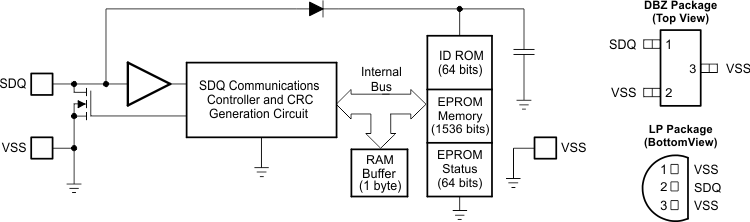
BQ2022A1K-bit Serial EPROM with SDQ Interface | Memory | 5 | Active | The BQ2022A is a 1-Kbit serial EPROM containing a factory-programmed, unique 48-bit identification number, 8-bit CRC generation, and the 8-bit family code (09h). A 64-bit status register controls write protection and page redirection.
The BQ2022A SDQ™ interface requires only a single connection and a ground return. The DATA pin is also the sole power source for the BQ2022A.
The small surface-mount package options saves printed-circuit-board space, while the low cost makes it ideal for applications such as battery pack configuration parameters, record maintenance, asset tracking, product-revision status, and access-code security.
The BQ2022A is a 1-Kbit serial EPROM containing a factory-programmed, unique 48-bit identification number, 8-bit CRC generation, and the 8-bit family code (09h). A 64-bit status register controls write protection and page redirection.
The BQ2022A SDQ™ interface requires only a single connection and a ground return. The DATA pin is also the sole power source for the BQ2022A.
The small surface-mount package options saves printed-circuit-board space, while the low cost makes it ideal for applications such as battery pack configuration parameters, record maintenance, asset tracking, product-revision status, and access-code security. |
BQ2023Single-wire advanced battery Monitor IC for cellular and PDA applications | Power Management (PMIC) | 2 | Active | The bq2023 is an advanced battery monitoring IC that accurately measures the charge and discharge currents in rechargeable battery packs. Intended for pack integration, the bq2023 contains all the necessary functions to form the basis for an accurate battery gas gauge in cellular phones, PDAs, or other portable products.
Gas gauging is accomplished by coulomb counting (i.e., measuring the charge input to and subsequently removed from the battery). The bq2023 achieves that by measuring the differential voltage drop across a low-value series sense resistor between the negative terminal of the battery and the battery-pack negative contact. An internal voltage-to-frequency converter (VFC) converts this voltage into charge and discharge counts. The VFC is capable of resolving signals down to 3.05 uV. By using the accumulated counts in the charge, discharge, and self-discharge registers, an intelligent host controller can determine battery state-of-charge information. To improve accuracy, the bq2023 continuously measures and compensates offset errors in the VFC.
The bq2023 works with the host controller in the portable system to implement the battery management system. The host controller interprets the bq2023 data and communicates meaningful battery data to the end-user or power-management system. The SDQ single-wire bus architecture allows multiple bq2023s to exist on the same communications node simultaneously.
The bq2023 provides 224 bytes of flash memory, 8-bytes of secure ID ROM, and 32 bytes of RAM. The nonvolatile memory maintains formatted battery monitor information, identification codes, warranty information, or other critical battery parameters while the battery is temporarily shorted or deeply discharged.
The bq2023 is an advanced battery monitoring IC that accurately measures the charge and discharge currents in rechargeable battery packs. Intended for pack integration, the bq2023 contains all the necessary functions to form the basis for an accurate battery gas gauge in cellular phones, PDAs, or other portable products.
Gas gauging is accomplished by coulomb counting (i.e., measuring the charge input to and subsequently removed from the battery). The bq2023 achieves that by measuring the differential voltage drop across a low-value series sense resistor between the negative terminal of the battery and the battery-pack negative contact. An internal voltage-to-frequency converter (VFC) converts this voltage into charge and discharge counts. The VFC is capable of resolving signals down to 3.05 uV. By using the accumulated counts in the charge, discharge, and self-discharge registers, an intelligent host controller can determine battery state-of-charge information. To improve accuracy, the bq2023 continuously measures and compensates offset errors in the VFC.
The bq2023 works with the host controller in the portable system to implement the battery management system. The host controller interprets the bq2023 data and communicates meaningful battery data to the end-user or power-management system. The SDQ single-wire bus architecture allows multiple bq2023s to exist on the same communications node simultaneously.
The bq2023 provides 224 bytes of flash memory, 8-bytes of secure ID ROM, and 32 bytes of RAM. The nonvolatile memory maintains formatted battery monitor information, identification codes, warranty information, or other critical battery parameters while the battery is temporarily shorted or deeply discharged. |
| Memory | 1 | Unknown | |
| Memory | 3 | Active | |
BQ20284Kb EEPROM with single-wire HDQ interface and temperature sensor | Integrated Circuits (ICs) | 2 | Active | The Texas Instruments bq2028 serial 4Kb nonvolatile memory (EEPROM) with integrated temperature sensor and LDO linear regulator provides pack-side memory storage and temperature monitoring for a single-cell system-side battery fuel gauge solution such as the bq27505-E1.
The bq2028 communicates with the bq27505-E1 gauge over a single-wire HDQ interface with a minimal overhead protocol yet ensures error free data transfer.
The Texas Instruments bq2028 serial 4Kb nonvolatile memory (EEPROM) with integrated temperature sensor and LDO linear regulator provides pack-side memory storage and temperature monitoring for a single-cell system-side battery fuel gauge solution such as the bq27505-E1.
The bq2028 communicates with the bq27505-E1 gauge over a single-wire HDQ interface with a minimal overhead protocol yet ensures error free data transfer. |