| Voltage Regulators - DC DC Switching Regulators | 1 | Active | |
TPS638102.5-A high-efficient buck-boost converter with I²C interface for dynamic voltage scaling | Voltage Regulators - DC DC Switching Regulators | 1 | Active | The TPS63810 and TPS63811 are high efficiency, high output current buck-boost converters fully programmable through I2C. Depending on the input voltage, they automatically operate in boost, buck or in a novel 4-cycle buck-boost mode when the input voltage is approximately equal to the output voltage.
The transitions between modes happen at defined thresholds and avoid unwanted toggling within the modes to reduce output voltage ripple.
Two registers, accessible through I2C, set the output voltage, and a VSEL pin selects which output voltage register is active. Thus the devices can support dynamic voltage scaling. If the output voltage register is changed during operation or the VSEL pin is toggled, the device transits in a defined, programmable ramp-rate.
The TPS63810 and TPS63811 are high efficiency, high output current buck-boost converters fully programmable through I2C. Depending on the input voltage, they automatically operate in boost, buck or in a novel 4-cycle buck-boost mode when the input voltage is approximately equal to the output voltage.
The transitions between modes happen at defined thresholds and avoid unwanted toggling within the modes to reduce output voltage ripple.
Two registers, accessible through I2C, set the output voltage, and a VSEL pin selects which output voltage register is active. Thus the devices can support dynamic voltage scaling. If the output voltage register is changed during operation or the VSEL pin is toggled, the device transits in a defined, programmable ramp-rate. |
TPS638112.5-A high-efficient buck-boost converter with I²C interface for dynamic voltage scaling | Development Boards, Kits, Programmers | 2 | Active | The TPS63810 and TPS63811 are high efficiency, high output current buck-boost converters fully programmable through I2C. Depending on the input voltage, they automatically operate in boost, buck or in a novel 4-cycle buck-boost mode when the input voltage is approximately equal to the output voltage.
The transitions between modes happen at defined thresholds and avoid unwanted toggling within the modes to reduce output voltage ripple.
Two registers, accessible through I2C, set the output voltage, and a VSEL pin selects which output voltage register is active. Thus the devices can support dynamic voltage scaling. If the output voltage register is changed during operation or the VSEL pin is toggled, the device transits in a defined, programmable ramp-rate.
The TPS63810 and TPS63811 are high efficiency, high output current buck-boost converters fully programmable through I2C. Depending on the input voltage, they automatically operate in boost, buck or in a novel 4-cycle buck-boost mode when the input voltage is approximately equal to the output voltage.
The transitions between modes happen at defined thresholds and avoid unwanted toggling within the modes to reduce output voltage ripple.
Two registers, accessible through I2C, set the output voltage, and a VSEL pin selects which output voltage register is active. Thus the devices can support dynamic voltage scaling. If the output voltage register is changed during operation or the VSEL pin is toggled, the device transits in a defined, programmable ramp-rate. |
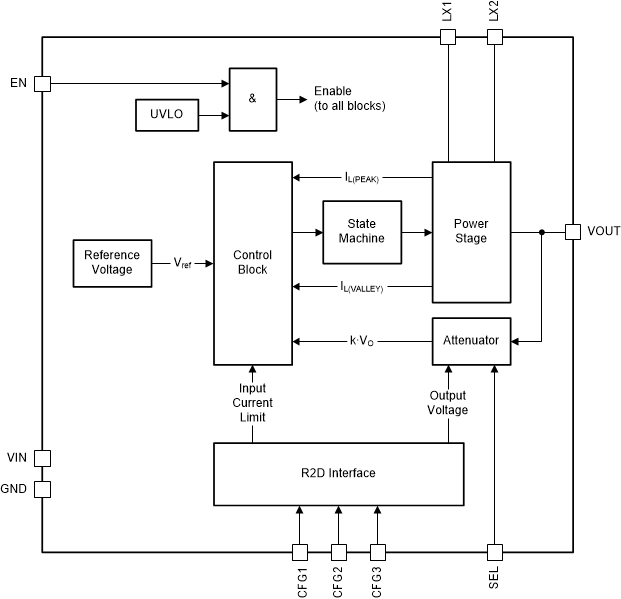
TPS639001.8-V to 5.5-V, 75-nA IQ buck-boost converter with input current limit and Dynamic Voltage Scaling | Power Management (PMIC) | 2 | Active | The TPS63900 device is a high-efficiency synchronous buck-boost converter with an extremely low quiescent current (75 nA typical). The device has 32 user-programmable output voltage settings from 1.8 V to 5 V.
A dynamic voltage-scaling feature lets applications switch between two output voltages during operation; for example, to save power by using a lower system supply voltage during standby operation.
With its wide supply voltage range and programmable input current limit (1 mA to 100 mA and unlimited), the device is ideal for use with a wide range of primary like 3S Alkaline, 1S Li-MnO2or 1S Li-SOCl2, and secondary battery types.
The high-output current capability supports commonly-used RF standards like sub-1-GHz, BLE, LoRa, wM-Bus, and NB-IoT.
The TPS63900 device is a high-efficiency synchronous buck-boost converter with an extremely low quiescent current (75 nA typical). The device has 32 user-programmable output voltage settings from 1.8 V to 5 V.
A dynamic voltage-scaling feature lets applications switch between two output voltages during operation; for example, to save power by using a lower system supply voltage during standby operation.
With its wide supply voltage range and programmable input current limit (1 mA to 100 mA and unlimited), the device is ideal for use with a wide range of primary like 3S Alkaline, 1S Li-MnO2or 1S Li-SOCl2, and secondary battery types.
The high-output current capability supports commonly-used RF standards like sub-1-GHz, BLE, LoRa, wM-Bus, and NB-IoT. |
TPS639015.5-V buck-boost converter with 75-nA operating IQ in WCSP package | Voltage Regulators - DC DC Switching Regulators | 1 | Active | The TPS63901 device is a high-efficiency synchronous buck-boost converter with an extremely low quiescent current (75 nA typical). The device has 32 user-programmable output voltage settings from 1.8 V to 5 V.
A dynamic voltage-scaling feature lets applications switch between two output voltages during operation; for example, to save power by using a lower system supply voltage during standby operation.
With its wide supply voltage range and programmable input current limit (1 mA to 100 mA and unlimited), the device is ideal for use with a wide range of primary like 3S Alkaline, 1S Li-MnO2 or 1S Li-SOCl2, and secondary battery types.
The high-output current capability supports commonly-used RF standards like sub-1-GHz, BLE, LoRa, wM-Bus, and NB-IoT.
The TPS63901 device is a high-efficiency synchronous buck-boost converter with an extremely low quiescent current (75 nA typical). The device has 32 user-programmable output voltage settings from 1.8 V to 5 V.
A dynamic voltage-scaling feature lets applications switch between two output voltages during operation; for example, to save power by using a lower system supply voltage during standby operation.
With its wide supply voltage range and programmable input current limit (1 mA to 100 mA and unlimited), the device is ideal for use with a wide range of primary like 3S Alkaline, 1S Li-MnO2 or 1S Li-SOCl2, and secondary battery types.
The high-output current capability supports commonly-used RF standards like sub-1-GHz, BLE, LoRa, wM-Bus, and NB-IoT. |
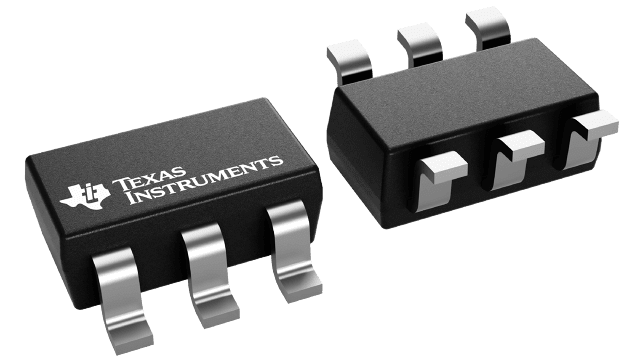
TPS642001.8 to 6.5 V input, 350 kHz, 95% efficient step-down controller, 20 uA, SOT-23 | DC DC Switching Controllers | 3 | Active | The TPS6420x are nonsynchronous step-down controllers that are ideally suited for systems powered from a 5-V or 3.3-V bus or for applications powered from a 1-cell Li-Ion battery or from a 2- to 4-cell NiCd, NiMH, or alkaline battery. These step-down controllers drive an external P-channel MOSFET allowing design flexibility. To achieve highest efficiency over a wide load current range, this controller uses a minimum on time, minimum off time control scheme and consumes only 20-µA quiescent current. The minimum on time of typically 600 ns (TPS64203) allows the use of small inductors and capacitors. When disabled, the current consumption is reduced to less than 1 µA. The TPS6420x is available in the 6-pin SOT23 (DBV) package and operates over a free air temperature range of –40°C to 85°C.
The TPS6420x are nonsynchronous step-down controllers that are ideally suited for systems powered from a 5-V or 3.3-V bus or for applications powered from a 1-cell Li-Ion battery or from a 2- to 4-cell NiCd, NiMH, or alkaline battery. These step-down controllers drive an external P-channel MOSFET allowing design flexibility. To achieve highest efficiency over a wide load current range, this controller uses a minimum on time, minimum off time control scheme and consumes only 20-µA quiescent current. The minimum on time of typically 600 ns (TPS64203) allows the use of small inductors and capacitors. When disabled, the current consumption is reduced to less than 1 µA. The TPS6420x is available in the 6-pin SOT23 (DBV) package and operates over a free air temperature range of –40°C to 85°C. |
| Power Management (PMIC) | 3 | Active | |
| Integrated Circuits (ICs) | 3 | Active | |
| Power Management (PMIC) | 4 | Active | |
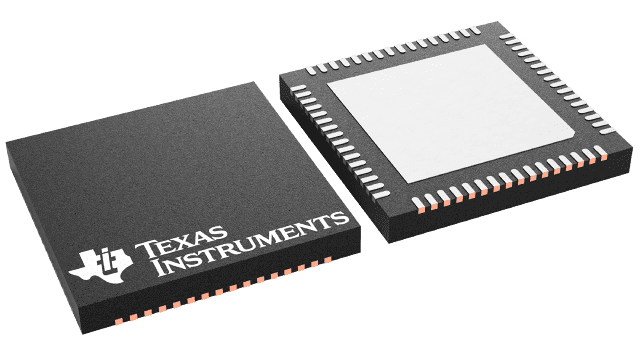
TPS650Configurable multi-rail PMIC for Xilinx MPSoCs and FPGAs | Evaluation and Demonstration Boards and Kits | 13 | Active | The TPS650864 device family is a single-chip power-management IC (PMIC) designed for Xilinx Zynq multiprocessor system-on-chip (MPSoCs) and field programmable gate array (FPGA) families. The TPS650864 offers an input range of 5.6V to 21V, enabling a wide range of applications (see the Device Comparison Table). The device is targeted for wall-powered applications or 2S, 3S, or 4S Li-Ion battery packs (NVDC or non-NVDC power architectures). See the Typical Application section for 5V input supplies. The D-CAP2 and DCS-Control high-frequency voltage regulators use small passives to achieve a small solution size. The D-CAP2 and DCS-Control topologies have excellent transient response performance, ideal for processor core and system memory rails that have fast load switching. An I2C interface allows simple control either by an embedded controller (EC) or by an SoC. The PMIC comes in an 8mm × 8mm, single-row VQFN package with thermal pad for good thermal dissipation.
The TPS650864 device family is a single-chip power-management IC (PMIC) designed for Xilinx Zynq multiprocessor system-on-chip (MPSoCs) and field programmable gate array (FPGA) families. The TPS650864 offers an input range of 5.6V to 21V, enabling a wide range of applications (see the Device Comparison Table). The device is targeted for wall-powered applications or 2S, 3S, or 4S Li-Ion battery packs (NVDC or non-NVDC power architectures). See the Typical Application section for 5V input supplies. The D-CAP2 and DCS-Control high-frequency voltage regulators use small passives to achieve a small solution size. The D-CAP2 and DCS-Control topologies have excellent transient response performance, ideal for processor core and system memory rails that have fast load switching. An I2C interface allows simple control either by an embedded controller (EC) or by an SoC. The PMIC comes in an 8mm × 8mm, single-row VQFN package with thermal pad for good thermal dissipation. |