T
Texas Instruments
| Series | Category | # Parts | Status | Description |
|---|---|---|---|---|
| Part | Spec A | Spec B | Spec C | Spec D | Description |
|---|---|---|---|---|---|



| Series | Category | # Parts | Status | Description |
|---|---|---|---|---|
| Part | Spec A | Spec B | Spec C | Spec D | Description |
|---|---|---|---|---|---|
| Part | Category | Description |
|---|---|---|
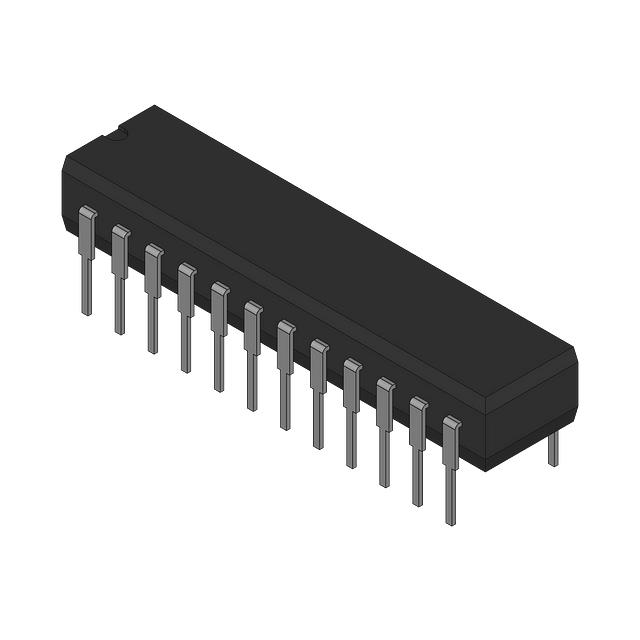 Texas Instruments | Integrated Circuits (ICs) | BUS DRIVER, BCT/FBT SERIES |
 Texas Instruments | Integrated Circuits (ICs) | 12BIT 3.3V~3.6V 210MHZ PARALLEL VQFN-48-EP(7X7) ANALOG TO DIGITAL CONVERTERS (ADC) ROHS |
Texas Instruments | Integrated Circuits (ICs) | TMX320DRE311 179PIN UBGA 200MHZ |
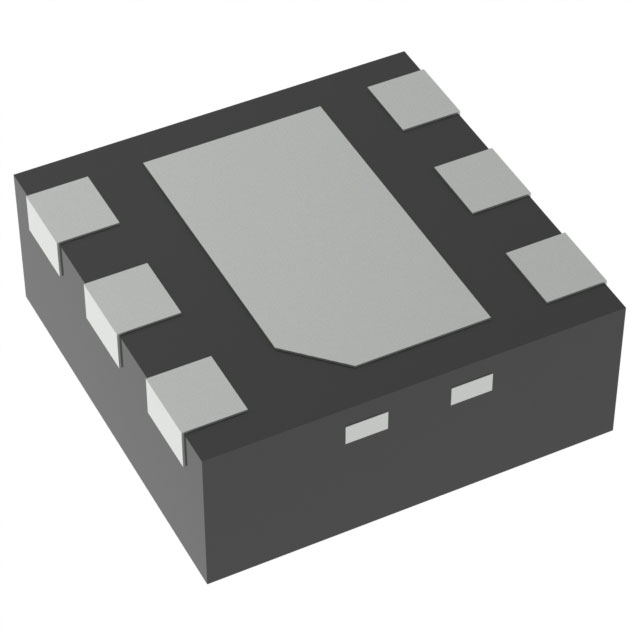 Texas Instruments TPS61040DRVTG4Unknown | Integrated Circuits (ICs) | IC LED DRV RGLTR PWM 350MA 6WSON |
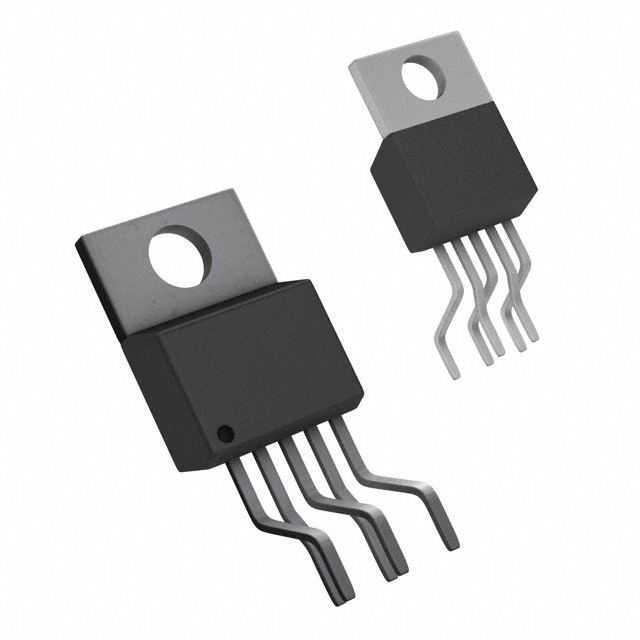 Texas Instruments LP3876ET-2.5Obsolete | Integrated Circuits (ICs) | IC REG LINEAR 2.5V 3A TO220-5 |
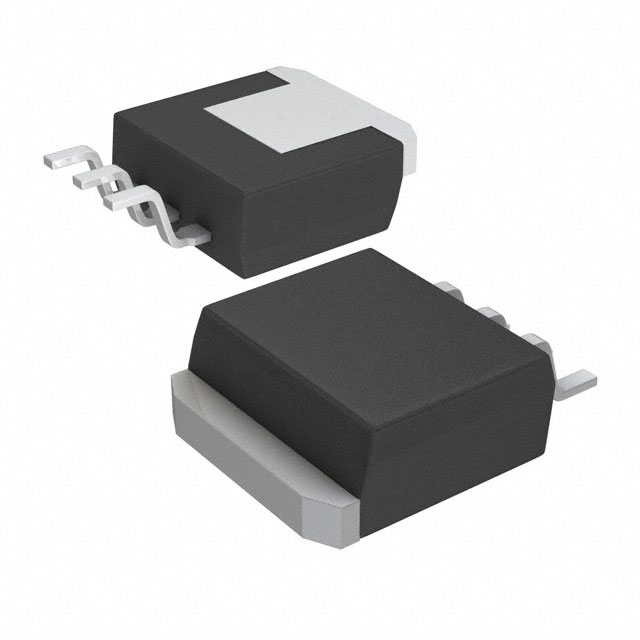 Texas Instruments LMS1585ACSX-ADJObsolete | Integrated Circuits (ICs) | IC REG LIN POS ADJ 5A DDPAK |
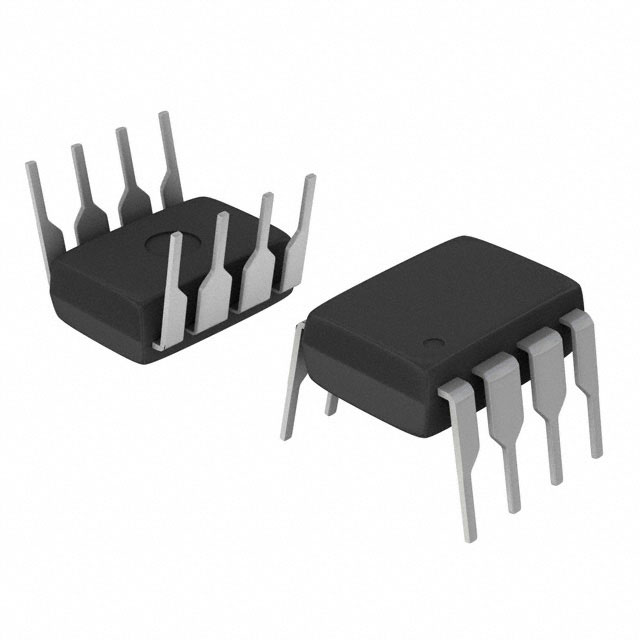 Texas Instruments INA111APG4Obsolete | Integrated Circuits (ICs) | IC INST AMP 1 CIRCUIT 8DIP |
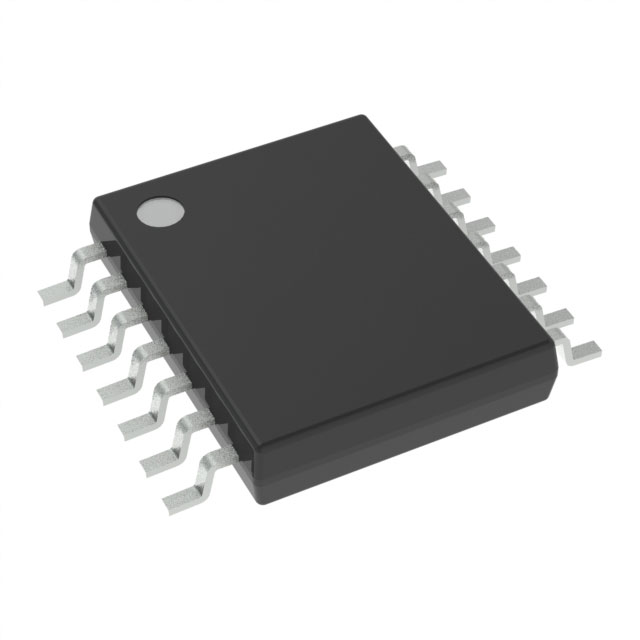 Texas Instruments | Integrated Circuits (ICs) | AUTOMOTIVE, QUAD 36V 1.2MHZ OPERATIONAL AMPLIFIER |
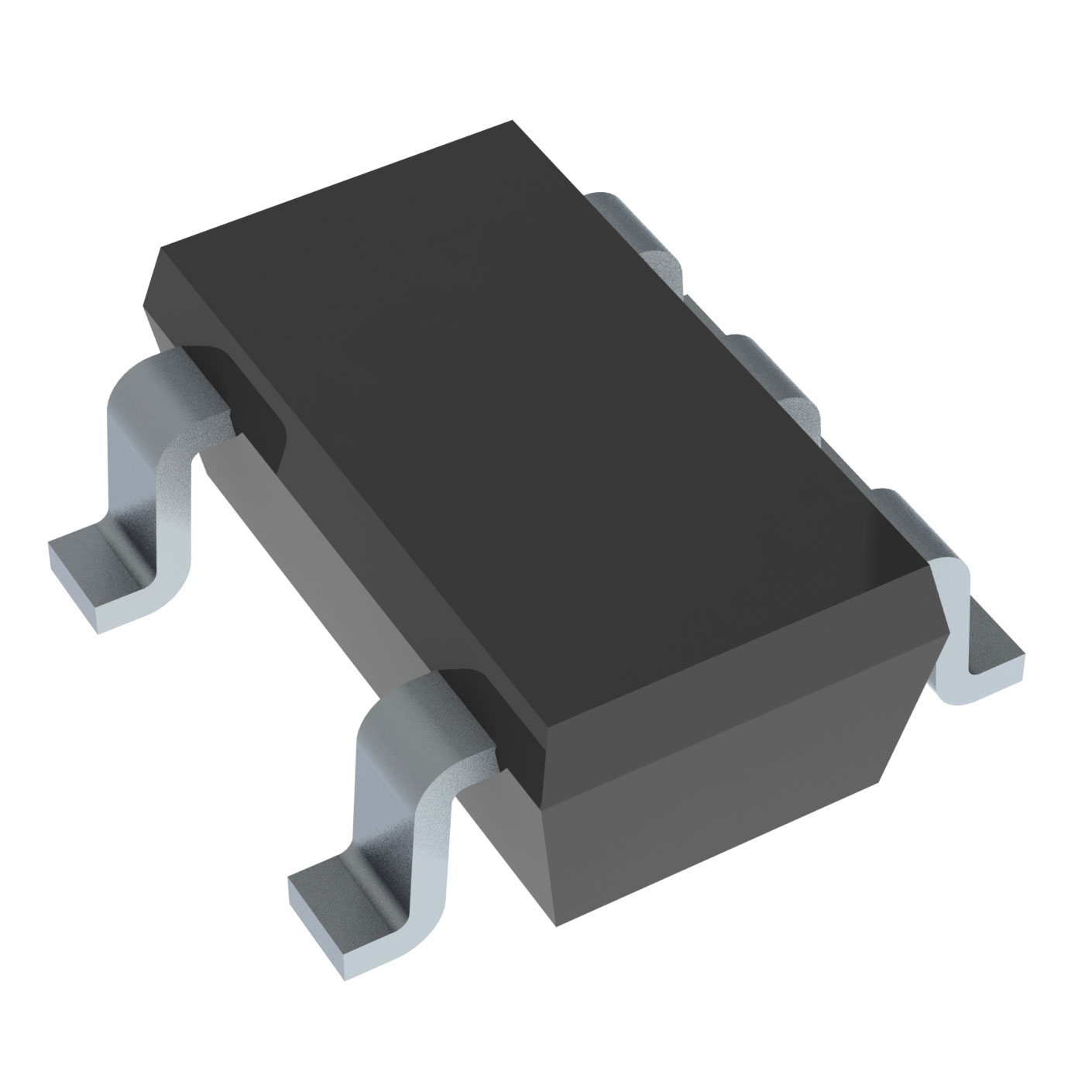 Texas Instruments OPA340NA/3KG4Unknown | Integrated Circuits (ICs) | IC OPAMP GP 1 CIRCUIT SOT23-5 |
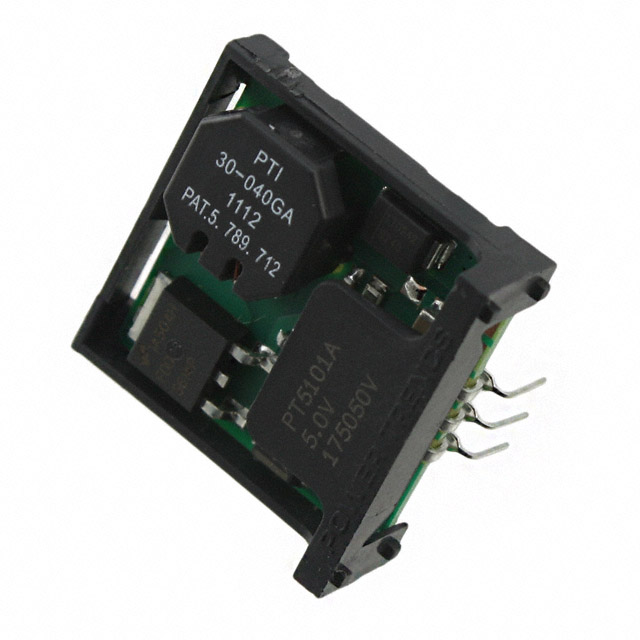 Texas Instruments PT5112AObsolete | Power Supplies - Board Mount | DC DC CONVERTER 8V 8W |
| Series | Category | # Parts | Status | Description |
|---|---|---|---|---|
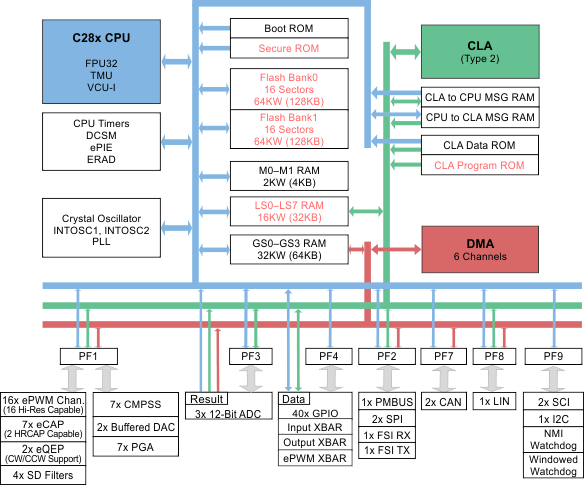
TMS320F280039C-Q1Automotive C2000™ 32-bit MCU 120-MHz 384-KB flash, FPU, TMU with CLA, CLB, AES and CAN-FD | Microcontrollers | 9 | Active | The TMS320F28003x (F28003x) is a member of the C2000™ real-time microcontroller family of scalable, ultra-low latency devices designed for efficiency in power electronics, including but not limited to: high power density, high switching frequencies, and supporting the use of GaN and SiC technologies.
These include suchapplicationsas:
Thereal-time control subsystemis based on TI’s 32-bit C28x DSP core, which provides 120 MHz of signal-processing performance for floating- or fixed-point code running from either on-chip flash or SRAM. The C28x CPU is further boosted by theFloating-Point Unit (FPU),Trigonometric Math Unit (TMU), andVCRC (Cyclical Redundancy Check) extended instruction sets, speeding up common algorithms key to real-time control systems.
The CLA allows significant offloading of common tasks from the main C28x CPU. The CLA is an independent 32-bit floating-point math accelerator that executes in parallel with the CPU. Additionally, the CLA has its own dedicated memory resources and it can directly access the key peripherals that are required in a typical control system. Support of a subset of ANSI C is standard, as are key features like hardware breakpoints and hardware task-switching.
The F28003x supports up to 384KB (192KW) of flash memory divided into three 128KB (64KW) banks, which enable programming and execution in parallel. Up to 69KB (34.5KW) of on-chip SRAM is also available to supplement the flash memory.
The Live Firmware Update hardware enhancements on F28003x allow fast context switching from the old firmware to the new firmware to minimize application downtime when updating the device firmware.
High-performance analog blocks are integrated on the F28003x real-time microcontroller (MCU) and are closely coupled with the processing and PWM units to provide optimal real-time signal chain performance. Sixteen PWM channels, all supporting frequency-independent resolution modes, enable control of various power stages from a 3-phase inverter to power factor correction and advanced multilevel power topologies.
The inclusion of the Configurable Logic Block (CLB) allows the user to addcustom logicand potentiallyintegrate FPGA-like functionsinto the C2000 real-time MCU.
Interfacing is supported through various industry-standard communication ports (such as SPI, SCI, I2C, PMBus, LIN, CAN and CAN FD) and offersmultiple pin-muxing optionsfor optimal signal placement. TheFast Serial Interface (FSI)enables up to 200Mbps of robust communications across an isolation boundary.
New to the C2000 platform is theHost Interface Controller (HIC), a high-throughput interface that allows an external host to access the resources of the TMS320F28003x directly.
Want to learn more about features that make C2000 Real-Time MCUs the right choice for your real-time control system? Check outThe Essential Guide for Developing With C2000™ Real-Time Microcontrollersand visit theC2000™ real-time control MCUspage.
TheGetting Started With C2000™ Real-Time Control Microcontrollers (MCUs) Getting Started Guidecovers all aspects of development with C2000 devices from hardware to support resources. In addition to key reference documents, each section provides relevant links and resources to further expand on the information covered.
Ready to get started? Check out theTMDSCNCD280039Cevaluation board and downloadC2000Ware.
The TMS320F28003x (F28003x) is a member of the C2000™ real-time microcontroller family of scalable, ultra-low latency devices designed for efficiency in power electronics, including but not limited to: high power density, high switching frequencies, and supporting the use of GaN and SiC technologies.
These include suchapplicationsas:
Thereal-time control subsystemis based on TI’s 32-bit C28x DSP core, which provides 120 MHz of signal-processing performance for floating- or fixed-point code running from either on-chip flash or SRAM. The C28x CPU is further boosted by theFloating-Point Unit (FPU),Trigonometric Math Unit (TMU), andVCRC (Cyclical Redundancy Check) extended instruction sets, speeding up common algorithms key to real-time control systems.
The CLA allows significant offloading of common tasks from the main C28x CPU. The CLA is an independent 32-bit floating-point math accelerator that executes in parallel with the CPU. Additionally, the CLA has its own dedicated memory resources and it can directly access the key peripherals that are required in a typical control system. Support of a subset of ANSI C is standard, as are key features like hardware breakpoints and hardware task-switching.
The F28003x supports up to 384KB (192KW) of flash memory divided into three 128KB (64KW) banks, which enable programming and execution in parallel. Up to 69KB (34.5KW) of on-chip SRAM is also available to supplement the flash memory.
The Live Firmware Update hardware enhancements on F28003x allow fast context switching from the old firmware to the new firmware to minimize application downtime when updating the device firmware.
High-performance analog blocks are integrated on the F28003x real-time microcontroller (MCU) and are closely coupled with the processing and PWM units to provide optimal real-time signal chain performance. Sixteen PWM channels, all supporting frequency-independent resolution modes, enable control of various power stages from a 3-phase inverter to power factor correction and advanced multilevel power topologies.
The inclusion of the Configurable Logic Block (CLB) allows the user to addcustom logicand potentiallyintegrate FPGA-like functionsinto the C2000 real-time MCU.
Interfacing is supported through various industry-standard communication ports (such as SPI, SCI, I2C, PMBus, LIN, CAN and CAN FD) and offersmultiple pin-muxing optionsfor optimal signal placement. TheFast Serial Interface (FSI)enables up to 200Mbps of robust communications across an isolation boundary.
New to the C2000 platform is theHost Interface Controller (HIC), a high-throughput interface that allows an external host to access the resources of the TMS320F28003x directly.
Want to learn more about features that make C2000 Real-Time MCUs the right choice for your real-time control system? Check outThe Essential Guide for Developing With C2000™ Real-Time Microcontrollersand visit theC2000™ real-time control MCUspage.
TheGetting Started With C2000™ Real-Time Control Microcontrollers (MCUs) Getting Started Guidecovers all aspects of development with C2000 devices from hardware to support resources. In addition to key reference documents, each section provides relevant links and resources to further expand on the information covered.
Ready to get started? Check out theTMDSCNCD280039Cevaluation board and downloadC2000Ware. |
TMS320F280040C-Q1Automotive C2000™ 32-bit MCU with 100 MHz, FPU, TMU, 128-KB flash, InstaSPIN-FOC, CLB, PGAs, SDFM | Microcontrollers | 2 | Active | C2000™ 32-bit microcontrollersare optimized for processing, sensing, and actuation to improve closed-loop performance inreal-time control applicationssuch asindustrial motor drives;solar inverters and digital power;electrical vehicles and transportation;motor control; andsensing and signal processing.
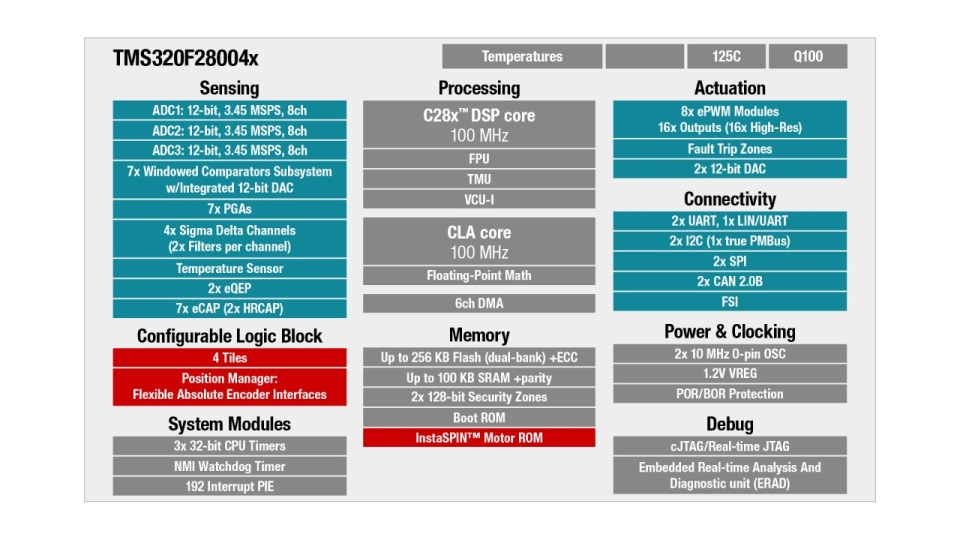
The TMS320F28004x (F28004x) is a powerful 32-bit floating-point microcontroller unit (MCU) that lets designers incorporate crucial control peripherals, differentiated analog, and nonvolatile memory on a single device.
The real-time control subsystem is based on TI’s 32-bit C28x CPU, which provides 100 MHz of signal processing performance. The C28x CPU is further boosted by the new TMU extended instruction set, which enables fast execution of algorithms with trigonometric operations commonly found in transforms and torque loop calculations; and the VCU-I extended instruction set, which reduces the latency for complex math operations commonly found in encoded applications.
The CLA allows significant offloading of common tasks from the main C28x CPU. The CLA is an independent 32-bit floating-point math accelerator that executes in parallel with the CPU. Additionally, the CLA has its own dedicated memory resources and it can directly access the key peripherals that are required in a typical control system. Support of a subset of ANSI C is standard, as are key features like hardware breakpoints and hardware task-switching.
The F28004x supports up to 256KB (128KW) of flash memory divided into two 128KB (64KW) banks, which enables programming and execution in parallel. Up to 100KB (50KW) of on-chip SRAM is also available in blocks of 4KB (2KW) and 16KB (8KW) for efficient system partitioning. Flash ECC, SRAM ECC/parity, and dual-zone security are also supported.
High-performance analog blocks are integrated on the F28004x MCU to further enable system consolidation. Three separate 12-bit ADCs provide precise and efficient management of multiple analog signals, which ultimately boosts system throughput. Seven PGAs on the analog front end enable on-chip voltage scaling before conversion. Seven analog comparator modules provide continuous monitoring of input voltage levels for trip conditions.
The TMS320C2000™ microcontrollers contain industry-leading control peripherals with frequency-independent ePWM/HRPWM and eCAP allow for a best-in-class level of control to the system. The built-in 4-channel SDFM allows for seamless integration of an oversampling sigma-delta modulator across an isolation barrier.
Connectivity is supported through various industry-standard communication ports (such as SPI, SCI, I2C, LIN, and CAN) and offers multiple muxing options for optimal signal placement in a variety of applications. New to the C2000 platform is the fully compliant PMBus. Additionally, in an industry first, the FSI enables high-speed, robust communication to complement the rich set of peripherals that are embedded in the device.
A specially enabled device variant, TMS320F28004xC, allows access to the Configurable Logic Block (CLB) for additional interfacing features and allows access to the secure ROM, which includes a library to enable InstaSPIN-FOC™. See Device Comparison for more information.
The Embedded Real-Time Analysis and Diagnostic (ERAD) module enhances the debug and system analysis capabilities of the device by providing additional hardware breakpoints and counters for profiling.
Want to learn more about features that make C2000 Real-Time MCUs the right choice for your real-time control system? Check outThe Essential Guide for Developing With C2000™ Real-Time Microcontrollersand visit theC2000™ real-time control MCUspage.
TheGetting Started With C2000™ Real-Time Control Microcontrollers (MCUs) Getting Started Guidecovers all aspects of development with C2000 devices from hardware to support resources. In addition to key reference documents, each section provides relevant links and resources to further expand on the information covered.
Ready to get started? Check out theTMDSCNCD280049Cor theLAUNCHXL-F280049Cevaluation boards and downloadC2000Ware.
C2000™ 32-bit microcontrollersare optimized for processing, sensing, and actuation to improve closed-loop performance inreal-time control applicationssuch asindustrial motor drives;solar inverters and digital power;electrical vehicles and transportation;motor control; andsensing and signal processing.
The TMS320F28004x (F28004x) is a powerful 32-bit floating-point microcontroller unit (MCU) that lets designers incorporate crucial control peripherals, differentiated analog, and nonvolatile memory on a single device.
The real-time control subsystem is based on TI’s 32-bit C28x CPU, which provides 100 MHz of signal processing performance. The C28x CPU is further boosted by the new TMU extended instruction set, which enables fast execution of algorithms with trigonometric operations commonly found in transforms and torque loop calculations; and the VCU-I extended instruction set, which reduces the latency for complex math operations commonly found in encoded applications.
The CLA allows significant offloading of common tasks from the main C28x CPU. The CLA is an independent 32-bit floating-point math accelerator that executes in parallel with the CPU. Additionally, the CLA has its own dedicated memory resources and it can directly access the key peripherals that are required in a typical control system. Support of a subset of ANSI C is standard, as are key features like hardware breakpoints and hardware task-switching.
The F28004x supports up to 256KB (128KW) of flash memory divided into two 128KB (64KW) banks, which enables programming and execution in parallel. Up to 100KB (50KW) of on-chip SRAM is also available in blocks of 4KB (2KW) and 16KB (8KW) for efficient system partitioning. Flash ECC, SRAM ECC/parity, and dual-zone security are also supported.
High-performance analog blocks are integrated on the F28004x MCU to further enable system consolidation. Three separate 12-bit ADCs provide precise and efficient management of multiple analog signals, which ultimately boosts system throughput. Seven PGAs on the analog front end enable on-chip voltage scaling before conversion. Seven analog comparator modules provide continuous monitoring of input voltage levels for trip conditions.
The TMS320C2000™ microcontrollers contain industry-leading control peripherals with frequency-independent ePWM/HRPWM and eCAP allow for a best-in-class level of control to the system. The built-in 4-channel SDFM allows for seamless integration of an oversampling sigma-delta modulator across an isolation barrier.
Connectivity is supported through various industry-standard communication ports (such as SPI, SCI, I2C, LIN, and CAN) and offers multiple muxing options for optimal signal placement in a variety of applications. New to the C2000 platform is the fully compliant PMBus. Additionally, in an industry first, the FSI enables high-speed, robust communication to complement the rich set of peripherals that are embedded in the device.
A specially enabled device variant, TMS320F28004xC, allows access to the Configurable Logic Block (CLB) for additional interfacing features and allows access to the secure ROM, which includes a library to enable InstaSPIN-FOC™. See Device Comparison for more information.
The Embedded Real-Time Analysis and Diagnostic (ERAD) module enhances the debug and system analysis capabilities of the device by providing additional hardware breakpoints and counters for profiling.
Want to learn more about features that make C2000 Real-Time MCUs the right choice for your real-time control system? Check outThe Essential Guide for Developing With C2000™ Real-Time Microcontrollersand visit theC2000™ real-time control MCUspage.
TheGetting Started With C2000™ Real-Time Control Microcontrollers (MCUs) Getting Started Guidecovers all aspects of development with C2000 devices from hardware to support resources. In addition to key reference documents, each section provides relevant links and resources to further expand on the information covered.
Ready to get started? Check out theTMDSCNCD280049Cor theLAUNCHXL-F280049Cevaluation boards and downloadC2000Ware. |
TMS320F280041C-Q1Automotive C2000™ 32-bit MCU with 100 MHz, FPU, TMU, 128 KB flash, InstaSPIN-FOC, CLB, PGAs, SDFM | Microcontrollers | 8 | Active | C2000™ 32-bit microcontrollersare optimized for processing, sensing, and actuation to improve closed-loop performance inreal-time control applicationssuch asindustrial motor drives;solar inverters and digital power;electrical vehicles and transportation;motor control; andsensing and signal processing.
The TMS320F28004x (F28004x) is a powerful 32-bit floating-point microcontroller unit (MCU) that lets designers incorporate crucial control peripherals, differentiated analog, and nonvolatile memory on a single device.
The real-time control subsystem is based on TI’s 32-bit C28x CPU, which provides 100 MHz of signal processing performance. The C28x CPU is further boosted by the new TMU extended instruction set, which enables fast execution of algorithms with trigonometric operations commonly found in transforms and torque loop calculations; and the VCU-I extended instruction set, which reduces the latency for complex math operations commonly found in encoded applications.
The CLA allows significant offloading of common tasks from the main C28x CPU. The CLA is an independent 32-bit floating-point math accelerator that executes in parallel with the CPU. Additionally, the CLA has its own dedicated memory resources and it can directly access the key peripherals that are required in a typical control system. Support of a subset of ANSI C is standard, as are key features like hardware breakpoints and hardware task-switching.
The F28004x supports up to 256KB (128KW) of flash memory divided into two 128KB (64KW) banks, which enables programming and execution in parallel. Up to 100KB (50KW) of on-chip SRAM is also available in blocks of 4KB (2KW) and 16KB (8KW) for efficient system partitioning. Flash ECC, SRAM ECC/parity, and dual-zone security are also supported.
High-performance analog blocks are integrated on the F28004x MCU to further enable system consolidation. Three separate 12-bit ADCs provide precise and efficient management of multiple analog signals, which ultimately boosts system throughput. Seven PGAs on the analog front end enable on-chip voltage scaling before conversion. Seven analog comparator modules provide continuous monitoring of input voltage levels for trip conditions.
The TMS320C2000™ microcontrollers contain industry-leading control peripherals with frequency-independent ePWM/HRPWM and eCAP allow for a best-in-class level of control to the system. The built-in 4-channel SDFM allows for seamless integration of an oversampling sigma-delta modulator across an isolation barrier.
Connectivity is supported through various industry-standard communication ports (such as SPI, SCI, I2C, LIN, and CAN) and offers multiple muxing options for optimal signal placement in a variety of applications. New to the C2000 platform is the fully compliant PMBus. Additionally, in an industry first, the FSI enables high-speed, robust communication to complement the rich set of peripherals that are embedded in the device.
A specially enabled device variant, TMS320F28004xC, allows access to the Configurable Logic Block (CLB) for additional interfacing features and allows access to the secure ROM, which includes a library to enable InstaSPIN-FOC™. See Device Comparison for more information.
The Embedded Real-Time Analysis and Diagnostic (ERAD) module enhances the debug and system analysis capabilities of the device by providing additional hardware breakpoints and counters for profiling.
Want to learn more about features that make C2000 Real-Time MCUs the right choice for your real-time control system? Check outThe Essential Guide for Developing With C2000™ Real-Time Microcontrollersand visit theC2000™ real-time control MCUspage.
TheGetting Started With C2000™ Real-Time Control Microcontrollers (MCUs) Getting Started Guidecovers all aspects of development with C2000 devices from hardware to support resources. In addition to key reference documents, each section provides relevant links and resources to further expand on the information covered.
Ready to get started? Check out theTMDSCNCD280049Cor theLAUNCHXL-F280049Cevaluation boards and downloadC2000Ware.
C2000™ 32-bit microcontrollersare optimized for processing, sensing, and actuation to improve closed-loop performance inreal-time control applicationssuch asindustrial motor drives;solar inverters and digital power;electrical vehicles and transportation;motor control; andsensing and signal processing.
The TMS320F28004x (F28004x) is a powerful 32-bit floating-point microcontroller unit (MCU) that lets designers incorporate crucial control peripherals, differentiated analog, and nonvolatile memory on a single device.
The real-time control subsystem is based on TI’s 32-bit C28x CPU, which provides 100 MHz of signal processing performance. The C28x CPU is further boosted by the new TMU extended instruction set, which enables fast execution of algorithms with trigonometric operations commonly found in transforms and torque loop calculations; and the VCU-I extended instruction set, which reduces the latency for complex math operations commonly found in encoded applications.
The CLA allows significant offloading of common tasks from the main C28x CPU. The CLA is an independent 32-bit floating-point math accelerator that executes in parallel with the CPU. Additionally, the CLA has its own dedicated memory resources and it can directly access the key peripherals that are required in a typical control system. Support of a subset of ANSI C is standard, as are key features like hardware breakpoints and hardware task-switching.
The F28004x supports up to 256KB (128KW) of flash memory divided into two 128KB (64KW) banks, which enables programming and execution in parallel. Up to 100KB (50KW) of on-chip SRAM is also available in blocks of 4KB (2KW) and 16KB (8KW) for efficient system partitioning. Flash ECC, SRAM ECC/parity, and dual-zone security are also supported.
High-performance analog blocks are integrated on the F28004x MCU to further enable system consolidation. Three separate 12-bit ADCs provide precise and efficient management of multiple analog signals, which ultimately boosts system throughput. Seven PGAs on the analog front end enable on-chip voltage scaling before conversion. Seven analog comparator modules provide continuous monitoring of input voltage levels for trip conditions.
The TMS320C2000™ microcontrollers contain industry-leading control peripherals with frequency-independent ePWM/HRPWM and eCAP allow for a best-in-class level of control to the system. The built-in 4-channel SDFM allows for seamless integration of an oversampling sigma-delta modulator across an isolation barrier.
Connectivity is supported through various industry-standard communication ports (such as SPI, SCI, I2C, LIN, and CAN) and offers multiple muxing options for optimal signal placement in a variety of applications. New to the C2000 platform is the fully compliant PMBus. Additionally, in an industry first, the FSI enables high-speed, robust communication to complement the rich set of peripherals that are embedded in the device.
A specially enabled device variant, TMS320F28004xC, allows access to the Configurable Logic Block (CLB) for additional interfacing features and allows access to the secure ROM, which includes a library to enable InstaSPIN-FOC™. See Device Comparison for more information.
The Embedded Real-Time Analysis and Diagnostic (ERAD) module enhances the debug and system analysis capabilities of the device by providing additional hardware breakpoints and counters for profiling.
Want to learn more about features that make C2000 Real-Time MCUs the right choice for your real-time control system? Check outThe Essential Guide for Developing With C2000™ Real-Time Microcontrollersand visit theC2000™ real-time control MCUspage.
TheGetting Started With C2000™ Real-Time Control Microcontrollers (MCUs) Getting Started Guidecovers all aspects of development with C2000 devices from hardware to support resources. In addition to key reference documents, each section provides relevant links and resources to further expand on the information covered.
Ready to get started? Check out theTMDSCNCD280049Cor theLAUNCHXL-F280049Cevaluation boards and downloadC2000Ware. |
TMS320F280045C2000™ 32-bit MCU with 100 MHz, FPU, TMU, 256 KB flash, PGAs, SDFM | Integrated Circuits (ICs) | 3 | Active | C2000™ 32-bit microcontrollersare optimized for processing, sensing, and actuation to improve closed-loop performance inreal-time control applicationssuch asindustrial motor drives;solar inverters and digital power;electrical vehicles and transportation;motor control; andsensing and signal processing.
The TMS320F28004x (F28004x) is a powerful 32-bit floating-point microcontroller unit (MCU) that lets designers incorporate crucial control peripherals, differentiated analog, and nonvolatile memory on a single device.
The real-time control subsystem is based on TI’s 32-bit C28x CPU, which provides 100 MHz of signal processing performance. The C28x CPU is further boosted by the new TMU extended instruction set, which enables fast execution of algorithms with trigonometric operations commonly found in transforms and torque loop calculations; and the VCU-I extended instruction set, which reduces the latency for complex math operations commonly found in encoded applications.
The CLA allows significant offloading of common tasks from the main C28x CPU. The CLA is an independent 32-bit floating-point math accelerator that executes in parallel with the CPU. Additionally, the CLA has its own dedicated memory resources and it can directly access the key peripherals that are required in a typical control system. Support of a subset of ANSI C is standard, as are key features like hardware breakpoints and hardware task-switching.
The F28004x supports up to 256KB (128KW) of flash memory divided into two 128KB (64KW) banks, which enables programming and execution in parallel. Up to 100KB (50KW) of on-chip SRAM is also available in blocks of 4KB (2KW) and 16KB (8KW) for efficient system partitioning. Flash ECC, SRAM ECC/parity, and dual-zone security are also supported.
High-performance analog blocks are integrated on the F28004x MCU to further enable system consolidation. Three separate 12-bit ADCs provide precise and efficient management of multiple analog signals, which ultimately boosts system throughput. Seven PGAs on the analog front end enable on-chip voltage scaling before conversion. Seven analog comparator modules provide continuous monitoring of input voltage levels for trip conditions.
The TMS320C2000™ microcontrollers contain industry-leading control peripherals with frequency-independent ePWM/HRPWM and eCAP allow for a best-in-class level of control to the system. The built-in 4-channel SDFM allows for seamless integration of an oversampling sigma-delta modulator across an isolation barrier.
Connectivity is supported through various industry-standard communication ports (such as SPI, SCI, I2C, LIN, and CAN) and offers multiple muxing options for optimal signal placement in a variety of applications. New to the C2000 platform is the fully compliant PMBus. Additionally, in an industry first, the FSI enables high-speed, robust communication to complement the rich set of peripherals that are embedded in the device.
A specially enabled device variant, TMS320F28004xC, allows access to the Configurable Logic Block (CLB) for additional interfacing features and allows access to the secure ROM, which includes a library to enable InstaSPIN-FOC™. See Device Comparison for more information.
The Embedded Real-Time Analysis and Diagnostic (ERAD) module enhances the debug and system analysis capabilities of the device by providing additional hardware breakpoints and counters for profiling.
Want to learn more about features that make C2000 Real-Time MCUs the right choice for your real-time control system? Check outThe Essential Guide for Developing With C2000™ Real-Time Microcontrollersand visit theC2000™ real-time control MCUspage.
TheGetting Started With C2000™ Real-Time Control Microcontrollers (MCUs) Getting Started Guidecovers all aspects of development with C2000 devices from hardware to support resources. In addition to key reference documents, each section provides relevant links and resources to further expand on the information covered.
Ready to get started? Check out theTMDSCNCD280049Cor theLAUNCHXL-F280049Cevaluation boards and downloadC2000Ware.
C2000™ 32-bit microcontrollersare optimized for processing, sensing, and actuation to improve closed-loop performance inreal-time control applicationssuch asindustrial motor drives;solar inverters and digital power;electrical vehicles and transportation;motor control; andsensing and signal processing.
The TMS320F28004x (F28004x) is a powerful 32-bit floating-point microcontroller unit (MCU) that lets designers incorporate crucial control peripherals, differentiated analog, and nonvolatile memory on a single device.
The real-time control subsystem is based on TI’s 32-bit C28x CPU, which provides 100 MHz of signal processing performance. The C28x CPU is further boosted by the new TMU extended instruction set, which enables fast execution of algorithms with trigonometric operations commonly found in transforms and torque loop calculations; and the VCU-I extended instruction set, which reduces the latency for complex math operations commonly found in encoded applications.
The CLA allows significant offloading of common tasks from the main C28x CPU. The CLA is an independent 32-bit floating-point math accelerator that executes in parallel with the CPU. Additionally, the CLA has its own dedicated memory resources and it can directly access the key peripherals that are required in a typical control system. Support of a subset of ANSI C is standard, as are key features like hardware breakpoints and hardware task-switching.
The F28004x supports up to 256KB (128KW) of flash memory divided into two 128KB (64KW) banks, which enables programming and execution in parallel. Up to 100KB (50KW) of on-chip SRAM is also available in blocks of 4KB (2KW) and 16KB (8KW) for efficient system partitioning. Flash ECC, SRAM ECC/parity, and dual-zone security are also supported.
High-performance analog blocks are integrated on the F28004x MCU to further enable system consolidation. Three separate 12-bit ADCs provide precise and efficient management of multiple analog signals, which ultimately boosts system throughput. Seven PGAs on the analog front end enable on-chip voltage scaling before conversion. Seven analog comparator modules provide continuous monitoring of input voltage levels for trip conditions.
The TMS320C2000™ microcontrollers contain industry-leading control peripherals with frequency-independent ePWM/HRPWM and eCAP allow for a best-in-class level of control to the system. The built-in 4-channel SDFM allows for seamless integration of an oversampling sigma-delta modulator across an isolation barrier.
Connectivity is supported through various industry-standard communication ports (such as SPI, SCI, I2C, LIN, and CAN) and offers multiple muxing options for optimal signal placement in a variety of applications. New to the C2000 platform is the fully compliant PMBus. Additionally, in an industry first, the FSI enables high-speed, robust communication to complement the rich set of peripherals that are embedded in the device.
A specially enabled device variant, TMS320F28004xC, allows access to the Configurable Logic Block (CLB) for additional interfacing features and allows access to the secure ROM, which includes a library to enable InstaSPIN-FOC™. See Device Comparison for more information.
The Embedded Real-Time Analysis and Diagnostic (ERAD) module enhances the debug and system analysis capabilities of the device by providing additional hardware breakpoints and counters for profiling.
Want to learn more about features that make C2000 Real-Time MCUs the right choice for your real-time control system? Check outThe Essential Guide for Developing With C2000™ Real-Time Microcontrollersand visit theC2000™ real-time control MCUspage.
TheGetting Started With C2000™ Real-Time Control Microcontrollers (MCUs) Getting Started Guidecovers all aspects of development with C2000 devices from hardware to support resources. In addition to key reference documents, each section provides relevant links and resources to further expand on the information covered.
Ready to get started? Check out theTMDSCNCD280049Cor theLAUNCHXL-F280049Cevaluation boards and downloadC2000Ware. |
TMS320F280048C-Q1Automotive C2000™ 32-bit MCU w/ 100 MHz, FPU, TMU, 256 KB flash, CLA, InstaSPIN-FOC, CLB, PGAs, SDFM | Embedded | 2 | Active | C2000™ 32-bit microcontrollersare optimized for processing, sensing, and actuation to improve closed-loop performance inreal-time control applicationssuch asindustrial motor drives;solar inverters and digital power;electrical vehicles and transportation;motor control; andsensing and signal processing.
The TMS320F28004x (F28004x) is a powerful 32-bit floating-point microcontroller unit (MCU) that lets designers incorporate crucial control peripherals, differentiated analog, and nonvolatile memory on a single device.
The real-time control subsystem is based on TI’s 32-bit C28x CPU, which provides 100 MHz of signal processing performance. The C28x CPU is further boosted by the new TMU extended instruction set, which enables fast execution of algorithms with trigonometric operations commonly found in transforms and torque loop calculations; and the VCU-I extended instruction set, which reduces the latency for complex math operations commonly found in encoded applications.
The CLA allows significant offloading of common tasks from the main C28x CPU. The CLA is an independent 32-bit floating-point math accelerator that executes in parallel with the CPU. Additionally, the CLA has its own dedicated memory resources and it can directly access the key peripherals that are required in a typical control system. Support of a subset of ANSI C is standard, as are key features like hardware breakpoints and hardware task-switching.
The F28004x supports up to 256KB (128KW) of flash memory divided into two 128KB (64KW) banks, which enables programming and execution in parallel. Up to 100KB (50KW) of on-chip SRAM is also available in blocks of 4KB (2KW) and 16KB (8KW) for efficient system partitioning. Flash ECC, SRAM ECC/parity, and dual-zone security are also supported.
High-performance analog blocks are integrated on the F28004x MCU to further enable system consolidation. Three separate 12-bit ADCs provide precise and efficient management of multiple analog signals, which ultimately boosts system throughput. Seven PGAs on the analog front end enable on-chip voltage scaling before conversion. Seven analog comparator modules provide continuous monitoring of input voltage levels for trip conditions.
The TMS320C2000™ microcontrollers contain industry-leading control peripherals with frequency-independent ePWM/HRPWM and eCAP allow for a best-in-class level of control to the system. The built-in 4-channel SDFM allows for seamless integration of an oversampling sigma-delta modulator across an isolation barrier.
Connectivity is supported through various industry-standard communication ports (such as SPI, SCI, I2C, LIN, and CAN) and offers multiple muxing options for optimal signal placement in a variety of applications. New to the C2000 platform is the fully compliant PMBus. Additionally, in an industry first, the FSI enables high-speed, robust communication to complement the rich set of peripherals that are embedded in the device.
A specially enabled device variant, TMS320F28004xC, allows access to the Configurable Logic Block (CLB) for additional interfacing features and allows access to the secure ROM, which includes a library to enable InstaSPIN-FOC™. See Device Comparison for more information.
The Embedded Real-Time Analysis and Diagnostic (ERAD) module enhances the debug and system analysis capabilities of the device by providing additional hardware breakpoints and counters for profiling.
Want to learn more about features that make C2000 Real-Time MCUs the right choice for your real-time control system? Check outThe Essential Guide for Developing With C2000™ Real-Time Microcontrollersand visit theC2000™ real-time control MCUspage.
TheGetting Started With C2000™ Real-Time Control Microcontrollers (MCUs) Getting Started Guidecovers all aspects of development with C2000 devices from hardware to support resources. In addition to key reference documents, each section provides relevant links and resources to further expand on the information covered.
Ready to get started? Check out theTMDSCNCD280049Cor theLAUNCHXL-F280049Cevaluation boards and downloadC2000Ware.
C2000™ 32-bit microcontrollersare optimized for processing, sensing, and actuation to improve closed-loop performance inreal-time control applicationssuch asindustrial motor drives;solar inverters and digital power;electrical vehicles and transportation;motor control; andsensing and signal processing.
The TMS320F28004x (F28004x) is a powerful 32-bit floating-point microcontroller unit (MCU) that lets designers incorporate crucial control peripherals, differentiated analog, and nonvolatile memory on a single device.
The real-time control subsystem is based on TI’s 32-bit C28x CPU, which provides 100 MHz of signal processing performance. The C28x CPU is further boosted by the new TMU extended instruction set, which enables fast execution of algorithms with trigonometric operations commonly found in transforms and torque loop calculations; and the VCU-I extended instruction set, which reduces the latency for complex math operations commonly found in encoded applications.
The CLA allows significant offloading of common tasks from the main C28x CPU. The CLA is an independent 32-bit floating-point math accelerator that executes in parallel with the CPU. Additionally, the CLA has its own dedicated memory resources and it can directly access the key peripherals that are required in a typical control system. Support of a subset of ANSI C is standard, as are key features like hardware breakpoints and hardware task-switching.
The F28004x supports up to 256KB (128KW) of flash memory divided into two 128KB (64KW) banks, which enables programming and execution in parallel. Up to 100KB (50KW) of on-chip SRAM is also available in blocks of 4KB (2KW) and 16KB (8KW) for efficient system partitioning. Flash ECC, SRAM ECC/parity, and dual-zone security are also supported.
High-performance analog blocks are integrated on the F28004x MCU to further enable system consolidation. Three separate 12-bit ADCs provide precise and efficient management of multiple analog signals, which ultimately boosts system throughput. Seven PGAs on the analog front end enable on-chip voltage scaling before conversion. Seven analog comparator modules provide continuous monitoring of input voltage levels for trip conditions.
The TMS320C2000™ microcontrollers contain industry-leading control peripherals with frequency-independent ePWM/HRPWM and eCAP allow for a best-in-class level of control to the system. The built-in 4-channel SDFM allows for seamless integration of an oversampling sigma-delta modulator across an isolation barrier.
Connectivity is supported through various industry-standard communication ports (such as SPI, SCI, I2C, LIN, and CAN) and offers multiple muxing options for optimal signal placement in a variety of applications. New to the C2000 platform is the fully compliant PMBus. Additionally, in an industry first, the FSI enables high-speed, robust communication to complement the rich set of peripherals that are embedded in the device.
A specially enabled device variant, TMS320F28004xC, allows access to the Configurable Logic Block (CLB) for additional interfacing features and allows access to the secure ROM, which includes a library to enable InstaSPIN-FOC™. See Device Comparison for more information.
The Embedded Real-Time Analysis and Diagnostic (ERAD) module enhances the debug and system analysis capabilities of the device by providing additional hardware breakpoints and counters for profiling.
Want to learn more about features that make C2000 Real-Time MCUs the right choice for your real-time control system? Check outThe Essential Guide for Developing With C2000™ Real-Time Microcontrollersand visit theC2000™ real-time control MCUspage.
TheGetting Started With C2000™ Real-Time Control Microcontrollers (MCUs) Getting Started Guidecovers all aspects of development with C2000 devices from hardware to support resources. In addition to key reference documents, each section provides relevant links and resources to further expand on the information covered.
Ready to get started? Check out theTMDSCNCD280049Cor theLAUNCHXL-F280049Cevaluation boards and downloadC2000Ware. |
TMS320F280049C-Q1Automotive C2000™ 32-bit MCU w/ 100 MHz, FPU, TMU, 256 KB flash, CLA, InstaSPIN-FOC, CLB, PGAs, SDFM | Microcontrollers | 8 | Active | C2000™ 32-bit microcontrollersare optimized for processing, sensing, and actuation to improve closed-loop performance inreal-time control applicationssuch asindustrial motor drives;solar inverters and digital power;electrical vehicles and transportation;motor control; andsensing and signal processing.
The TMS320F28004x (F28004x) is a powerful 32-bit floating-point microcontroller unit (MCU) that lets designers incorporate crucial control peripherals, differentiated analog, and nonvolatile memory on a single device.
The real-time control subsystem is based on TI’s 32-bit C28x CPU, which provides 100 MHz of signal processing performance. The C28x CPU is further boosted by the new TMU extended instruction set, which enables fast execution of algorithms with trigonometric operations commonly found in transforms and torque loop calculations; and the VCU-I extended instruction set, which reduces the latency for complex math operations commonly found in encoded applications.
The CLA allows significant offloading of common tasks from the main C28x CPU. The CLA is an independent 32-bit floating-point math accelerator that executes in parallel with the CPU. Additionally, the CLA has its own dedicated memory resources and it can directly access the key peripherals that are required in a typical control system. Support of a subset of ANSI C is standard, as are key features like hardware breakpoints and hardware task-switching.
The F28004x supports up to 256KB (128KW) of flash memory divided into two 128KB (64KW) banks, which enables programming and execution in parallel. Up to 100KB (50KW) of on-chip SRAM is also available in blocks of 4KB (2KW) and 16KB (8KW) for efficient system partitioning. Flash ECC, SRAM ECC/parity, and dual-zone security are also supported.
High-performance analog blocks are integrated on the F28004x MCU to further enable system consolidation. Three separate 12-bit ADCs provide precise and efficient management of multiple analog signals, which ultimately boosts system throughput. Seven PGAs on the analog front end enable on-chip voltage scaling before conversion. Seven analog comparator modules provide continuous monitoring of input voltage levels for trip conditions.
The TMS320C2000™ microcontrollers contain industry-leading control peripherals with frequency-independent ePWM/HRPWM and eCAP allow for a best-in-class level of control to the system. The built-in 4-channel SDFM allows for seamless integration of an oversampling sigma-delta modulator across an isolation barrier.
Connectivity is supported through various industry-standard communication ports (such as SPI, SCI, I2C, LIN, and CAN) and offers multiple muxing options for optimal signal placement in a variety of applications. New to the C2000 platform is the fully compliant PMBus. Additionally, in an industry first, the FSI enables high-speed, robust communication to complement the rich set of peripherals that are embedded in the device.
A specially enabled device variant, TMS320F28004xC, allows access to the Configurable Logic Block (CLB) for additional interfacing features and allows access to the secure ROM, which includes a library to enable InstaSPIN-FOC™. See Device Comparison for more information.
The Embedded Real-Time Analysis and Diagnostic (ERAD) module enhances the debug and system analysis capabilities of the device by providing additional hardware breakpoints and counters for profiling.
Want to learn more about features that make C2000 Real-Time MCUs the right choice for your real-time control system? Check outThe Essential Guide for Developing With C2000™ Real-Time Microcontrollersand visit theC2000™ real-time control MCUspage.
TheGetting Started With C2000™ Real-Time Control Microcontrollers (MCUs) Getting Started Guidecovers all aspects of development with C2000 devices from hardware to support resources. In addition to key reference documents, each section provides relevant links and resources to further expand on the information covered.
Ready to get started? Check out theTMDSCNCD280049Cor theLAUNCHXL-F280049Cevaluation boards and downloadC2000Ware.
C2000™ 32-bit microcontrollersare optimized for processing, sensing, and actuation to improve closed-loop performance inreal-time control applicationssuch asindustrial motor drives;solar inverters and digital power;electrical vehicles and transportation;motor control; andsensing and signal processing.
The TMS320F28004x (F28004x) is a powerful 32-bit floating-point microcontroller unit (MCU) that lets designers incorporate crucial control peripherals, differentiated analog, and nonvolatile memory on a single device.
The real-time control subsystem is based on TI’s 32-bit C28x CPU, which provides 100 MHz of signal processing performance. The C28x CPU is further boosted by the new TMU extended instruction set, which enables fast execution of algorithms with trigonometric operations commonly found in transforms and torque loop calculations; and the VCU-I extended instruction set, which reduces the latency for complex math operations commonly found in encoded applications.
The CLA allows significant offloading of common tasks from the main C28x CPU. The CLA is an independent 32-bit floating-point math accelerator that executes in parallel with the CPU. Additionally, the CLA has its own dedicated memory resources and it can directly access the key peripherals that are required in a typical control system. Support of a subset of ANSI C is standard, as are key features like hardware breakpoints and hardware task-switching.
The F28004x supports up to 256KB (128KW) of flash memory divided into two 128KB (64KW) banks, which enables programming and execution in parallel. Up to 100KB (50KW) of on-chip SRAM is also available in blocks of 4KB (2KW) and 16KB (8KW) for efficient system partitioning. Flash ECC, SRAM ECC/parity, and dual-zone security are also supported.
High-performance analog blocks are integrated on the F28004x MCU to further enable system consolidation. Three separate 12-bit ADCs provide precise and efficient management of multiple analog signals, which ultimately boosts system throughput. Seven PGAs on the analog front end enable on-chip voltage scaling before conversion. Seven analog comparator modules provide continuous monitoring of input voltage levels for trip conditions.
The TMS320C2000™ microcontrollers contain industry-leading control peripherals with frequency-independent ePWM/HRPWM and eCAP allow for a best-in-class level of control to the system. The built-in 4-channel SDFM allows for seamless integration of an oversampling sigma-delta modulator across an isolation barrier.
Connectivity is supported through various industry-standard communication ports (such as SPI, SCI, I2C, LIN, and CAN) and offers multiple muxing options for optimal signal placement in a variety of applications. New to the C2000 platform is the fully compliant PMBus. Additionally, in an industry first, the FSI enables high-speed, robust communication to complement the rich set of peripherals that are embedded in the device.
A specially enabled device variant, TMS320F28004xC, allows access to the Configurable Logic Block (CLB) for additional interfacing features and allows access to the secure ROM, which includes a library to enable InstaSPIN-FOC™. See Device Comparison for more information.
The Embedded Real-Time Analysis and Diagnostic (ERAD) module enhances the debug and system analysis capabilities of the device by providing additional hardware breakpoints and counters for profiling.
Want to learn more about features that make C2000 Real-Time MCUs the right choice for your real-time control system? Check outThe Essential Guide for Developing With C2000™ Real-Time Microcontrollersand visit theC2000™ real-time control MCUspage.
TheGetting Started With C2000™ Real-Time Control Microcontrollers (MCUs) Getting Started Guidecovers all aspects of development with C2000 devices from hardware to support resources. In addition to key reference documents, each section provides relevant links and resources to further expand on the information covered.
Ready to get started? Check out theTMDSCNCD280049Cor theLAUNCHXL-F280049Cevaluation boards and downloadC2000Ware. |
TMS320F28377S-Q1C2000™ Enhanced Product 32-bit MCU with 800 MIPS, 2xCPU, 2xCLA, FPU, TMU, 1 MB flash, EMIF, 16b ADC | Uncategorized | 1155 | Active | The TMS320C672x is the next generation of Texas Instruments' C67x generation of high-performance 32-/64-bit floating-point digital signal processors. The TMS320C672x includes the TMS320C6727B, TMS320C6726B, TMS320C6722B, and TMS320C6720 devices.(1)
Enhanced C67x+ CPU. The C67x+ CPU is an enhanced version of the C67x CPU used on the C671x DSPs. It is compatible with the C67x CPU but offers significant improvements in speed, code density, and floating-point performance per clock cycle. At 350 MHz, the CPU is capable of a maximum performance of 2800 MIPS/2100 MFLOPS by executing up to eight instructions (six of which are floating-point instructions) in parallel each cycle. The CPU natively supports 32-bit fixed-point, 32-bit single-precision floating-point, and 64-bit double-precision floating-point arithmetic.
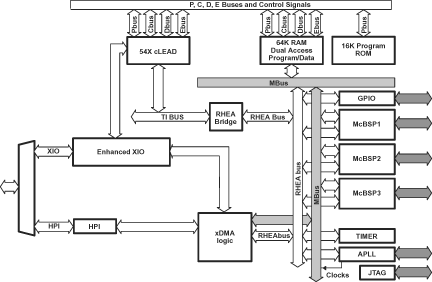
Efficient Memory System. The memory controller maps the large on-chip 256K-byte RAM and 384K-byte ROM as unified program/data memory. Development is simplified since there is no fixed division between program and data memory size as on some other devices.
The memory controller supports single-cycle data accesses from the C67x+ CPU to the RAM and ROM. Up to three parallel accesses to the internal RAM and ROM from three of the following four sources are supported:
The large (32K-byte) program cache translates to a high hit rate for most applications. This prevents most program/data access conflicts to the on-chip memory. It also enables effective program execution from an off-chip memory such as an SDRAM.
High-Performance Crossbar Switch. A high-performance crossbar switch acts as a central hub between the different bus masters (CPU, dMAX, UHPI) and different targets (peripherals and memory). The crossbar is partially connected; some connections are not supported (for example, UHPI-to-peripheral connections).
Multiple transfers occur in parallel through the crossbar as long as there is no conflict between bus masters for a particular target. When a conflict does occur, the arbitration is a simple and deterministic fixed-priority scheme.
The dMAX is given highest-priority since it is responsible for the most time-critical I/O transfers, followed next by the UHPI, and finally by the CPU.
dMAX Dual Data Movement Accelerator. The dMAX is a module designed to perform Data Movement Acceleration. The Data Movement Accelerator (dMAX) controller handles user-programmed data transfers between the internal data memory controller and the device peripherals on the C672x DSPs. The dMAX allows movement of data to/from any addressable memory space including internal memory, peripherals, and external memory.
The dMAX controller includes features such as the capability to perform three-dimensional data transfers for advanced data sorting, and the capability to manage a section of the memory as a circular buffer/FIFO with delay-tap based reading and writing of data. The dMAX controller is capable of concurrently processing two transfer requests (provided that they are to/from different source/destinations).
External Memory Interface (EMIF) for Flexibility and Expansion. The external memory interface on the C672x supports a single bank of SDRAM and a single bank of asynchronous memory. The EMIF data width is 16 bits wide on the C6726B, C6722B, and C6720 and 32 bits wide on the C6727B.
SDRAM support includes x16 and x32 SDRAM devices with 1, 2, or 4 banks.
The C6726B, C6722B, and C6720 support SDRAM devices up to 128M bits.
The C6727B extends SDRAM support to 256M-bit and 512M-bit devices.
Asynchronous memory support is typically used to boot from a parallel non-multiplexed NOR flash device that can be 8, 16, or 32 bits wide. Booting from larger flash devices than are natively supported by the dedicated EMIF address lines is accomplished by using general-purpose I/O pins for upper address lines.
The asynchronous memory interface can also be configured to support 8- or 16-bit-wide NAND flash. It includes a hardware ECC calculation (for single-bit errors) that can operate on blocks of data up to 512 bytes.
Universal Host-Port Interface (UHPI) for High-Speed Parallel I/O. The Universal Host-Port Interface (UHPI) is a parallel interface through which an external host CPU can access memories on the DSP.
Three modes are supported by the C672x UHPI:
The UHPI can also be restricted to accessing a single page (64K bytes) of memory anywhere in the address space of the C672x; this page can be changed, but only by the C672x CPU. This feature allows the UHPI to be used for high-speed data transfers even in systems where security is an important requirement.
The UHPI is only available on the C6727B.
Multichannel Audio Serial Ports (McASP0, McASP1, and McASP2) - Up to 16 Stereo Channels I2S.The multichannel audio serial port (McASP) seamlessly interfaces to CODECs, DACs, ADCs, and other devices. It supports the ubiquitous IIS format as well as many variations of this format, including time division multiplex (TDM) formats with up to 32 time slots.
Each McASP includes a transmit and receive section which may operate independently or synchronously; furthermore, each section includes its own flexible clock generator and extensive error-checking logic.
As data passes through the McASP, it can be realigned so that the fixed-point representation used by the application code can be independent of the representation used by the external devices without requiring any CPU overhead to make the conversion.
The McASP is a configurable module and supports between 2 and 16 serial data pins. It also has the option of supporting a Digital Interface Transmitter (DIT) mode with a full 384 bits of channel status and user data memory.
McASP2 is not available on the C6722B and C6720.
Inter-Integrated Circuit Serial Ports (I2C0, I2C1). The C672x includes two inter-integrated circuit (I2C) serial ports. A typical application is to configure one I2C serial port as a slave to an external user-interface microcontroller. The other I2C serial port may then be used by the C672x DSP to control external peripheral devices, such as a CODEC or network controller, which are functionally peripherals of the DSP device.
The two I2C serial ports are pin-multiplexed with the SPI0 serial port.
Serial Peripheral Interface Ports (SPI0, SPI1). As in the case of the I2C serial ports, the C672x DSP also includes two serial peripheral interface (SPI) serial ports. This allows one SPI port to be configured as a slave to control the DSP while the other SPI serial port is used by the DSP to control external peripherals.
The SPI ports support a basic 3-pin mode as well as optional 4- and 5-pin modes. The optional pins include a slave chip-select pin and an enable pin which implements handshaking automatically in hardware for maximum SPI throughput.
The SPI0 port is pin-multiplexed with the two I2C serial ports (I2C0 and I2C1). The SPI1 serial port is pin-multiplexed with five of the serial data pins from McASP0 and McASP1.
Real-Time Interrupt Timer (RTI). The real-time interrupt timer module includes:
Clock Generation (PLL and OSC). The C672x DSP includes an on-chip oscillator that supports crystals in the range of 12 MHz to 25 MHz. Alternatively, the clock can be provided externally through the CLKIN pin.
The DSP includes a flexible, software-programmable phase-locked loop (PLL) clock generator. Three different clock domains (SYSCLK1, SYSCLK2, and SYSCLK3) are generated by dividing down the PLL output. SYSCLK1 is the clock used by the CPU, memory controller, and memories. SYSCLK2 is used by the peripheral subsystem and dMAX. SYSCLK3 is used exclusively for the EMIF.
(1)Throughout the remainder of the document, TMS320C6727B (or C6727B), TMS320C6726B (or C6726B), TMS320C6722B (or C6722B), and/or TMS320C6720 (or C6720) will be referred to as TMS320C672x (or C672x).
The TMS320C672x is the next generation of Texas Instruments' C67x generation of high-performance 32-/64-bit floating-point digital signal processors. The TMS320C672x includes the TMS320C6727B, TMS320C6726B, TMS320C6722B, and TMS320C6720 devices.(1)
Enhanced C67x+ CPU. The C67x+ CPU is an enhanced version of the C67x CPU used on the C671x DSPs. It is compatible with the C67x CPU but offers significant improvements in speed, code density, and floating-point performance per clock cycle. At 350 MHz, the CPU is capable of a maximum performance of 2800 MIPS/2100 MFLOPS by executing up to eight instructions (six of which are floating-point instructions) in parallel each cycle. The CPU natively supports 32-bit fixed-point, 32-bit single-precision floating-point, and 64-bit double-precision floating-point arithmetic.
Efficient Memory System. The memory controller maps the large on-chip 256K-byte RAM and 384K-byte ROM as unified program/data memory. Development is simplified since there is no fixed division between program and data memory size as on some other devices.
The memory controller supports single-cycle data accesses from the C67x+ CPU to the RAM and ROM. Up to three parallel accesses to the internal RAM and ROM from three of the following four sources are supported:
The large (32K-byte) program cache translates to a high hit rate for most applications. This prevents most program/data access conflicts to the on-chip memory. It also enables effective program execution from an off-chip memory such as an SDRAM.
High-Performance Crossbar Switch. A high-performance crossbar switch acts as a central hub between the different bus masters (CPU, dMAX, UHPI) and different targets (peripherals and memory). The crossbar is partially connected; some connections are not supported (for example, UHPI-to-peripheral connections).
Multiple transfers occur in parallel through the crossbar as long as there is no conflict between bus masters for a particular target. When a conflict does occur, the arbitration is a simple and deterministic fixed-priority scheme.
The dMAX is given highest-priority since it is responsible for the most time-critical I/O transfers, followed next by the UHPI, and finally by the CPU.
dMAX Dual Data Movement Accelerator. The dMAX is a module designed to perform Data Movement Acceleration. The Data Movement Accelerator (dMAX) controller handles user-programmed data transfers between the internal data memory controller and the device peripherals on the C672x DSPs. The dMAX allows movement of data to/from any addressable memory space including internal memory, peripherals, and external memory.
The dMAX controller includes features such as the capability to perform three-dimensional data transfers for advanced data sorting, and the capability to manage a section of the memory as a circular buffer/FIFO with delay-tap based reading and writing of data. The dMAX controller is capable of concurrently processing two transfer requests (provided that they are to/from different source/destinations).
External Memory Interface (EMIF) for Flexibility and Expansion. The external memory interface on the C672x supports a single bank of SDRAM and a single bank of asynchronous memory. The EMIF data width is 16 bits wide on the C6726B, C6722B, and C6720 and 32 bits wide on the C6727B.
SDRAM support includes x16 and x32 SDRAM devices with 1, 2, or 4 banks.
The C6726B, C6722B, and C6720 support SDRAM devices up to 128M bits.
The C6727B extends SDRAM support to 256M-bit and 512M-bit devices.
Asynchronous memory support is typically used to boot from a parallel non-multiplexed NOR flash device that can be 8, 16, or 32 bits wide. Booting from larger flash devices than are natively supported by the dedicated EMIF address lines is accomplished by using general-purpose I/O pins for upper address lines.
The asynchronous memory interface can also be configured to support 8- or 16-bit-wide NAND flash. It includes a hardware ECC calculation (for single-bit errors) that can operate on blocks of data up to 512 bytes.
Universal Host-Port Interface (UHPI) for High-Speed Parallel I/O. The Universal Host-Port Interface (UHPI) is a parallel interface through which an external host CPU can access memories on the DSP.
Three modes are supported by the C672x UHPI:
The UHPI can also be restricted to accessing a single page (64K bytes) of memory anywhere in the address space of the C672x; this page can be changed, but only by the C672x CPU. This feature allows the UHPI to be used for high-speed data transfers even in systems where security is an important requirement.
The UHPI is only available on the C6727B.
Multichannel Audio Serial Ports (McASP0, McASP1, and McASP2) - Up to 16 Stereo Channels I2S.The multichannel audio serial port (McASP) seamlessly interfaces to CODECs, DACs, ADCs, and other devices. It supports the ubiquitous IIS format as well as many variations of this format, including time division multiplex (TDM) formats with up to 32 time slots.
Each McASP includes a transmit and receive section which may operate independently or synchronously; furthermore, each section includes its own flexible clock generator and extensive error-checking logic.
As data passes through the McASP, it can be realigned so that the fixed-point representation used by the application code can be independent of the representation used by the external devices without requiring any CPU overhead to make the conversion.
The McASP is a configurable module and supports between 2 and 16 serial data pins. It also has the option of supporting a Digital Interface Transmitter (DIT) mode with a full 384 bits of channel status and user data memory.
McASP2 is not available on the C6722B and C6720.
Inter-Integrated Circuit Serial Ports (I2C0, I2C1). The C672x includes two inter-integrated circuit (I2C) serial ports. A typical application is to configure one I2C serial port as a slave to an external user-interface microcontroller. The other I2C serial port may then be used by the C672x DSP to control external peripheral devices, such as a CODEC or network controller, which are functionally peripherals of the DSP device.
The two I2C serial ports are pin-multiplexed with the SPI0 serial port.
Serial Peripheral Interface Ports (SPI0, SPI1). As in the case of the I2C serial ports, the C672x DSP also includes two serial peripheral interface (SPI) serial ports. This allows one SPI port to be configured as a slave to control the DSP while the other SPI serial port is used by the DSP to control external peripherals.
The SPI ports support a basic 3-pin mode as well as optional 4- and 5-pin modes. The optional pins include a slave chip-select pin and an enable pin which implements handshaking automatically in hardware for maximum SPI throughput.
The SPI0 port is pin-multiplexed with the two I2C serial ports (I2C0 and I2C1). The SPI1 serial port is pin-multiplexed with five of the serial data pins from McASP0 and McASP1.
Real-Time Interrupt Timer (RTI). The real-time interrupt timer module includes:
Clock Generation (PLL and OSC). The C672x DSP includes an on-chip oscillator that supports crystals in the range of 12 MHz to 25 MHz. Alternatively, the clock can be provided externally through the CLKIN pin.
The DSP includes a flexible, software-programmable phase-locked loop (PLL) clock generator. Three different clock domains (SYSCLK1, SYSCLK2, and SYSCLK3) are generated by dividing down the PLL output. SYSCLK1 is the clock used by the CPU, memory controller, and memories. SYSCLK2 is used by the peripheral subsystem and dMAX. SYSCLK3 is used exclusively for the EMIF.
(1)Throughout the remainder of the document, TMS320C6727B (or C6727B), TMS320C6726B (or C6726B), TMS320C6722B (or C6722B), and/or TMS320C6720 (or C6720) will be referred to as TMS320C672x (or C672x). |
TMS320F28384D-Q1Automotive C2000™ 32-bit MCU w/ connectivity manager, 2x C28x+CLA CPU, 1.5MB flash, FPU64, Ethernet | Microcontrollers | 4 | Active | The TMS320F2838x (F2838x) is a member of the C2000™ real-time microcontroller family of scalable, ultra-low latency devices designed for efficiency in power electronics, including but not limited to: high power density, high switching frequencies, and supporting the use ofGaN and SiC technologies.
These include such applications as:
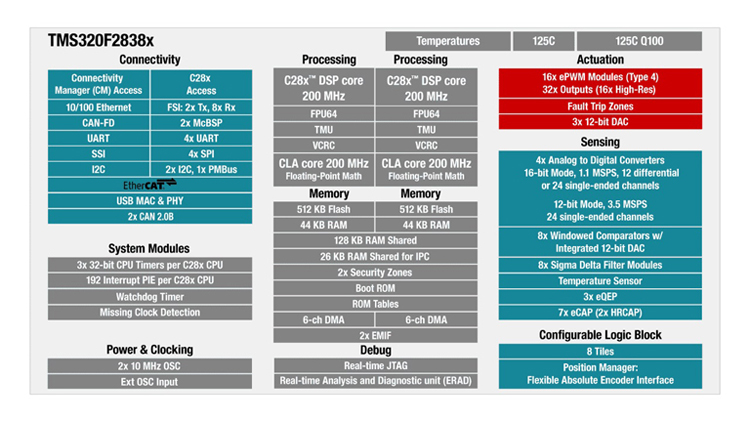
Thereal-time control subsystemis based on TI’s 32-bit C28x DSP core, which provides 200 MHz of signal-processing performance in each core for floating- or fixed-point code running from either on-chip flash or SRAM. The C28x CPU is further boosted by theTrigonometric Math Unit (TMU)andVCRC (Cyclical Redundancy Check) extended instruction sets, speeding up common algorithms key to real-time control systems. Extended instruction sets enable IEEE double-precision 64-bit floating-point math. Finally, theControl Law Accelerator (CLA)enables an additional 200 MHz per core of independent processing ability.
This device also contains an independent Connectivity Manager (CM), based on the ARM Cortex-M4 processor, that runs at 125 MHz. With its own dedicated flash and SRAM, the CM allows fully independent control of the interfaces coming in and out of the F2838x, allowing maximum bandwidth for the C28x DSPs to focus on real-time control.
High-performance analog blocks are tightly integrated with the processing and control units to provide optimal real-time signal chain performance. Thirty-two frequency-independent PWMs enable control of multiple power stages, from a 3-phase inverter to advanced multilevel power topologies.
The inclusion of the Configurable Logic Block (CLB) allows the user to addcustom logicand potentiallyintegrate FPGA-like functionsinto the C2000 real-time MCU.
For the first time on a C2000 real-time MCU, there is an EtherCAT Slave Controller, along with other industry-standard protocols like CAN FD and USB 2.0. TheFast Serial Interface (FSI)enables up to 200 Mbps of robust communications across an isolation boundary.
Want to learn more about features that make C2000 MCUs the right choice for your real-time control system? Check outThe Essential Guide for Developing With C2000™ Real-Time Microcontrollersand visit theC2000™ real-time control MCUspage.
TheGetting Started With C2000™ Real-Time Control Microcontrollers (MCUs) Getting Started Guidecovers all aspects of development with C2000 devices from hardware to support resources. In addition to key reference documents, each section provides relevant links and resources to further expand on the information covered.
Ready to get started? Check out theTMDSCNCD28388Devaluation board and downloadC2000Ware.
The TMS320F2838x (F2838x) is a member of the C2000™ real-time microcontroller family of scalable, ultra-low latency devices designed for efficiency in power electronics, including but not limited to: high power density, high switching frequencies, and supporting the use ofGaN and SiC technologies.
These include such applications as:
Thereal-time control subsystemis based on TI’s 32-bit C28x DSP core, which provides 200 MHz of signal-processing performance in each core for floating- or fixed-point code running from either on-chip flash or SRAM. The C28x CPU is further boosted by theTrigonometric Math Unit (TMU)andVCRC (Cyclical Redundancy Check) extended instruction sets, speeding up common algorithms key to real-time control systems. Extended instruction sets enable IEEE double-precision 64-bit floating-point math. Finally, theControl Law Accelerator (CLA)enables an additional 200 MHz per core of independent processing ability.
This device also contains an independent Connectivity Manager (CM), based on the ARM Cortex-M4 processor, that runs at 125 MHz. With its own dedicated flash and SRAM, the CM allows fully independent control of the interfaces coming in and out of the F2838x, allowing maximum bandwidth for the C28x DSPs to focus on real-time control.
High-performance analog blocks are tightly integrated with the processing and control units to provide optimal real-time signal chain performance. Thirty-two frequency-independent PWMs enable control of multiple power stages, from a 3-phase inverter to advanced multilevel power topologies.
The inclusion of the Configurable Logic Block (CLB) allows the user to addcustom logicand potentiallyintegrate FPGA-like functionsinto the C2000 real-time MCU.
For the first time on a C2000 real-time MCU, there is an EtherCAT Slave Controller, along with other industry-standard protocols like CAN FD and USB 2.0. TheFast Serial Interface (FSI)enables up to 200 Mbps of robust communications across an isolation boundary.
Want to learn more about features that make C2000 MCUs the right choice for your real-time control system? Check outThe Essential Guide for Developing With C2000™ Real-Time Microcontrollersand visit theC2000™ real-time control MCUspage.
TheGetting Started With C2000™ Real-Time Control Microcontrollers (MCUs) Getting Started Guidecovers all aspects of development with C2000 devices from hardware to support resources. In addition to key reference documents, each section provides relevant links and resources to further expand on the information covered.
Ready to get started? Check out theTMDSCNCD28388Devaluation board and downloadC2000Ware. |
TMS320F28386D-Q1Automotive C2000™ 32-bit MCU w/ connectivity manager, 2x C28x+CLA CPU, 1.5MB flash, FPU64, CLB, Eth | Integrated Circuits (ICs) | 6 | Active | The TMS320F2838x (F2838x) is a member of the C2000™ real-time microcontroller family of scalable, ultra-low latency devices designed for efficiency in power electronics, including but not limited to: high power density, high switching frequencies, and supporting the use ofGaN and SiC technologies.
These include such applications as:
Thereal-time control subsystemis based on TI’s 32-bit C28x DSP core, which provides 200 MHz of signal-processing performance in each core for floating- or fixed-point code running from either on-chip flash or SRAM. The C28x CPU is further boosted by theTrigonometric Math Unit (TMU)andVCRC (Cyclical Redundancy Check) extended instruction sets, speeding up common algorithms key to real-time control systems. Extended instruction sets enable IEEE double-precision 64-bit floating-point math. Finally, theControl Law Accelerator (CLA)enables an additional 200 MHz per core of independent processing ability.
This device also contains an independent Connectivity Manager (CM), based on the ARM Cortex-M4 processor, that runs at 125 MHz. With its own dedicated flash and SRAM, the CM allows fully independent control of the interfaces coming in and out of the F2838x, allowing maximum bandwidth for the C28x DSPs to focus on real-time control.
High-performance analog blocks are tightly integrated with the processing and control units to provide optimal real-time signal chain performance. Thirty-two frequency-independent PWMs enable control of multiple power stages, from a 3-phase inverter to advanced multilevel power topologies.
The inclusion of the Configurable Logic Block (CLB) allows the user to addcustom logicand potentiallyintegrate FPGA-like functionsinto the C2000 real-time MCU.
For the first time on a C2000 real-time MCU, there is an EtherCAT Slave Controller, along with other industry-standard protocols like CAN FD and USB 2.0. TheFast Serial Interface (FSI)enables up to 200 Mbps of robust communications across an isolation boundary.
Want to learn more about features that make C2000 MCUs the right choice for your real-time control system? Check outThe Essential Guide for Developing With C2000™ Real-Time Microcontrollersand visit theC2000™ real-time control MCUspage.
TheGetting Started With C2000™ Real-Time Control Microcontrollers (MCUs) Getting Started Guidecovers all aspects of development with C2000 devices from hardware to support resources. In addition to key reference documents, each section provides relevant links and resources to further expand on the information covered.
Ready to get started? Check out theTMDSCNCD28388Devaluation board and downloadC2000Ware.
The TMS320F2838x (F2838x) is a member of the C2000™ real-time microcontroller family of scalable, ultra-low latency devices designed for efficiency in power electronics, including but not limited to: high power density, high switching frequencies, and supporting the use ofGaN and SiC technologies.
These include such applications as:
Thereal-time control subsystemis based on TI’s 32-bit C28x DSP core, which provides 200 MHz of signal-processing performance in each core for floating- or fixed-point code running from either on-chip flash or SRAM. The C28x CPU is further boosted by theTrigonometric Math Unit (TMU)andVCRC (Cyclical Redundancy Check) extended instruction sets, speeding up common algorithms key to real-time control systems. Extended instruction sets enable IEEE double-precision 64-bit floating-point math. Finally, theControl Law Accelerator (CLA)enables an additional 200 MHz per core of independent processing ability.
This device also contains an independent Connectivity Manager (CM), based on the ARM Cortex-M4 processor, that runs at 125 MHz. With its own dedicated flash and SRAM, the CM allows fully independent control of the interfaces coming in and out of the F2838x, allowing maximum bandwidth for the C28x DSPs to focus on real-time control.
High-performance analog blocks are tightly integrated with the processing and control units to provide optimal real-time signal chain performance. Thirty-two frequency-independent PWMs enable control of multiple power stages, from a 3-phase inverter to advanced multilevel power topologies.
The inclusion of the Configurable Logic Block (CLB) allows the user to addcustom logicand potentiallyintegrate FPGA-like functionsinto the C2000 real-time MCU.
For the first time on a C2000 real-time MCU, there is an EtherCAT Slave Controller, along with other industry-standard protocols like CAN FD and USB 2.0. TheFast Serial Interface (FSI)enables up to 200 Mbps of robust communications across an isolation boundary.
Want to learn more about features that make C2000 MCUs the right choice for your real-time control system? Check outThe Essential Guide for Developing With C2000™ Real-Time Microcontrollersand visit theC2000™ real-time control MCUspage.
TheGetting Started With C2000™ Real-Time Control Microcontrollers (MCUs) Getting Started Guidecovers all aspects of development with C2000 devices from hardware to support resources. In addition to key reference documents, each section provides relevant links and resources to further expand on the information covered.
Ready to get started? Check out theTMDSCNCD28388Devaluation board and downloadC2000Ware. |
TMS320F28388SC2000™ 32-bit MCU w/ connectivity manager, 2x C28x+CLA CPU, 1.5-MB flash, FPU64, CLB, ENET, EtherCAT | Embedded | 4 | Active | The TMS320F2838x (F2838x) is a member of the C2000™ real-time microcontroller family of scalable, ultra-low latency devices designed for efficiency in power electronics, including but not limited to: high power density, high switching frequencies, and supporting the use ofGaN and SiC technologies.
These include such applications as:
Thereal-time control subsystemis based on TI’s 32-bit C28x DSP core, which provides 200 MHz of signal-processing performance in each core for floating- or fixed-point code running from either on-chip flash or SRAM. The C28x CPU is further boosted by theTrigonometric Math Unit (TMU)andVCRC (Cyclical Redundancy Check) extended instruction sets, speeding up common algorithms key to real-time control systems. Extended instruction sets enable IEEE double-precision 64-bit floating-point math. Finally, theControl Law Accelerator (CLA)enables an additional 200 MHz per core of independent processing ability.
This device also contains an independent Connectivity Manager (CM), based on the ARM Cortex-M4 processor, that runs at 125 MHz. With its own dedicated flash and SRAM, the CM allows fully independent control of the interfaces coming in and out of the F2838x, allowing maximum bandwidth for the C28x DSPs to focus on real-time control.
High-performance analog blocks are tightly integrated with the processing and control units to provide optimal real-time signal chain performance. Thirty-two frequency-independent PWMs enable control of multiple power stages, from a 3-phase inverter to advanced multilevel power topologies.
The inclusion of the Configurable Logic Block (CLB) allows the user to addcustom logicand potentiallyintegrate FPGA-like functionsinto the C2000 real-time MCU.
For the first time on a C2000 real-time MCU, there is an EtherCAT Slave Controller, along with other industry-standard protocols like CAN FD and USB 2.0. TheFast Serial Interface (FSI)enables up to 200 Mbps of robust communications across an isolation boundary.
Want to learn more about features that make C2000 MCUs the right choice for your real-time control system? Check outThe Essential Guide for Developing With C2000™ Real-Time Microcontrollersand visit theC2000™ real-time control MCUspage.
TheGetting Started With C2000™ Real-Time Control Microcontrollers (MCUs) Getting Started Guidecovers all aspects of development with C2000 devices from hardware to support resources. In addition to key reference documents, each section provides relevant links and resources to further expand on the information covered.
Ready to get started? Check out theTMDSCNCD28388Devaluation board and downloadC2000Ware.
The TMS320F2838x (F2838x) is a member of the C2000™ real-time microcontroller family of scalable, ultra-low latency devices designed for efficiency in power electronics, including but not limited to: high power density, high switching frequencies, and supporting the use ofGaN and SiC technologies.
These include such applications as:
Thereal-time control subsystemis based on TI’s 32-bit C28x DSP core, which provides 200 MHz of signal-processing performance in each core for floating- or fixed-point code running from either on-chip flash or SRAM. The C28x CPU is further boosted by theTrigonometric Math Unit (TMU)andVCRC (Cyclical Redundancy Check) extended instruction sets, speeding up common algorithms key to real-time control systems. Extended instruction sets enable IEEE double-precision 64-bit floating-point math. Finally, theControl Law Accelerator (CLA)enables an additional 200 MHz per core of independent processing ability.
This device also contains an independent Connectivity Manager (CM), based on the ARM Cortex-M4 processor, that runs at 125 MHz. With its own dedicated flash and SRAM, the CM allows fully independent control of the interfaces coming in and out of the F2838x, allowing maximum bandwidth for the C28x DSPs to focus on real-time control.
High-performance analog blocks are tightly integrated with the processing and control units to provide optimal real-time signal chain performance. Thirty-two frequency-independent PWMs enable control of multiple power stages, from a 3-phase inverter to advanced multilevel power topologies.
The inclusion of the Configurable Logic Block (CLB) allows the user to addcustom logicand potentiallyintegrate FPGA-like functionsinto the C2000 real-time MCU.
For the first time on a C2000 real-time MCU, there is an EtherCAT Slave Controller, along with other industry-standard protocols like CAN FD and USB 2.0. TheFast Serial Interface (FSI)enables up to 200 Mbps of robust communications across an isolation boundary.
Want to learn more about features that make C2000 MCUs the right choice for your real-time control system? Check outThe Essential Guide for Developing With C2000™ Real-Time Microcontrollersand visit theC2000™ real-time control MCUspage.
TheGetting Started With C2000™ Real-Time Control Microcontrollers (MCUs) Getting Started Guidecovers all aspects of development with C2000 devices from hardware to support resources. In addition to key reference documents, each section provides relevant links and resources to further expand on the information covered.
Ready to get started? Check out theTMDSCNCD28388Devaluation board and downloadC2000Ware. |