| Interface | 3 | Obsolete | |
| Unclassified | 1 | Obsolete | |
| Integrated Circuits (ICs) | 3 | Obsolete | |
TL5580ADual, 32-V, 12-MHz, low noise (7-nV/√Hz), 1-mV offset voltage operational amplifier | Linear | 5 | Active | The TL5580 is a dual bipolar operational amplifier that combines both high dc and ac performance with its low offset voltage, high-gain bandwidth, low harmonic distortion, and low-noise characteristics. In addition, its output is capable of driving 600-loads. All these characteristics make the device ideally suited for use in audio, active filtering, and industrial measurement applications.
The TL5580 is a dual bipolar operational amplifier that combines both high dc and ac performance with its low offset voltage, high-gain bandwidth, low harmonic distortion, and low-noise characteristics. In addition, its output is capable of driving 600-loads. All these characteristics make the device ideally suited for use in audio, active filtering, and industrial measurement applications. |
TL592B50MHz Differential Video Amplifier with Adjustable gain | Amplifiers | 3 | Active | This device is a monolithic two-stage video amplifier with differential inputs and differential outputs. It features internal series-shunt feedback that provides wide bandwidth, low phase distortion, and excellent gain stability. Emitter-follower outputs enable the device to drive capacitive loads. All stages are current-source biased to obtain high common-mode and supply-voltage rejection ratios.
The differential gain is typically 400 when the gain adjust pins are connected together, or amplification may be adjusted for near 0 to 400 by the use of a single external resistor connected between the gain adjustment pins A and B. No external frequency-compensating components are required for any gain option.
The device is particularly useful in magnetic-tape or disk-file systems using phase or NRZ encoding and in high-speed thin-film or plated-wire memories. Other applications include general-purpose video and pulse amplifiers.
The device achieves low equivalent noise voltage through special processing and a new circuit layout incorporating input transistors with low base resistance.
The TL592B is characterized for operation from 0°C to 70°C.
This device is a monolithic two-stage video amplifier with differential inputs and differential outputs. It features internal series-shunt feedback that provides wide bandwidth, low phase distortion, and excellent gain stability. Emitter-follower outputs enable the device to drive capacitive loads. All stages are current-source biased to obtain high common-mode and supply-voltage rejection ratios.
The differential gain is typically 400 when the gain adjust pins are connected together, or amplification may be adjusted for near 0 to 400 by the use of a single external resistor connected between the gain adjustment pins A and B. No external frequency-compensating components are required for any gain option.
The device is particularly useful in magnetic-tape or disk-file systems using phase or NRZ encoding and in high-speed thin-film or plated-wire memories. Other applications include general-purpose video and pulse amplifiers.
The device achieves low equivalent noise voltage through special processing and a new circuit layout incorporating input transistors with low base resistance.
The TL592B is characterized for operation from 0°C to 70°C. |
| Power Management (PMIC) | 19 | Active | |
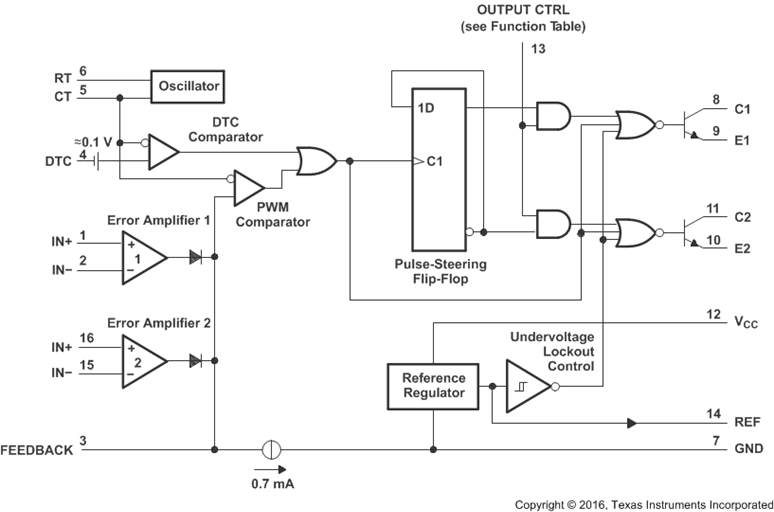
TL598Pulse-width-modulation (Pwm) control circuit | Power Management (PMIC) | 3 | Active | The TL598 incorporates all the functions required in the construction of pulse-width-modulated (PWM) controlled systems on a single chip. Designed primarily for power-supply control, the TL598 provides the systems engineer with the flexibility to tailor the power-supply control circuits to a specific application.
The TL598 contains two error amplifiers, an internal oscillator (externally adjustable), a dead-time control (DTC) comparator, a pulse-steering flip-flop, a 5-V precision reference, undervoltage lockout control, and output control circuits. Two totem-pole outputs provide exceptional rise- and fall-time performance for power FET control. The outputs share a common source supply and common power ground terminals, which allow system designers to eliminate errors caused by high current-induced voltage drops and common-mode noise.
The error amplifier has a common-mode voltage range of 0 V to VCC - 2 V. The DTC comparator has a fixed offset that prevents overlap of the outputs during push-pull operation. A synchronous multiple supply operation can be achieved by connecting RT to the reference output and providing a sawtooth input to CT.
The TL598 device provides an output control function to select either push-pull or parallel operation. Circuit architecture prevents either output from being pulsed twice during push-pull operation. The output frequency for push-pull applications is one-half the oscillator frequency (fo=1/2 RT CT). For single-ended applications: (fo=1/RT CT)
The TL598 incorporates all the functions required in the construction of pulse-width-modulated (PWM) controlled systems on a single chip. Designed primarily for power-supply control, the TL598 provides the systems engineer with the flexibility to tailor the power-supply control circuits to a specific application.
The TL598 contains two error amplifiers, an internal oscillator (externally adjustable), a dead-time control (DTC) comparator, a pulse-steering flip-flop, a 5-V precision reference, undervoltage lockout control, and output control circuits. Two totem-pole outputs provide exceptional rise- and fall-time performance for power FET control. The outputs share a common source supply and common power ground terminals, which allow system designers to eliminate errors caused by high current-induced voltage drops and common-mode noise.
The error amplifier has a common-mode voltage range of 0 V to VCC - 2 V. The DTC comparator has a fixed offset that prevents overlap of the outputs during push-pull operation. A synchronous multiple supply operation can be achieved by connecting RT to the reference output and providing a sawtooth input to CT.
The TL598 device provides an output control function to select either push-pull or parallel operation. Circuit architecture prevents either output from being pulsed twice during push-pull operation. The output frequency for push-pull applications is one-half the oscillator frequency (fo=1/2 RT CT). For single-ended applications: (fo=1/RT CT) |
TL712Single Differential Comparator with Push-Pull Outputs | Comparators | 8 | Active | The TL712 is a high-speed comparator fabricated with bipolar Schottky process technology. The circuit has differential analog inputs and complementary 3-state TTL-compatible logic outputs with symmetrical switching characteristics. When the output enable (OE) is low, both outputs are in the high-impedance state. This device operates from a single 5-V supply and is useful as a disk memory read-chain data comparator.
The TL712 is a high-speed comparator fabricated with bipolar Schottky process technology. The circuit has differential analog inputs and complementary 3-state TTL-compatible logic outputs with symmetrical switching characteristics. When the output enable (OE) is low, both outputs are in the high-impedance state. This device operates from a single 5-V supply and is useful as a disk memory read-chain data comparator. |
TL714Single High-Speed Differential Comparator with Push-Pull Outputs | Integrated Circuits (ICs) | 1 | Active | The TL714C is a high-speed differential comparator fabricated with bipolar Schottky process technology. The circuit has differential inputs and a TTL-compatible logic output with symmetrical switching characteristics.
The device operates from a single 5-V supply and is useful as a disk-memory read-chain data comparator.
The TL714C is a high-speed differential comparator fabricated with bipolar Schottky process technology. The circuit has differential inputs and a TTL-compatible logic output with symmetrical switching characteristics.
The device operates from a single 5-V supply and is useful as a disk-memory read-chain data comparator. |
TL720M05-Q1Automotive 450-mA off-battery (42V) low-dropout voltage regulator with reverse voltage protection | Uncategorized | 6 | Active | The TL720M05-Q1 is a low-dropout linear regulator designed to connect to the battery in automotive applications. The device has an input voltage range extending to 40V (new chip). This range allows the device to withstand transients (such as load dumps) that are anticipated in automotive systems. With only a 17µA quiescent current at light loads, the device is designed for powering always-on components. Examples of such components are microcontrollers (MCUs) and controller area network (CAN) transceivers in standby systems.
The device (new chip) has a state-of-the-art transient response that allows the output to quickly react to changes in load or line. For example, during cold-crank conditions. Additionally, the device has a novel architecture that minimizes output overshoot when recovering from dropout. During normal operation, the device has a tight DC accuracy of ±1.15% over line, load, and temperature (new chip).
The device also incorporates a number of internal circuits for protection against overload and overtemperature. The legacy chip also provides protection against reverse polarity.
The TL720M05-Q1 is available in thermally conductive packaging to allow the device to efficiently transfer heat to the circuit board.
The TL720M05-Q1 is a low-dropout linear regulator designed to connect to the battery in automotive applications. The device has an input voltage range extending to 40V (new chip). This range allows the device to withstand transients (such as load dumps) that are anticipated in automotive systems. With only a 17µA quiescent current at light loads, the device is designed for powering always-on components. Examples of such components are microcontrollers (MCUs) and controller area network (CAN) transceivers in standby systems.
The device (new chip) has a state-of-the-art transient response that allows the output to quickly react to changes in load or line. For example, during cold-crank conditions. Additionally, the device has a novel architecture that minimizes output overshoot when recovering from dropout. During normal operation, the device has a tight DC accuracy of ±1.15% over line, load, and temperature (new chip).
The device also incorporates a number of internal circuits for protection against overload and overtemperature. The legacy chip also provides protection against reverse polarity.
The TL720M05-Q1 is available in thermally conductive packaging to allow the device to efficiently transfer heat to the circuit board. |