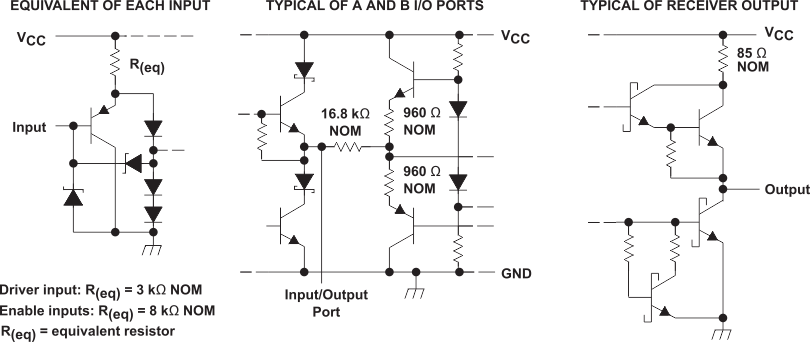
SN75160BOctal General-Purpose Interface Bus Transceiver | Interface | 8 | Active | The SN75160B 8-channel general-purpose interface bus (GPIB) transceiver is a monolithic, high-speed, low-power Schottky device designed for two-way data communications over single-ended transmission lines. It is designed to meet the requirements of IEEE Standard 488-1978. The transceiver features driver outputs that can be operated in either the passive-pullup or 3-state mode. If talk enable (TE) is high, these ports have the characteristics of passive-pullup outputs when pullup enable (PE) is low and of 3-state outputs when PE is high. Taking TE low places these ports in the high-impedance state. The driver outputs are designed to handle loads up to 48 mA of sink current.
Output glitches during power up and power down are eliminated by an internal circuit that disables both the bus and receiver outputs. The outputs do not load the bus when VCC= 0. When combined with the SN75161B or SN75162B management bus transceivers, the pair provides the complete 16-wire interface for the IEEE-488 bus.
The SN75160B is characterized for operation from 0°C to 70°C.
The SN75160B 8-channel general-purpose interface bus (GPIB) transceiver is a monolithic, high-speed, low-power Schottky device designed for two-way data communications over single-ended transmission lines. It is designed to meet the requirements of IEEE Standard 488-1978. The transceiver features driver outputs that can be operated in either the passive-pullup or 3-state mode. If talk enable (TE) is high, these ports have the characteristics of passive-pullup outputs when pullup enable (PE) is low and of 3-state outputs when PE is high. Taking TE low places these ports in the high-impedance state. The driver outputs are designed to handle loads up to 48 mA of sink current.
Output glitches during power up and power down are eliminated by an internal circuit that disables both the bus and receiver outputs. The outputs do not load the bus when VCC= 0. When combined with the SN75161B or SN75162B management bus transceivers, the pair provides the complete 16-wire interface for the IEEE-488 bus.
The SN75160B is characterized for operation from 0°C to 70°C. |
SN75161BOctal General-Purpose Interface Bus Transceiver | Drivers, Receivers, Transceivers | 6 | Active | The SN75161B and SN75162B eight-channel, general-purpose interface bus transceivers are monolithic, high-speed, low-power Schottky devices designed to meet the requirements of IEEE Standard 488-1978. Each transceiver is designed to provide the bus-management and data-transfer signals between operating units ofa single- or multiple-controller instrumentation system. When combined with the SN75160B octal bus transceiver, the SN75161B or SN75162B provides the complete 16-wire interface for the IEEE-488 bus.
The SN75161B and SN75162B feature eight driver-receiver pairs connected in a front-to-back configuration to form input/output (I/O) ports at both the bus and terminal sides. A power-up/-down disable circuit is included on all bus and receiver outputs. This provides glitch-free operation during VCCpower up and power down.
The direction of data through these driver-receiver pairs is determined by the DC, TE, and SC (on SN75162B) enable signals. The SC input on the SN75162B allows the REN and IFC transceivers to be controlled independently.
The driver outputs (GPIB I/O ports) feature active bus-terminating resistor circuits designed to provide a high impedance to the bus when supply voltage VCCis 0. The drivers are designed to handle loads up to 48 mA of sink current. Each receiver features pnp transistor inputs for high input impedance and hysteresis of 400 mV for increased noise immunity. All receivers have 3-state outputs to present a high impedance to the terminal when disabled.
The SN75161B and SN75162B are characterized for operation from 0°C to 70°C.
H = high level, L = low level, R = receive, T = transmit, X = irrelevantDirection of data transmission is from the terminal side to the bus side, and the direction of data receiving is from the bus side to the terminal side. Data transfer is noninverting in both directions.
ATN is a normal transceiver channel that functions additionally as an internal direction control or talk enable for EOI whenever the DC and TE inputs are in the same state. When DC and TE are in opposite states, the ATN channel functions as an independent transceiver only.
H = high level, L = low level, R = receive, T = transmit, X = irrelevantDirection of data transmission is from the terminal side to the bus side, and the direction of data receiving is from the bus side to the terminal side. Data transfer is noninverting in both directions.
ATN is a normal transceiver channel that functions additionally as an internal direction control or talk enable for EOI whenever the DC and TE inputs are in the same state. When DC and TE are in opposite states, the ATN channel functions as an independent transceiver only.
The SN75161B and SN75162B eight-channel, general-purpose interface bus transceivers are monolithic, high-speed, low-power Schottky devices designed to meet the requirements of IEEE Standard 488-1978. Each transceiver is designed to provide the bus-management and data-transfer signals between operating units ofa single- or multiple-controller instrumentation system. When combined with the SN75160B octal bus transceiver, the SN75161B or SN75162B provides the complete 16-wire interface for the IEEE-488 bus.
The SN75161B and SN75162B feature eight driver-receiver pairs connected in a front-to-back configuration to form input/output (I/O) ports at both the bus and terminal sides. A power-up/-down disable circuit is included on all bus and receiver outputs. This provides glitch-free operation during VCCpower up and power down.
The direction of data through these driver-receiver pairs is determined by the DC, TE, and SC (on SN75162B) enable signals. The SC input on the SN75162B allows the REN and IFC transceivers to be controlled independently.
The driver outputs (GPIB I/O ports) feature active bus-terminating resistor circuits designed to provide a high impedance to the bus when supply voltage VCCis 0. The drivers are designed to handle loads up to 48 mA of sink current. Each receiver features pnp transistor inputs for high input impedance and hysteresis of 400 mV for increased noise immunity. All receivers have 3-state outputs to present a high impedance to the terminal when disabled.
The SN75161B and SN75162B are characterized for operation from 0°C to 70°C.
H = high level, L = low level, R = receive, T = transmit, X = irrelevantDirection of data transmission is from the terminal side to the bus side, and the direction of data receiving is from the bus side to the terminal side. Data transfer is noninverting in both directions.
ATN is a normal transceiver channel that functions additionally as an internal direction control or talk enable for EOI whenever the DC and TE inputs are in the same state. When DC and TE are in opposite states, the ATN channel functions as an independent transceiver only.
H = high level, L = low level, R = receive, T = transmit, X = irrelevantDirection of data transmission is from the terminal side to the bus side, and the direction of data receiving is from the bus side to the terminal side. Data transfer is noninverting in both directions.
ATN is a normal transceiver channel that functions additionally as an internal direction control or talk enable for EOI whenever the DC and TE inputs are in the same state. When DC and TE are in opposite states, the ATN channel functions as an independent transceiver only. |
SN75162BOctal General-Purpose Interface Bus Transceiver | Integrated Circuits (ICs) | 1 | Active | The SN75161B and SN75162B eight-channel, general-purpose interface bus transceivers are monolithic, high-speed, low-power Schottky devices designed to meet the requirements of IEEE Standard 488-1978. Each transceiver is designed to provide the bus-management and data-transfer signals between operating units ofa single- or multiple-controller instrumentation system. When combined with the SN75160B octal bus transceiver, the SN75161B or SN75162B provides the complete 16-wire interface for the IEEE-488 bus.
The SN75161B and SN75162B feature eight driver-receiver pairs connected in a front-to-back configuration to form input/output (I/O) ports at both the bus and terminal sides. A power-up/-down disable circuit is included on all bus and receiver outputs. This provides glitch-free operation during VCCpower up and power down.
The direction of data through these driver-receiver pairs is determined by the DC, TE, and SC (on SN75162B) enable signals. The SC input on the SN75162B allows the REN and IFC transceivers to be controlled independently.
The driver outputs (GPIB I/O ports) feature active bus-terminating resistor circuits designed to provide a high impedance to the bus when supply voltage VCCis 0. The drivers are designed to handle loads up to 48 mA of sink current. Each receiver features pnp transistor inputs for high input impedance and hysteresis of 400 mV for increased noise immunity. All receivers have 3-state outputs to present a high impedance to the terminal when disabled.
The SN75161B and SN75162B are characterized for operation from 0°C to 70°C.
H = high level, L = low level, R = receive, T = transmit, X = irrelevantDirection of data transmission is from the terminal side to the bus side, and the direction of data receiving is from the bus side to the terminal side. Data transfer is noninverting in both directions.
ATN is a normal transceiver channel that functions additionally as an internal direction control or talk enable for EOI whenever the DC and TE inputs are in the same state. When DC and TE are in opposite states, the ATN channel functions as an independent transceiver only.
H = high level, L = low level, R = receive, T = transmit, X = irrelevantDirection of data transmission is from the terminal side to the bus side, and the direction of data receiving is from the bus side to the terminal side. Data transfer is noninverting in both directions.
ATN is a normal transceiver channel that functions additionally as an internal direction control or talk enable for EOI whenever the DC and TE inputs are in the same state. When DC and TE are in opposite states, the ATN channel functions as an independent transceiver only.
The SN75161B and SN75162B eight-channel, general-purpose interface bus transceivers are monolithic, high-speed, low-power Schottky devices designed to meet the requirements of IEEE Standard 488-1978. Each transceiver is designed to provide the bus-management and data-transfer signals between operating units ofa single- or multiple-controller instrumentation system. When combined with the SN75160B octal bus transceiver, the SN75161B or SN75162B provides the complete 16-wire interface for the IEEE-488 bus.
The SN75161B and SN75162B feature eight driver-receiver pairs connected in a front-to-back configuration to form input/output (I/O) ports at both the bus and terminal sides. A power-up/-down disable circuit is included on all bus and receiver outputs. This provides glitch-free operation during VCCpower up and power down.
The direction of data through these driver-receiver pairs is determined by the DC, TE, and SC (on SN75162B) enable signals. The SC input on the SN75162B allows the REN and IFC transceivers to be controlled independently.
The driver outputs (GPIB I/O ports) feature active bus-terminating resistor circuits designed to provide a high impedance to the bus when supply voltage VCCis 0. The drivers are designed to handle loads up to 48 mA of sink current. Each receiver features pnp transistor inputs for high input impedance and hysteresis of 400 mV for increased noise immunity. All receivers have 3-state outputs to present a high impedance to the terminal when disabled.
The SN75161B and SN75162B are characterized for operation from 0°C to 70°C.
H = high level, L = low level, R = receive, T = transmit, X = irrelevantDirection of data transmission is from the terminal side to the bus side, and the direction of data receiving is from the bus side to the terminal side. Data transfer is noninverting in both directions.
ATN is a normal transceiver channel that functions additionally as an internal direction control or talk enable for EOI whenever the DC and TE inputs are in the same state. When DC and TE are in opposite states, the ATN channel functions as an independent transceiver only.
H = high level, L = low level, R = receive, T = transmit, X = irrelevantDirection of data transmission is from the terminal side to the bus side, and the direction of data receiving is from the bus side to the terminal side. Data transfer is noninverting in both directions.
ATN is a normal transceiver channel that functions additionally as an internal direction control or talk enable for EOI whenever the DC and TE inputs are in the same state. When DC and TE are in opposite states, the ATN channel functions as an independent transceiver only. |
| Integrated Circuits (ICs) | 2 | Active | The SN751701 line driver and receiver is designed to satisfy the requirements of the standard interface between data terminal equipment and data communication equipment as defined by ANSI TIA/EIA-232-E. The driver used is similar to the SN75188. The receiver used is similar to the SN75189A. The device operates over a wide range of supply voltages (VCC= ±4.5 V to ±15 V) from the included reference regulator.
The SN751701 line driver and receiver is designed to satisfy the requirements of the standard interface between data terminal equipment and data communication equipment as defined by ANSI TIA/EIA-232-E. The driver used is similar to the SN75188. The receiver used is similar to the SN75189A. The device operates over a wide range of supply voltages (VCC= ±4.5 V to ±15 V) from the included reference regulator. |
SN75172Quadruple Differential Line Driver | Integrated Circuits (ICs) | 2 | Active | The SN75172 is a monolithic quadruple differential line driver with 3-state outputs. Dsigned to meet the requirements of ANSI Standards EIA/TIA-422-B and RS-485 and ITU Recommendation V.11. The device is optimized for balanced multipoint bus transmission at rates of up to 4 megabaud. Each driver features wide positive and negative common-mode output voltage ranges, making it suitable for party-line applications in noisy environments.
The SN75172 provides positive- and negative-current limiting and thermal shutdown for protection from line fault conditions on the transmission bus line. Shutdown occurs at a junction temperature of approximately 150°C. This device offers optimum performance when used with the SN75173 or SN75175 quadruple differential line receivers.
The SN75172 is characterized for operation from 0°C to 70°C.
The SN75172 is a monolithic quadruple differential line driver with 3-state outputs. Dsigned to meet the requirements of ANSI Standards EIA/TIA-422-B and RS-485 and ITU Recommendation V.11. The device is optimized for balanced multipoint bus transmission at rates of up to 4 megabaud. Each driver features wide positive and negative common-mode output voltage ranges, making it suitable for party-line applications in noisy environments.
The SN75172 provides positive- and negative-current limiting and thermal shutdown for protection from line fault conditions on the transmission bus line. Shutdown occurs at a junction temperature of approximately 150°C. This device offers optimum performance when used with the SN75173 or SN75175 quadruple differential line receivers.
The SN75172 is characterized for operation from 0°C to 70°C. |
SN75173Quadruple Differential Line Receiver | Integrated Circuits (ICs) | 2 | Obsolete | The SN55173 and SN75173 are monolithic quadruple differential line receivers with 3-state outputs. They are designed to meet the requirements of TIA/EIA-422-B, TIA/EIA-423-B, TIA/EIA-485-A, and several ITU recommendations. The standards are for balanced multipoint bus transmission at rates up to 10 megabits per second. The four receivers share two OR enable inputs, one active when high, the other active when low. These devices feature high input impedance, input hysteresis for increased noise immunity, and input sensitivity of ± 200 mV over a common-mode input voltage range of – 12 V to 12 V. Fail-safe design specifies that if the inputs are open circuited, the outputs are always high. The SN65173 and SN75173 are designed for optimum performance when used with the SN75172 or SN75174 quad differential line drivers.
The SN55173 is characterized over the full military temperature range of – 55°C to 125°C. The SN75173 is characterized for operation from 0°C to 70°C.
The SN55173 and SN75173 are monolithic quadruple differential line receivers with 3-state outputs. They are designed to meet the requirements of TIA/EIA-422-B, TIA/EIA-423-B, TIA/EIA-485-A, and several ITU recommendations. The standards are for balanced multipoint bus transmission at rates up to 10 megabits per second. The four receivers share two OR enable inputs, one active when high, the other active when low. These devices feature high input impedance, input hysteresis for increased noise immunity, and input sensitivity of ± 200 mV over a common-mode input voltage range of – 12 V to 12 V. Fail-safe design specifies that if the inputs are open circuited, the outputs are always high. The SN65173 and SN75173 are designed for optimum performance when used with the SN75172 or SN75174 quad differential line drivers.
The SN55173 is characterized over the full military temperature range of – 55°C to 125°C. The SN75173 is characterized for operation from 0°C to 70°C. |
| Drivers, Receivers, Transceivers | 2 | Obsolete | The SN751730 triple line driver/receiver is specifically designed to meet the input/output interface specifications for IBM System 360/370. It also is compatible with standard TTL logic and supply voltage levels.
The low-impedance emitter-follower driver outputs of the SN751730 drive terminated lines, such as coaxial cable or twisted pair. Having the outputs uncommitted allows wired-OR logic to be performed in party-line applications. Output short-circuit protection is provided by an internal clamping network that turns on when the output voltage drops below approximately 2.5 V.
An open line affects the receiver input as does a low-level input voltage.
All the driver inputs and receiver outputs are in conventional TTL configuration and the gating can be used during power-up and power-down sequences to ensure that no noise is introduced to the line by pulling either DE1 or DE2 to a low level.
The SN751730 triple line driver/receiver is specifically designed to meet the input/output interface specifications for IBM System 360/370. It also is compatible with standard TTL logic and supply voltage levels.
The low-impedance emitter-follower driver outputs of the SN751730 drive terminated lines, such as coaxial cable or twisted pair. Having the outputs uncommitted allows wired-OR logic to be performed in party-line applications. Output short-circuit protection is provided by an internal clamping network that turns on when the output voltage drops below approximately 2.5 V.
An open line affects the receiver input as does a low-level input voltage.
All the driver inputs and receiver outputs are in conventional TTL configuration and the gating can be used during power-up and power-down sequences to ensure that no noise is introduced to the line by pulling either DE1 or DE2 to a low level. |
SN75174Quadruple Differential Line Driver | Integrated Circuits (ICs) | 5 | Active | The SN75174 is a monolithic quadruple differential line driver with 3-state outputs. It is designed to meet the requirements of ANSI Standards EIA/TIA-422-B and RS-485 and ITU Recommendation V.11. The device is optimized for balanced multipoint bus transmission at rates up to 4 megabaud. Each driver features wide positive and negative common-mode output voltage ranges making it suitable for party-line applications in noisy environments.
The SN75174 provides positive- and negative-current limiting and thermal shutdown for protection from line fault conditions on the transmission bus line. Shutdown occurs at a junction temperature of approximately 150°C. This device offers optimum performance when used with the SN75173 or SN75175 quadruple differential line receivers.
The SN75174 is characterized for operation from 0°C to 70°C.
The SN75174 is a monolithic quadruple differential line driver with 3-state outputs. It is designed to meet the requirements of ANSI Standards EIA/TIA-422-B and RS-485 and ITU Recommendation V.11. The device is optimized for balanced multipoint bus transmission at rates up to 4 megabaud. Each driver features wide positive and negative common-mode output voltage ranges making it suitable for party-line applications in noisy environments.
The SN75174 provides positive- and negative-current limiting and thermal shutdown for protection from line fault conditions on the transmission bus line. Shutdown occurs at a junction temperature of approximately 150°C. This device offers optimum performance when used with the SN75173 or SN75175 quadruple differential line receivers.
The SN75174 is characterized for operation from 0°C to 70°C. |
SN75175Quadruple Differential Line Receiver | Integrated Circuits (ICs) | 8 | Active | The SN65175 and SN75175 are monolithic quadruple differential line receivers with 3-state outputs. They are designed to meet the requirements of ANSI Standards EIA/TIA-422-B, RS-423-B, and RS-485, and several ITU recommendations. These standards are for balanced multipoint bus transmission at rates up to 10 megabits per second. Each of the two pairs of receivers has a common active-high enable.
The receivers feature high input impedance, input hysteresis for increased noise immunity, and input sensitivity of ±200 mV over a common-mode input voltage range of ±12 V. The SN65175 and SN75175 are designed for optimum performance when used with the SN75172 or SN75174 quadruple differential line drivers.
The SN65175 is characterized for operation from −40°C to 85°C. The SN75175 is characterized for operation from 0°C to 70°C.
The SN65175 and SN75175 are monolithic quadruple differential line receivers with 3-state outputs. They are designed to meet the requirements of ANSI Standards EIA/TIA-422-B, RS-423-B, and RS-485, and several ITU recommendations. These standards are for balanced multipoint bus transmission at rates up to 10 megabits per second. Each of the two pairs of receivers has a common active-high enable.
The receivers feature high input impedance, input hysteresis for increased noise immunity, and input sensitivity of ±200 mV over a common-mode input voltage range of ±12 V. The SN65175 and SN75175 are designed for optimum performance when used with the SN75172 or SN75174 quadruple differential line drivers.
The SN65175 is characterized for operation from −40°C to 85°C. The SN75175 is characterized for operation from 0°C to 70°C. |
| Integrated Circuits (ICs) | 11 | Active | The SN75176A differential bus transceiver is a monolithic integrated circuit designed for bidirectional data communication on multipoint bus-transmission lines. It is designed for balanced transmission lines and meets ANSI Standard EIA/TIA-422-B and ITU Recommendation V.11.
The SN75176A combines a 3-state differential line driver and a differential input line receiver, both of which operate from a single 5-V power supply. The driver and receiver have active-high and active-low enables, respectively, that can be externally connected together to function as a direction control. The driver differential outputs and the receiver differential inputs are connected internally to form differential input/output (I/O) bus ports that are designed to offer minimum loading to the bus whenever the driver is disabled or VCC = 0. These ports feature wide positive and negative common-mode voltage ranges making the device suitable for party-line applications.
The driver is designed to handle loads up to 60 mA of sink or source current. The driver features positive- and negative-current limiting and thermal shutdown for protection from line fault conditions. Thermal shutdown is designed to occur at a junction temperature of approximately 150°C. The receiver features a minimum input impedance of 12 kΩ, an input sensitivity of ±200 mV, and a typical input hysteresis of 50 mV.
The SN75176A can be used in transmission-line applications employing the SN75172 and SN75174 quadruple differential line drivers and SN75173 and SN75175 quadruple differential line receivers.
The SN75176A is characterized for operation from 0°C to 70°C.
The SN75176A differential bus transceiver is a monolithic integrated circuit designed for bidirectional data communication on multipoint bus-transmission lines. It is designed for balanced transmission lines and meets ANSI Standard EIA/TIA-422-B and ITU Recommendation V.11.
The SN75176A combines a 3-state differential line driver and a differential input line receiver, both of which operate from a single 5-V power supply. The driver and receiver have active-high and active-low enables, respectively, that can be externally connected together to function as a direction control. The driver differential outputs and the receiver differential inputs are connected internally to form differential input/output (I/O) bus ports that are designed to offer minimum loading to the bus whenever the driver is disabled or VCC = 0. These ports feature wide positive and negative common-mode voltage ranges making the device suitable for party-line applications.
The driver is designed to handle loads up to 60 mA of sink or source current. The driver features positive- and negative-current limiting and thermal shutdown for protection from line fault conditions. Thermal shutdown is designed to occur at a junction temperature of approximately 150°C. The receiver features a minimum input impedance of 12 kΩ, an input sensitivity of ±200 mV, and a typical input hysteresis of 50 mV.
The SN75176A can be used in transmission-line applications employing the SN75172 and SN75174 quadruple differential line drivers and SN75173 and SN75175 quadruple differential line receivers.
The SN75176A is characterized for operation from 0°C to 70°C. |