| Integrated Circuits (ICs) | 1 | Active | This device consists of a dual single-ended line receiver with TTL-compatible strobes and outputs. The reference voltage (switching threshold) is applied externally and can be adjusted from 1.5 V to 3.4 V, making it possible to optimize noise immunity for a given system design. Due to the low input current (less than 100 µA), the device is suited ideally for party-line (data-bus) systems.
The SN74LS2323 has a common reference-voltage pin and a common strobe.
This device consists of a dual single-ended line receiver with TTL-compatible strobes and outputs. The reference voltage (switching threshold) is applied externally and can be adjusted from 1.5 V to 3.4 V, making it possible to optimize noise immunity for a given system design. Due to the low input current (less than 100 µA), the device is suited ideally for party-line (data-bus) systems.
The SN74LS2323 has a common reference-voltage pin and a common strobe. |
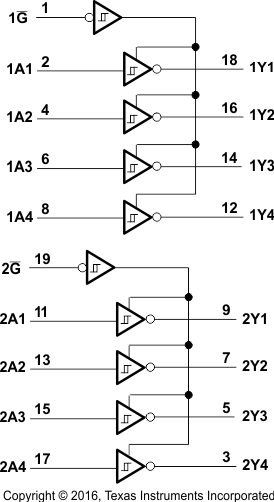
SN74LS2408-ch, 4.75-V to 5.25-V bipolar inverters with 3-state outputs | Buffers, Drivers, Receivers, Transceivers | 7 | Active | The SNx4LS24x, SNx4S24x octal buffers and line drivers are designed specifically to improve both the performance and density of three-state memory address drivers, clock drivers, and bus-oriented receivers and transmitters. The designer has a choice of selected combinations of inverting and non-inverting outputs, symmetrical, active-low output-control (G) inputs, and complementary output-control (G andG) inputs. These devices feature high fan-out, improved fan-in, and 400-mV noise margin. The SN74LS24x and SN74S24x devices can be used to drive terminated lines down to 133 Ω.
The SNx4LS24x, SNx4S24x octal buffers and line drivers are designed specifically to improve both the performance and density of three-state memory address drivers, clock drivers, and bus-oriented receivers and transmitters. The designer has a choice of selected combinations of inverting and non-inverting outputs, symmetrical, active-low output-control (G) inputs, and complementary output-control (G andG) inputs. These devices feature high fan-out, improved fan-in, and 400-mV noise margin. The SN74LS24x and SN74S24x devices can be used to drive terminated lines down to 133 Ω. |
SN74LS2418-ch, 4.75-V to 5.25-V bipolar buffers with 3-state outputs | Integrated Circuits (ICs) | 4 | Active | The SNx4LS24x, SNx4S24x octal buffers and line drivers are designed specifically to improve both the performance and density of three-state memory address drivers, clock drivers, and bus-oriented receivers and transmitters. The designer has a choice of selected combinations of inverting and non-inverting outputs, symmetrical, active-low output-control (G) inputs, and complementary output-control (G andG) inputs. These devices feature high fan-out, improved fan-in, and 400-mV noise margin. The SN74LS24x and SN74S24x devices can be used to drive terminated lines down to 133 Ω.
The SNx4LS24x, SNx4S24x octal buffers and line drivers are designed specifically to improve both the performance and density of three-state memory address drivers, clock drivers, and bus-oriented receivers and transmitters. The designer has a choice of selected combinations of inverting and non-inverting outputs, symmetrical, active-low output-control (G) inputs, and complementary output-control (G andG) inputs. These devices feature high fan-out, improved fan-in, and 400-mV noise margin. The SN74LS24x and SN74S24x devices can be used to drive terminated lines down to 133 Ω. |
| Integrated Circuits (ICs) | 2 | Active | These four-data-line transceivers are designed for asynchronous two-way communications between data buses. SN74LS243 can be used to drive terminated lines down to 133.
SN54LS243 is characterized for operation over the full military temperature range of –55°C to 125°C. SN74LS243 is characterized for operation from 0°C to 70°C.
These four-data-line transceivers are designed for asynchronous two-way communications between data buses. SN74LS243 can be used to drive terminated lines down to 133.
SN54LS243 is characterized for operation over the full military temperature range of –55°C to 125°C. SN74LS243 is characterized for operation from 0°C to 70°C. |
SN74LS2448-ch, 4.75-V to 5.25-V bipolar buffers with 3-state outputs | Integrated Circuits (ICs) | 7 | Active | The SNx4LS24x, SNx4S24x octal buffers and line drivers are designed specifically to improve both the performance and density of three-state memory address drivers, clock drivers, and bus-oriented receivers and transmitters. The designer has a choice of selected combinations of inverting and non-inverting outputs, symmetrical, active-low output-control (G) inputs, and complementary output-control (G andG) inputs. These devices feature high fan-out, improved fan-in, and 400-mV noise margin. The SN74LS24x and SN74S24x devices can be used to drive terminated lines down to 133 Ω.
The SNx4LS24x, SNx4S24x octal buffers and line drivers are designed specifically to improve both the performance and density of three-state memory address drivers, clock drivers, and bus-oriented receivers and transmitters. The designer has a choice of selected combinations of inverting and non-inverting outputs, symmetrical, active-low output-control (G) inputs, and complementary output-control (G andG) inputs. These devices feature high fan-out, improved fan-in, and 400-mV noise margin. The SN74LS24x and SN74S24x devices can be used to drive terminated lines down to 133 Ω. |
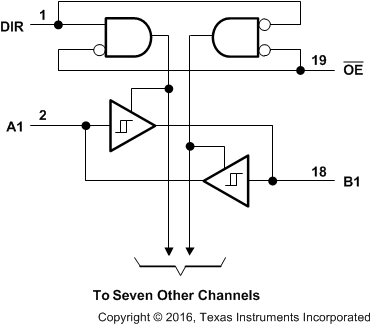
| Integrated Circuits (ICs) | 8 | Active | These octal bus transceivers are designed for asynchronous two-way communication between data buses. The control-function implementation minimizes external timing requirements.
The SNx4LS245 devices allow data transmission from the A bus to the B bus or from the B bus to the A bus, depending on the logic level at the direction-control (DIR) input. The output-enable (OE) input can disable the device so that the buses are effectively isolated.
These octal bus transceivers are designed for asynchronous two-way communication between data buses. The control-function implementation minimizes external timing requirements.
The SNx4LS245 devices allow data transmission from the A bus to the B bus or from the B bus to the A bus, depending on the logic level at the direction-control (DIR) input. The output-enable (OE) input can disable the device so that the buses are effectively isolated. |
SN74LS247BCD-To-Seven-Segment Decoders/Drivers | Integrated Circuits (ICs) | 2 | Active | The '246 and '247 are electrically and functionally identical to the SN5446A/SN7446A, and SN5447A/SN7447A respectively, and have the same pin assignments as their equivalents. The 'LS247 and 'LS248 are electrically and functionally identical to the SN54LS47/SN74LS47 and SN54LS48/SN74LS48, respectively, and have the same pin assignments as their equivalents. They can be used interchangeably in present or future designs to offer designers a choice between two indicator fonts. The '46A, '47A, 'LS47, and 'LS48 compose the 6 and 9 the without tails and the '246, '247, 'LS247, and 'LS248 compose the and the with tails. Composition of all other characters, including display patterns for BCD inputs above nine, is identical. The '246, '247, and 'LS247 feature active-low outputs designed for driving indicators directly, and the 'LS248 features active-high outputs for driving lamp buffers. All of the circuits have full ripple-blanking input/output controls and a lamp test input. Segment identification and resultant displays are shown below. Display patterns for BCD input counts above 9 are unique symbols to authenticate input conditions.
All of these circuits incorporate automatic leading and/or trailing-edge zero-blanking control (RBI\ and RBO\). Lamp test (LT\) of these types may be performed at any time when the BI\/RBO\ node is at a high level. All types contain an overriding blanking input (BI) which can be used to control the lamp intensity by pulsing or to inhibit the outputs. Inputs and outputs are entirely compatible for use with TTL logic outputs.
Series 54 and Series 54LS devices are characterized for operation over the full military temperature range of -55°C to 125°C; Series 74 and Series 74LS devices are characterized for operation from 0°C to 70°C.
The '246 and '247 are electrically and functionally identical to the SN5446A/SN7446A, and SN5447A/SN7447A respectively, and have the same pin assignments as their equivalents. The 'LS247 and 'LS248 are electrically and functionally identical to the SN54LS47/SN74LS47 and SN54LS48/SN74LS48, respectively, and have the same pin assignments as their equivalents. They can be used interchangeably in present or future designs to offer designers a choice between two indicator fonts. The '46A, '47A, 'LS47, and 'LS48 compose the 6 and 9 the without tails and the '246, '247, 'LS247, and 'LS248 compose the and the with tails. Composition of all other characters, including display patterns for BCD inputs above nine, is identical. The '246, '247, and 'LS247 feature active-low outputs designed for driving indicators directly, and the 'LS248 features active-high outputs for driving lamp buffers. All of the circuits have full ripple-blanking input/output controls and a lamp test input. Segment identification and resultant displays are shown below. Display patterns for BCD input counts above 9 are unique symbols to authenticate input conditions.
All of these circuits incorporate automatic leading and/or trailing-edge zero-blanking control (RBI\ and RBO\). Lamp test (LT\) of these types may be performed at any time when the BI\/RBO\ node is at a high level. All types contain an overriding blanking input (BI) which can be used to control the lamp intensity by pulsing or to inhibit the outputs. Inputs and outputs are entirely compatible for use with TTL logic outputs.
Series 54 and Series 54LS devices are characterized for operation over the full military temperature range of -55°C to 125°C; Series 74 and Series 74LS devices are characterized for operation from 0°C to 70°C. |
SN74LS2518-Line To 1-Line Data Selectors/Multiplexers With 3-State Outputs | Integrated Circuits (ICs) | 5 | Active | These monolithic data selectors/multiplexers contain full on-chip binary decoding to select one-of-eight data sources and feature a strobe-controlled three-state output. The strobe must be at a low logic level to enable these devices. The three-state outputs permit a number of outputs to be connected to a common bus. When the strobe input is high, both outputs are in a high-impedance state in which both the upper and lower transistors of each totem-pole output are off, and the output neither drives nor loads the bus significantly. When the strobe is low, the outputs are activated and operate as standard TTL totem-pole outputs.
To minimize the possibility that two outputs will attempt to take a common bus to opposite logic levels, the output control circuitry is designed so that the average output disable time is shorter than the average output enable time. The SN54251 and SN74251 have output clamp diodes to attenuate reflections on the bus line.
These monolithic data selectors/multiplexers contain full on-chip binary decoding to select one-of-eight data sources and feature a strobe-controlled three-state output. The strobe must be at a low logic level to enable these devices. The three-state outputs permit a number of outputs to be connected to a common bus. When the strobe input is high, both outputs are in a high-impedance state in which both the upper and lower transistors of each totem-pole output are off, and the output neither drives nor loads the bus significantly. When the strobe is low, the outputs are activated and operate as standard TTL totem-pole outputs.
To minimize the possibility that two outputs will attempt to take a common bus to opposite logic levels, the output control circuitry is designed so that the average output disable time is shorter than the average output enable time. The SN54251 and SN74251 have output clamp diodes to attenuate reflections on the bus line. |
SN74LS253Dual 4-Line To 1-Line Data Selectors/Multiplexers With 3-State Outputs | Integrated Circuits (ICs) | 4 | Active | Each of these Schottky-clamped data selectors/multiplexers contains inverters and drivers to supply fully complementary, on-chip, binary decoding data selection to the AND-OR gates. Separate output control inputs are provided for each of the two four-line sections.
The three-state outputs can interface with and drive data lines of bus-organized systems. With all but one of the common outputs disabled (at a high-impedance state) the low-impedance of the single enabled output will drive the bus line to a high or low logic level.
Each of these Schottky-clamped data selectors/multiplexers contains inverters and drivers to supply fully complementary, on-chip, binary decoding data selection to the AND-OR gates. Separate output control inputs are provided for each of the two four-line sections.
The three-state outputs can interface with and drive data lines of bus-organized systems. With all but one of the common outputs disabled (at a high-impedance state) the low-impedance of the single enabled output will drive the bus line to a high or low logic level. |
SN74LS257BQuadruple 2-Line To 1-Line Data Selectors/Multiplexers With 3-State Outputs | Integrated Circuits (ICs) | 3 | Active | These devices are designed to multiplex signals from four-bit data sources to four-output data lines in bus-organized systems. The 3-state outputs will not load the data lines when the output control pin (G\) is at a high-logic level.
Series 54LS and 54S are characterized for operation over the full military temperature range of -55°C to 125°C; Series 74LS and 74S are characterized for operation from 0°C to 70°C.
These devices are designed to multiplex signals from four-bit data sources to four-output data lines in bus-organized systems. The 3-state outputs will not load the data lines when the output control pin (G\) is at a high-logic level.
Series 54LS and 54S are characterized for operation over the full military temperature range of -55°C to 125°C; Series 74LS and 74S are characterized for operation from 0°C to 70°C. |