SN65LVPE5044-channel (half x4 lane) PCI Express Gen II redriver | Signal Buffers, Repeaters, Splitters | 1 | Active | The SN65LVPE504 is a quad channel, half four lane PCIe redriver and signal conditioner supporting data rates of up to 5.0Gbps. The device complies with PCIe spec revision 2.1, supporting electrical idle and power management modes.
Programmable EQ, De-Emphasis and Amplitude Swing
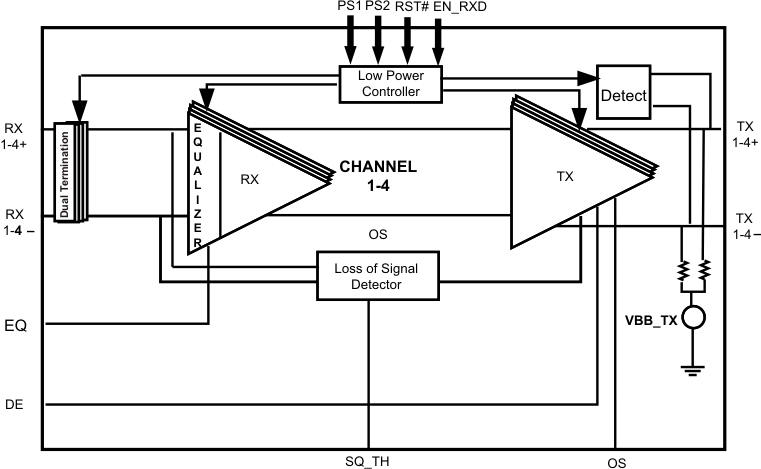
The SN65LVPE504 is designed to minimize the signal degradation effects such as crosstalk and inter-symbol interference (ISI) that limits interconnect distance between two devices. The input stage of each channel offers selectable equalization settings that can be programmed to match loss in the channel. The differential outputs provide selectable de-emphasis to compensate for the anticipated distortion PCIe signal will experience. Both equalization and de-emphasis levels for all 4 channels are controlled by the setting of signal control pins EQ, DE and OS.
See Table 1 for EQ, DE and OS setting details.
The SN65LVPE504 is a quad channel, half four lane PCIe redriver and signal conditioner supporting data rates of up to 5.0Gbps. The device complies with PCIe spec revision 2.1, supporting electrical idle and power management modes.
Programmable EQ, De-Emphasis and Amplitude Swing
The SN65LVPE504 is designed to minimize the signal degradation effects such as crosstalk and inter-symbol interference (ISI) that limits interconnect distance between two devices. The input stage of each channel offers selectable equalization settings that can be programmed to match loss in the channel. The differential outputs provide selectable de-emphasis to compensate for the anticipated distortion PCIe signal will experience. Both equalization and de-emphasis levels for all 4 channels are controlled by the setting of signal control pins EQ, DE and OS.
See Table 1 for EQ, DE and OS setting details. |
SN65LVPE5122nd generation dual channel USB 3.0 redriver | Development Boards, Kits, Programmers | 2 | NRND | The SN65LVPE512 device is a dual-channel, single-lane USB 3.0 redriver and signal conditioner supporting data rates of 5 Gbps. The device complies with USB 3.0 spec revision 1.0, supporting electrical idle condition and low frequency periodic signals (LFPS) for USB 3.0 power management modes.
The SN65LVPE512 device is a dual-channel, single-lane USB 3.0 redriver and signal conditioner supporting data rates of 5 Gbps. The device complies with USB 3.0 spec revision 1.0, supporting electrical idle condition and low frequency periodic signals (LFPS) for USB 3.0 power management modes. |
| Integrated Circuits (ICs) | 2 | Obsolete | |
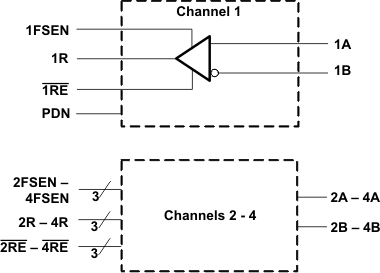
SN65MLVD0404-channel half-duplex M-LVDS line transceivers | Drivers, Receivers, Transceivers | 1 | Active | The SN65MLVD040 provides four half-duplex transceivers for transmitting and receiving Multipoint-Low-Voltage Differential Signals in full compliance with the TIA/EIA-899 (M-LVDS) standard, which are optimized to operate at signaling rates up to 250Mbps. The driver outputs have been designed to support multipoint buses presenting loads as low as 30Ω and incorporates controlled transition times to allow for stubs off of the backplane transmission line.
The M-LVDS standard defines two types of receivers, designated as Type-1 and Type-2. Type-1 receivers have thresholds centered about zero with 25mV of hysteresis to prevent output oscillations with loss of input; Type-2 receivers implement a failsafe by using an offset threshold. The xFSEN pins is used to select the Type-1 and Type-2 receiver for each of the channels. In addition, the driver rise and fall times are between 1ns and 2ns, complying with the M-LVDS standard to provide operation at 250Mbps while also accommodating stubs on the bus. Receiver outputs are slew rate controlled to reduce EMI and crosstalk effects associated with large current surges. The M-LVDS standard allows for 32 nodes on the bus providing a high-speed replacement for RS-485 where lower common-mode can be tolerated or when higher signaling rates are needed.
The driver logic inputs and the receiver logic outputs are on separate pins rather than tied together as in some transceiver designs. The drivers have separate enables (DE) and so does the receivers ( RE). This arrangement of separate logic inputs, logic outputs, and enable pins allows for a listen-while-talking operation. The devices are characterized for operation from –40°C to 85°C.
The SN65MLVD040 provides four half-duplex transceivers for transmitting and receiving Multipoint-Low-Voltage Differential Signals in full compliance with the TIA/EIA-899 (M-LVDS) standard, which are optimized to operate at signaling rates up to 250Mbps. The driver outputs have been designed to support multipoint buses presenting loads as low as 30Ω and incorporates controlled transition times to allow for stubs off of the backplane transmission line.
The M-LVDS standard defines two types of receivers, designated as Type-1 and Type-2. Type-1 receivers have thresholds centered about zero with 25mV of hysteresis to prevent output oscillations with loss of input; Type-2 receivers implement a failsafe by using an offset threshold. The xFSEN pins is used to select the Type-1 and Type-2 receiver for each of the channels. In addition, the driver rise and fall times are between 1ns and 2ns, complying with the M-LVDS standard to provide operation at 250Mbps while also accommodating stubs on the bus. Receiver outputs are slew rate controlled to reduce EMI and crosstalk effects associated with large current surges. The M-LVDS standard allows for 32 nodes on the bus providing a high-speed replacement for RS-485 where lower common-mode can be tolerated or when higher signaling rates are needed.
The driver logic inputs and the receiver logic outputs are on separate pins rather than tied together as in some transceiver designs. The drivers have separate enables (DE) and so does the receivers ( RE). This arrangement of separate logic inputs, logic outputs, and enable pins allows for a listen-while-talking operation. The devices are characterized for operation from –40°C to 85°C. |
| Interface | 10 | Active | The SN65MLVD047A is a quadruple line driver that complies with the TIA/EIA-899 standard, Electrical Characteristics of Multipoint-Low-Voltage Differential Signaling (M−LVDS). The output current of this M−LVDS device has been increased, in comparison to standard LVDS compliant devices, in order to support doubly terminated transmission lines and heavily loaded backplane bus applications. Backplane applications generally require impedance matching termination resistors at both ends of the bus. The effective impedance of a doubly terminated bus can be as low as 30Ω due to the bus terminations, as well as the capacitive load of bus interface devices. SN65MLVD047A drivers allow for operation with loads as low as 30Ω. The SN65MLVD047A devices allow for multiple drivers to be present on a single bus. SN65MLVD047A drivers are high impedance when disabled or unpowered. Driver edge rate control is incorporated to support operation. The M−LVDS standard allows up to 32 nodes (drivers and/or receivers) to be connected to the same media in a backplane when multiple bus stubs are expected from the main transmission line to interface devices. The SN65MLVD047A provides 9kV ESD protection on all bus pins.
The SN65MLVD047A is a quadruple line driver that complies with the TIA/EIA-899 standard, Electrical Characteristics of Multipoint-Low-Voltage Differential Signaling (M−LVDS). The output current of this M−LVDS device has been increased, in comparison to standard LVDS compliant devices, in order to support doubly terminated transmission lines and heavily loaded backplane bus applications. Backplane applications generally require impedance matching termination resistors at both ends of the bus. The effective impedance of a doubly terminated bus can be as low as 30Ω due to the bus terminations, as well as the capacitive load of bus interface devices. SN65MLVD047A drivers allow for operation with loads as low as 30Ω. The SN65MLVD047A devices allow for multiple drivers to be present on a single bus. SN65MLVD047A drivers are high impedance when disabled or unpowered. Driver edge rate control is incorporated to support operation. The M−LVDS standard allows up to 32 nodes (drivers and/or receivers) to be connected to the same media in a backplane when multiple bus stubs are expected from the main transmission line to interface devices. The SN65MLVD047A provides 9kV ESD protection on all bus pins. |
| Interface | 2 | Active | The SN65MLVD048 is a quad-channel M-LVDS receiver. This device is designed in full compliance with the TIA/EIA-899 (M-LVDS) standard, which is optimized to operate at signaling rates up to 250Mbps. Each receiver channel is controlled by a receive enable ( RE). When RE = low, the corresponding channel is enabled; when RE = high, the corresponding channel is disabled.
The M-LVDS standard defines two types of receivers, designated as Type-1 and Type-2. Type-1 receivers have thresholds centered about zero with 25mV of hysteresis to prevent output oscillations with loss of input; Type-2 receivers implement a failsafe by using an offset threshold. Receiver outputs are slew rate controlled to reduce EMI and crosstalk effects associated with large current surges.
The devices are characterized for operation from –40°C to 85°C.
The SN65MLVD048 is a quad-channel M-LVDS receiver. This device is designed in full compliance with the TIA/EIA-899 (M-LVDS) standard, which is optimized to operate at signaling rates up to 250Mbps. Each receiver channel is controlled by a receive enable ( RE). When RE = low, the corresponding channel is enabled; when RE = high, the corresponding channel is disabled.
The M-LVDS standard defines two types of receivers, designated as Type-1 and Type-2. Type-1 receivers have thresholds centered about zero with 25mV of hysteresis to prevent output oscillations with loss of input; Type-2 receivers implement a failsafe by using an offset threshold. Receiver outputs are slew rate controlled to reduce EMI and crosstalk effects associated with large current surges.
The devices are characterized for operation from –40°C to 85°C. |
| Integrated Circuits (ICs) | 3 | Active | The SN65MLVD080 and SN65MLVD082 provide eight half-duplex transceivers for transmitting and receiving Multipoint-Low-Voltage Differential Signals in full compliance with the TIA/EIA-899 (M-LVDS) standard, which are optimized to operate at signaling rates up to 250 Mbps. The driver outputs have been designed to support multipoint buses presenting loads as low as 30-and incorporates controlled transition times to allow for stubs off of the backbone transmission line.
The M-LVDS standard defines two types of receivers, designated as Type-1 and Type-2. Type-1 receivers (SN65MLVD080) have thresholds centered about zero with 25 mV of hysteresis to prevent output oscillations with loss of input; Type-2 receivers (SN65MLVD082) implement a failsafe by using an offset threshold. In addition, the driver rise and fall times are between 1 and 1.5 ns, complying with the M-LVDS standard to provide operation at 250 Mbps while also accommodating stubs on the bus. Receiver outputs are slew rate controlled to reduce EMI and crosstalk effects associated with large current surges. The M-LVDS standard allows for 32 nodes on the bus providing a high-speed replacement for RS-485 where lower common-mode can be tolerated or when higher signaling rates are needed.
The driver logic inputs and the receiver logic outputs are on separate pins rather than tied together as in some transceiver designs. The drivers have separate enables (DE) and the receivers are enabled globally through (RE)\. This arrangement of separate logic inputs, logic outputs, and enable pins allows for a listen-while-talking operation. The devices are characterized for operation from –40°C to 85°C.
The SN65MLVD080 and SN65MLVD082 provide eight half-duplex transceivers for transmitting and receiving Multipoint-Low-Voltage Differential Signals in full compliance with the TIA/EIA-899 (M-LVDS) standard, which are optimized to operate at signaling rates up to 250 Mbps. The driver outputs have been designed to support multipoint buses presenting loads as low as 30-and incorporates controlled transition times to allow for stubs off of the backbone transmission line.
The M-LVDS standard defines two types of receivers, designated as Type-1 and Type-2. Type-1 receivers (SN65MLVD080) have thresholds centered about zero with 25 mV of hysteresis to prevent output oscillations with loss of input; Type-2 receivers (SN65MLVD082) implement a failsafe by using an offset threshold. In addition, the driver rise and fall times are between 1 and 1.5 ns, complying with the M-LVDS standard to provide operation at 250 Mbps while also accommodating stubs on the bus. Receiver outputs are slew rate controlled to reduce EMI and crosstalk effects associated with large current surges. The M-LVDS standard allows for 32 nodes on the bus providing a high-speed replacement for RS-485 where lower common-mode can be tolerated or when higher signaling rates are needed.
The driver logic inputs and the receiver logic outputs are on separate pins rather than tied together as in some transceiver designs. The drivers have separate enables (DE) and the receivers are enabled globally through (RE)\. This arrangement of separate logic inputs, logic outputs, and enable pins allows for a listen-while-talking operation. The devices are characterized for operation from –40°C to 85°C. |
| Drivers, Receivers, Transceivers | 3 | Active | The SN65MLVD080 and SN65MLVD082 provide eight half-duplex transceivers for transmitting and receiving Multipoint-Low-Voltage Differential Signals in full compliance with the TIA/EIA-899 (M-LVDS) standard, which are optimized to operate at signaling rates up to 250 Mbps. The driver outputs have been designed to support multipoint buses presenting loads as low as 30-and incorporates controlled transition times to allow for stubs off of the backbone transmission line.
The M-LVDS standard defines two types of receivers, designated as Type-1 and Type-2. Type-1 receivers (SN65MLVD080) have thresholds centered about zero with 25 mV of hysteresis to prevent output oscillations with loss of input; Type-2 receivers (SN65MLVD082) implement a failsafe by using an offset threshold. In addition, the driver rise and fall times are between 1 and 1.5 ns, complying with the M-LVDS standard to provide operation at 250 Mbps while also accommodating stubs on the bus. Receiver outputs are slew rate controlled to reduce EMI and crosstalk effects associated with large current surges. The M-LVDS standard allows for 32 nodes on the bus providing a high-speed replacement for RS-485 where lower common-mode can be tolerated or when higher signaling rates are needed.
The driver logic inputs and the receiver logic outputs are on separate pins rather than tied together as in some transceiver designs. The drivers have separate enables (DE) and the receivers are enabled globally through (RE)\. This arrangement of separate logic inputs, logic outputs, and enable pins allows for a listen-while-talking operation. The devices are characterized for operation from –40°C to 85°C.
The SN65MLVD080 and SN65MLVD082 provide eight half-duplex transceivers for transmitting and receiving Multipoint-Low-Voltage Differential Signals in full compliance with the TIA/EIA-899 (M-LVDS) standard, which are optimized to operate at signaling rates up to 250 Mbps. The driver outputs have been designed to support multipoint buses presenting loads as low as 30-and incorporates controlled transition times to allow for stubs off of the backbone transmission line.
The M-LVDS standard defines two types of receivers, designated as Type-1 and Type-2. Type-1 receivers (SN65MLVD080) have thresholds centered about zero with 25 mV of hysteresis to prevent output oscillations with loss of input; Type-2 receivers (SN65MLVD082) implement a failsafe by using an offset threshold. In addition, the driver rise and fall times are between 1 and 1.5 ns, complying with the M-LVDS standard to provide operation at 250 Mbps while also accommodating stubs on the bus. Receiver outputs are slew rate controlled to reduce EMI and crosstalk effects associated with large current surges. The M-LVDS standard allows for 32 nodes on the bus providing a high-speed replacement for RS-485 where lower common-mode can be tolerated or when higher signaling rates are needed.
The driver logic inputs and the receiver logic outputs are on separate pins rather than tied together as in some transceiver designs. The drivers have separate enables (DE) and the receivers are enabled globally through (RE)\. This arrangement of separate logic inputs, logic outputs, and enable pins allows for a listen-while-talking operation. The devices are characterized for operation from –40°C to 85°C. |
| Interface | 2 | Active | The SN65MLVD128 and SN65MLVD129 are LVTTL-to-M.LVDS translators/repeaters. Outputs comply with the M.LVDS standard (TIA/EIA-899) and are optimized for data rates up to 250 Mbps, and clock frequencies up to 125 MHz. The driver outputs have been designed to support multipoint buses presenting loads as low as 30and incorporates controlled transition times for backbone operation.
M-LVDS compliant devices allow for 32 nodes on a common bus, providing a high-speed replacement for RS-485 devices when lower common-mode voltage range and lower output signaling levels are acceptable. The SN65MLVD128 and SN65MLVD129 provide separate driver enables, allowing for independent control of each output signal.
Intended applications for these devices include transmission of clock signals from a central clock module, as well as translation and buffering of data or control signals for transmission through a controlled impedance backplane or cable.
The SN65MLVD128 and SN65MLVD129 are LVTTL-to-M.LVDS translators/repeaters. Outputs comply with the M.LVDS standard (TIA/EIA-899) and are optimized for data rates up to 250 Mbps, and clock frequencies up to 125 MHz. The driver outputs have been designed to support multipoint buses presenting loads as low as 30and incorporates controlled transition times for backbone operation.
M-LVDS compliant devices allow for 32 nodes on a common bus, providing a high-speed replacement for RS-485 devices when lower common-mode voltage range and lower output signaling levels are acceptable. The SN65MLVD128 and SN65MLVD129 provide separate driver enables, allowing for independent control of each output signal.
Intended applications for these devices include transmission of clock signals from a central clock module, as well as translation and buffering of data or control signals for transmission through a controlled impedance backplane or cable. |
| Signal Buffers, Repeaters, Splitters | 2 | Active | The SN65MLVD128 and SN65MLVD129 are LVTTL-to-M.LVDS translators/repeaters. Outputs comply with the M.LVDS standard (TIA/EIA-899) and are optimized for data rates up to 250 Mbps, and clock frequencies up to 125 MHz. The driver outputs have been designed to support multipoint buses presenting loads as low as 30and incorporates controlled transition times for backbone operation.
M-LVDS compliant devices allow for 32 nodes on a common bus, providing a high-speed replacement for RS-485 devices when lower common-mode voltage range and lower output signaling levels are acceptable. The SN65MLVD128 and SN65MLVD129 provide separate driver enables, allowing for independent control of each output signal.
Intended applications for these devices include transmission of clock signals from a central clock module, as well as translation and buffering of data or control signals for transmission through a controlled impedance backplane or cable.
The SN65MLVD128 and SN65MLVD129 are LVTTL-to-M.LVDS translators/repeaters. Outputs comply with the M.LVDS standard (TIA/EIA-899) and are optimized for data rates up to 250 Mbps, and clock frequencies up to 125 MHz. The driver outputs have been designed to support multipoint buses presenting loads as low as 30and incorporates controlled transition times for backbone operation.
M-LVDS compliant devices allow for 32 nodes on a common bus, providing a high-speed replacement for RS-485 devices when lower common-mode voltage range and lower output signaling levels are acceptable. The SN65MLVD128 and SN65MLVD129 provide separate driver enables, allowing for independent control of each output signal.
Intended applications for these devices include transmission of clock signals from a central clock module, as well as translation and buffering of data or control signals for transmission through a controlled impedance backplane or cable. |