SN65LVDS9637BDual LVDS receiver with -2 to 4.4-V common-mode range | Interface | 9 | Active | This family of differential line receivers offers improved performance and features that implement the electrical characteristics of low-voltage differential signaling (LVDS). LVDS is defined in the TIA/EIA-644 standard. This improved performance represents the second generation of receiver products for this standard, providing a better overall solution for the cabled environment. This generation of products is an extension to TI's overall product portfolio and is not necessarily a replacement for older LVDS receivers.
Improved features include an input common-mode voltage range 2 V wider than the minimum required by the standard. This will allow longer cable lengths by tripling the allowable ground noise tolerance to 3 V between a driver and receiver. TI has additionally introduced an even wider input common-mode voltage range of -4 to 5 V in their SN65LVDS/T33 and SN65LVDS/T34.
Precise control of the differential input voltage thresholds now allows for inclusion of 50 mV of input voltage hysteresis to improve noise rejection on slowly changing input signals. The input thresholds are still no more than ±50 mV over the full input common-mode voltage range.
The high-speed switching of LVDS signals almost always necessitates the use of a line impedance matching resistor at the receiving-end of the cable or transmission media. The SN65LVDT series of receivers eliminates this external resistor by integrating it with the receiver. The non-terminated SN65LVDS series is also available for multidrop or other termination circuits.
The receivers can withstand ±15-kV human-body model (HBM) and ±600 V-machine model (MM) electrostatic discharges to the receiver input pins with respect to ground without damage. This provides reliability in cabled and other connections where potentially damaging noise is always a threat.
The receivers also include a (patent pending) fail-safe circuit that will provide a high-level output within 600 ns after loss of the input signal. The most common causes of signal loss are disconnected cables, shorted lines, or powered-down transmitters. This prevents noise from being received as valid data under these fault conditions. This feature may also be used for wired-OR bus signaling.
The intended application of these devices and signaling technique is for point-to-point baseband data transmission over controlled impedance media of approximately 100. The transmission media may be printed-circuit board traces, backplanes, or cables. The ultimate rate and distance of data transfer is dependent upon the attenuation characteristics of the media and the noise coupling to the environment.
The SN65LVDS32B, SN65LVDT32B, SN65LVDS3486B, SN65LVDT3486B, SN65LVDS9637B, and SN65LVDT9637B are characterized for operation from -40°C to 85°C.
This family of differential line receivers offers improved performance and features that implement the electrical characteristics of low-voltage differential signaling (LVDS). LVDS is defined in the TIA/EIA-644 standard. This improved performance represents the second generation of receiver products for this standard, providing a better overall solution for the cabled environment. This generation of products is an extension to TI's overall product portfolio and is not necessarily a replacement for older LVDS receivers.
Improved features include an input common-mode voltage range 2 V wider than the minimum required by the standard. This will allow longer cable lengths by tripling the allowable ground noise tolerance to 3 V between a driver and receiver. TI has additionally introduced an even wider input common-mode voltage range of -4 to 5 V in their SN65LVDS/T33 and SN65LVDS/T34.
Precise control of the differential input voltage thresholds now allows for inclusion of 50 mV of input voltage hysteresis to improve noise rejection on slowly changing input signals. The input thresholds are still no more than ±50 mV over the full input common-mode voltage range.
The high-speed switching of LVDS signals almost always necessitates the use of a line impedance matching resistor at the receiving-end of the cable or transmission media. The SN65LVDT series of receivers eliminates this external resistor by integrating it with the receiver. The non-terminated SN65LVDS series is also available for multidrop or other termination circuits.
The receivers can withstand ±15-kV human-body model (HBM) and ±600 V-machine model (MM) electrostatic discharges to the receiver input pins with respect to ground without damage. This provides reliability in cabled and other connections where potentially damaging noise is always a threat.
The receivers also include a (patent pending) fail-safe circuit that will provide a high-level output within 600 ns after loss of the input signal. The most common causes of signal loss are disconnected cables, shorted lines, or powered-down transmitters. This prevents noise from being received as valid data under these fault conditions. This feature may also be used for wired-OR bus signaling.
The intended application of these devices and signaling technique is for point-to-point baseband data transmission over controlled impedance media of approximately 100. The transmission media may be printed-circuit board traces, backplanes, or cables. The ultimate rate and distance of data transfer is dependent upon the attenuation characteristics of the media and the noise coupling to the environment.
The SN65LVDS32B, SN65LVDT32B, SN65LVDS3486B, SN65LVDT3486B, SN65LVDS9637B, and SN65LVDT9637B are characterized for operation from -40°C to 85°C. |
SN65LVDS96381500-Mbps LVDS dial high speed differential driver | Drivers, Receivers, Transceivers | 8 | Active | The SN55LVDS31, SN65LVDS31, SN65LVDS3487, and SN65LVDS9638 devices are differential line drivers that implement the electrical characteristics of low-voltage differential signaling (LVDS). This signaling technique lowers the output voltage levels of 5-V differential standard levels (such as TIA/EIA-422B) to reduce the power, increase the switching speeds, and allow operation with a 3.3-V supply rail. Any of the four current-mode drivers will deliver a minimum differential output voltage magnitude of 247 mV into a 100-Ω load when enabled.
The SN55LVDS31, SN65LVDS31, SN65LVDS3487, and SN65LVDS9638 devices are differential line drivers that implement the electrical characteristics of low-voltage differential signaling (LVDS). This signaling technique lowers the output voltage levels of 5-V differential standard levels (such as TIA/EIA-422B) to reduce the power, increase the switching speeds, and allow operation with a 3.3-V supply rail. Any of the four current-mode drivers will deliver a minimum differential output voltage magnitude of 247 mV into a 100-Ω load when enabled. |
SN65LVDT1002-Gbps LVDS, LVPECL & CML to LVDS repeater/translator | Interface | 4 | Active | The SN65LVDS100, SN65LVDT100, SN65LVDS101, and SN65LVDT101 are high-speed differential receivers and drivers connected as repeaters. The receiver accepts low-voltage differential signaling (LVDS), positive-emitter-coupled logic (PECL), or current-mode logic (CML) input signals at rates up to 2 Gbps and repeats it as either an LVDS or PECL output signal. The signal path through the device is differential for low radiated emissions and minimal added jitter.
The outputs of the SN65LVDS100 and SN65LVDT100 are LVDS levels as defined by TIA/EIA-644-A. The outputs of the SN65LVDS101 and SN65LVDT101 are compatible with 3.3-V PECL levels. Both drive differential transmission lines with nominally 100-Ω characteristic impedance.
The SN65LVDT100 and SN65LVDT101 include a 110-Ω differential line termination resistor for less board space, fewer components, and the shortest stub length possible. They do not include the VBBvoltage reference found in the SN65LVDS100 and SN65LVDS101. VBBprovides a voltage reference of typically 1.35 V below VCCfor use in receiving single-ended input signals and is particularly useful with single-ended 3.3-V PECL inputs. When VBBis not used, it should be unconnected or open.
All devices are characterized for operation from –40°C to 85°C.
The SN65LVDS100, SN65LVDT100, SN65LVDS101, and SN65LVDT101 are high-speed differential receivers and drivers connected as repeaters. The receiver accepts low-voltage differential signaling (LVDS), positive-emitter-coupled logic (PECL), or current-mode logic (CML) input signals at rates up to 2 Gbps and repeats it as either an LVDS or PECL output signal. The signal path through the device is differential for low radiated emissions and minimal added jitter.
The outputs of the SN65LVDS100 and SN65LVDT100 are LVDS levels as defined by TIA/EIA-644-A. The outputs of the SN65LVDS101 and SN65LVDT101 are compatible with 3.3-V PECL levels. Both drive differential transmission lines with nominally 100-Ω characteristic impedance.
The SN65LVDT100 and SN65LVDT101 include a 110-Ω differential line termination resistor for less board space, fewer components, and the shortest stub length possible. They do not include the VBBvoltage reference found in the SN65LVDS100 and SN65LVDS101. VBBprovides a voltage reference of typically 1.35 V below VCCfor use in receiving single-ended input signals and is particularly useful with single-ended 3.3-V PECL inputs. When VBBis not used, it should be unconnected or open.
All devices are characterized for operation from –40°C to 85°C. |
SN65LVDT1012-Gbps LVDS, LVPECL & CML to LVPECL repeater/translator | Signal Buffers, Repeaters, Splitters | 3 | Active | The SN65LVDS100, SN65LVDT100, SN65LVDS101, and SN65LVDT101 are high-speed differential receivers and drivers connected as repeaters. The receiver accepts low-voltage differential signaling (LVDS), positive-emitter-coupled logic (PECL), or current-mode logic (CML) input signals at rates up to 2 Gbps and repeats it as either an LVDS or PECL output signal. The signal path through the device is differential for low radiated emissions and minimal added jitter.
The outputs of the SN65LVDS100 and SN65LVDT100 are LVDS levels as defined by TIA/EIA-644-A. The outputs of the SN65LVDS101 and SN65LVDT101 are compatible with 3.3-V PECL levels. Both drive differential transmission lines with nominally 100-Ω characteristic impedance.
The SN65LVDT100 and SN65LVDT101 include a 110-Ω differential line termination resistor for less board space, fewer components, and the shortest stub length possible. They do not include the VBBvoltage reference found in the SN65LVDS100 and SN65LVDS101. VBBprovides a voltage reference of typically 1.35 V below VCCfor use in receiving single-ended input signals and is particularly useful with single-ended 3.3-V PECL inputs. When VBBis not used, it should be unconnected or open.
All devices are characterized for operation from –40°C to 85°C.
The SN65LVDS100, SN65LVDT100, SN65LVDS101, and SN65LVDT101 are high-speed differential receivers and drivers connected as repeaters. The receiver accepts low-voltage differential signaling (LVDS), positive-emitter-coupled logic (PECL), or current-mode logic (CML) input signals at rates up to 2 Gbps and repeats it as either an LVDS or PECL output signal. The signal path through the device is differential for low radiated emissions and minimal added jitter.
The outputs of the SN65LVDS100 and SN65LVDT100 are LVDS levels as defined by TIA/EIA-644-A. The outputs of the SN65LVDS101 and SN65LVDT101 are compatible with 3.3-V PECL levels. Both drive differential transmission lines with nominally 100-Ω characteristic impedance.
The SN65LVDT100 and SN65LVDT101 include a 110-Ω differential line termination resistor for less board space, fewer components, and the shortest stub length possible. They do not include the VBBvoltage reference found in the SN65LVDS100 and SN65LVDS101. VBBprovides a voltage reference of typically 1.35 V below VCCfor use in receiving single-ended input signals and is particularly useful with single-ended 3.3-V PECL inputs. When VBBis not used, it should be unconnected or open.
All devices are characterized for operation from –40°C to 85°C. |
| Logic | 4 | Active | The SN65LVDS122 and SN65LVDT122 are crosspoint switches that use low voltage differential signaling (LVDS) to achieve signaling rates as high as 1.5 Gbps. They are pin-compatible speed upgrades to the SN65LVDS22 and SN65LVDM22. The internal signal paths maintain differential signaling for high speeds and low signal skews. These devices have a 0 V to 4 V common-mode input range that accepts LVDS, LVPECL, CML inputs. Two logic pins (S0 and S1) set the internal configuration between the differential inputs and outputs. This allows the flexibility to perform the following configurations: 2 x 2 crosspoint switch, 2:1 mux, 1:2 splitter or dual repeater/translator within a single device. Additionally, SN65LVDT122 incorporates a 110-termination resistor for those applications where board space is a premium. Although these devices are designed for 1.5 Gbps, some applications at a 2-Gbps data rate can be supported depending on loading and signal quality.
The intended application of this device is ideal for loopback switching for diagnostic routines, fanout buffering of clock/data distribution provide protection in fault-tolerant systems, clock muxing in optical modules, and for overall signal boosting over extended distances.
The SN65LVDS122 and SN65LVDT122 are characterized for operation from –40°C to 85°C.
The SN65LVDS122 and SN65LVDT122 are crosspoint switches that use low voltage differential signaling (LVDS) to achieve signaling rates as high as 1.5 Gbps. They are pin-compatible speed upgrades to the SN65LVDS22 and SN65LVDM22. The internal signal paths maintain differential signaling for high speeds and low signal skews. These devices have a 0 V to 4 V common-mode input range that accepts LVDS, LVPECL, CML inputs. Two logic pins (S0 and S1) set the internal configuration between the differential inputs and outputs. This allows the flexibility to perform the following configurations: 2 x 2 crosspoint switch, 2:1 mux, 1:2 splitter or dual repeater/translator within a single device. Additionally, SN65LVDT122 incorporates a 110-termination resistor for those applications where board space is a premium. Although these devices are designed for 1.5 Gbps, some applications at a 2-Gbps data rate can be supported depending on loading and signal quality.
The intended application of this device is ideal for loopback switching for diagnostic routines, fanout buffering of clock/data distribution provide protection in fault-tolerant systems, clock muxing in optical modules, and for overall signal boosting over extended distances.
The SN65LVDS122 and SN65LVDT122 are characterized for operation from –40°C to 85°C. |
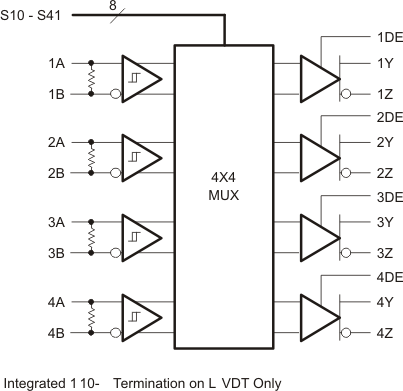
| Integrated Circuits (ICs) | 3 | Active | The SN65LVDS125A and SN65LVDT125A are 4x4 nonblocking crosspoint switches. Low-voltage differential signaling (LVDS) is used to achieve signaling rates of 1.5 Gbps per channel. Each output driver includes a 4:1 multiplexer to allow any input to be routed to any output. Internal signal paths are fully differential to achieve the high signaling speeds while maintaining low signal skews. The SN65LVDT125A incorporates 110-Ω termination resistors for those applications where board space is a premium.
Designed to support signaling rates up to 1.5 Gbps for OC-12 clocks (622 MHz). The 1.5-Gbps signaling rate allows use in HDTV systems, including SMPTE 292 video applications requiring signaling rates of 1.485 Gbps.
The SN65LVDS125A and SN65LVDT125A are characterized for operation from –40°C to 85°C.
The SN65LVDS125A and SN65LVDT125A are 4x4 nonblocking crosspoint switches. Low-voltage differential signaling (LVDS) is used to achieve signaling rates of 1.5 Gbps per channel. Each output driver includes a 4:1 multiplexer to allow any input to be routed to any output. Internal signal paths are fully differential to achieve the high signaling speeds while maintaining low signal skews. The SN65LVDT125A incorporates 110-Ω termination resistors for those applications where board space is a premium.
Designed to support signaling rates up to 1.5 Gbps for OC-12 clocks (622 MHz). The 1.5-Gbps signaling rate allows use in HDTV systems, including SMPTE 292 video applications requiring signaling rates of 1.485 Gbps.
The SN65LVDS125A and SN65LVDT125A are characterized for operation from –40°C to 85°C. |
SN65LVDT14Multi-channel transceivers for SPI over LVDS | Integrated Circuits (ICs) | 4 | Active | The SN65LVDTxx devices are multi-channel LVDS transceivers that operate using LVDS line drivers and receivers. The SN65LVDTxx devices support signaling rates of at least 250 Mbps, and the devices operate from a single supply (typically at 3.3 V) in a 20-pin TSSOP package designed for easy PCB layout.
The SN65LVDT14 and SN65LVDT41 provide general-purpose, asymmetric, bidirectional communication with the added benefit of high noise immunity, low electromagnetic interference (EMI), and increased cable length through the use of LVDS lines. The SN65LVDT14 and SN65LVDT41 are primarily used for SPI over LVDS applications.
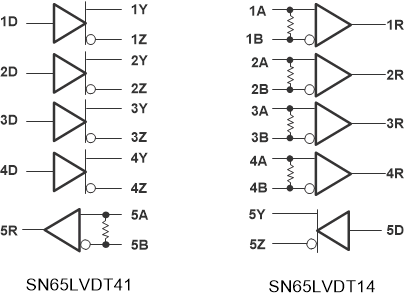
The SN65LVDT14 combines one LVDS line driver with four terminated LVDS line receivers in one package. The SN65LVDT14 can be used to extend asymmetric, bidirectional interfaces such as SPI over long distances, and should be located at the SPI slave.
The SN65LVDT41 combines four LVDS line drivers with a single terminated LVDS line receiver in one package. The SN65LVDT41 can be used to extend asymmetric, bidirectional interfaces such as SPI over long distances, and should be located at the SPI master.
The SN65LVDTxx devices are multi-channel LVDS transceivers that operate using LVDS line drivers and receivers. The SN65LVDTxx devices support signaling rates of at least 250 Mbps, and the devices operate from a single supply (typically at 3.3 V) in a 20-pin TSSOP package designed for easy PCB layout.
The SN65LVDT14 and SN65LVDT41 provide general-purpose, asymmetric, bidirectional communication with the added benefit of high noise immunity, low electromagnetic interference (EMI), and increased cable length through the use of LVDS lines. The SN65LVDT14 and SN65LVDT41 are primarily used for SPI over LVDS applications.
The SN65LVDT14 combines one LVDS line driver with four terminated LVDS line receivers in one package. The SN65LVDT14 can be used to extend asymmetric, bidirectional interfaces such as SPI over long distances, and should be located at the SPI slave.
The SN65LVDT41 combines four LVDS line drivers with a single terminated LVDS line receiver in one package. The SN65LVDT41 can be used to extend asymmetric, bidirectional interfaces such as SPI over long distances, and should be located at the SPI master. |
| Integrated Circuits (ICs) | 5 | Active | The SN65LVDS1, SN65LVDS2, and SN65LVDT2 devices are single, low-voltage, differential line drivers and receivers in the small-outline transistor package. The outputs comply with the TIA/EIA-644 standard and provide a minimum differential output voltage magnitude of 247mV into a 100Ω load at signaling rates up to 630Mbps for drivers and 400Mbps for receivers.
When the SN65LVDS1 device is used with an LVDS receiver (such as the SN65LVDT2) in a point-to-point connection, data or clocking signals can be transmitted over printed-circuit board traces or cables at very high rates with very low electromagnetic emissions and power consumption. The packaging, low power, low EMI, high ESD tolerance, and wide supply voltage range make the device ideal for battery-powered applications.
The SN65LVDS1, SN65LVDS2, and SN65LVDT2 devices are characterized for operation from –40°C to 85°C.
The SN65LVDS1, SN65LVDS2, and SN65LVDT2 devices are single, low-voltage, differential line drivers and receivers in the small-outline transistor package. The outputs comply with the TIA/EIA-644 standard and provide a minimum differential output voltage magnitude of 247mV into a 100Ω load at signaling rates up to 630Mbps for drivers and 400Mbps for receivers.
When the SN65LVDS1 device is used with an LVDS receiver (such as the SN65LVDT2) in a point-to-point connection, data or clocking signals can be transmitted over printed-circuit board traces or cables at very high rates with very low electromagnetic emissions and power consumption. The packaging, low power, low EMI, high ESD tolerance, and wide supply voltage range make the device ideal for battery-powered applications.
The SN65LVDS1, SN65LVDS2, and SN65LVDT2 devices are characterized for operation from –40°C to 85°C. |
| Logic | 2 | Active | The SN65LVDS250 and SN65LVDT250 are 4x4 nonblocking crosspoint switches in a flow-through pin-out allowing for ease in PCB layout. Low-voltage differential signaling (LVDS) is used to achieve a high-speed data throughput while using low power. Each of the output drivers includes a 4:1 multiplexer to allow any input to be routed to any output. Internal signal paths are fully differential to achieve the high signaling speeds while maintaining low signal skews. The SN65LVDT250 incorporates 110-termination resistors for those applications where board space is a premium.
The SN65LVDS250 and SN65LVDT250 are characterized for operation from –40°C to 85°C.
The SN65LVDS250 and SN65LVDT250 are 4x4 nonblocking crosspoint switches in a flow-through pin-out allowing for ease in PCB layout. Low-voltage differential signaling (LVDS) is used to achieve a high-speed data throughput while using low power. Each of the output drivers includes a 4:1 multiplexer to allow any input to be routed to any output. Internal signal paths are fully differential to achieve the high signaling speeds while maintaining low signal skews. The SN65LVDT250 incorporates 110-termination resistors for those applications where board space is a premium.
The SN65LVDS250 and SN65LVDT250 are characterized for operation from –40°C to 85°C. |
SN65LVDT32BQuad LVDS receiver with -2 to 4.4-V common-mode range | Integrated Circuits (ICs) | 2 | Active | This family of differential line receivers offers improved performance and features that implement the electrical characteristics of low-voltage differential signaling (LVDS). LVDS is defined in the TIA/EIA-644 standard. This improved performance represents the second generation of receiver products for this standard, providing a better overall solution for the cabled environment. This generation of products is an extension to TI's overall product portfolio and is not necessarily a replacement for older LVDS receivers.
Improved features include an input common-mode voltage range 2 V wider than the minimum required by the standard. This will allow longer cable lengths by tripling the allowable ground noise tolerance to 3 V between a driver and receiver. TI has additionally introduced an even wider input common-mode voltage range of -4 to 5 V in their SN65LVDS/T33 and SN65LVDS/T34.
Precise control of the differential input voltage thresholds now allows for inclusion of 50 mV of input voltage hysteresis to improve noise rejection on slowly changing input signals. The input thresholds are still no more than ±50 mV over the full input common-mode voltage range.
The high-speed switching of LVDS signals almost always necessitates the use of a line impedance matching resistor at the receiving-end of the cable or transmission media. The SN65LVDT series of receivers eliminates this external resistor by integrating it with the receiver. The non-terminated SN65LVDS series is also available for multidrop or other termination circuits.
The receivers can withstand ±15-kV human-body model (HBM) and ±600 V-machine model (MM) electrostatic discharges to the receiver input pins with respect to ground without damage. This provides reliability in cabled and other connections where potentially damaging noise is always a threat.
The receivers also include a (patent pending) fail-safe circuit that will provide a high-level output within 600 ns after loss of the input signal. The most common causes of signal loss are disconnected cables, shorted lines, or powered-down transmitters. This prevents noise from being received as valid data under these fault conditions. This feature may also be used for wired-OR bus signaling.
The intended application of these devices and signaling technique is for point-to-point baseband data transmission over controlled impedance media of approximately 100. The transmission media may be printed-circuit board traces, backplanes, or cables. The ultimate rate and distance of data transfer is dependent upon the attenuation characteristics of the media and the noise coupling to the environment.
The SN65LVDS32B, SN65LVDT32B, SN65LVDS3486B, SN65LVDT3486B, SN65LVDS9637B, and SN65LVDT9637B are characterized for operation from -40°C to 85°C.
This family of differential line receivers offers improved performance and features that implement the electrical characteristics of low-voltage differential signaling (LVDS). LVDS is defined in the TIA/EIA-644 standard. This improved performance represents the second generation of receiver products for this standard, providing a better overall solution for the cabled environment. This generation of products is an extension to TI's overall product portfolio and is not necessarily a replacement for older LVDS receivers.
Improved features include an input common-mode voltage range 2 V wider than the minimum required by the standard. This will allow longer cable lengths by tripling the allowable ground noise tolerance to 3 V between a driver and receiver. TI has additionally introduced an even wider input common-mode voltage range of -4 to 5 V in their SN65LVDS/T33 and SN65LVDS/T34.
Precise control of the differential input voltage thresholds now allows for inclusion of 50 mV of input voltage hysteresis to improve noise rejection on slowly changing input signals. The input thresholds are still no more than ±50 mV over the full input common-mode voltage range.
The high-speed switching of LVDS signals almost always necessitates the use of a line impedance matching resistor at the receiving-end of the cable or transmission media. The SN65LVDT series of receivers eliminates this external resistor by integrating it with the receiver. The non-terminated SN65LVDS series is also available for multidrop or other termination circuits.
The receivers can withstand ±15-kV human-body model (HBM) and ±600 V-machine model (MM) electrostatic discharges to the receiver input pins with respect to ground without damage. This provides reliability in cabled and other connections where potentially damaging noise is always a threat.
The receivers also include a (patent pending) fail-safe circuit that will provide a high-level output within 600 ns after loss of the input signal. The most common causes of signal loss are disconnected cables, shorted lines, or powered-down transmitters. This prevents noise from being received as valid data under these fault conditions. This feature may also be used for wired-OR bus signaling.
The intended application of these devices and signaling technique is for point-to-point baseband data transmission over controlled impedance media of approximately 100. The transmission media may be printed-circuit board traces, backplanes, or cables. The ultimate rate and distance of data transfer is dependent upon the attenuation characteristics of the media and the noise coupling to the environment.
The SN65LVDS32B, SN65LVDT32B, SN65LVDS3486B, SN65LVDT3486B, SN65LVDS9637B, and SN65LVDT9637B are characterized for operation from -40°C to 85°C. |