T
Texas Instruments
| Series | Category | # Parts | Status | Description |
|---|---|---|---|---|
| Part | Spec A | Spec B | Spec C | Spec D | Description |
|---|---|---|---|---|---|



| Series | Category | # Parts | Status | Description |
|---|---|---|---|---|
| Part | Spec A | Spec B | Spec C | Spec D | Description |
|---|---|---|---|---|---|
| Part | Category | Description |
|---|---|---|
 Texas Instruments | Integrated Circuits (ICs) | BUS DRIVER, BCT/FBT SERIES |
 Texas Instruments | Integrated Circuits (ICs) | 12BIT 3.3V~3.6V 210MHZ PARALLEL VQFN-48-EP(7X7) ANALOG TO DIGITAL CONVERTERS (ADC) ROHS |
Texas Instruments | Integrated Circuits (ICs) | TMX320DRE311 179PIN UBGA 200MHZ |
 Texas Instruments TPS61040DRVTG4Unknown | Integrated Circuits (ICs) | IC LED DRV RGLTR PWM 350MA 6WSON |
 Texas Instruments LP3876ET-2.5Obsolete | Integrated Circuits (ICs) | IC REG LINEAR 2.5V 3A TO220-5 |
 Texas Instruments LMS1585ACSX-ADJObsolete | Integrated Circuits (ICs) | IC REG LIN POS ADJ 5A DDPAK |
 Texas Instruments INA111APG4Obsolete | Integrated Circuits (ICs) | IC INST AMP 1 CIRCUIT 8DIP |
 Texas Instruments | Integrated Circuits (ICs) | AUTOMOTIVE, QUAD 36V 1.2MHZ OPERATIONAL AMPLIFIER |
 Texas Instruments OPA340NA/3KG4Unknown | Integrated Circuits (ICs) | IC OPAMP GP 1 CIRCUIT SOT23-5 |
 Texas Instruments PT5112AObsolete | Power Supplies - Board Mount | DC DC CONVERTER 8V 8W |
| Series | Category | # Parts | Status | Description |
|---|---|---|---|---|
SN65HVD1781A-Q1Automotive, Fault-Protected RS-485 Transceivers With 3.3-V to 5-V Operation | Drivers, Receivers, Transceivers | 5 | Active | The SN65HVD178x devices are designed to survive overvoltage faults such as direct shorts to power supplies, mis-wiring faults, connector failures, cable crushes, and tool mis-applications. The devices are also robust to ESD events with high levels of protection to the human-body-model specification.
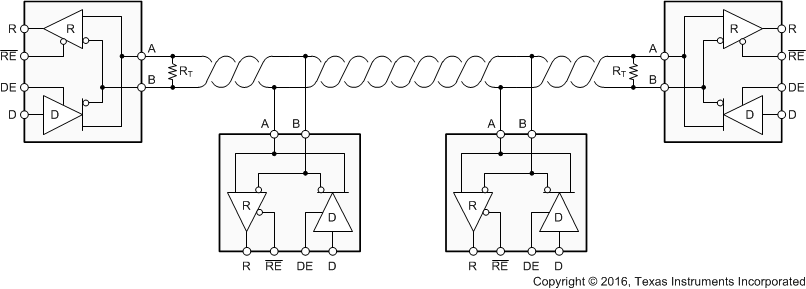
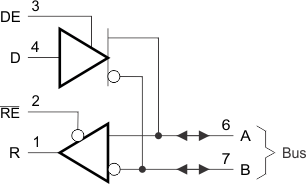
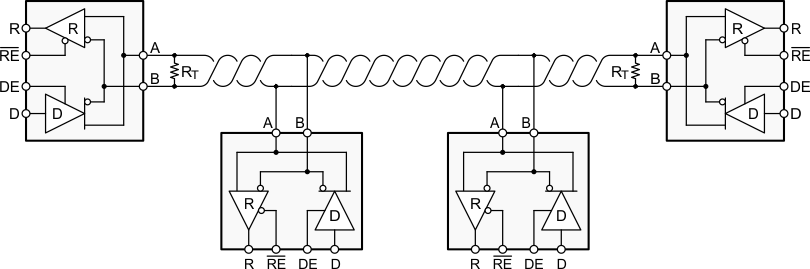
The SN65HVD178x devices combine a differential driver and a differential receiver, which operate from a single power supply. In the SN65HVD1782, the driver differential outputs and the receiver differential inputs are connected internally to form a bus port suitable for half-duplex (two-wire bus) communication. This port features a wide common-mode voltage range, making the devices suitable for multipoint applications over long cable runs. These devices are characterized from –40°C to 125°C. These devices are pin-compatible with the industry-standard SN75176 transceiver, making them drop-in upgrades in most systems.
These devices are fully compliant with ANSI TIA/EIA 485-A with a 5-V supply and can operate with a 3.3-V supply with reduced driver output voltage for low-power applications. For applications where operation is required over an extended common-mode voltage range, see the SN65HVD1785 (SLLS872) data sheet.
The SN65HVD178x devices are designed to survive overvoltage faults such as direct shorts to power supplies, mis-wiring faults, connector failures, cable crushes, and tool mis-applications. The devices are also robust to ESD events with high levels of protection to the human-body-model specification.
The SN65HVD178x devices combine a differential driver and a differential receiver, which operate from a single power supply. In the SN65HVD1782, the driver differential outputs and the receiver differential inputs are connected internally to form a bus port suitable for half-duplex (two-wire bus) communication. This port features a wide common-mode voltage range, making the devices suitable for multipoint applications over long cable runs. These devices are characterized from –40°C to 125°C. These devices are pin-compatible with the industry-standard SN75176 transceiver, making them drop-in upgrades in most systems.
These devices are fully compliant with ANSI TIA/EIA 485-A with a 5-V supply and can operate with a 3.3-V supply with reduced driver output voltage for low-power applications. For applications where operation is required over an extended common-mode voltage range, see the SN65HVD1785 (SLLS872) data sheet. |
SN65HVD1782-Q1Automotive Fault-Protected RS-485 Transceivers with 3.3-V to 5-V Operation | Interface | 3 | Active | The SN65HVD178x devices are designed to survive overvoltage faults such as direct shorts to power supplies, mis-wiring faults, connector failures, cable crushes, and tool mis-applications. The devices are also robust to ESD events with high levels of protection to the human-body-model specification.
The SN65HVD178x devices combine a differential driver and a differential receiver, which operate from a single power supply. In the SN65HVD1782, the driver differential outputs and the receiver differential inputs are connected internally to form a bus port suitable for half-duplex (two-wire bus) communication. This port features a wide common-mode voltage range, making the devices suitable for multipoint applications over long cable runs. These devices are characterized from –40°C to 125°C. These devices are pin-compatible with the industry-standard SN75176 transceiver, making them drop-in upgrades in most systems.
These devices are fully compliant with ANSI TIA/EIA 485-A with a 5-V supply and can operate with a 3.3-V supply with reduced driver output voltage for low-power applications. For applications where operation is required over an extended common-mode voltage range, see the SN65HVD1785 (SLLS872) data sheet.
The SN65HVD178x devices are designed to survive overvoltage faults such as direct shorts to power supplies, mis-wiring faults, connector failures, cable crushes, and tool mis-applications. The devices are also robust to ESD events with high levels of protection to the human-body-model specification.
The SN65HVD178x devices combine a differential driver and a differential receiver, which operate from a single power supply. In the SN65HVD1782, the driver differential outputs and the receiver differential inputs are connected internally to form a bus port suitable for half-duplex (two-wire bus) communication. This port features a wide common-mode voltage range, making the devices suitable for multipoint applications over long cable runs. These devices are characterized from –40°C to 125°C. These devices are pin-compatible with the industry-standard SN75176 transceiver, making them drop-in upgrades in most systems.
These devices are fully compliant with ANSI TIA/EIA 485-A with a 5-V supply and can operate with a 3.3-V supply with reduced driver output voltage for low-power applications. For applications where operation is required over an extended common-mode voltage range, see the SN65HVD1785 (SLLS872) data sheet. |
SN65HVD178570-V Fault-Protected RS-485 with -20 to +25 common mode | Drivers, Receivers, Transceivers | 3 | Active | These devices are designed to survive overvoltage faults such as direct shorts to power supplies, mis-wiring faults, connector failures, cable crushes, and tool mis-applications. They are also robust to ESD events, with high levels of protection to human-body model specifications.
These devices combine a differential driver and a differential receiver, which operate from a single power supply. In the ’HVD1785, ’HVD1786, and ’HVD1787, the driver differential outputs and the receiver differential inputs are connected internally to form a bus port suitable for half-duplex (two-wire bus) communication. In the ’HVD1793, the driver differential outputs and the receiver differential inputs are separate pins, to form a bus port suitable for full-duplex (four-wire bus) communication. These ports feature a wide common-mode voltage range, making the devices suitable for multipoint applications over long cable runs. These devices are characterized from –40°C to 105°C.
For similar features with 3.3-V supply operation, see the SN65HVD1781 (SLLS877).
These devices are designed to survive overvoltage faults such as direct shorts to power supplies, mis-wiring faults, connector failures, cable crushes, and tool mis-applications. They are also robust to ESD events, with high levels of protection to human-body model specifications.
These devices combine a differential driver and a differential receiver, which operate from a single power supply. In the ’HVD1785, ’HVD1786, and ’HVD1787, the driver differential outputs and the receiver differential inputs are connected internally to form a bus port suitable for half-duplex (two-wire bus) communication. In the ’HVD1793, the driver differential outputs and the receiver differential inputs are separate pins, to form a bus port suitable for full-duplex (four-wire bus) communication. These ports feature a wide common-mode voltage range, making the devices suitable for multipoint applications over long cable runs. These devices are characterized from –40°C to 105°C.
For similar features with 3.3-V supply operation, see the SN65HVD1781 (SLLS877). |
SN65HVD178670-V Fault-Protected RS-485 with -20 to +25 common mode | Drivers, Receivers, Transceivers | 3 | Active | These devices are designed to survive overvoltage faults such as direct shorts to power supplies, mis-wiring faults, connector failures, cable crushes, and tool mis-applications. They are also robust to ESD events, with high levels of protection to human-body model specifications.
These devices combine a differential driver and a differential receiver, which operate from a single power supply. In the ’HVD1785, ’HVD1786, and ’HVD1787, the driver differential outputs and the receiver differential inputs are connected internally to form a bus port suitable for half-duplex (two-wire bus) communication. In the ’HVD1793, the driver differential outputs and the receiver differential inputs are separate pins, to form a bus port suitable for full-duplex (four-wire bus) communication. These ports feature a wide common-mode voltage range, making the devices suitable for multipoint applications over long cable runs. These devices are characterized from –40°C to 105°C.
For similar features with 3.3-V supply operation, see the SN65HVD1781 (SLLS877).
These devices are designed to survive overvoltage faults such as direct shorts to power supplies, mis-wiring faults, connector failures, cable crushes, and tool mis-applications. They are also robust to ESD events, with high levels of protection to human-body model specifications.
These devices combine a differential driver and a differential receiver, which operate from a single power supply. In the ’HVD1785, ’HVD1786, and ’HVD1787, the driver differential outputs and the receiver differential inputs are connected internally to form a bus port suitable for half-duplex (two-wire bus) communication. In the ’HVD1793, the driver differential outputs and the receiver differential inputs are separate pins, to form a bus port suitable for full-duplex (four-wire bus) communication. These ports feature a wide common-mode voltage range, making the devices suitable for multipoint applications over long cable runs. These devices are characterized from –40°C to 105°C.
For similar features with 3.3-V supply operation, see the SN65HVD1781 (SLLS877). |
SN65HVD178730-V Fault-Protected RS-485 with -20 to +25 common mode | Integrated Circuits (ICs) | 3 | Active | These devices are designed to survive overvoltage faults such as direct shorts to power supplies, mis-wiring faults, connector failures, cable crushes, and tool mis-applications. They are also robust to ESD events, with high levels of protection to human-body model specifications.
These devices combine a differential driver and a differential receiver, which operate from a single power supply. In the ’HVD1785, ’HVD1786, and ’HVD1787, the driver differential outputs and the receiver differential inputs are connected internally to form a bus port suitable for half-duplex (two-wire bus) communication. In the ’HVD1793, the driver differential outputs and the receiver differential inputs are separate pins, to form a bus port suitable for full-duplex (four-wire bus) communication. These ports feature a wide common-mode voltage range, making the devices suitable for multipoint applications over long cable runs. These devices are characterized from –40°C to 105°C.
For similar features with 3.3-V supply operation, see the SN65HVD1781 (SLLS877).
These devices are designed to survive overvoltage faults such as direct shorts to power supplies, mis-wiring faults, connector failures, cable crushes, and tool mis-applications. They are also robust to ESD events, with high levels of protection to human-body model specifications.
These devices combine a differential driver and a differential receiver, which operate from a single power supply. In the ’HVD1785, ’HVD1786, and ’HVD1787, the driver differential outputs and the receiver differential inputs are connected internally to form a bus port suitable for half-duplex (two-wire bus) communication. In the ’HVD1793, the driver differential outputs and the receiver differential inputs are separate pins, to form a bus port suitable for full-duplex (four-wire bus) communication. These ports feature a wide common-mode voltage range, making the devices suitable for multipoint applications over long cable runs. These devices are characterized from –40°C to 105°C.
For similar features with 3.3-V supply operation, see the SN65HVD1781 (SLLS877). |
SN65HVD1795 V Full-Duplex RS-485/RS-422 Drivers and Balanced Receivers | Integrated Circuits (ICs) | 3 | Active | The SN65HVD179 is a differential line driver and differential-input line receiver that operates with a 5-V power supply. Each driver and receiver has separate input and output pins for full-duplex bus communication designs. They are designed for balanced transmission lines and interoperation with ANSI TIA/EIA-485A, TIA/EIA-422-B, ITU-T v.11, and ISO 8482:1993 standard-compliant devices.
The differential bus driver and receiver are monolithic, integrated circuits designed for full-duplex bi-directional data communication on multipoint bus-transmission lines at signaling rates(1)up to 25 Mbps. The SN65HVD179 is fully enabled with no external enabling pins.
The 1/2 unit load receiver has a high receiver input resistance. This results in lower bus leakage currents over the common-mode voltage range, and reduces the total amount of current that a 485 driver is forced to source or sink when transmitting.
The balanced differential receiver input threshold makes the SN65HVD179 fully compatible with fieldbus requirements that define an external failsafe structure.
(1)The signaling rate of a line is the number of voltage transitions that are made per second expressed in the units bps (bits per second).
The SN65HVD179 is a differential line driver and differential-input line receiver that operates with a 5-V power supply. Each driver and receiver has separate input and output pins for full-duplex bus communication designs. They are designed for balanced transmission lines and interoperation with ANSI TIA/EIA-485A, TIA/EIA-422-B, ITU-T v.11, and ISO 8482:1993 standard-compliant devices.
The differential bus driver and receiver are monolithic, integrated circuits designed for full-duplex bi-directional data communication on multipoint bus-transmission lines at signaling rates(1)up to 25 Mbps. The SN65HVD179 is fully enabled with no external enabling pins.
The 1/2 unit load receiver has a high receiver input resistance. This results in lower bus leakage currents over the common-mode voltage range, and reduces the total amount of current that a 485 driver is forced to source or sink when transmitting.
The balanced differential receiver input threshold makes the SN65HVD179 fully compatible with fieldbus requirements that define an external failsafe structure.
(1)The signaling rate of a line is the number of voltage transitions that are made per second expressed in the units bps (bits per second). |
SN65HVD179170-V Fault-Protected RS-485 Transceivers Full-Duplex with -20 to +25 common mode | Interface | 2 | Active | These devices are designed to survive overvoltage faults such as direct shorts to power supplies, mis-wiring faults, connector failures, cable crushes, and tool mis-applications. They are also robust to ESD events, with high levels of protection to human-body model specifications.
These devices combine a differential driver and a differential receiver, which operate from a single power supply. In the ’HVD1785, ’HVD1786, and ’HVD1787, the driver differential outputs and the receiver differential inputs are connected internally to form a bus port suitable for half-duplex (two-wire bus) communication. In the ’HVD1793, the driver differential outputs and the receiver differential inputs are separate pins, to form a bus port suitable for full-duplex (four-wire bus) communication. These ports feature a wide common-mode voltage range, making the devices suitable for multipoint applications over long cable runs. These devices are characterized from –40°C to 105°C.
For similar features with 3.3-V supply operation, see the SN65HVD1781 (SLLS877).
These devices are designed to survive overvoltage faults such as direct shorts to power supplies, mis-wiring faults, connector failures, cable crushes, and tool mis-applications. They are also robust to ESD events, with high levels of protection to human-body model specifications.
These devices combine a differential driver and a differential receiver, which operate from a single power supply. In the ’HVD1785, ’HVD1786, and ’HVD1787, the driver differential outputs and the receiver differential inputs are connected internally to form a bus port suitable for half-duplex (two-wire bus) communication. In the ’HVD1793, the driver differential outputs and the receiver differential inputs are separate pins, to form a bus port suitable for full-duplex (four-wire bus) communication. These ports feature a wide common-mode voltage range, making the devices suitable for multipoint applications over long cable runs. These devices are characterized from –40°C to 105°C.
For similar features with 3.3-V supply operation, see the SN65HVD1781 (SLLS877). |
SN65HVD1792-EP70-V Fault-Protected RS-485 Transceivers Full-Duplex with -20 to +25 common mode | Drivers, Receivers, Transceivers | 4 | Active | These devices are designed to survive overvoltage faults such as direct shorts to power supplies, mis-wiring faults, connector failures, cable crushes, and tool mis-applications. They are also robust to ESD events, with high levels of protection to human-body model specifications.
These devices combine a differential driver and a differential receiver, which operate from a single power supply. In the ’HVD1785, ’HVD1786, and ’HVD1787, the driver differential outputs and the receiver differential inputs are connected internally to form a bus port suitable for half-duplex (two-wire bus) communication. In the ’HVD1793, the driver differential outputs and the receiver differential inputs are separate pins, to form a bus port suitable for full-duplex (four-wire bus) communication. These ports feature a wide common-mode voltage range, making the devices suitable for multipoint applications over long cable runs. These devices are characterized from –40°C to 105°C.
For similar features with 3.3-V supply operation, see the SN65HVD1781 (SLLS877).
These devices are designed to survive overvoltage faults such as direct shorts to power supplies, mis-wiring faults, connector failures, cable crushes, and tool mis-applications. They are also robust to ESD events, with high levels of protection to human-body model specifications.
These devices combine a differential driver and a differential receiver, which operate from a single power supply. In the ’HVD1785, ’HVD1786, and ’HVD1787, the driver differential outputs and the receiver differential inputs are connected internally to form a bus port suitable for half-duplex (two-wire bus) communication. In the ’HVD1793, the driver differential outputs and the receiver differential inputs are separate pins, to form a bus port suitable for full-duplex (four-wire bus) communication. These ports feature a wide common-mode voltage range, making the devices suitable for multipoint applications over long cable runs. These devices are characterized from –40°C to 105°C.
For similar features with 3.3-V supply operation, see the SN65HVD1781 (SLLS877). |
SN65HVD179370-V Fault-Protected RS-485 Transceivers Full-Duplex with -20 to +25 common mode | Drivers, Receivers, Transceivers | 2 | Active | These devices are designed to survive overvoltage faults such as direct shorts to power supplies, mis-wiring faults, connector failures, cable crushes, and tool mis-applications. They are also robust to ESD events, with high levels of protection to human-body model specifications.
These devices combine a differential driver and a differential receiver, which operate from a single power supply. In the ’HVD1785, ’HVD1786, and ’HVD1787, the driver differential outputs and the receiver differential inputs are connected internally to form a bus port suitable for half-duplex (two-wire bus) communication. In the ’HVD1793, the driver differential outputs and the receiver differential inputs are separate pins, to form a bus port suitable for full-duplex (four-wire bus) communication. These ports feature a wide common-mode voltage range, making the devices suitable for multipoint applications over long cable runs. These devices are characterized from –40°C to 105°C.
For similar features with 3.3-V supply operation, see the SN65HVD1781 (SLLS877).
These devices are designed to survive overvoltage faults such as direct shorts to power supplies, mis-wiring faults, connector failures, cable crushes, and tool mis-applications. They are also robust to ESD events, with high levels of protection to human-body model specifications.
These devices combine a differential driver and a differential receiver, which operate from a single power supply. In the ’HVD1785, ’HVD1786, and ’HVD1787, the driver differential outputs and the receiver differential inputs are connected internally to form a bus port suitable for half-duplex (two-wire bus) communication. In the ’HVD1793, the driver differential outputs and the receiver differential inputs are separate pins, to form a bus port suitable for full-duplex (four-wire bus) communication. These ports feature a wide common-mode voltage range, making the devices suitable for multipoint applications over long cable runs. These devices are characterized from –40°C to 105°C.
For similar features with 3.3-V supply operation, see the SN65HVD1781 (SLLS877). |
SN65HVD179470-V Fault-Protected RS-485 Transceiver With Cable Invert | Integrated Circuits (ICs) | 3 | Active | These devices are designed to survive overvoltage faults such as direct shorts to power supplies, mis-wiring faults, connector failures, cable crushes, and tool mis-applications. They are also robust to ESD events, with high levels of protection to human-body model specifications.
These devices combine a differential driver and a differential receiver, which operate from a single power supply. The driver differential outputs and the receiver differential inputs are connected internally to for a bus port suitable for half-duplex (two-wire bus) communication. A cable invert pin (INV) allows active correction of mis-wires that may occur during installation. Upon detecting communication errors, the user can apply a logic HIGH to the INV pin, effectively inverting the polarity of the differential bus port, thereby correcting for the reversed bus wires.
These devices feature a wide common-mode voltage range, making them suitable for multi-point applications over long cable runs. These devices are characterized from –40°C to 105°C.
For similar features with 3.3 V supply operation, see the SN65HVD1781 (SLLS877).
These devices are designed to survive overvoltage faults such as direct shorts to power supplies, mis-wiring faults, connector failures, cable crushes, and tool mis-applications. They are also robust to ESD events, with high levels of protection to human-body model specifications.
These devices combine a differential driver and a differential receiver, which operate from a single power supply. The driver differential outputs and the receiver differential inputs are connected internally to for a bus port suitable for half-duplex (two-wire bus) communication. A cable invert pin (INV) allows active correction of mis-wires that may occur during installation. Upon detecting communication errors, the user can apply a logic HIGH to the INV pin, effectively inverting the polarity of the differential bus port, thereby correcting for the reversed bus wires.
These devices feature a wide common-mode voltage range, making them suitable for multi-point applications over long cable runs. These devices are characterized from –40°C to 105°C.
For similar features with 3.3 V supply operation, see the SN65HVD1781 (SLLS877). |