| Logic | 1 | Active | These synchronous, presettable counters feature an internal carry look-ahead for application in high-speed counting designs. The '160, '162, 'LS160A, 'LS162A, and 'S162 are decade counters and the '161, '163, 'LS161A, 'LS163A, and 'S163 are 4-bit binary counters. Synchronous operation is provided by having all flip-flops clocked simultaneously so that the outputs change coincident with each other when so instructed by the count-enable inputs and internal gating. This mode of operation eliminates the output counting spikes that are normally associated with asynchronous (ripple clock) counters, however counting spikes may occur on the (RCO) ripple carry output. A buffered clock input triggers the four flip-flops on the rising edge of the clock input waveform.
These counters are fully programmable; that is, the outputs may be preset to either level. As presetting is synchronous, setting up a low level at the load input disables the counter and causes the outputs to agree with the setup data after the next clock pulse regardless of the levels of the enable inputs. Low-to-high transitions at the load input of the '160 thru '163 should be avoided when the clock is low if the enable inputs are high at or before the transition. This restriction is not applicable to the 'LS160A thru 'LS163A or 'S162 or 'S163. The clear function for the '160, '161, 'LS160A, and 'LS161A is asynchronous and a low level at the clear input sets all four of the flip-flop outputs low regardless of the levels of clock, load, or enable inputs. The clear function for the '162, '163, 'LS162A, 'LS163A, 'S162, and 'S163 is synchronous and a low level at the clear input sets all four of the flip-flop outputs low after the next clock pulse, regardless of the levels of the enable inputs. This synchronous clear allows the count length to be modified easily as decoding the maximum count desired can be accomplished with one external NAND gate. The gate output is connected to the clear input to synchronously clear the counter to 0000 (LLLL). Low-to-high transitions at the clear input of the '162 and '163 should be avoided when the clock is low if the enable and load inputs are high at or before the transition.
The carry look-ahead circuitry provides for cascading counters for n-bit synchronous applications without additional gating. Instrumental in accomplishing this function are two count-enable inputs and a ripple carry output. Both count-enable inputs (P and T) must be high to count, and input T is fed forward to enable the ripple carry output. The ripple carry output thus enabled will produce a high-level output pulse with a duration approximately equal to the high-level portion of the QAoutput. This high-level overflow ripple carry pulse can be used to enable successive cascaded stages. High-to-low level transitions at the enable P or T inputs of the '160 thru '163 should occur only when the clock input is high. Transitions at the enable P or T inputs of the 'LS160A thru 'LS163A or 'S162 and 'S163 are allowed regardless of the level of the clock input.
'LS160A thru 'LS163A, 'S162 and 'S163 feature a fully independent clock circuit. Changes at control inputs (enable P or T, or load) that will modify the operating mode have no effect until clocking occurs. The function of the counter (whether enabled, disabled, loading, or counting) will be dictated solely by the conditions meeting the stable setup and hold times.
These synchronous, presettable counters feature an internal carry look-ahead for application in high-speed counting designs. The '160, '162, 'LS160A, 'LS162A, and 'S162 are decade counters and the '161, '163, 'LS161A, 'LS163A, and 'S163 are 4-bit binary counters. Synchronous operation is provided by having all flip-flops clocked simultaneously so that the outputs change coincident with each other when so instructed by the count-enable inputs and internal gating. This mode of operation eliminates the output counting spikes that are normally associated with asynchronous (ripple clock) counters, however counting spikes may occur on the (RCO) ripple carry output. A buffered clock input triggers the four flip-flops on the rising edge of the clock input waveform.
These counters are fully programmable; that is, the outputs may be preset to either level. As presetting is synchronous, setting up a low level at the load input disables the counter and causes the outputs to agree with the setup data after the next clock pulse regardless of the levels of the enable inputs. Low-to-high transitions at the load input of the '160 thru '163 should be avoided when the clock is low if the enable inputs are high at or before the transition. This restriction is not applicable to the 'LS160A thru 'LS163A or 'S162 or 'S163. The clear function for the '160, '161, 'LS160A, and 'LS161A is asynchronous and a low level at the clear input sets all four of the flip-flop outputs low regardless of the levels of clock, load, or enable inputs. The clear function for the '162, '163, 'LS162A, 'LS163A, 'S162, and 'S163 is synchronous and a low level at the clear input sets all four of the flip-flop outputs low after the next clock pulse, regardless of the levels of the enable inputs. This synchronous clear allows the count length to be modified easily as decoding the maximum count desired can be accomplished with one external NAND gate. The gate output is connected to the clear input to synchronously clear the counter to 0000 (LLLL). Low-to-high transitions at the clear input of the '162 and '163 should be avoided when the clock is low if the enable and load inputs are high at or before the transition.
The carry look-ahead circuitry provides for cascading counters for n-bit synchronous applications without additional gating. Instrumental in accomplishing this function are two count-enable inputs and a ripple carry output. Both count-enable inputs (P and T) must be high to count, and input T is fed forward to enable the ripple carry output. The ripple carry output thus enabled will produce a high-level output pulse with a duration approximately equal to the high-level portion of the QAoutput. This high-level overflow ripple carry pulse can be used to enable successive cascaded stages. High-to-low level transitions at the enable P or T inputs of the '160 thru '163 should occur only when the clock input is high. Transitions at the enable P or T inputs of the 'LS160A thru 'LS163A or 'S162 and 'S163 are allowed regardless of the level of the clock input.
'LS160A thru 'LS163A, 'S162 and 'S163 feature a fully independent clock circuit. Changes at control inputs (enable P or T, or load) that will modify the operating mode have no effect until clocking occurs. The function of the counter (whether enabled, disabled, loading, or counting) will be dictated solely by the conditions meeting the stable setup and hold times. |
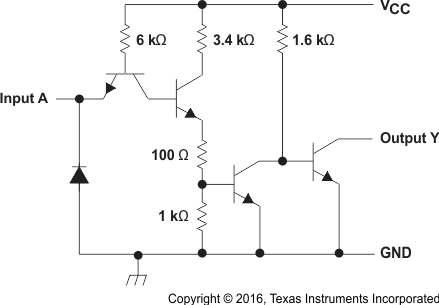
SN5417Military six-channel, 4.5-V to 5.5-V bipolar buffers with 15-V tolerant open-collector outputs | Integrated Circuits (ICs) | 1 | Active | These TTL hex buffers and drivers feature high-voltage open-collector outputs for interfacing with high-level circuits (such as MOS) or for driving high-current loads (such as lamps or relays), and also are characterized for use as buffers for driving TTL inputs. The SN5407 and SN7407 devices have minimum breakdown voltages of 30 V, and the SN5417 and SN7417 devices have minimum breakdown voltages of 15 V. The maximum sink current is 30 mA for the SN5407 and SN5417 devices and 40 mA for the SN7407 and SN7417 devices.
These devices perform the Boolean function Y = A in positive logic.
These circuits are completely compatible with most TTL families. Inputs are diode clamped to minimize transmission-line effects, which simplifies design. Typical power dissipation is 145 mW, and average propagation delay time is 14 ns.
These TTL hex buffers and drivers feature high-voltage open-collector outputs for interfacing with high-level circuits (such as MOS) or for driving high-current loads (such as lamps or relays), and also are characterized for use as buffers for driving TTL inputs. The SN5407 and SN7407 devices have minimum breakdown voltages of 30 V, and the SN5417 and SN7417 devices have minimum breakdown voltages of 15 V. The maximum sink current is 30 mA for the SN5407 and SN5417 devices and 40 mA for the SN7407 and SN7417 devices.
These devices perform the Boolean function Y = A in positive logic.
These circuits are completely compatible with most TTL families. Inputs are diode clamped to minimize transmission-line effects, which simplifies design. Typical power dissipation is 145 mW, and average propagation delay time is 14 ns. |
SN5419650/30/100-Mhz Presettable Decade OR Binary Counters/Latches | Counters, Dividers | 1 | Active | These high-speed monolithic counters consist of four d-c coupled, master-slave flip-flops, which are internally interconnected to provide either a divide-by-two and a divide-by-five counter (’196, ’LS196, ’S196) or a divide-by-two and a divide-by-eight counter (’197, ’LS197, ’S197). These four counters are fully programmable; that is, the outputs may be preset to any state by placing a low on the count/load input and entering the desired data at the data inputs. The outputs will change to agree with the data inputs independent of the state of the clocks.
During the count operation, transfer of information to the outputs occurs on the negative-going edge of the clock pulse. These counters feature a direct clear which when taken low sets all outputs low regardless of the states of the clocks.
These counters may also be used as 4-bit latches by using the count/load input as the strobe and entering data at the data inputs. The outputs will directly follow the data inputs when the count/load is low, but will remain unchanged when the count/load is high and the clock inputs are inactive.
All inputs are diode-clamped to minimize transmission-line effects and simplify system design. These circuits are compatible with most TTL logic families. Series 54, 54LS, and 54S circuits are characterized for operation over the full military temperature range of -55°C to 125°C; Series 74, 74LS, and 74S circuits are characterized for operation from 0°C to 70°C.
These high-speed monolithic counters consist of four d-c coupled, master-slave flip-flops, which are internally interconnected to provide either a divide-by-two and a divide-by-five counter (’196, ’LS196, ’S196) or a divide-by-two and a divide-by-eight counter (’197, ’LS197, ’S197). These four counters are fully programmable; that is, the outputs may be preset to any state by placing a low on the count/load input and entering the desired data at the data inputs. The outputs will change to agree with the data inputs independent of the state of the clocks.
During the count operation, transfer of information to the outputs occurs on the negative-going edge of the clock pulse. These counters feature a direct clear which when taken low sets all outputs low regardless of the states of the clocks.
These counters may also be used as 4-bit latches by using the count/load input as the strobe and entering data at the data inputs. The outputs will directly follow the data inputs when the count/load is low, but will remain unchanged when the count/load is high and the clock inputs are inactive.
All inputs are diode-clamped to minimize transmission-line effects and simplify system design. These circuits are compatible with most TTL logic families. Series 54, 54LS, and 54S circuits are characterized for operation over the full military temperature range of -55°C to 125°C; Series 74, 74LS, and 74S circuits are characterized for operation from 0°C to 70°C. |
SN5419750/30/100-Mhz Presettable Decade OR Binary Counters/Latches | Logic | 1 | Active | These high-speed monolithic counters consist of four d-c coupled, master-slave flip-flops, which are internally interconnected to provide either a divide-by-two and a divide-by-five counter (’196, ’LS196, ’S196) or a divide-by-two and a divide-by-eight counter (’197, ’LS197, ’S197). These four counters are fully programmable; that is, the outputs may be preset to any state by placing a low on the count/load input and entering the desired data at the data inputs. The outputs will change to agree with the data inputs independent of the state of the clocks.
During the count operation, transfer of information to the outputs occurs on the negative-going edge of the clock pulse. These counters feature a direct clear which when taken low sets all outputs low regardless of the states of the clocks.
These counters may also be used as 4-bit latches by using the count/load input as the strobe and entering data at the data inputs. The outputs will directly follow the data inputs when the count/load is low, but will remain unchanged when the count/load is high and the clock inputs are inactive.
All inputs are diode-clamped to minimize transmission-line effects and simplify system design. These circuits are compatible with most TTL logic families. Series 54, 54LS, and 54S circuits are characterized for operation over the full military temperature range of -55°C to 125°C; Series 74, 74LS, and 74S circuits are characterized for operation from 0°C to 70°C.
These high-speed monolithic counters consist of four d-c coupled, master-slave flip-flops, which are internally interconnected to provide either a divide-by-two and a divide-by-five counter (’196, ’LS196, ’S196) or a divide-by-two and a divide-by-eight counter (’197, ’LS197, ’S197). These four counters are fully programmable; that is, the outputs may be preset to any state by placing a low on the count/load input and entering the desired data at the data inputs. The outputs will change to agree with the data inputs independent of the state of the clocks.
During the count operation, transfer of information to the outputs occurs on the negative-going edge of the clock pulse. These counters feature a direct clear which when taken low sets all outputs low regardless of the states of the clocks.
These counters may also be used as 4-bit latches by using the count/load input as the strobe and entering data at the data inputs. The outputs will directly follow the data inputs when the count/load is low, but will remain unchanged when the count/load is high and the clock inputs are inactive.
All inputs are diode-clamped to minimize transmission-line effects and simplify system design. These circuits are compatible with most TTL logic families. Series 54, 54LS, and 54S circuits are characterized for operation over the full military temperature range of -55°C to 125°C; Series 74, 74LS, and 74S circuits are characterized for operation from 0°C to 70°C. |
SN54221Dual Monostable Multivibrators With Schmitt-trigger Inputs | Multivibrators | 1 | Active | The '221 and 'LS221 devices are monolithic dual multivibrators with performance characteristics virtually identical to those of the '121 devices. Each multivibrator features a negative-transition- triggered input and a positive-transition-triggered input, either of which can be used as an inhibit input.
Pulse triggering occurs at a particular voltage level and is not directly related to the transition time of the input pulse. Schmitt-trigger input circuitry (TTL hysteresis) for B input allows jitter-free triggering from inputs with transition rates as slow as 1 V/s, providing the circuit with excellent noise immunity, typically of 1.2 V. A high immunity to VCCnoise, typically of 1.5 V, is also provided by internal latching circuitry.
Once fired, the outputs are independent of further transitions of the A and B inputs and are a function of the timing components, or the output pulses can be terminated by the overriding clear. Input pulses can be of any duration relative to the output pulse. Output pulse length can be varied from 35 ns to the maximums shown in the above table by choosing appropriate timing components. With Rext= 2 kand Cext= 0, an output pulse typically of 30 ns is achieved, which can be used as a dc-triggered reset signal. Output rise and fall times are TTL compatible and independent of pulse length. Typical triggering and clearing sequences are shown as a part of the switching characteristics waveforms.
Pulse-width stability is achieved through internal compensation and is virtually independent of VCCand temperature. In most applications, pulse stability is limited only by the accuracy of external timing components.
Jitter-free operation is maintained over the full temperature and VCCranges for more than six decades of timing capacitance (10 pF to 10 µF) and more than one decade of timing resistance (2 kcan be used. Also, the range of jitter-free output pulse widths is extended if VCCis held to 5 V and free-air temperature is 25°C. Duty cycles as high as 90% are achieved when using maximum recommended RT. Higher duty cycles are available if a certain amount of pulse-width jitter is allowed.
The variance in output pulse width from device to device typically is less than ±0.5% for given external timing components. An example of this distribution for the '221 is shown in Figure 3. Variations in output pulse width versus supply voltage and temperature for the '221 are shown in Figures 4 and 5, respectively.
Pin assignments for these devices are identical to those of the SN54123/SN74123 or SN54LS123/SN74LS123 so that the '221 or 'LS221 devices can be substituted for those products in systems not using the retrigger by merely changing the value of Rextand/or Cext; however, the polarity of the capacitor must be changed.
The '221 and 'LS221 devices are monolithic dual multivibrators with performance characteristics virtually identical to those of the '121 devices. Each multivibrator features a negative-transition- triggered input and a positive-transition-triggered input, either of which can be used as an inhibit input.
Pulse triggering occurs at a particular voltage level and is not directly related to the transition time of the input pulse. Schmitt-trigger input circuitry (TTL hysteresis) for B input allows jitter-free triggering from inputs with transition rates as slow as 1 V/s, providing the circuit with excellent noise immunity, typically of 1.2 V. A high immunity to VCCnoise, typically of 1.5 V, is also provided by internal latching circuitry.
Once fired, the outputs are independent of further transitions of the A and B inputs and are a function of the timing components, or the output pulses can be terminated by the overriding clear. Input pulses can be of any duration relative to the output pulse. Output pulse length can be varied from 35 ns to the maximums shown in the above table by choosing appropriate timing components. With Rext= 2 kand Cext= 0, an output pulse typically of 30 ns is achieved, which can be used as a dc-triggered reset signal. Output rise and fall times are TTL compatible and independent of pulse length. Typical triggering and clearing sequences are shown as a part of the switching characteristics waveforms.
Pulse-width stability is achieved through internal compensation and is virtually independent of VCCand temperature. In most applications, pulse stability is limited only by the accuracy of external timing components.
Jitter-free operation is maintained over the full temperature and VCCranges for more than six decades of timing capacitance (10 pF to 10 µF) and more than one decade of timing resistance (2 kcan be used. Also, the range of jitter-free output pulse widths is extended if VCCis held to 5 V and free-air temperature is 25°C. Duty cycles as high as 90% are achieved when using maximum recommended RT. Higher duty cycles are available if a certain amount of pulse-width jitter is allowed.
The variance in output pulse width from device to device typically is less than ±0.5% for given external timing components. An example of this distribution for the '221 is shown in Figure 3. Variations in output pulse width versus supply voltage and temperature for the '221 are shown in Figures 4 and 5, respectively.
Pin assignments for these devices are identical to those of the SN54123/SN74123 or SN54LS123/SN74LS123 so that the '221 or 'LS221 devices can be substituted for those products in systems not using the retrigger by merely changing the value of Rextand/or Cext; however, the polarity of the capacitor must be changed. |
SN5425Military 2-ch, 4-input, 4.5-V to 5.5-V bipolar NOR gates | Integrated Circuits (ICs) | 1 | Active | These devices contain dual 4-input positive NOR gates with strobe. They perform the Boolean function:
The SN5423 and the SN5425 are characterized for operation over the full military temperature range of -55°C to 125°C. The SN7423 and the SN7425 are characterized for operation from 0°C to 70°C.
These devices contain dual 4-input positive NOR gates with strobe. They perform the Boolean function:
The SN5423 and the SN5425 are characterized for operation over the full military temperature range of -55°C to 125°C. The SN7423 and the SN7425 are characterized for operation from 0°C to 70°C. |
SN5438Military 4-ch, 2-input, 4.5-V to 5.5-V bipolar NAND gates with open-collector outputs | Integrated Circuits (ICs) | 1 | Active | These devices contain four independent 2-input NAND buffer gates with open-collector outputs. The open-collector outputs require pull-up resistors to perform correctly. They may be connected to other open-collector outputs to implement active-low wired-OR or active-high wired-AND functions. Open-collector devices are often used to generate high VOHlevels.
The SN5438, SN54LS38, and SN54S38 are characterized for operation over the full military temperature range of -55°C to 125°C. The SN7438, SN74LS38, and SN74S38 are characterized for operation from 0°C to 70°C.
These devices contain four independent 2-input NAND buffer gates with open-collector outputs. The open-collector outputs require pull-up resistors to perform correctly. They may be connected to other open-collector outputs to implement active-low wired-OR or active-high wired-AND functions. Open-collector devices are often used to generate high VOHlevels.
The SN5438, SN54LS38, and SN54S38 are characterized for operation over the full military temperature range of -55°C to 125°C. The SN7438, SN74LS38, and SN74S38 are characterized for operation from 0°C to 70°C. |
SN5472And-Gated J-K Master-Slave Flip-Flops With Preset And Clear | Flip Flops | 1 | Active | These J-K flip-flops are based on the master-slave principle and each has AND gate inputs for entry into the master section which are controlled by the clock pulse. The clock pulse also regulates the state of the coupling transistors which connect the master and slave sections. The sequence of operation is as follows:
The logical states of the J and K inputs must not be allowed to change when the clock pulse is in a high state.
The SN5472, and the SN54H72 are characterized for operation over the full military temperature range of -55°C to 125°C. The SN7472 is characterized for operation from 0°C to 70°C.
These J-K flip-flops are based on the master-slave principle and each has AND gate inputs for entry into the master section which are controlled by the clock pulse. The clock pulse also regulates the state of the coupling transistors which connect the master and slave sections. The sequence of operation is as follows:
The logical states of the J and K inputs must not be allowed to change when the clock pulse is in a high state.
The SN5472, and the SN54H72 are characterized for operation over the full military temperature range of -55°C to 125°C. The SN7472 is characterized for operation from 0°C to 70°C. |
SN5476Dual J-K Flip-Flops With Preset And Clear | Logic | 1 | Active | The '76 contains two independent J-K flip-flops with individual J-K, clock, preset, and clear inputs. The '76 is a positive-edge-triggered flip-flop. J-K input is loaded into the master while the clock is high and transferred to the slave on the high-to-low transition. For these devices the J and K inputs must be stable while the clock is high.
The 'LS76A contain two independent negative-edge-triggered flip-flops. The J and K inputs must be stable one setup time prior to the high-to-low clock transition for predictable operation. The preset and clear are asynchronous active low inputs. When low they override the clock and data inputs forcing the outputs to the steady state levels as shown in the function table.
The SN5476 and the SN54LS76A are characterized for operation over the full military temperature range of -55°C to 125°C. The SN7476 and the SN74LS76A are characterized for operation from 0°C to 70°C.
The '76 contains two independent J-K flip-flops with individual J-K, clock, preset, and clear inputs. The '76 is a positive-edge-triggered flip-flop. J-K input is loaded into the master while the clock is high and transferred to the slave on the high-to-low transition. For these devices the J and K inputs must be stable while the clock is high.
The 'LS76A contain two independent negative-edge-triggered flip-flops. The J and K inputs must be stable one setup time prior to the high-to-low clock transition for predictable operation. The preset and clear are asynchronous active low inputs. When low they override the clock and data inputs forcing the outputs to the steady state levels as shown in the function table.
The SN5476 and the SN54LS76A are characterized for operation over the full military temperature range of -55°C to 125°C. The SN7476 and the SN74LS76A are characterized for operation from 0°C to 70°C. |
SN54ABT125Military 4-ch, 4.5-V to 5.5-V buffers with TTL-compatible CMOS inputs and 3-state outputs | Buffers, Drivers, Receivers, Transceivers | 1 | Active | The ’ABT125 quadruple bus buffer gates feature independent line drivers with 3-state outputs. Each output is disabled when the associated output-enable (OE)\ input is high.
These devices are fully specified for hot-insertion applications using Ioffand power-up 3-state. The Ioffcircuitry disables the outputs, preventing damaging current backflow through the devices when they are powered down. The power-up 3-state circuitry places the outputs in the high-impedance state during power up and power down, which prevents driver conflict.
To ensure the high-impedance state during power up or power down, OE\ should be tied to VCCthrough a pullup resistor; the minimum value of the resistor is determined by the current-sinking capability of the driver.
The ’ABT125 quadruple bus buffer gates feature independent line drivers with 3-state outputs. Each output is disabled when the associated output-enable (OE)\ input is high.
These devices are fully specified for hot-insertion applications using Ioffand power-up 3-state. The Ioffcircuitry disables the outputs, preventing damaging current backflow through the devices when they are powered down. The power-up 3-state circuitry places the outputs in the high-impedance state during power up and power down, which prevents driver conflict.
To ensure the high-impedance state during power up or power down, OE\ should be tied to VCCthrough a pullup resistor; the minimum value of the resistor is determined by the current-sinking capability of the driver. |