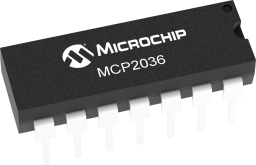
| Specialized | 2 | Active | The MCP2036 Analog Front End combines all necessary analog functions for a complete inductance-measurement system |
| Integrated Circuits (ICs) | 5 | Active | |
MCP2120Infrared Encoder/Decoder, IrDA® Support | Integrated Circuits (ICs) | 2 | Active | MCP2120 is a low-cost, high-performance, fully-static infrared encoder/decoder. This device sits between a UART and an infrared (IR) optical transceiver The data received from a standard UART is encoded (modulated), and output as electrical pulses to the IR Transceiver. The IR Transceiver also receives data which it outputs as electrical pulses that the MCP2120 decodes (demodulates) then transmits the data via the MCP2120 UART. This modulation and demodualtion method is performed in accordance with the IrDA standard. |
MCP2122Infrared Encoder/Decoder Compatible with HSDL-7000 | Integrated Circuits (ICs) | 2 | Obsolete | Converts serial data from UART bitstreams to IrDA standard bitstreams (encodes) and from IrDA standard bitstreams to UART bitstreams (decodes). Requires input clock that is 16x needed baud rate. |
| Encoders, Decoders, Converters | 2 | Obsolete | |
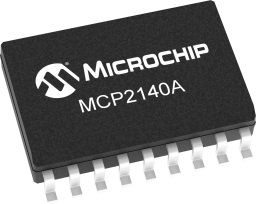
MCP2140AIrDA® Standard Protocol Stack controller with Fixed 9600 Band Communication Rate | Integrated Circuits (ICs) | 7 | Active | The MCP2140 is a cost-effective, low pin count (18-pin), easy-to-use device for implementing IrDA standard wireless connectivity. The MCP2140 provides support for the IrDA standard protocol "stack", bit encoding/decoding and low cost, discrete IR receiver circuitry.
The serial and IR interface baud rates are fixed at 9600 baud. The serial interface and IR interface baud rates are dependent on the device frequency, but IrDA standard operation requires a device frequency of 7.3728 MHz.
The MCP2140 will specify to the Primary Device the IR baud rate during the Discover phase. |
| Evaluation Boards | 3 | Active | |
MCP2155IrDA® Standard Protocol Stack Controller Supporting DTE Applications | Integrated Circuits (ICs) | 3 | Active | The MCP2155 is a cost effective, low pin count (18-pin), easy to use device for implementing IrDA standard wireless connectivity. The MCP2155 handles for the IrDA standard protocol "stack" plus bit encoding/decoding. The MCP2155 operates in Data Communication Equipment (DCE) applications and sits between a UART and an infrared optical transceiver.
The Serial interface baud rates are user selectable to one of four IrDA standard baud rates between 9600 baud and 115.2 kbaud (9600, 19200, 57600, 115200). The IR baud rates are user selectable to one of five IrDA standard baud rates between 9600 baud and 115.2 kbaud (9600, 19200, 38400, 57600, 115200). The serial interface baud rate will be specified by the BAUD1: BAUD0 pins, while the IR baud rate is specified by the Host Controller. This means that the baud rates do not need to be the same.
The MCP2155 encodes an asynchronous serial data stream, converting each data bit to the corresponding infrared (IR) formatted pulse. IR pulses that are received are decoded, and then handled by the protocol handler state machine. The protocol handler will then send the appropriate data bytes to the host controller in UART formatted serial data.
The MCP2155 supports "point-to-point" applications. That is one Primary device and one Secondary device. The MCP2155 is a secondary device and does not support "multi-point" applications.
Sending data using IR light requires some hardware and the use of specialized communications protocols. These protocols and hardware requirements are described in detail by the IrDA standard specifications. The encoding/decoding functionality of the MCP2155 is designed to be compatible with the physical layer component of the IrDA standard. This part of the standard is often referred to as "IrPHY".
The complete IrDA standard specifications are available for download from the IrDA website (www.IrDA.org). |
| Integrated Circuits (ICs) | 9 | Active | |
| Integrated Circuits (ICs) | 6 | Active | |